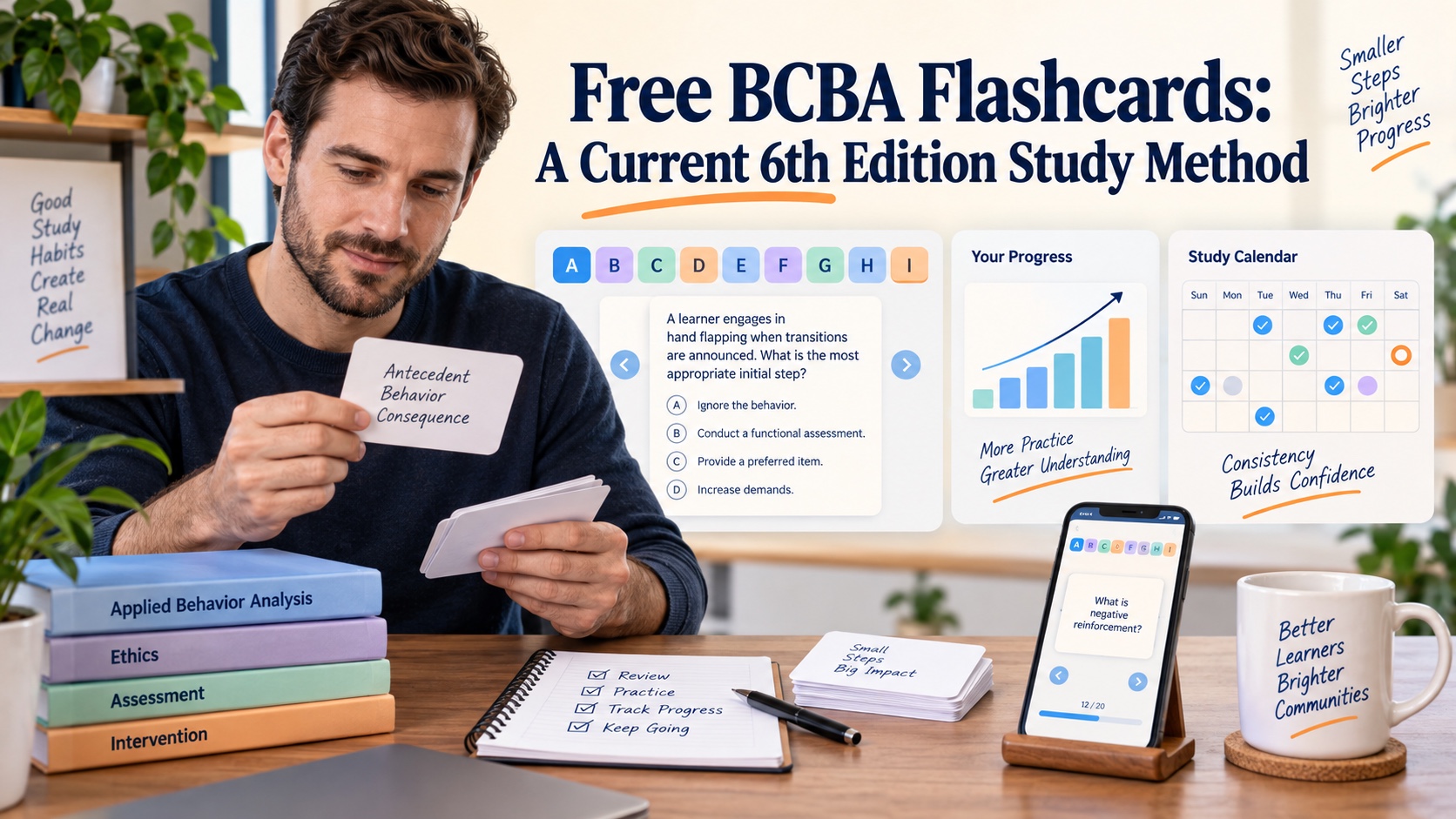
Free BCBA Flashcards: A Current 6th Edition Study Method
Free BCBA flashcards can make a large study blueprint easier to approach. One card can help you retrieve a definition, compare two procedures, or notice the task verb in a question. But a deck is not automatically useful because it is long or free. For the current BCBA examination, your cards should map to the BCBA Test Content Outline (6th ed.) and move beyond word recognition into data interpretation, ethical reasoning, intervention selection, and supervision decisions.
This guide explains how to use flashcards with the current 6th-edition exam boundary. It is independent educational material, not official BACB examination content, a replacement for the current TCO, Ethics Code, training materials, fieldwork, supervision, eligibility rules, or a pass guarantee.
Quick answer: Free BCBA flashcards are useful for active recall, comparison sets, and short review sessions, but they are not enough by themselves. Use the current BCBA TCO as the map, retrieve a concept, apply it to a scenario or data display, explain why the answer fits the evidence and context, and schedule a later review. Keep the official source nearby whenever an edition, eligibility, ethics, or exam-format claim matters.
Keep the exam numbers together: the current BCBA examination includes 175 scored questions and 10 unscored pilot questions, or 185 questions total. Each question has four answer choices with one correct answer, and candidates have four hours. The domain percentages help allocate study attention; they do not create separate pass thresholds.
What good free BCBA flashcards should cover
A definition card is a start, not the finished product. A strong BCBA card usually includes a task verb and a reason. For example, instead of asking only “What is latency?” ask, “Which measure captures the time from an instruction to the beginning of the response, and when would it answer the question better than frequency?”
- One precise target: define the concept or decision the card is testing.
- One close contrast: show the idea most likely to be confused with it.
- One applied cue: include a graph, observation, client goal, staff performance issue, or ethical constraint.
- One rationale: explain why the best option fits and why the alternatives are weaker.
- One boundary: state what the evidence, role, plan, or current source does not justify.
For a reinforcement card, ask what changed in future behavior and under which contingency. For an assessment card, distinguish descriptive information from a demonstrated functional relation. For an intervention card, add social validity, treatment integrity, generalization, and monitoring. For an ethics card, include consent, confidentiality, competence, cultural responsiveness, or supervision as the situation requires.
The nine-domain flashcard map
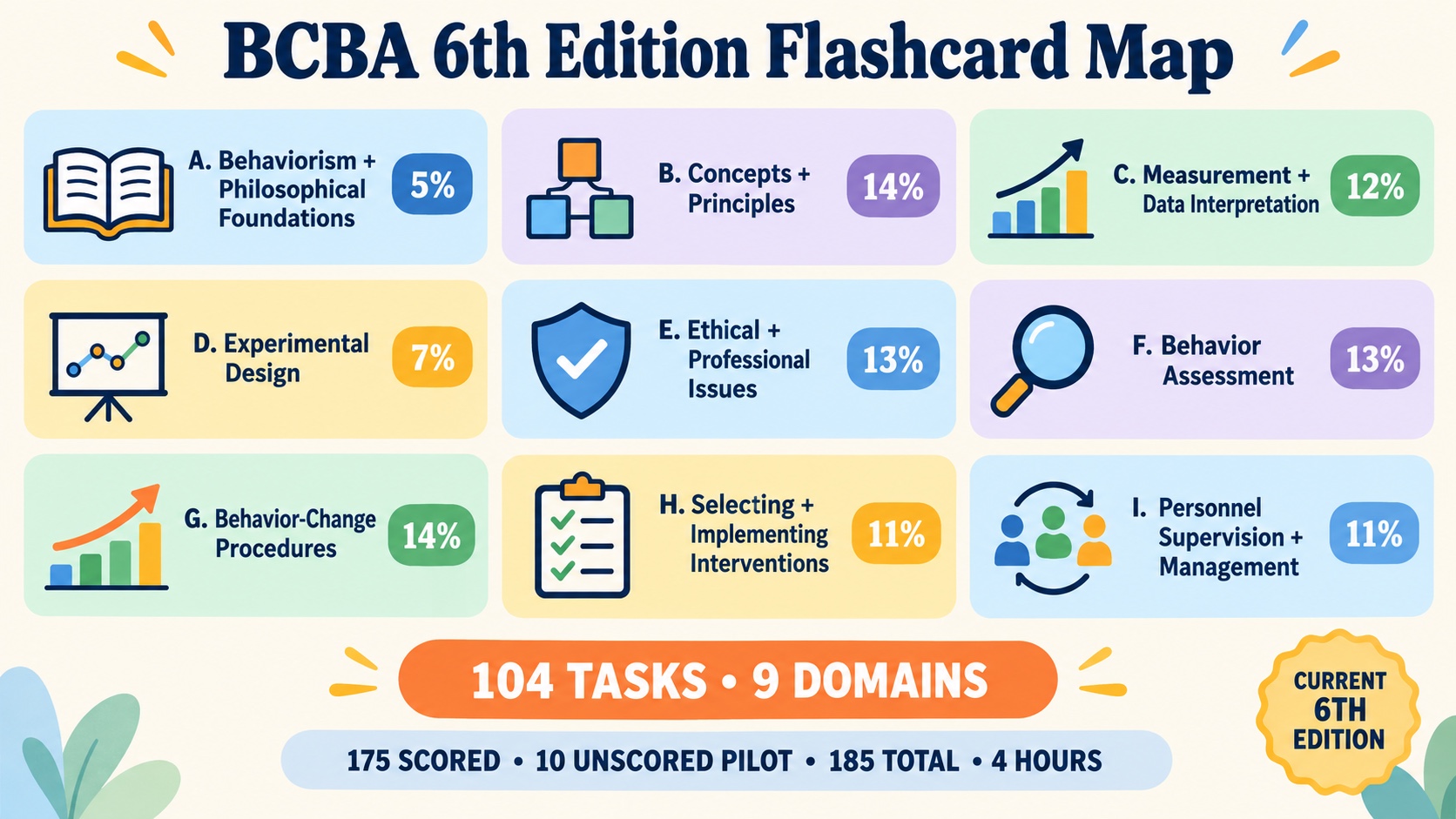
The current BCBA Test Content Outline (6th ed.) contains 104 tasks in nine domains. Use the rounded shares as a planning signal, not a prediction of question order or a separate pass score.
- A. Behaviorism and Philosophical Foundations — 8 questions, 5%: goals of science, philosophical assumptions, radical behaviorism, branches of behavior analysis, and ABA dimensions.
- B. Concepts and Principles — 24 questions, 14%: contingencies, schedules, extinction, stimulus control, motivating operations, verbal behavior, generalization, maintenance, matching, imitation, and related distinctions.
- C. Measurement, Data Display, and Interpretation — 21 questions, 12%: measurement selection, reliability and validity, data displays, visual analysis, and data-based interpretation.
- D. Experimental Design — 13 questions, 7%: single-case designs, functional relations, replication, validity, threats, and ethical design decisions.
- E. Ethical and Professional Issues — 22 questions, 13%: current ethical standards, competence, consent, confidentiality, cultural responsiveness, documentation, and professional boundaries.
- F. Behavior Assessment — 23 questions, 13%: record review, interviews, observation, preference and skill assessment, FBA, functional analysis, and interpretation boundaries.
- G. Behavior-Change Procedures — 25 questions, 14%: reinforcement, punishment, prompting, fading, shaping, chaining, discrimination, verbal behavior, generalization, and maintenance.
- H. Selecting and Implementing Interventions — 20 questions, 11%: socially significant goals, contextual fit, stakeholder collaboration, treatment integrity, effectiveness, and follow-up.
- I. Personnel Supervision and Management — 19 questions, 11%: performance assessment, training, feedback, supervision, equity, documentation, and outcome monitoring.
The largest rounded shares are not permission to ignore Domain A or Domain D. A balanced deck needs both concepts and the research logic that helps you decide whether an intervention changed behavior.
How to use cards for application
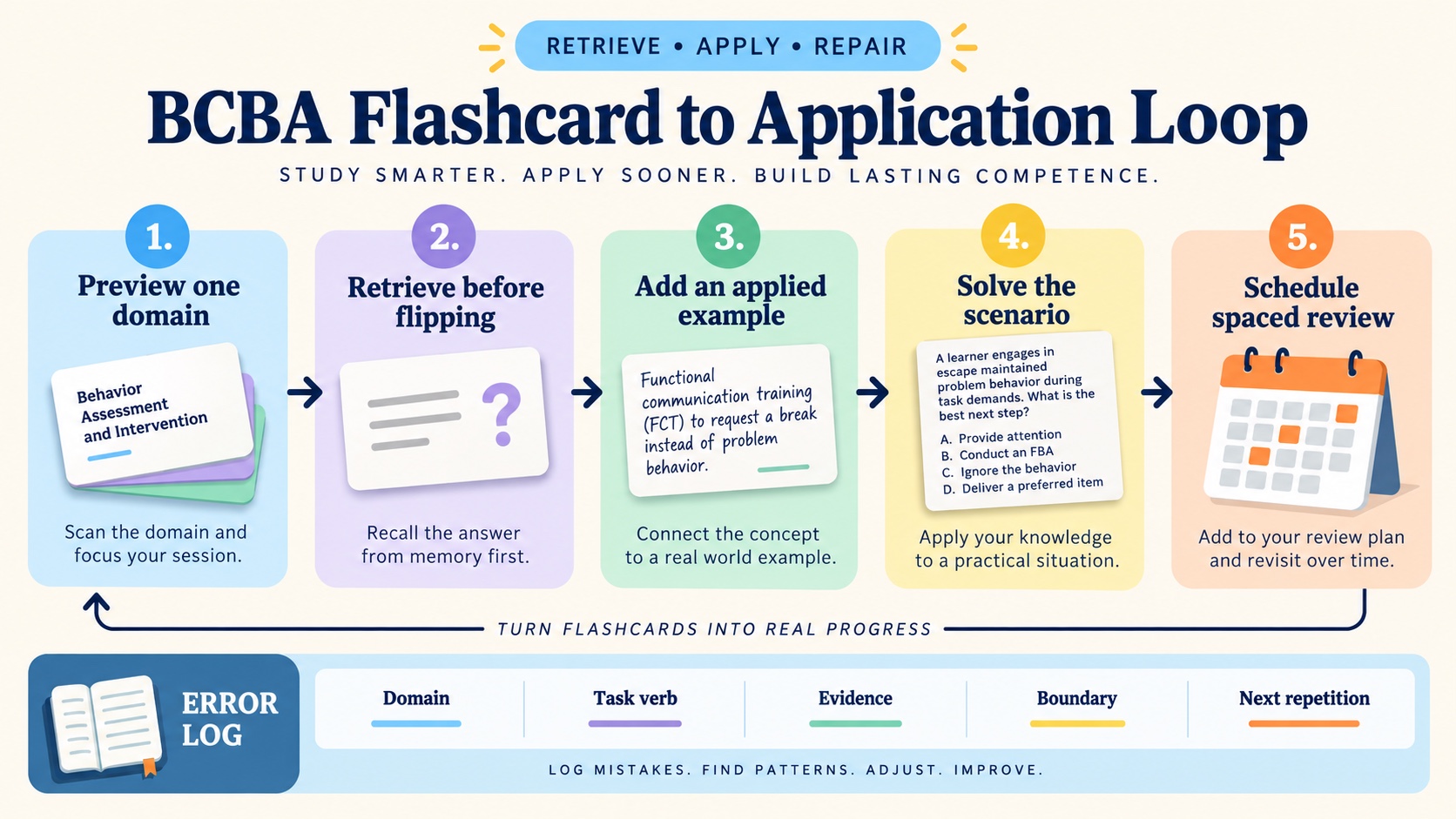
Try a ten-minute application loop:
- Preview: choose one domain and a small set of cards.
- Retrieve: answer before revealing the back. State the task verb if there is one.
- Elaborate: add a plain-language example and one contrast.
- Apply: solve a short scenario, graph, or decision prompt.
- Repair: record the evidence, rationale, boundary, and next review date.
Make a personal-confusion deck from your misses. Examples include positive versus negative reinforcement, respondent versus operant conditioning, level versus trend, descriptive assessment versus functional analysis, treatment integrity versus treatment effectiveness, stimulus versus response generalization, and supervision feedback versus informal advice. A deck built around your errors is more useful than a generic stack you never revisit.
Use the same card in more than one setting. Answer it at a desk, explain it while walking, and later solve a new example without the wording you first memorized. This small variation checks whether the concept has generalized beyond one cue. If the card only works when the exact definition is visible, it belongs in practice again.
Flashcards versus practice questions
Flashcards answer, “Can I retrieve this concept?” Practice questions ask, “Which concept, design, intervention, or ethical boundary controls this situation?” You need both because a learner can know a definition and still select the wrong measurement, overstate an assessment conclusion, or ignore social validity and contextual fit.
After a card session, use free BCBA practice questions. When you miss an item, do not only record the correct letter. Write the domain, task verb, evidence that mattered, the distinction you missed, and the next example you will retrieve. The BCBA study path can hold the longer explanation, while the card keeps the target concise.
When you review a rationale, ask whether the answer would change if the measurement, client goal, setting, or ethical constraint changed. That question keeps the deck connected to professional judgment rather than turning every item into a fixed slogan.
Common BCBA flashcard mistakes
- Using a 5th-edition deck: verify that the cards map to the current BCBA TCO (6th ed.).
- Confusing 185 total with 175 scored: label the 10 unscored pilot questions clearly.
- Treating domain percentages as pass thresholds: use them to plan review, not to skip low-share domains.
- Memorizing definitions without decisions: add a graph, scenario, ethical constraint, or implementation question.
- Ignoring supervision and ethics: the current outline includes professional judgment, supervision, and management—not only procedures.
- Assuming free means official: use BACB sources for current certification and examination information.
Free BCBA flashcards FAQ
Are free BCBA flashcards enough to pass?
No study tool can promise a passing result. Flashcards are useful for retrieval and comparisons, but preparation should also include the current TCO, Ethics Code, training materials, applied practice, review of rationales, and the current Handbook.
How many BCBA flashcards should I study?
There is no BACB card-count requirement. Start with a balanced set across all nine domains, then add personal-confusion cards from practice errors. Depth and application matter more than the number printed on a deck page.
What is the current BCBA exam edition?
The current examination blueprint is the BCBA Test Content Outline (6th ed.). The current Handbook and BACB TCO page should be checked for official updates. “2027” eligibility material should not be treated as an automatic 7th-edition exam claim.
Are Quizlet BCBA flashcards official?
Third-party decks are not automatically official BACB materials. Check edition, terminology, source date, and scope against BACB’s current official resources.
Use the ABA Study Online app
If you want flashcards, section practice, audio review, progress, and teaching tools in one study loop, explore the ABA Study Online app. Start with one BCBA domain, flag the cards you miss, practice a related scenario, and return later for spaced review. The app is an independent study companion; use BACB sources for official certification and examination information.