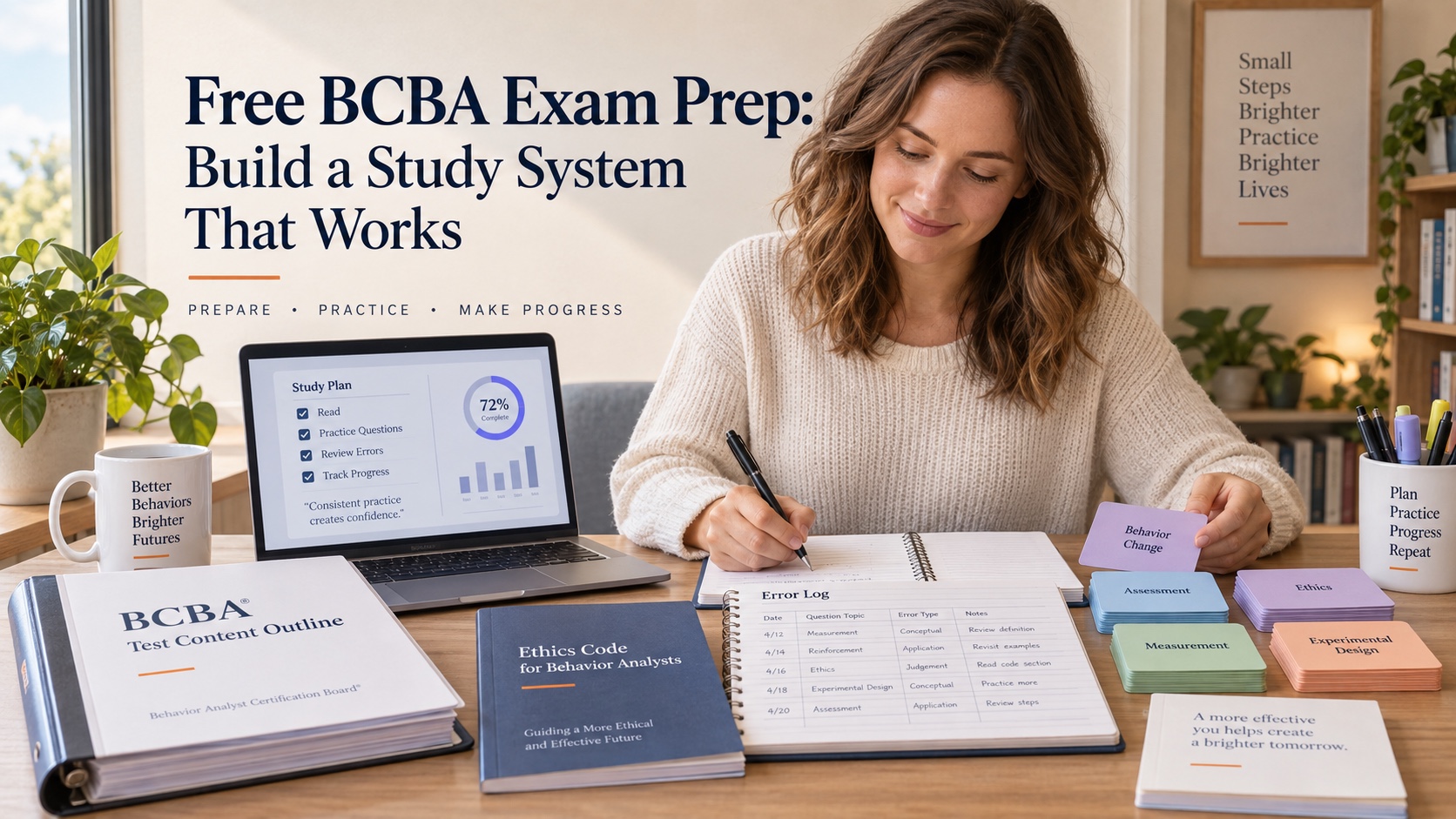
Free BCBA Exam Prep: Build a Study System That Works
Free BCBA exam prep can be enough to build a serious study system, but “free” is not the same as “complete.” A useful plan starts with the current BACB Test Content Outline, the Ethics Code for Behavior Analysts, and the materials from your training. It then adds original practice, clear rationales, an error log, and timed review. Random PDFs, copied questions, and a long list of bookmarks do not become a preparation system simply because they cost nothing.
The BACB does not endorse specific study guides or promise that buying or using a particular resource will produce a passing result. Your job is to check the current source version, learn the task, apply it to a scenario, and use your mistakes to choose the next study action.
The quick answer
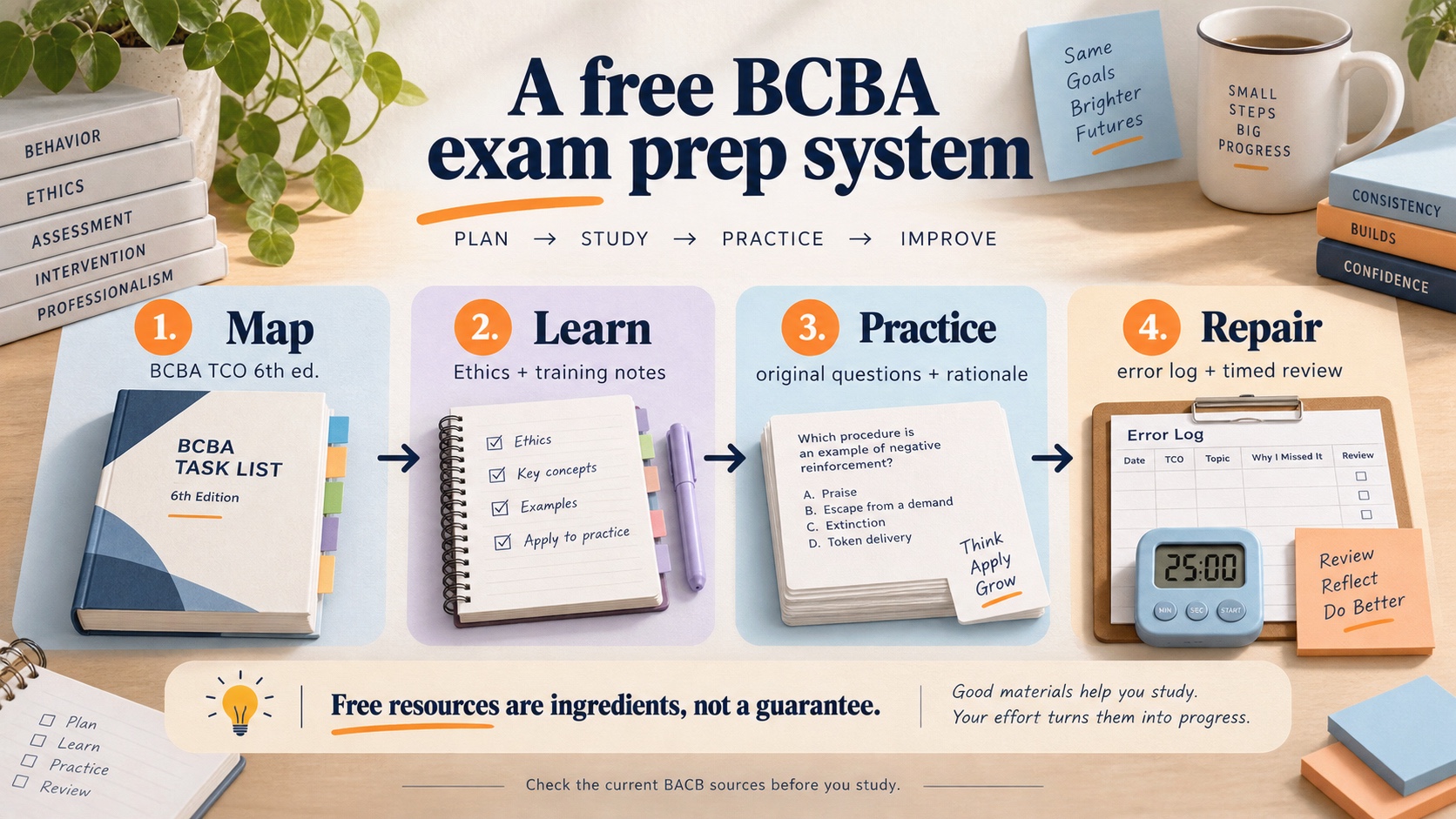
The best free BCBA exam prep plan has five parts:
- Map: use the current BCBA TCO to see what the exam covers.
- Learn: review your training notes, definitions, examples, and the Ethics Code.
- Practice: answer original scenario questions and explain why the best answer wins.
- Repair: record the reason for each miss instead of only recording the letter you chose.
- Rehearse: use mixed and timed sets after you have repaired weak distinctions.
This sequence matters. If you begin with hundreds of random questions, you may mistake familiarity with wording for mastery. If you only read notes, you may understand a definition but miss the best application in a scenario. Free preparation works when reading and retrieval are connected.
Start with the current exam map
The current BCBA Test Content Outline is the 6th edition. It organizes 104 tasks across nine content areas. The examination includes 175 scored questions and 10 unscored pilot questions, and candidates have four hours to complete it. The nine areas are Behaviorism and Philosophical Foundations, Concepts and Principles, Measurement, Data Display, and Interpretation, Experimental Design, Ethical and Professional Issues, Behavior Assessment, Behavior-Change Procedures, Selecting and Implementing Interventions, and Personnel Supervision and Management.
Use those domains as a map, not as a promise that your practice score in one domain predicts the final result. The BACB explains that the result is based on overall performance. The percentages in the outline can help you allocate study time, but they do not turn the examination into nine separate pass/fail tests.
Make a one-page map with three columns: task or domain, what you can explain without notes, and what you need to practice. A topic belongs in the third column when you can repeat a definition but cannot distinguish it from a close alternative, choose a measurement method, interpret a graph, or defend an ethical decision in a scenario.
Build a free resource stack
Give each resource one clear role. The official TCO is your coverage map. The Ethics Code is a source for ethical and professional decisions, not a substitute for learning every exam domain. Your graduate or training materials provide explanations, examples, and context. A concept glossary can help you check terminology, but a glossary alone cannot teach you when two procedures look similar in a case.
Use free practice questions selectively. Before adding a question to your study set, ask whether it has an answer key, a rationale, a clear stem, and one defensible best answer. Avoid copied questions that reproduce another provider’s wording, use an outdated outline, or present an unsupported “BACB trick.” Practice should strengthen reasoning, not train you to guess what a particular website wants.
Your error log is the most valuable free tool because it turns study time into feedback. For every missed or guessed item, record the domain, the concept, the reason for the miss, and the repair action. Useful error types include knowledge gap, confusing two terms, missing a condition in the stem, choosing a procedure outside scope, calculation or graph error, and changing an evidence-supported answer without a reason.
A four-week free-prep sequence
Week 1: baseline and map
Read the current TCO and complete a small mixed baseline set. Do not try to finish the whole exam in the first session. Mark each answer as confident, uncertain, or guessed, then compare your reasoning with the rationale. Build a short list of high-impact distinctions rather than a giant vocabulary dump.
Week 2: learn and discriminate
Study one or two connected domains at a time. For each concept, write a plain-language definition, a nonexample, and a short scenario. Then compare pairs that are easy to blur together, such as negative reinforcement and punishment, motivating operations and stimulus control, or descriptive assessment and experimental analysis. The point is not to memorize isolated sentences; it is to notice the conditions that change the answer.
Week 3: practice and repair
Use mixed practice after focused practice. Review every miss and every lucky guess. If you missed because the question asked for a measurement dimension, repair the measurement distinction. If you missed because you ignored the client’s context or an ethical boundary, return to the relevant source and write a decision rule. Re-answer a similar question later without looking at your original note.
Week 4: timed rehearsal
Increase the length of your mixed sets and add a timer. A timed set is a diagnostic, not a prediction of your score. Notice whether time is lost to reading, calculations, repeated answer changes, or knowledge gaps. Keep the final study sessions focused on repairing recurring errors and checking the current official materials rather than chasing every new free resource you find.
Common free-prep mistakes
- Using an old edition: check the publication date and compare the resource with the current BACB TCO and handbook.
- Confusing practice with authority: a free question bank is a study aid, not an official BACB exam or endorsement.
- Collecting instead of studying: choose a small stack and finish the review loop before adding another PDF or video.
- Memorizing answer letters: explain the behavior, condition, procedure, or ethical boundary in your own words.
- Ignoring ethics and supervision: these are not optional “soft” topics; they are part of the current exam map and professional practice.
- Trusting a pass guarantee: no free or paid resource can guarantee a certification result.
A simple checklist
- Confirm that your study map uses the current BCBA TCO (6th ed.).
- Keep the current Ethics Code and your training materials accessible.
- Use original questions with explanations and a clear reason for the best answer.
- Maintain an error log that records why you missed the item.
- Schedule both untimed reasoning practice and timed mixed sets.
- Check official BACB pages before relying on a rule, format, or transition statement.
For organized concept review, use the ABA Study Online BCBA learning route. For question practice, see the BCBA question library. The app review loop can help you revisit weak domains, but the BACB remains the authority for the current examination and certification rules.
FAQ
Can I pass the BCBA exam using free resources?
Free resources can support a serious plan, but no resource mix guarantees a passing result. Your preparation needs current coverage, accurate explanations, application practice, error review, and timed rehearsal.
What should I use first?
Start with the current BCBA TCO, then connect it to the Ethics Code and your training materials. Add practice questions after you know what the question set is supposed to cover.
Is the BCBA exam based on the 6th edition?
The current BACB BCBA Handbook and TCO resources identify the BCBA examination as based on the 6th edition. Always confirm the current official version before your authorization and test date.
Are free online questions official BACB questions?
Not unless the BACB explicitly identifies them as official. Treat independent questions as practice material and check their edition, wording, rationales, and source boundaries.