Free BCBA CEUs: How to Verify ACE Credit, Track Your Cycle, and Avoid Mistakes
“Free BCBA CEUs” sounds like a simple search, but the important question is not only whether an event costs nothing. The important question is whether the specific activity, provider, content category, date, participation record, and documentation fit the BACB requirements that apply to your certification cycle.
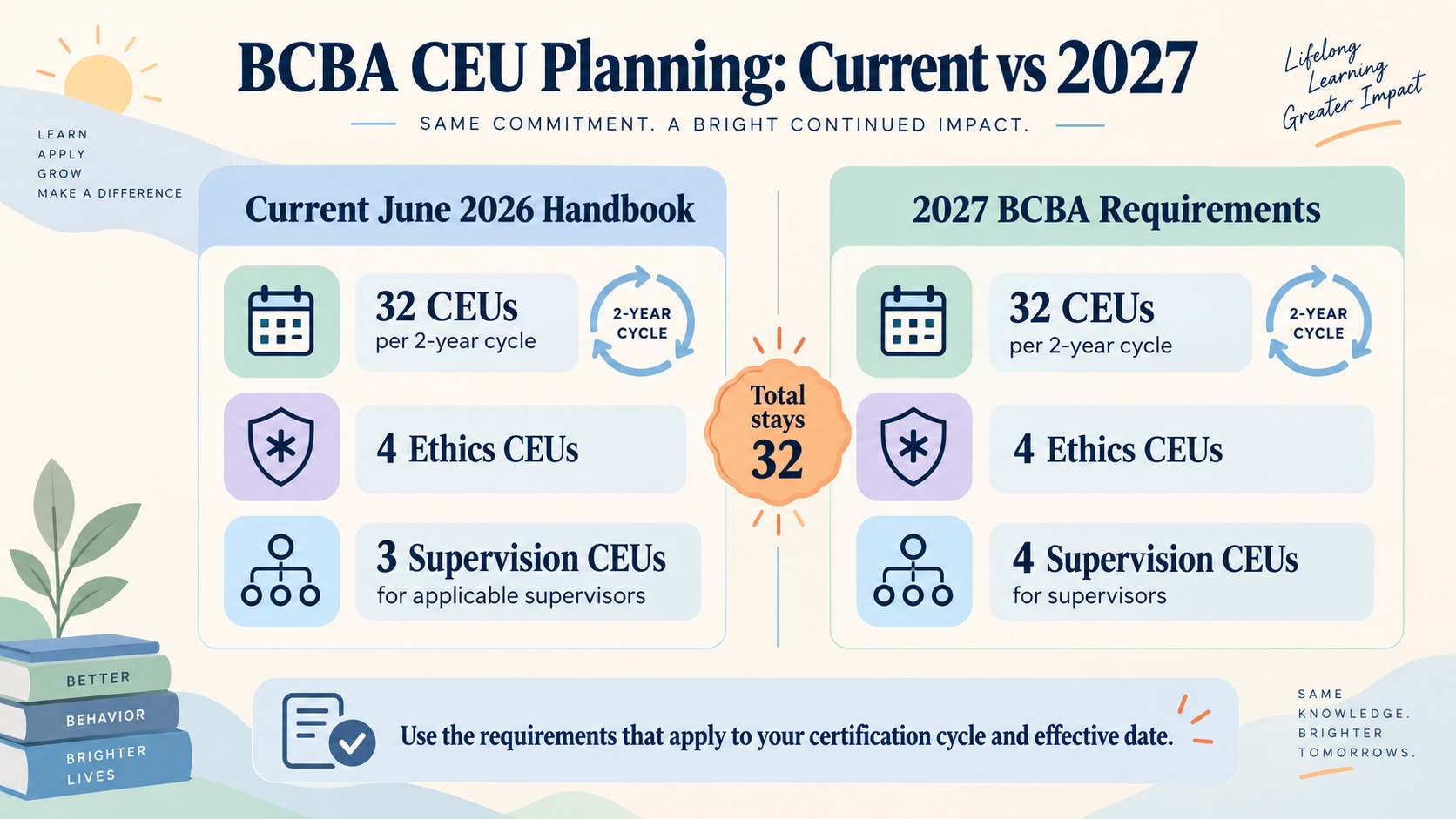
The current BCBA Handbook says that BCBAs need 32 continuing education units in each two-year recertification cycle, including 4 ethics CEUs and 3 supervision CEUs for supervisors. The public 2027 BCBA Requirements document keeps the total at 32 but lists 4 supervision CEUs for supervisors, so a date-sensitive plan must separate current-cycle rules from 2027 requirements.
This article gives you a screening method for free or low-cost opportunities. It does not certify that a particular event counts, and ABA Study Online is not an ACE Provider. Use the current BACB Handbook, your BACB Portal, and the ACE Provider Verification Registry for the decision that applies to you.
Table of Contents
What “free” means in a BCBA CEU search
A free CEU opportunity can take several forms. A provider might offer free registration but charge for a certificate. A webinar might be free to watch but not offer CE credit. A member benefit might be free only after joining an organization. A recorded event might have a different participation or knowledge-check process than a live event. A course may be educational yet still fail to meet the category or documentation requirements for your cycle.
So separate three questions:
- Is access free? Can you attend or complete the learning event without paying?
- Is the activity eligible? Is the provider authorized or is the activity one of the other handbook pathways, such as qualifying teaching, graduate coursework, scholarship, or a BACB activity?
- Can you document it? Will you receive or retain the record the BACB requires, with the event name, date, provider, amount, category, and any other requested details?
Only the second and third questions determine whether a free opportunity is useful for recertification. Price is a convenience, not an authorization category. A genuinely free event can be valuable professional learning even if it is not a CEU. Conversely, an event advertised as “free CEUs” still deserves verification before you count it toward a cycle.
Current BCBA CEU totals and cycle timing
Under the current June 2026 BCBA Handbook, the basic maintenance picture is:
- 32 CEUs within each two-year recertification cycle.
- 4 ethics CEUs within the cycle.
- 3 supervision CEUs for BCBAs who have the applicable supervision responsibility during the cycle.
- Current-cycle timing: the CEUs must be earned within the cycle to which they are applied.
- Documentation: enter the information into the BACB Portal and keep supporting records.
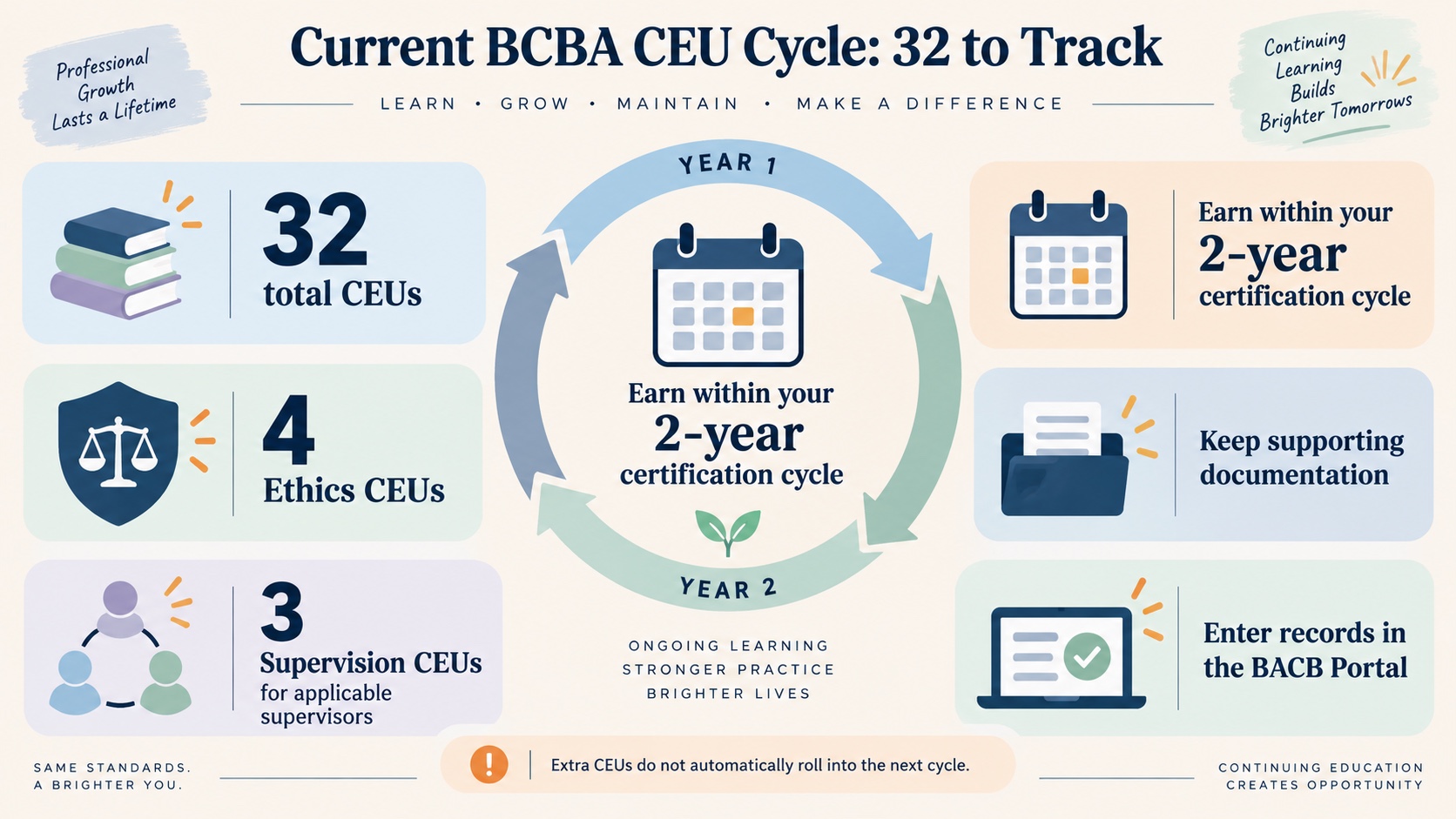
The cycle is tied to your own certification or recertification date, not to the calendar year. That means a free webinar completed in December may belong to one cycle, while a similar webinar completed in January may belong to the next one. Check your dates before registering, and do not assume that an unused CEU can automatically move forward. The current handbook says that excess CEUs cannot be applied to the next cycle and missed CEUs cannot simply be made up after the recertification date.
A simple tracker should include the event title, provider, event date, CEU type, ethics or supervision category if applicable, number of CEUs, certificate location, and the cycle to which you plan to apply it. Entering information soon after the event reduces the chance that a certificate disappears into an email folder when the deadline approaches.
What can count as continuing education
The BCBA Handbook describes three broad activity types: Learning, Teaching, and Scholarship. For many people searching for free BCBA CEUs, Learning events are the most familiar, but they are not the only possible route.
Learning
Learning can include attending behavior-analytic learning events offered by Authorized Continuing Education Providers. The handbook table uses 25 minutes of learning as 0.5 CEU and 50 minutes as 1 CEU. Qualifying graduate coursework and certain BACB certification activities are also described as learning pathways with their own documentation rules.
For an event, save the certificate and the event information that supports the category. The fact that a video discusses behavior analysis is not enough by itself. The provider status, event design, participation requirements, content, and record all matter.
Teaching
Teaching can include a single instruction session for a Learning CE event or qualifying behavior-analysis university teaching. The documentation is different from simply attending. If you are counting teaching, keep the provider’s record of the instruction time or the university documentation described by the handbook.
Scholarship
Scholarship can include publishing a behavior-analysis article in a peer-reviewed journal or completing a qualifying peer-review or decision-letter activity. The handbook assigns its own CEU values and documentation. Do not convert ordinary blog writing, reading, or social-media posting into scholarship CEUs without checking the actual criteria.
Continuing education may address behavior-analytic practice, science, methodology, theory, or the profession, but the handbook says it must go beyond a basic introduction to behavior-analytic techniques. That is another reason to read the event description rather than rely on a page title.
How to verify a free CEU opportunity
Use the following sequence before you count a free event. It is a planning tool, not an individualized compliance determination.
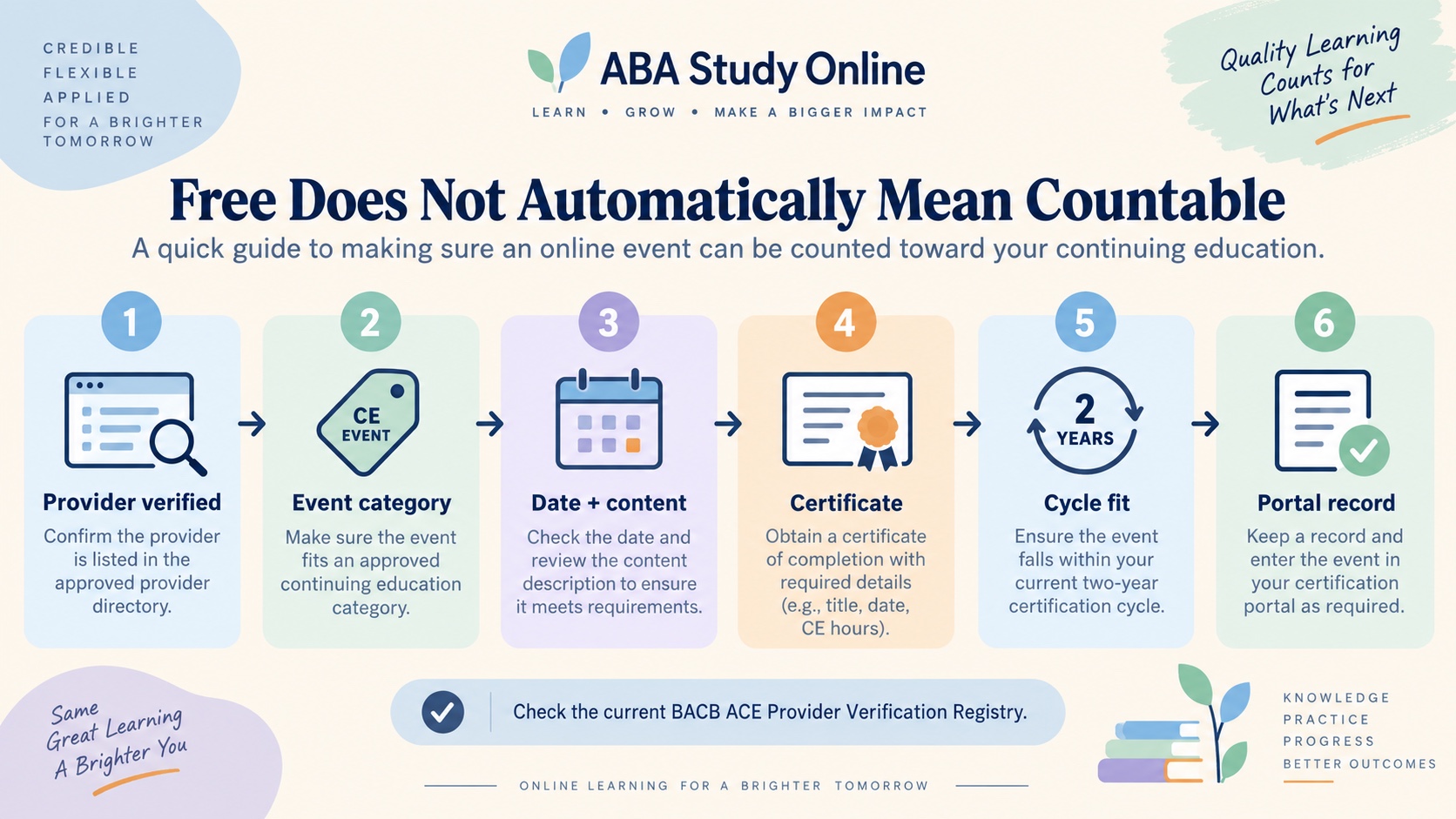
- Find the provider in the BACB registry. Start with the BACB Authorized Continuing Education Providers page and the ACE Provider Verification Registry. Do not rely only on a badge, an old blog roundup, or a provider’s marketing sentence.
- Verify the individual event. Confirm the event title, format, date, amount of credit, and whether the event is listed as Learning, Ethics, or another category that the provider can document.
- Read the content description. A course that mentions ethics for five minutes is not automatically an ethics CEU. The ethics material must meet the current content definition and be central enough to qualify.
- Check participation requirements. Confirm whether you must attend live, remain present, complete knowledge checks, answer questions, or meet another participation condition. Do not assume that opening a recording equals completing a CE event.
- Confirm the certificate or record. Before investing time, know what documentation you will receive. Check that the record identifies the provider, event, date, CEU amount, and relevant category.
- Match it to your cycle. Confirm that the event date falls inside the cycle to which you intend to apply it and that the amount will not be counted twice.
- Enter and store it. Add the CEU to the BACB Portal using information that matches the supporting documentation. Keep the file in a durable folder, not only in a temporary download directory.
This process explains why a current “free BCBA CEUs” article should not promise a permanent list of providers. ACE status, event formats, prices, certificates, and requirements can change. A verification method ages better than an unmarked list of links.
For a practical tracker, use one row per event and five short checkpoints: provider verified, event category verified, documentation received, cycle date checked, and Portal entry completed. Add a note when an event is intended for ethics or supervision. If a checkpoint is blank, leave the CEU in a “needs verification” column rather than counting it in your completed total. That small delay is easier to manage than discovering a documentation gap immediately before recertification.
You can also set a monthly target instead of waiting for the last weeks of the cycle. Divide your remaining CEUs by the number of months left, reserve space for the ethics and supervision categories that apply to you, and review the official requirements whenever a transition date is approaching. The goal is an organized record, not a last-minute collection of attractive-looking free links.
Ethics and supervision CEUs need their own check
Ethics and supervision are not just labels to add after you finish a general course. Under the current handbook, ethics continuing education must relate to the BACB’s ethics requirements and/or cultural or contextual responsiveness, connect to behavior-analytic practice or applied research, and be directly linked to the behavior-analytic literature or established practice. Most of the event must focus on ethics or cultural/contextual responsiveness. Incidental mention does not make a general course an ethics CEU.
Supervision CEUs also have a current-cycle condition. The handbook says that BCBAs who have supervised the ongoing practice of RBTs or BCaBAs on record, or trainees pursuing BCBA or BCaBA certification, at any point during the cycle must obtain and enter 3 supervision CEUs to recertify under the current requirements. The content must be behavior-analytic and address effective supervision practices in the relevant BACB supervision materials.
When you screen an offer, ask a more precise question than “Does this mention ethics?” Ask: “Would the provider document this event in the category I need, and does the majority of the content meet the current definition?” For supervision, ask whether the event is actually about behavior-analytic supervision rather than generic leadership or workplace management.
How the 2027 BCBA changes fit
The BACB’s 2027 BCBA Requirements document retains 32 CEUs in each two-year recertification cycle but lists 4 ethics CEUs and 4 supervision CEUs for supervisors. The document also defines ethics continuing education with the expanded language around ethics requirements and cultural/contextual responsiveness. That is a future-facing requirement boundary, not a reason to rewrite every current-cycle record.
Use the date that governs your certification cycle and the official document that applies to that cycle. If you are close to a transition, record the event date, the current handbook version you consulted, the provider information, and the certificate. When the rules affect your own recertification, verify the current BACB announcement or contact the BACB rather than relying on a general blog explanation.
The practical planning habit is simple: label your tracker “current cycle” or “2027 applicable,” and do not mix 3 supervision CEUs with 4 supervision CEUs as though they were interchangeable requirements. The public upcoming-changes page is useful for watching effective dates, but your handbook and Portal remain the working records.
Common mistakes and FAQ
Do free BCBA CEUs count?
They can, but free access alone does not decide that. Verify the provider, the event, the content category, the participation requirements, the documentation, and the certification cycle.
Does every ACE Provider event count as an ethics CEU?
No. An ACE Provider may offer different kinds of Learning CE. An ethics CEU must meet the current ethics-content definition; a brief ethics reference inside a general course is not enough.
Can I use an old free-CEU list?
Use old lists only as leads. Confirm the current provider status and current event details in the BACB registry. ACE requirements and provider offerings change, and a page can remain online after its information becomes stale.
Can I carry extra CEUs into the next cycle?
The current BCBA Handbook says that CEUs exceeding the required amount cannot be applied to the next cycle. Keep your tracker organized by the cycle in which the activity was earned.
Can ABA Study Online provide free BCBA CEUs?
Not through this educational article. ABA Study Online can support ABA vocabulary, theory review, and professional learning, but it should not be represented as an ACE Provider or as awarding BACB CEU credit unless that status is separately verified and explicitly established.
What changes in 2027?
The official 2027 BCBA Requirements document keeps the 32-CEU total but lists 4 ethics and 4 supervision CEUs for supervisors. Apply the requirements that govern your cycle and check the current BACB source when the transition affects your records.
For background learning that is not presented as CEU credit, you can use the BCBA theory blocks, the ABA Definition Search, the free resources library, or the ABA Study Online app for short review sessions. These are study destinations, not ACE events.