Free BCBA CEUs Online: What Actually Counts?
Searching for free BCBA CEUs online can lead you to useful learning, but “free” does not automatically mean “countable for BCBA recertification.” A video, article, webinar, or quiz may be free to view and still fail to provide the provider record, category evidence, or documentation you need for your BACB account.
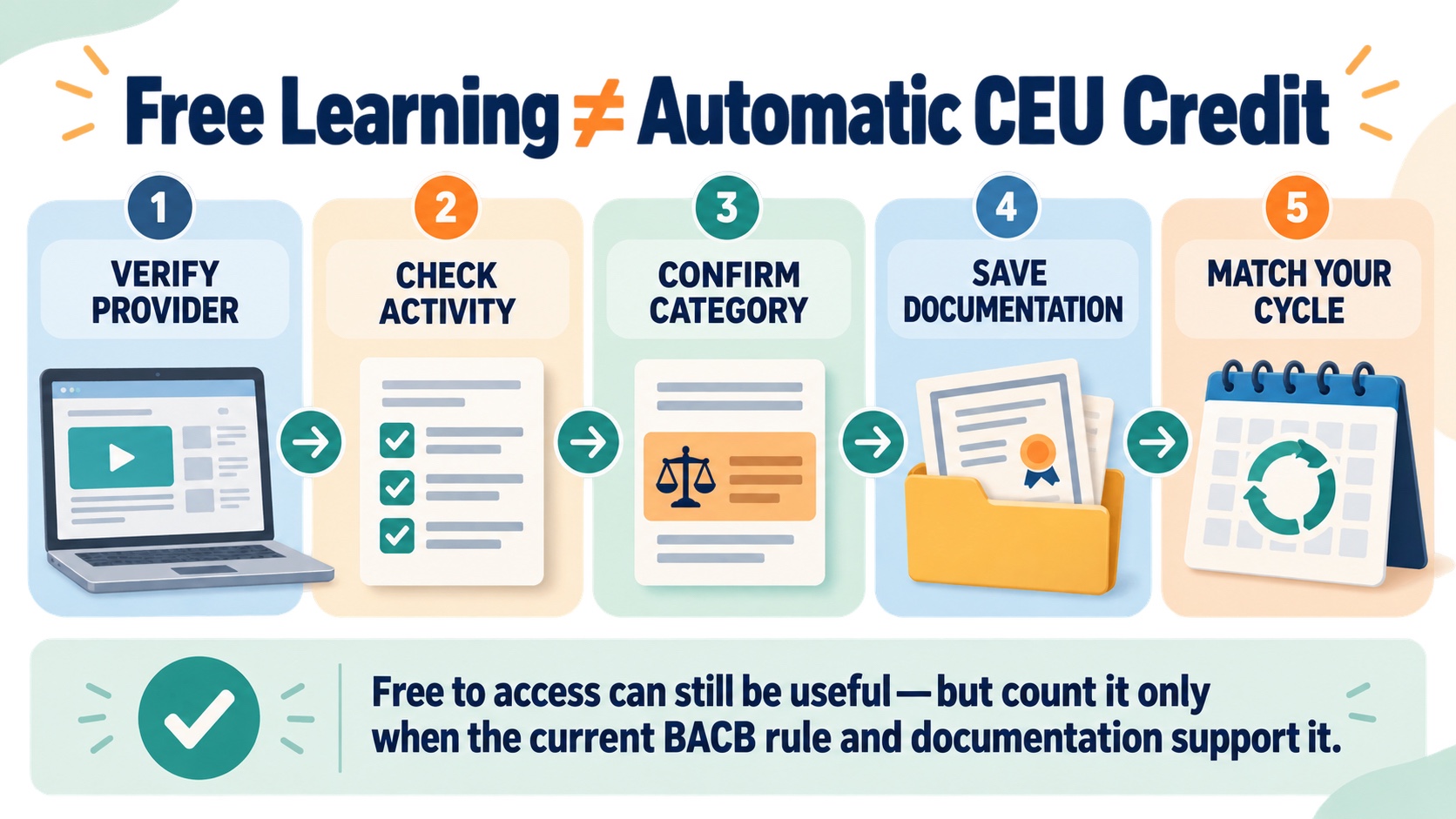
The safest approach is to separate two goals: free professional learning and CEUs that satisfy a current recertification requirement. Both can be worthwhile. Before counting an activity, verify the provider, the activity type, the number of CEUs, the ethics or supervision category if relevant, the supporting document, and the dates of your two-year cycle.
The quick answer
Some online activities may be available at no cost and still qualify as CE learning, but you should count them only when the current BACB rule, provider status, activity documentation, and your recertification cycle support the entry. A free certificate by itself is not proof that the activity is an acceptable BCBA CEU.
The BACB’s Authorized Continuing Education program exists so certificants can verify providers and activity information. Use the ACE Provider Verification Registry or the provider information linked by the current BACB resources. Do not assume that a site is authorized because it uses “BACB,” “CEU,” “ethics,” or “free” in a page title.
Free learning versus CEU credit
| What you find online | What it may provide | What you still need to check |
|---|---|---|
| Free article or video | Concept review and professional learning | Whether it is an eligible CE activity and has required documentation |
| Free live webinar | Learning event, sometimes with a certificate | Provider authorization, learning minutes, attendance, and category |
| Free certificate after a quiz | Evidence of completion | Whether the issuer and activity meet the current BACB rule |
| Free ethics resource | Ethics study and discussion | Whether most of the activity substantively focuses on qualifying ethics content |
In other words, price is only one feature of an activity. A paid course can still be the wrong category, and a free activity can still be valuable even when you use it for learning rather than claim it as a CEU.
For planning purposes, keep the resource decision separate from the credit decision. First ask whether the material improves your behavior-analytic knowledge or practice. Then ask whether the activity meets the BACB maintenance rule for your cycle. This two-step check prevents a useful free article from being discarded while also preventing an attractive certificate from being counted without evidence.
What to verify
Before entering a free online activity in your BACB portal, record the following:
- Provider: identify the organization or individual and verify the current ACE status when the activity is offered through ACE.
- Activity type: determine whether it is a qualifying learning, teaching, or scholarship activity rather than general website content.
- Learning amount: confirm the eligible minutes or stated CEU value and keep the calculation supplied by the provider.
- Category: check whether the activity is general, ethics, supervision, or another category recognized by the current handbook.
- Documentation: save the certificate, title, date, provider details, description, and any syllabus or category statement.
- Cycle: confirm that the activity occurred inside the two-year recertification cycle to which you plan to apply it.
If any of those pieces are missing, treat the activity as learning until you can verify it. Do not fill a documentation gap with an assumption. The purpose of a tracker is to make uncertainty visible early, while you still have time to choose a clearly documented activity.
Ethics and supervision categories
Category labels deserve extra attention. The current BCBA Handbook requires 4 ethics CEUs in the two-year cycle. For an activity to qualify as ethics continuing education, most of the event should focus on BACB ethics requirements and/or cultural or contextual responsiveness, connect to behavior-analytic practice or applied research, and relate to behavior-analytic literature or established practice.
A course that mentions ethics in one introductory slide but spends the rest of the time on unrelated content should not automatically be entered as an ethics CEU. Read the description and keep the provider’s category statement. For supervision CEUs, verify that the activity meets the supervision rule that applies to your cycle and role. The published 2027 BCBA Requirements document states a different supervision amount for supervisors than the June 2026 handbook, so do not copy a future number into a current cycle without checking the applicable document.
A no-cost verification workflow
- Start with the current BCBA Handbook and write down your cycle dates and reserved category amounts.
- Find a free activity and capture its provider, date, learning minutes, category, and documentation promise before you begin.
- Verify the provider or route the activity through the current BACB ACE information.
- Complete the activity and save the certificate, description, and any quiz or attendance record in one folder.
- Enter the activity in your tracker, then into your BACB account when the supporting evidence is ready.
- Before recertification, audit the total, category amounts, dates, and documents against the current official instructions.
This approach lets free content do useful work even when it is not a CEU. Use it for concept review, professional reflection, or deciding what kind of qualifying activity you need next. Do not weaken your documentation standard simply because an activity costs nothing.
A simple spreadsheet can track activity title, provider, date, minutes, category, certificate location, and cycle. Add a “verified?” column and leave it blank until the source check is complete.
Common mistakes
- Counting every free webinar as an ACE activity without verifying the provider.
- Assuming a certificate proves ethics or supervision classification.
- Entering an activity outside the current recertification cycle.
- Saving only a screenshot and losing the activity description or provider record.
- Calling a free study resource “official BACB CEU content” when it has no such authorization.
- Waiting until the recertification deadline to discover that a category is short.
For general study, the ABA Study Online BCBA learning route and free resources library can support behavior-analytic learning. They do not replace the current BACB Handbook, and they should not be described as ACE-provider CEUs unless the applicable authorization and documentation are actually in place.
FAQ
Are free BCBA CEUs online really free?
Some activities are free to access, but a certificate, provider record, or qualifying category may have separate conditions. Check the full activity and documentation terms before counting it.
Can a free YouTube video count as a BCBA CEU?
Do not assume it can. General viewing may be useful learning, but CEU eligibility requires the applicable activity, provider, category, and documentation rules.
Can free content count as ethics CEUs?
Only when the activity meets the current ethics CEU definition and has supporting documentation. A brief ethics mention in an otherwise unrelated resource is not enough.
Does ABA Study Online provide free official BCBA CEUs?
ABA Study Online resources are independent learning materials. Do not treat them as ACE-provider CEUs or enter them for recertification without verified authorization and documentation.