FIT BCBA Mock Exam: What It Means, What It Is Not, and How to Study Safely
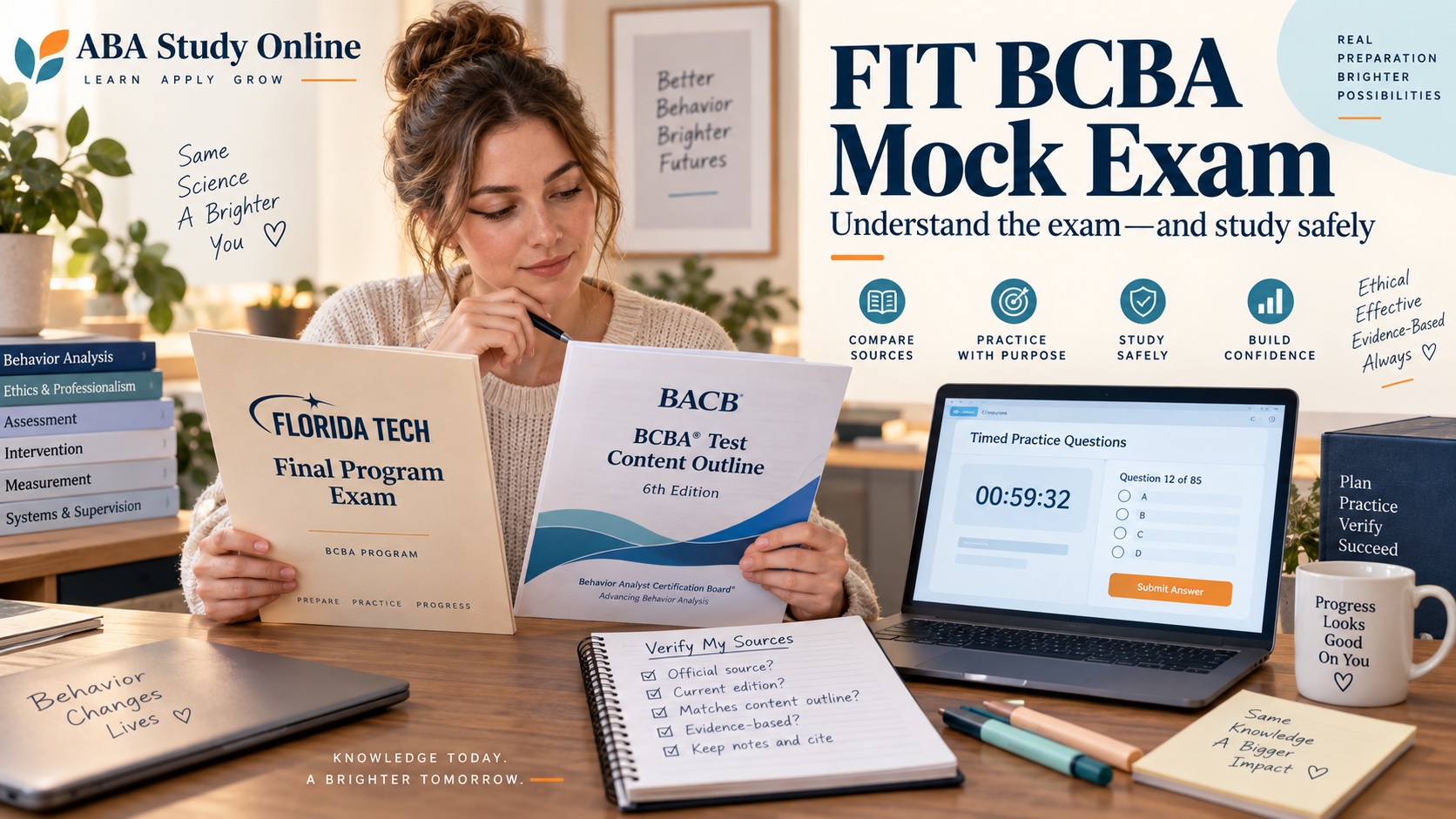
If you search for a FIT BCBA mock exam, you may be looking for Florida Tech’s Final Program Exam (FPE), a practice resource associated with Florida Tech graduates, or a public PDF that uses “FIT” in its title. Those are not automatically the same thing. The safest approach is to identify the source, separate the university exam from the BACB certification examination, and check whether a practice resource uses the current BCBA Test Content Outline (6th ed.).
This article explains the distinction and gives you a study-and-source checklist. It does not reproduce exam questions, endorse a public answer bank, claim access to live items, or promise a passing result. Use Florida Tech’s current student resources for its FPE and BACB’s current handbook and TCO for the certification exam.
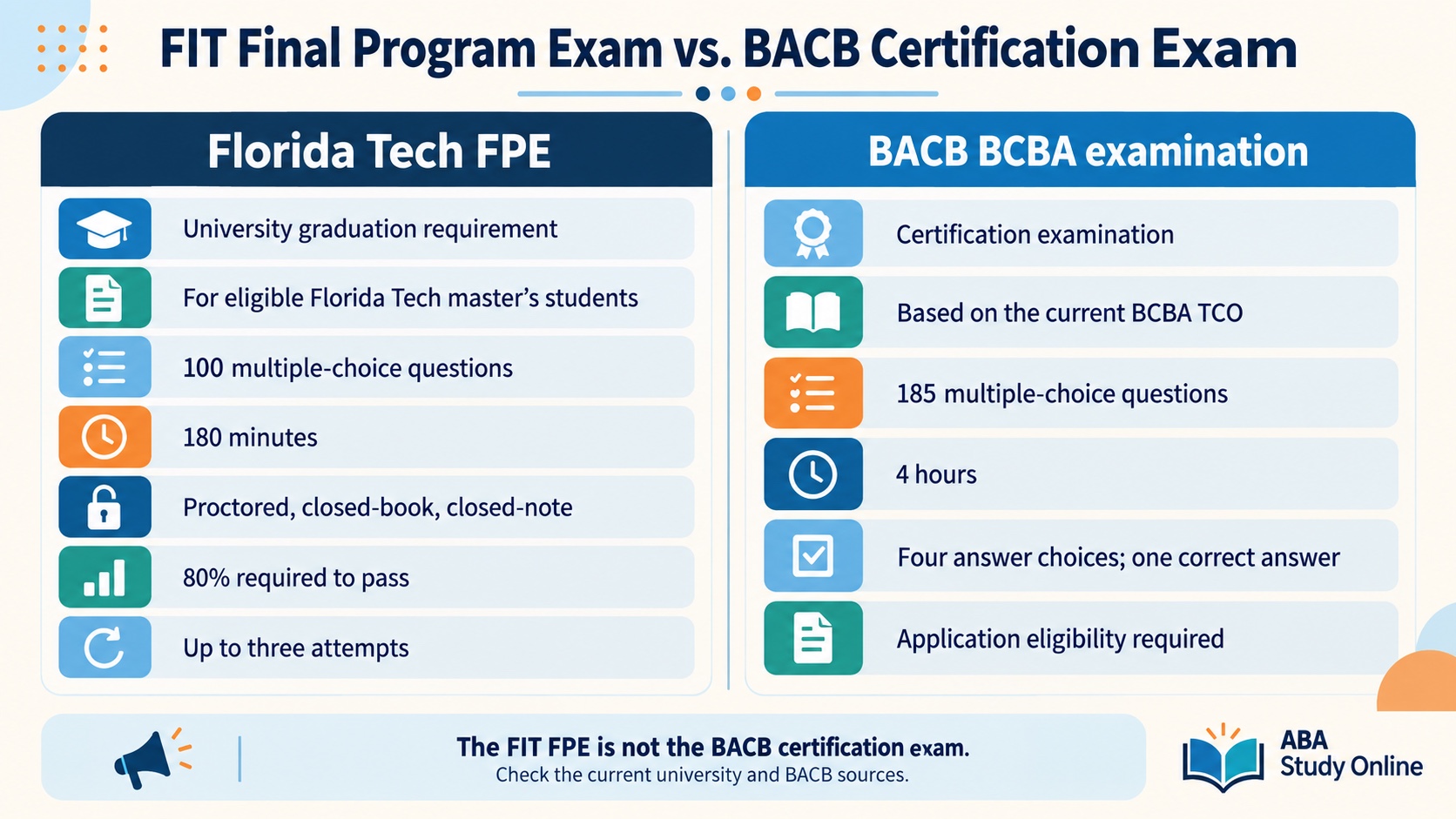
Quick answer: Florida Tech’s Final Program Exam is a university graduation requirement for eligible master’s students; it is not the BACB BCBA certification examination. Florida Tech’s ABA Online FPE page describes a 100-question, 180-minute, proctored, closed-book and closed-note exam with an 80% passing requirement and up to three attempts. The BACB BCBA examination is a separate certification exam based on the current BCBA TCO and requires application eligibility. A public “FIT mock exam” may be an unofficial practice product, so check its source and version before relying on it.
What Florida Tech’s FPE actually is
Florida Tech’s Final Program Exam, or FPE, is part of the university’s program requirements. The current ABA Online student resource says it is required for students in the master’s programs and not required for certificate-program students. It is taken in the final semester, is proctored and closed-book/closed-note, and is graded pass/fail with an 80% requirement.
The current page lists 100 multiple-choice questions and 180 minutes, with one attempt per semester and up to three attempts total. It also says that students who do not pass receive feedback on areas to improve. These details describe the Florida Tech university exam; they should not be copied into a page that claims to describe the BACB exam.
Florida Tech’s program context also matters. Its current course-information pages distinguish programs aligned with 2027 requirements from older programs aligned with 2022 requirements. A student should use the handbook and course resources for the program and year that actually apply to them. A generic internet PDF cannot tell you whether it matches your program’s current FPE.
How the BACB BCBA exam is different
The BACB BCBA certification examination is part of the certification pathway. The current BCBA Handbook and examination information describe the format and point candidates to the current BCBA TCO (6th ed.). The TCO organizes 104 tasks across nine domains and describes 175 scored questions plus 10 unscored pilot questions. The handbook describes 185 multiple-choice questions, four hours, four answer choices, and one correct answer per question.
The university FPE can help a Florida Tech student review program content, but passing it does not itself award BCBA certification. Conversely, studying for the BACB exam does not automatically satisfy a Florida Tech graduation requirement. Keep the two goals in separate columns in your study plan: university completion and certification eligibility and examination.
The BACB also states that it does not endorse specific study guides or preparation materials, and purchasing a study product does not guarantee a pass. That is a useful boundary for any article or provider that uses the words “FIT,” “official,” “actual,” or “guaranteed.”
When deciding what to practice, name the immediate outcome. If you need to pass a Florida Tech graduation requirement, begin with your current Florida Tech course materials and FPE instructions. If you need to prepare for BACB certification, begin with the BACB TCO, handbook, ethics code, and your training materials. If you simply want stronger ABA reasoning, use a clearly labeled practice set and review its rationales. One resource can support more than one goal, but its label should not hide which goal it actually serves.
What “FIT-style” practice may mean
Online discussions sometimes use “FIT mock” to describe practice that feels like a Florida Tech assessment or that was created by someone familiar with a Florida Tech program. The phrase is not a universal product category. One resource may be a student’s study file, another may be a commercial mock, and another may be an outdated document copied from a prior task outline.
Do not assume a PDF is trustworthy because its title says “FIT BCBA Mock Exam.” Public marketplace pages may use claims such as “actual questions,” “verified answers,” or “100% guaranteed pass.” Those claims are not evidence of BACB endorsement or exam validity. They can also encourage people to seek or share unauthorized exam content. A practice resource should teach reasoning from current sources, not sell the idea of a leaked answer key.
How to evaluate a practice resource
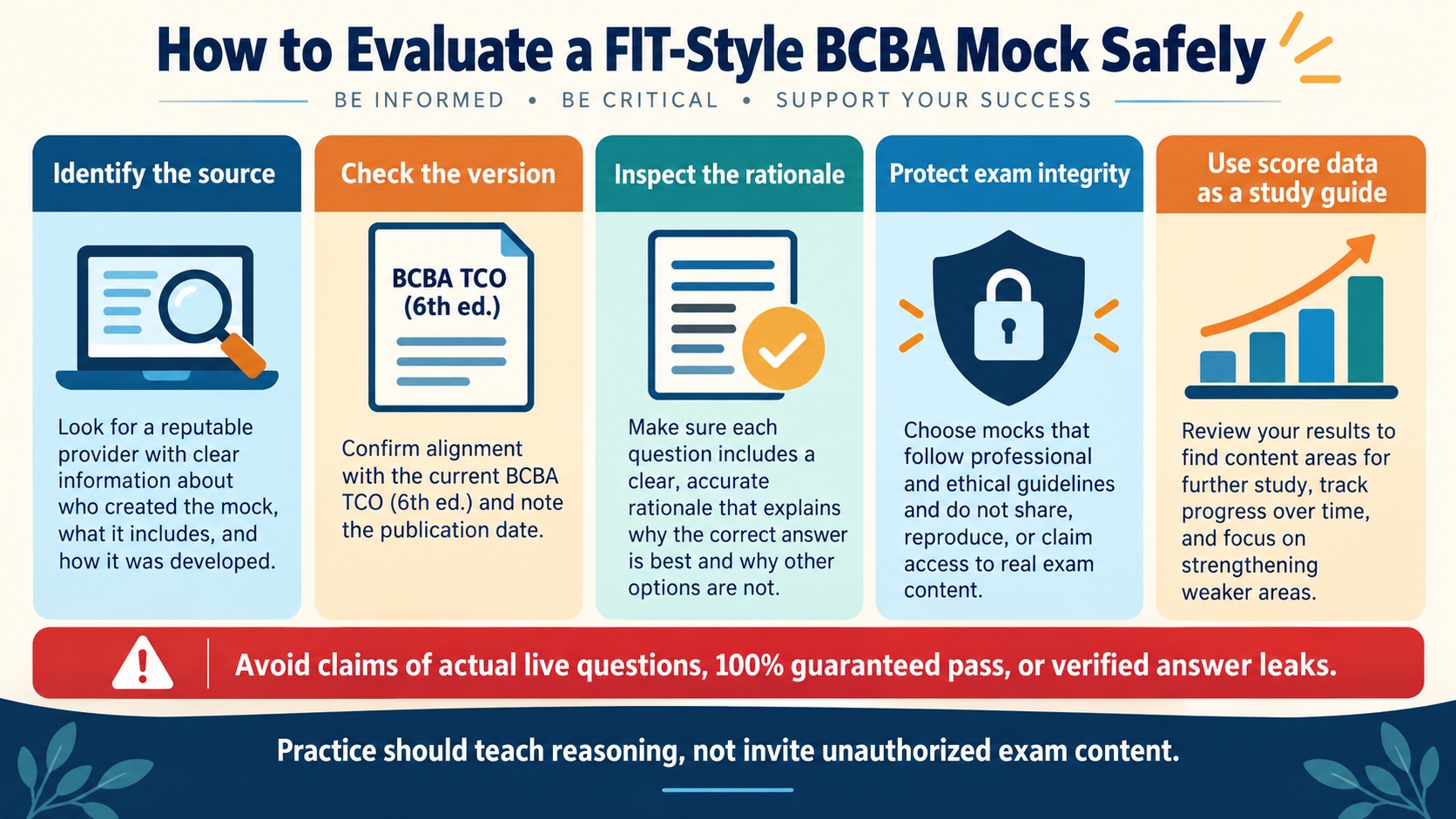
- Identify the creator: look for a named university, instructor, provider, or organization with a clear description of how the questions were developed.
- Check the version: confirm that the content is aligned with the current BCBA TCO (6th ed.) and note the publication or revision date.
- Inspect the rationales: explanations should show why the best answer fits the facts and why the other options are less appropriate.
- Check application demand: strong items require decisions about measurement, assessment, ethics, intervention, design, or supervision rather than only term recall.
- Review access and privacy: understand whether the resource is a university assessment, a practice product, or a shared file, and use it under the provider’s terms.
- Reject guarantee language: no mock can guarantee a live examination result.
How to use a FIT-style mock in a study plan
Use the first attempt as a diagnostic. Complete a timed set, record your accuracy and time, then tag each miss as a knowledge gap, misread stem, weak discrimination, timing issue, or careless error. Next, map the missed content to the current TCO domain or task. This helps you avoid rereading an entire textbook when the actual gap is one decision rule.
Review the rationale actively. Explain why the best option fits, why the alternatives fail, and what fact would change the answer. If you got an item right for the wrong reason, count it as a review target. Then study the relevant source, complete a new example, and return to a mixed set later. The goal is flexible application, not memorizing the position of an answer choice.
For a Florida Tech student, keep FPE preparation connected to the current course materials and BEH 5040 recommendations on the university page. For a BCBA candidate preparing for the BACB exam, keep the current BACB TCO, handbook, Ethics Code, and training materials in the source set. The same ABA concept can appear in both contexts, but the exam and requirement are not interchangeable.
After each practice session, write one sentence that names the concept, one sentence that explains the decision, and one sentence that points to the source. That small routine makes the practice traceable and reduces the temptation to memorize an answer key without understanding the behavior-analytic reasoning behind it.
Accuracy, ethics, and source quality belong in the same review.
Protect exam integrity
Do not seek, buy, share, reproduce, or upload materials that claim to contain live or stolen examination questions. Avoid copying a question into a public group with identifying details about where it came from. Use authorized practice, official retired examples when available, and your own notes. If a product’s main selling point is “actual questions” or “guaranteed answers,” choose a safer resource.
Exam integrity is also a learning issue. A memorized answer from an unverified file can teach the wrong concept, use an old blueprint, or reward a reasoning error. A transparent practice provider should be willing to explain its sources, revision process, answer rationales, and limitations.
Common mistakes
- Calling the FPE the BCBA exam: the FPE is a Florida Tech university requirement; the BACB exam is a certification examination.
- Assuming every FIT PDF is current: check the source, date, program context, and current TCO alignment.
- Trusting “actual questions” claims: use official and ethically sourced practice instead.
- Studying only by score: inspect the rationale, domain, timing, and reason for every miss.
- Using the wrong blueprint: confirm the current BCBA TCO (6th ed.) for certification preparation.
- Expecting a guarantee: a mock can guide study; it cannot guarantee a live exam result.
FAQ
Is a FIT BCBA mock exam the same as the BACB exam?
No. Florida Tech’s FPE is a university program exam, while the BACB exam is the certification examination. An unofficial FIT-style mock is also not the BACB exam.
How many questions are on the FIT FPE?
Florida Tech’s current ABA Online FPE page lists 100 multiple-choice questions and 180 minutes. Check the university page for the program and term that apply to you.
Does FIT still offer a mock exam?
Florida Tech’s official pages describe the current FPE and student resources. They do not make every public file titled “FIT mock exam” an official Florida Tech resource. Verify access through your student or program channel.
What blueprint should a BCBA certification mock use?
Use the current BACB BCBA TCO (6th ed.) and the current handbook. If a resource uses another edition, it should explain the difference and revision plan.
Can a FIT mock guarantee that I will pass?
No. A mock can provide practice, pacing information, and feedback. It cannot guarantee a live examination result.