
Fieldwork and Supervision for Behavior Analysts: Is the 2nd Edition Worth Using?
If you searched for Fieldwork and Supervision for Behavior Analysts: A Handbook, 2nd edition, you are probably deciding more than whether to buy a book. You may be trying to organize BCBA fieldwork, prepare for supervision meetings, choose a resource for a training program, or work out whether a commercial handbook is still useful alongside the current BACB documents.
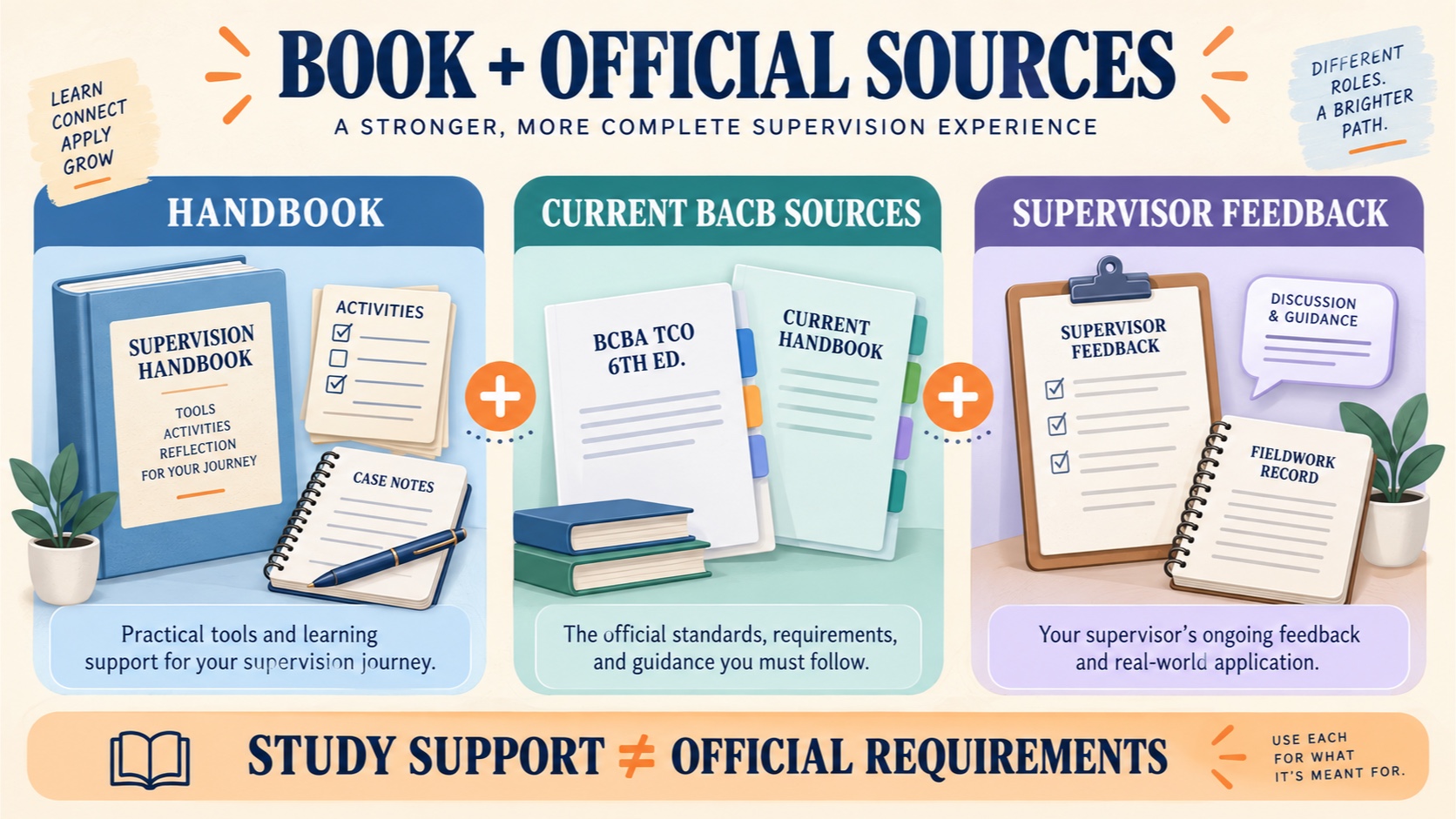
The short answer is that the 2024 second edition looks most useful as a structured companion for trainees, supervisors, and educators who want activities, case discussion, meeting structure, and competency-focused practice. It should not be treated as the rulebook for certification, a substitute for a qualified supervisor, or a guarantee that every page reflects the latest BACB requirement. Use it to make learning more concrete, then verify current rules in the official source.
Table of Contents
What the second edition is
The public publisher record identifies the book as Fieldwork and Supervision for Behavior Analysts: A Handbook, second edition, by Ellie Kazemi, Peter Adzhyan, and Brian Rice. Springer lists the second edition in 2024 and describes it as a competency-based guide for supervisors and supervisees. The public book record lists 418 pages, with print ISBN 9780826188724 and eText ISBN 9780826188731.
The publisher description highlights step-by-step supervision strategies, activities, case scenarios, ethics, cultural responsiveness, and author-developed competencies. It also describes CourseConnect and says the book aligns with the BCBA Test Content Outline, sixth edition. Those are useful signals when you are comparing study resources, but they are publisher-described features—not a BACB endorsement and not proof that reading the book completes a certification requirement.
Who is most likely to benefit?
BCBA trainees who need structure
A trainee often has several sources open at once: a university course, a fieldwork agreement, a supervisor’s agenda, the BCBA Handbook, the TCO, and notes from client work. A handbook can give that material a sequence. Instead of asking only “What should I read?”, you can ask “What competency am I practicing, what evidence will show it, and what question should I bring to supervision?”
This is especially useful when a learner understands a definition but cannot yet apply it. A case scenario or worksheet can turn a term such as measurement quality, functional assessment, intervention selection, or feedback into a decision that can be discussed and revised.
Supervisors and educators who want reusable prompts
Supervisors may find value in meeting prompts, activities, case discussions, and competency language that make feedback more observable. That does not mean a template should replace individualization. The supervisee’s role, setting, client needs, cultural context, current skill level, and fieldwork arrangement still shape the meeting.
Readers who want a book, not only a question bank
If your only goal is to complete timed exam questions, a full handbook may be more than you need. If you want a broader supervision and fieldwork companion—one that helps connect meetings, practice, reflection, and competency development—the format may fit better than a page of flashcards alone.
How it fits with current BACB sources
The official BCBA Test Content Outline, sixth edition, describes the examination content beginning in 2025. It lists 104 tasks across nine domains and an examination structure of 175 scored questions plus 10 unscored pilot questions. The TCO is a blueprint for exam content; it is not a supervision workbook and it does not answer every fieldwork-documentation question.
That distinction gives the book a sensible role. The TCO tells you the official content boundary. The current BCBA Handbook and related BACB resources tell you about eligibility, fieldwork, supervision, documentation, and examination policies. The handbook can help you study and practice within those lanes. When a book and a current official page appear to disagree about a number, date, form, or eligibility rule, pause and follow the live official source.
The 2027 BCBA changes should also be kept separate from the book’s edition label. A book’s second edition is a publishing edition; it is not a new BACB exam edition. If your application timing reaches a transition period, use the current BACB requirements and transition materials rather than assuming that a study book answers the administrative question.
How to use the handbook as a learning system
Reading from page one to the end can feel productive without showing whether your skill is changing. A more useful loop is:
- Choose one competency or decision. Start with the supervision problem you actually need to understand, such as giving feedback, interpreting data, planning an assessment, or preparing for a meeting.
- Anchor the topic to the current official source. Open the relevant TCO, Handbook section, ethics resource, or supervisor-provided document before making notes.
- Read for an action. Mark the example, activity, or question that changes what you will do—not just the sentence that sounds familiar.
- Apply it to a de-identified scenario. Write what you would observe, measure, ask, document, or revise. Do not place client-identifying information into a study file.
- Bring the uncertain part to supervision. A supervisor can correct the classification, scope, sequence, or level of independence. The book cannot approve your fieldwork hours or make a clinical decision for you.
- Review the mistake later. Use independent practice questions or flashcards to check whether you can recognize and explain the concept in a new scenario.
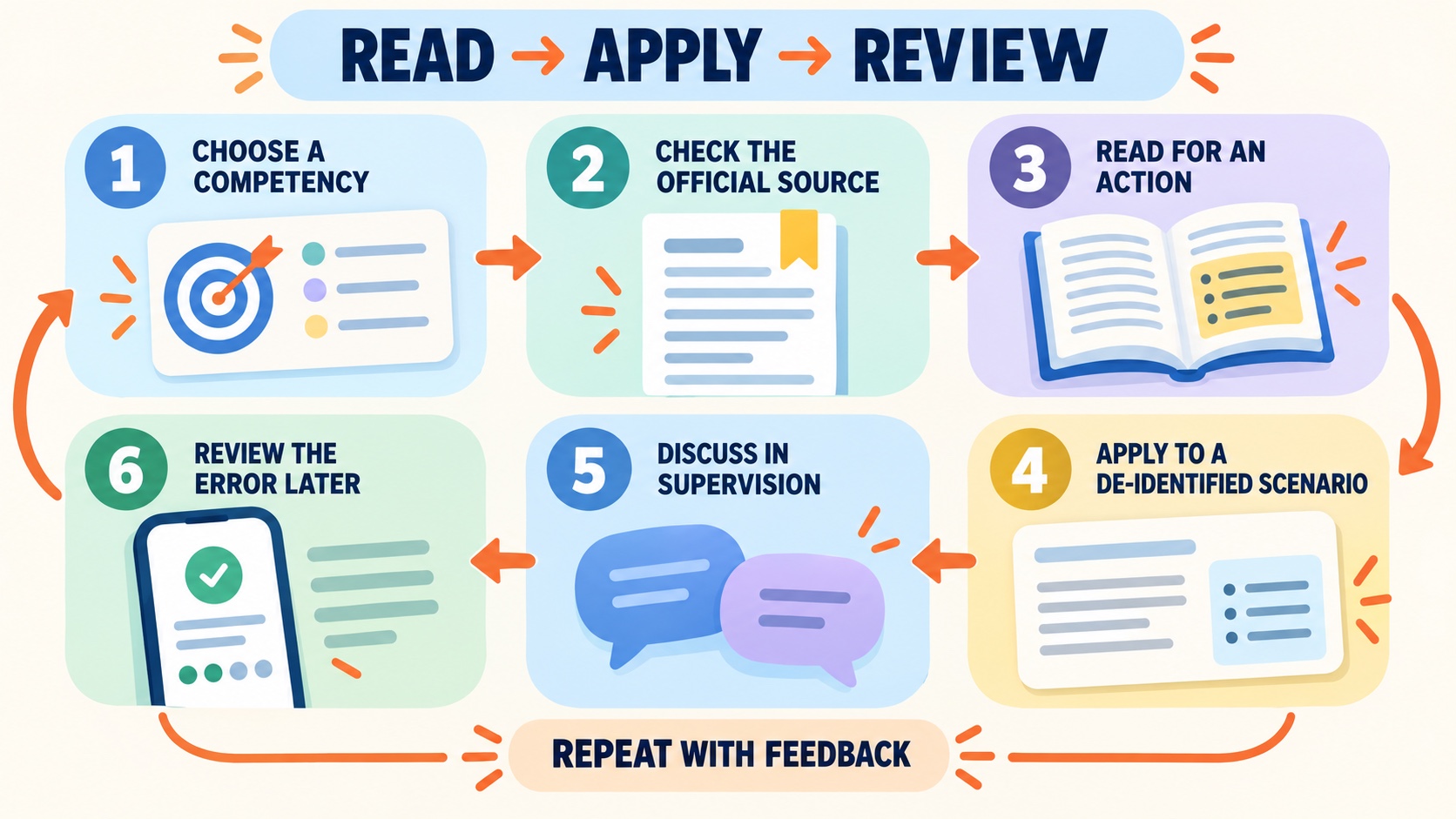
This loop also protects against a common mistake: using a commercial resource as if it were a private replacement for supervision. A strong study session ends with a clearer question, a safer application, or evidence of improved performance—not merely a longer list of highlighted pages.
For example, a chapter about feedback should lead to a small observable rehearsal. Draft one specific piece of feedback, identify the behavior or skill it addresses, predict how the supervisee might respond, and ask how the supervisor would adjust the wording. That exercise is more valuable than copying a definition into a notebook because it creates something that can be reviewed, revised, and used in a real supervision conversation. Keep the practice example de-identified and label it as a learning artifact, not as an official fieldwork record.
Turn reading into repeatable practice
After you choose a topic from the handbook, you can use the ABA Study Online app or BCBA practice questions to rehearse the distinction, review explanations, and return to weak areas. These are independent learning aids: they do not replace the book, current BACB sources, or a qualified supervisor.
What to check before buying
- Edition and date: confirm that you are looking at the 2024 second edition rather than an older listing for the 2018 first edition.
- Format: compare print, eText, and any access-code or companion-material conditions before paying.
- Your actual job: decide whether you need supervision structure, fieldwork documentation help, exam review, or a narrow official rule. One resource may not do all four jobs well.
- Currency: use the current BACB Handbook and TCO for dates, requirements, forms, and policies.
- Privacy: keep real client information out of worksheets, screenshots, and practice prompts.
- Support: if you are in supervised fieldwork, ask your supervisor how the book fits the agreement and learning goals before treating a worksheet as a record.
Limits and common mistakes
The book is not an official BACB publication, does not issue certification, does not grant fieldwork approval, and cannot guarantee an exam result. It also should not be used to copy or reconstruct secure examination items. Use its activities as learning prompts, write your own responses, and verify any current rule in the source that controls that rule.
Do not buy a second edition simply because “newer” sounds like “current in every detail.” A 2024 book can be valuable and still need a 2026 or 2027 source check. Conversely, do not discard a book because it is not the official rulebook; its value may be the structure it gives to practice, feedback, and reflection.
FAQ and sources
Is the second edition aligned with the BCBA 6th edition? The publisher describes it as aligned with the BCBA Test Content Outline, sixth edition. Treat that as a publisher description and use the current BACB TCO as the authority for exam content.
Is it an official BACB handbook? No. It is a commercial Springer Publishing book. The official BACB Handbook and current BACB resources control certification, fieldwork, ethics, and exam requirements.
Is it useful for BCBA fieldwork? It may be useful for organizing learning, supervision conversations, activities, and competency practice. It cannot approve an individual activity or replace the supervision agreement and supervisor review.
Should I use it instead of practice questions? Usually, the two formats serve different jobs. The handbook can help you build understanding and application; questions can reveal whether you can recognize and transfer that understanding under pressure.