
Examples of Verbal Behavior in ABA: Mand, Tact, Echoic, and Intraverbal
Verbal behavior in ABA is analyzed by the variables that evoke and maintain a response. That means the same word can be a mand in one situation, a tact in another, or part of an intraverbal exchange somewhere else. The response form matters, but it does not tell you the whole function.
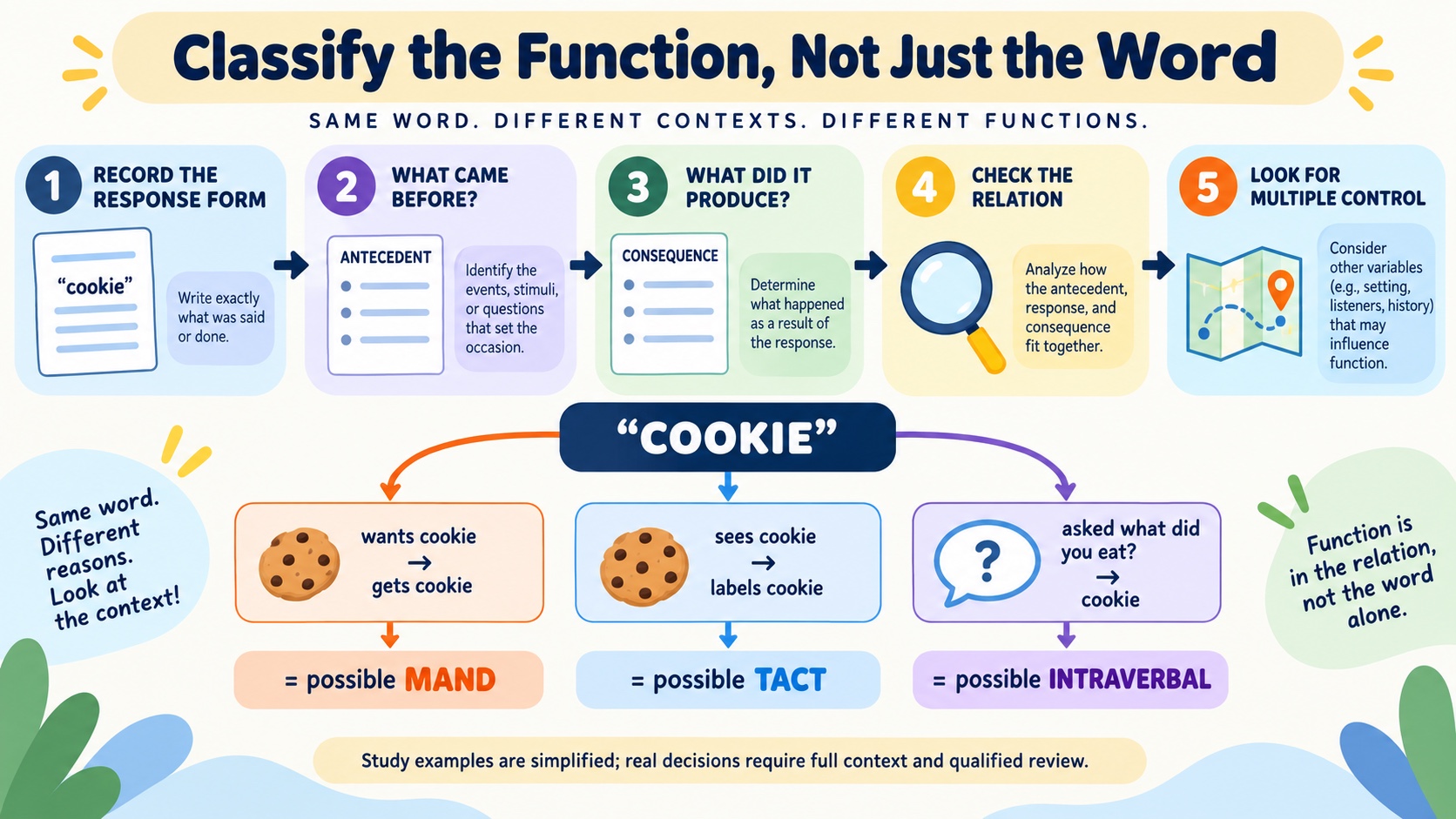
For example, a learner says “cookie.” If the learner is hungry and the word produces a cookie, the example may be a mand. If the learner sees a cookie and labels it while receiving social attention, it may be a tact. If an adult says “cookie” and the learner repeats it, the response may be an echoic. If someone asks, “What did you have for snack?” and the learner answers “cookie,” the response may be an intraverbal. The word is identical; the controlling context is not.
This guide uses simple study examples to show the difference. The examples are not a universal assessment protocol or an individualized teaching plan. In real practice, a qualified professional would examine the person’s communication history, current context, motivating variables, prompts, response form, and consequences before making a clinical decision.
Table of Contents
What verbal behavior means in ABA
In a behavior-analytic account, verbal behavior includes behavior that is reinforced through the mediation of another person. “Verbal” therefore does not mean only spoken language. A vocal response, sign, written response, picture exchange, or selection on an augmentative and alternative communication device may serve a verbal function when a listener mediates the relevant consequence. The response form and the function should be described separately.
Skinner’s analysis describes verbal operants as functional units. The term operant points attention to the relation among antecedent variables, the response, and its consequences. A learner who says “help,” presses a help icon, or signs for assistance may have different response forms, but the communication may serve a similar mand function if the response is evoked by a relevant motivating condition and produces assistance.
Research on verbal behavior often examines mand, tact, echoic, and intraverbal repertoires separately because the variables that support one repertoire do not automatically establish another. The Journal of Applied Behavior Analysis literature, for example, describes these operants using different stimulus-control and reinforcement relations. That is why an example list is most useful when each example also names the important context.
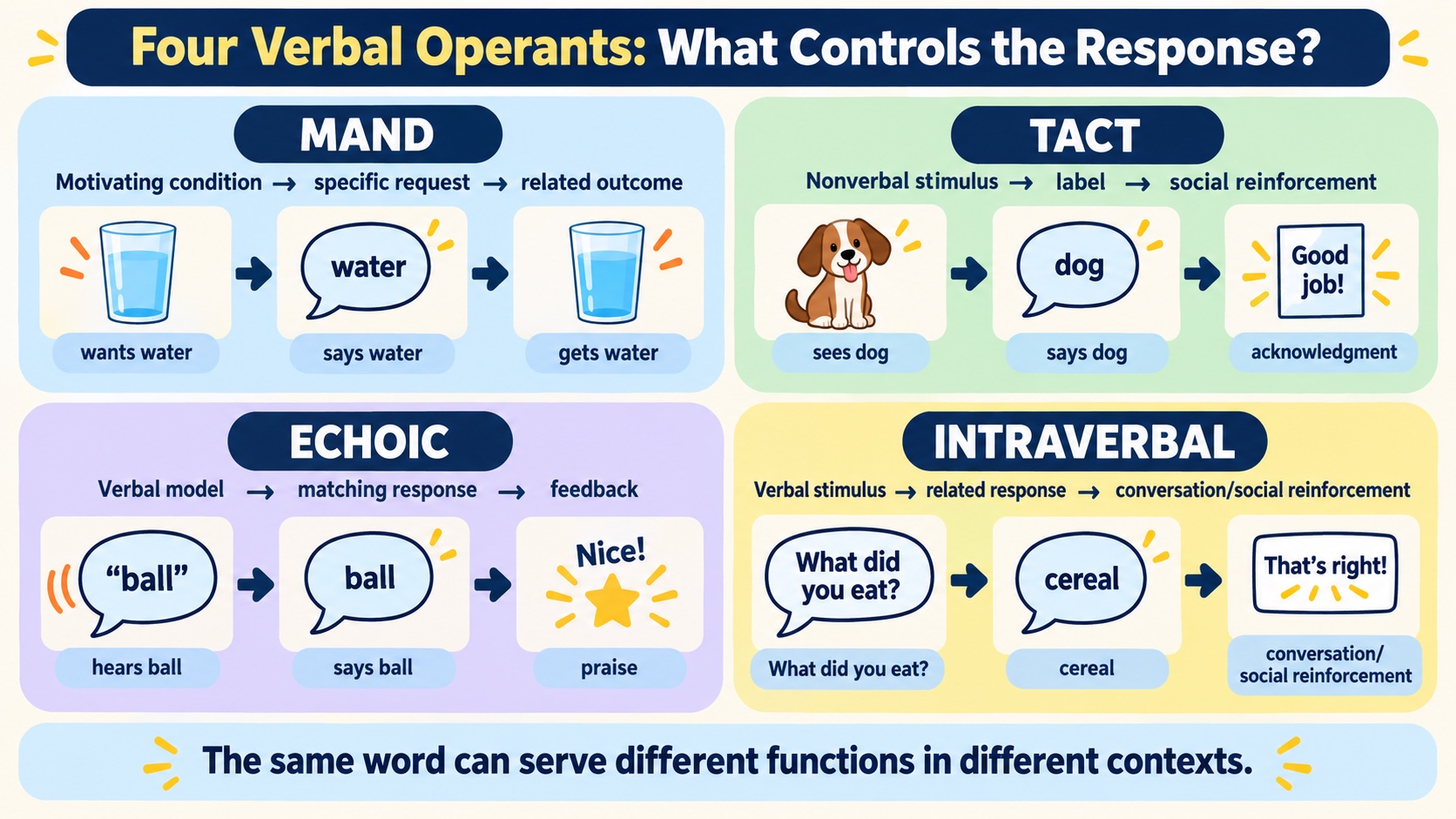
Mand examples: asking for what matters now
A mand is commonly taught as a request, but “request” is only a helpful shortcut. The more precise study question is: what motivating condition or relevant establishing or abolishing operation evokes the response, and does the response produce a specific consequence related to that condition?
- Water: after a long walk, a learner says “water” and receives water. The current motivating condition and the specific consequence are central to the example.
- Help: a learner cannot open a container, selects the “help” icon, and receives assistance. The response form is device-based, but the communication can be analyzed as a mand.
- Break: during a difficult task, a learner signs or says “break,” and the agreed break procedure begins. Whether the example is classified as a mand depends on the actual variables and consequence, not simply on the word break.
- More: a learner reaches the end of a preferred activity, says “more,” and receives another turn when the arrangement makes that consequence available.
Notice that the consequence is not merely praise in these examples. The relevant outcome is access to the item, event, assistance, or activity requested. A request can also be prompted or multiply controlled, so a short example should not be treated as proof that every occurrence of the word has the same function.
Tact examples: contacting and labeling events
A tact is often introduced as labeling. In a basic study example, a nonverbal stimulus evokes the response and the response is maintained by generalized social reinforcement, such as attention or acknowledgment. The important contrast with a mand is that the response is not primarily evoked by a current desire for the named item.
- Object tact: a learner sees a ball, says “ball,” and receives a social response such as “Yes, that is a ball.”
- Action tact: a learner watches someone run, says “running,” and receives social attention for the label.
- Feature tact: a learner sees a cup that is blue and says “blue” when the teaching arrangement makes the color feature relevant.
- Event tact: a learner hears thunder, says “loud,” and receives acknowledgment of the observation.
The same item can appear in a mand and a tact example. A learner may say “ball” while wanting access to the ball, which can function as a mand. The learner may also say “ball” while simply labeling the object in view, which can function as a tact. The response topography does not settle the classification.
Echoic examples: repeating a verbal model
An echoic is a verbal response evoked by a preceding verbal stimulus with point-to-point correspondence and formal similarity between the model and the response. In plain language, a person says something after hearing a similar verbal model, and the parts of the response correspond to the parts of the model.
- An adult says “ball,” and the learner says “ball” while practicing vocal imitation.
- A teacher models “ma,” and the learner repeats “ma” with the teaching arrangement providing social reinforcement.
- A learner hears a short sound pattern and reproduces it during an imitation activity.
Echoic behavior should not be confused with every repeated phrase. The classification depends on the relevant relation between the model and the response. If a learner repeats a word later because it helps request an item, the current function may not be simply echoic. A response can also be multiply controlled, so the best analysis uses the full context rather than a label chosen from the sound alone.
Intraverbal examples: responding to verbal stimuli
An intraverbal is a verbal response evoked by another verbal stimulus without point-to-point correspondence. Conversation, fill-in statements, answering questions, and category responses can provide study examples when the response is controlled by the preceding verbal material rather than by a matching vocal model or a directly present nonverbal object.
- Question and answer: someone asks, “What do you eat for breakfast?” and the learner answers “cereal.” The answer does not copy the question’s words.
- Fill-in: an adult says, “Ready, set…” and the learner responds “go.”
- Category response: someone asks, “Name an animal,” and the learner says “dog.”
- Conversation: a friend says, “I went to the park,” and the learner replies, “I went yesterday.” The exact classification depends on the broader verbal and motivational context, but the example shows why a conversational response is not defined only by its topic.
Intraverbal teaching research often examines how prompts and transfer procedures affect responses to verbal stimuli. For study purposes, do not assume that a learner who can tact an item can automatically answer questions about it. The controlling variables may be different, and a new response may need its own teaching arrangement.
Why the same word can change function
Consider the word “cookie” in four short scenes:
| Scene | What happens before | What happens after | Possible study classification |
|---|---|---|---|
| Snack request | The learner is hungry and cookies are available. | The learner receives a cookie. | Mand |
| Picture label | The learner sees a cookie picture during labeling. | The listener provides social acknowledgment. | Tact |
| Vocal imitation | An adult says “cookie.” | The learner receives feedback for matching the model. | Echoic |
| Conversation answer | An adult asks, “What did you eat?” | The conversation continues or the learner receives social reinforcement. | Intraverbal |
This table is a learning illustration, not a shortcut for clinical coding. If the learner is looking at the picture, hearing a prompt, wanting the food, and answering a question at the same time, several sources of control may be present. The analyst would need to examine the arrangement and the learner’s history before deciding how to describe the response.
A practical classification routine
When a question asks for an example of verbal behavior, use this five-step routine:
- Write the response form. Record what the learner says, signs, writes, selects, or exchanges without yet naming the operant.
- Identify what was present or said before. Was there a motivating condition, an object or event, a verbal model, or another verbal stimulus?
- Ask what the response produced. Did it produce access to a specific item or event, social reinforcement, matching feedback, information, or another consequence?
- Check the relation. Does the response match a verbal model point to point? Does it label a nonverbal event? Does it answer or continue verbal material without copying it?
- Look for competing control. If more than one variable is present, say that the example is simplified or multiply controlled rather than forcing a false certainty.
This routine is useful for exam review because it changes the question from “What does the word mean?” to “What variable is controlling the response in this example?” It also makes explanations more precise. A strong answer names the antecedent, the response, the consequence, and the reason the relation supports the classification.
Common study mistakes
- Calling every request a mand. The response must be analyzed in relation to motivating variables and the relevant consequence.
- Calling every label a tact. A word can be evoked by a verbal question, a request for an item, or a verbal model instead.
- Calling every repetition an echoic. Repetition may be part of another functional relation; check the immediate verbal stimulus and correspondence.
- Defining an intraverbal by conversation alone. Look for control by verbal stimuli without point-to-point correspondence, not merely a conversation topic.
- Assuming spoken language is the only verbal behavior. Analyze the function and mediation by a listener, not just whether the response is vocal.
- Turning a study example into treatment advice. Real communication goals require qualified assessment, collaboration, consent, and attention to the learner’s preferences and context.
FAQ and sources
What are the most common examples of verbal behavior in ABA?
Common study examples include manding for water or help, tacting a visible item or event, echoing a modeled word, and answering a question as an intraverbal. The classification depends on the controlling variables around each example.
Is verbal behavior the same as talking?
No. Spoken language is one possible response form. Signs, written responses, picture exchanges, and AAC selections can also be analyzed as verbal behavior when another person mediates the relevant consequence.
Can the same word be a mand and a tact?
Yes. “Ball” can request access to a ball in one context and label a ball in another. The word alone does not determine the verbal operant.
What is an intraverbal example?
If someone asks, “What do you eat for breakfast?” and the learner answers “cereal,” the response is a common intraverbal study example because it is evoked by verbal material without copying the question word for word.
Where can I study these concepts?
Start with the current BACB Test Content Outlines for the credential track you are studying, then use peer-reviewed behavior-analytic literature to deepen the examples. ABA Study Online’s ABA study guide and practice questions can help organize review, but they do not replace coursework, supervision, or individualized clinical assessment.