
Ethics Code for Behavior Analysts: A Practical Study Guide
If you searched for the Ethics Code for Behavior Analysts, you may be looking for more than a list of rules. You may be studying for a BCBA or BCaBA exam, trying to understand a boundary question, or wondering what to do when several people and responsibilities pull in different directions. The current BACB Code is a professional standards document: it helps behavior analysts evaluate their conduct, protect clients and stakeholders, and respond to ethical concerns with care.
The Code is not a substitute for law, licensure requirements, organizational policy, funder rules, supervision requirements, or advice from an appropriately qualified professional. The BACB says it cannot provide legal or ethics advice. This article explains the structure and a useful reasoning process; it does not decide whether a specific person violated a standard or tell you how to handle a live complaint.
Table of Contents
What the Ethics Code covers
The BACB’s Ethics Code for Behavior Analysts outlines ethics standards for BCBA and BCaBA certificants and applicants and Authorized Continuing Education providers. The current Code went into effect on January 1, 2022, and the official document is dated August 2024. It is different from the RBT Ethics Code (2.0), which applies to RBT applicants and certificants.
The Code has six broad sections:
- Responsibility as a professional: truthful conduct, competence, cultural responsiveness, boundaries, and professional obligations.
- Responsibility in practice: assessment, intervention, documentation, consent, confidentiality, and conditions that affect service delivery.
- Responsibility to clients and stakeholders: client welfare, stakeholder roles, service agreements, financial arrangements, consultation, and continuity.
- Responsibility to supervisees and trainees: qualified supervision, training, volume, feedback, delegation, and evaluation.
- Responsibility in public statements: accurate public information, advertising, social media, and testimonials.
- Responsibility in research: ethical research conduct, participants, data, publication, and dissemination.
Do not treat the section titles as six isolated subjects. A single situation can involve more than one section. For example, posting a client video may raise questions about consent, confidentiality, public statements, and the relationship between professional roles. The practical skill is learning to identify the people affected, the possible risks, the relevant standards, and the documentation needed to support a careful decision.
The four foundational principles
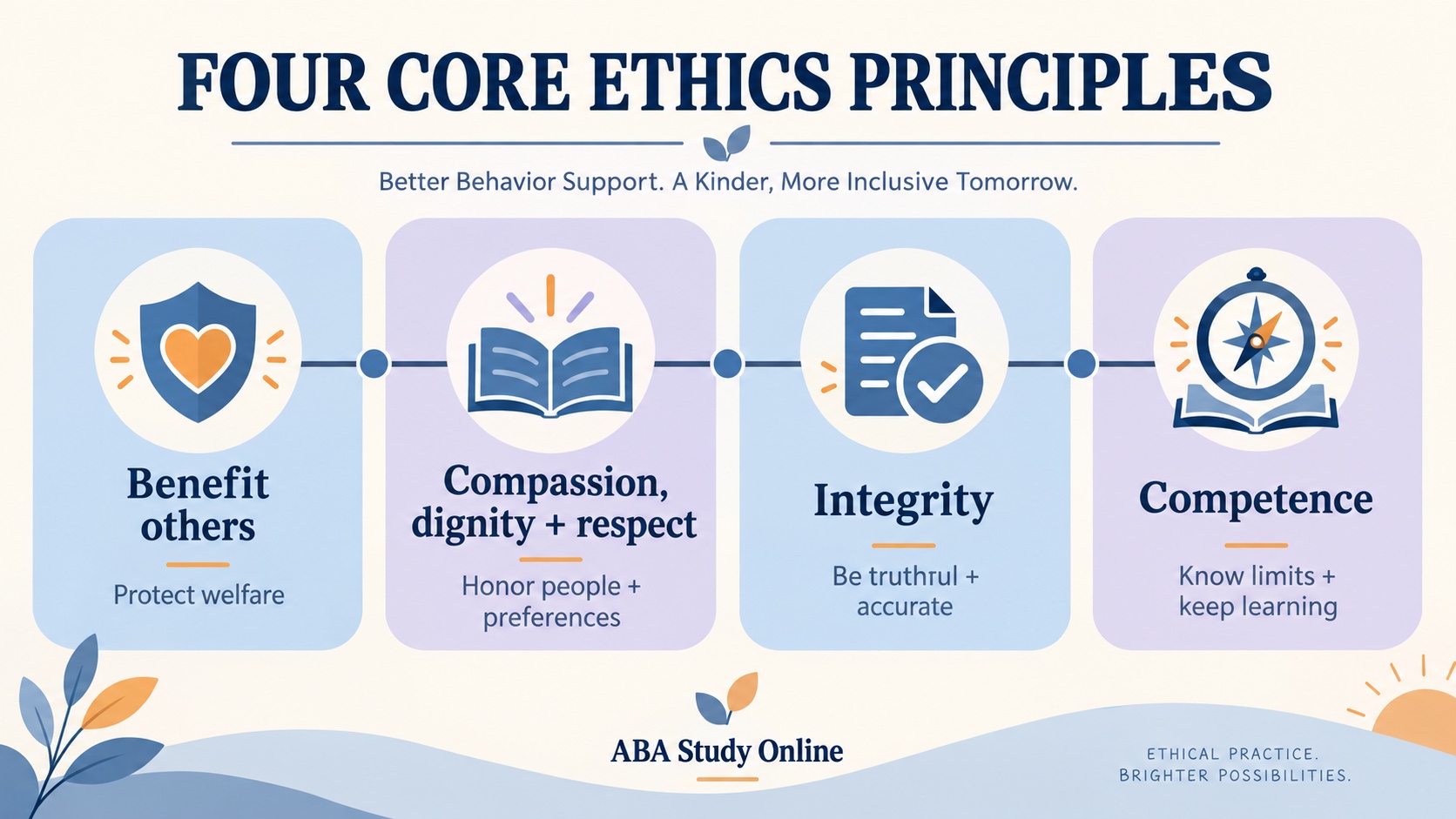
The Code presents four foundational principles as a framework for interpreting the standards. The wording is best understood as a set of priorities that guide professional judgment, not as four slogans to memorize without context.
- Benefit others. Behavior analysts should work toward client and stakeholder benefit, reduce avoidable harm, and consider whether an intervention is actually helping the people it is meant to serve.
- Treat others with compassion, dignity, and respect. This includes listening, honoring preferences and rights, avoiding demeaning language, and considering cultural and contextual variables rather than treating a person as a problem to fix.
- Behave with integrity. Accurate records, truthful communication, honest representation of credentials, and responsible use of data are part of ethical practice.
- Ensure competence. Behavior analysts should maintain relevant knowledge and skills, recognize limits, seek training or consultation, and avoid accepting responsibilities they cannot perform competently.
These principles can point in different directions during a difficult case. A stakeholder may request a fast intervention, while the available data are weak. A team may want a public success story, while the client’s privacy risk is high. A supervisor may want to help a trainee, while the supervisor’s caseload is already too large. The principles do not eliminate judgment; they make the questions that judgment must answer more visible.
A structured ethical decision process
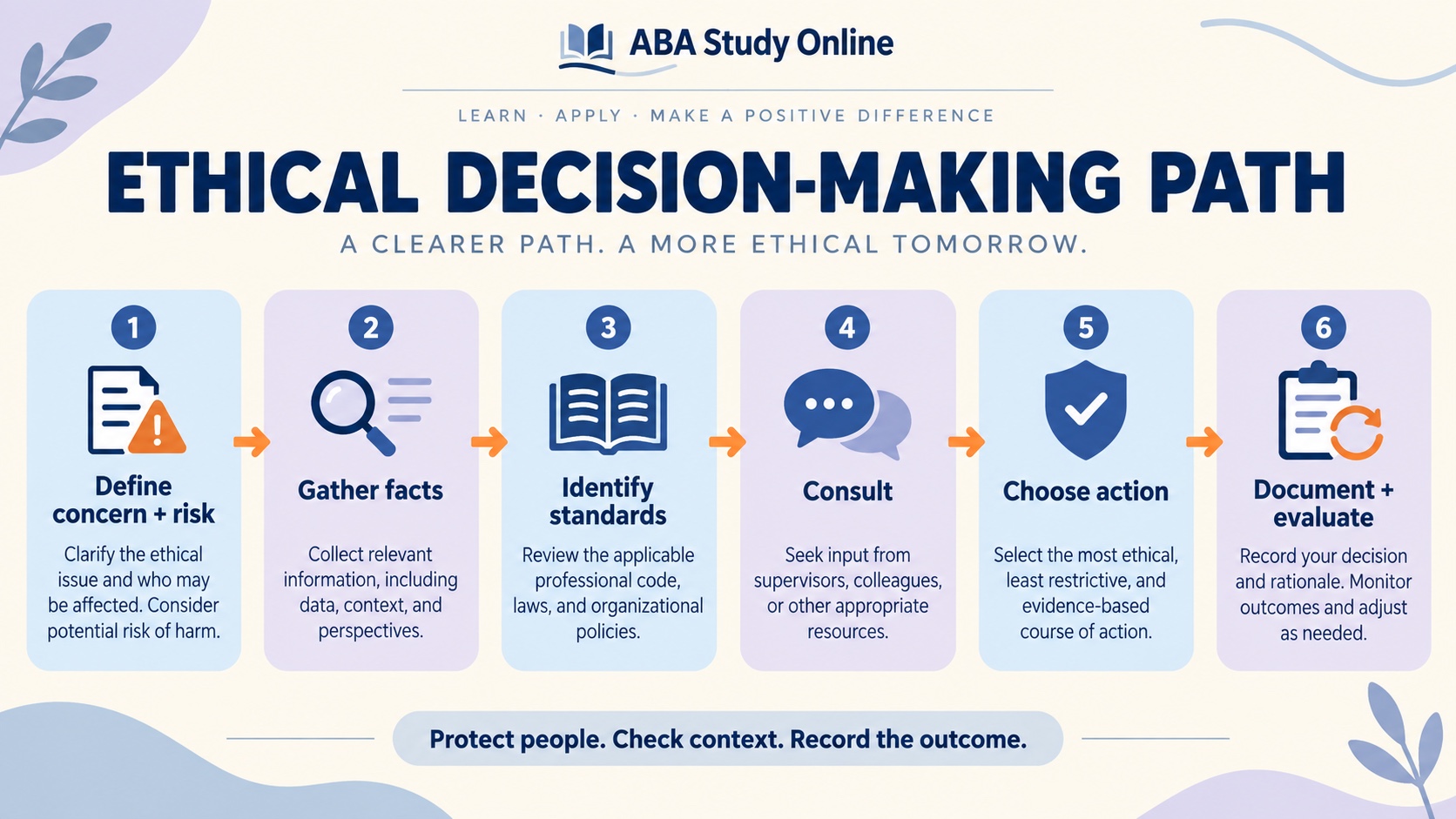
The Code includes an illustrative decision-making process for complex ethical dilemmas. You can turn it into a practical study and workplace routine. The order matters because acting on a rumor or an incomplete description can create a second problem while trying to solve the first.
- Define the concern and possible risk of harm. Write a neutral description of what happened, who may be affected, and what could go wrong if nothing changes.
- Identify relevant people and roles. Consider the client, caregivers, staff, supervisor, employer, school, funder, or researcher. Clarify who has which responsibility.
- Gather supporting information. Check records, dates, consent documents, data, contracts, and direct observations. Follow up on second-hand information before treating it as established fact.
- Consider learning history and bias. Ask whether your assumptions, role, culture, or prior experience are influencing how you interpret the situation.
- Identify relevant principles and standards. Read the current Code language and any connected BACB requirement, law, licensure rule, organization policy, or contract.
- Consult appropriate resources. Discuss the question with a supervisor, trusted colleague, subject-matter expert, or other appropriate resource while protecting confidentiality.
- Develop more than one possible action. Include options that reduce or remove the risk of harm and that respect client preferences and applicable requirements.
- Evaluate, select, and act. Consider the likely impact, social acceptability, restrictiveness, feasibility, and chance that the action will solve the concern without creating a new one.
- Document and evaluate the outcome. Record the decision, people involved, actions, due dates, and what happened afterward. If the concern remains, revise the plan and consult again.
This process is not a permission slip to delay urgent safety action. When there is an immediate risk, follow emergency, mandated-reporting, organizational, and legal procedures first. Documentation should support action, not become a reason to leave a person in danger.
How the Code changes everyday practice
Scenario: a request for a quick program change. A caregiver asks the team to change an intervention because the current routine is difficult at home. An ethical response is not to dismiss the request or change the procedure without review. Clarify the concern, examine the data and context, consider the client’s preferences and welfare, consult the relevant supervisor or team, and document the agreed plan and follow-up.
Scenario: a boundary that feels friendly. A current client’s family invites a behavior analyst to a private event and offers a valuable gift. The question is not only whether the person feels comfortable. Consider multiple relationships, conflicts of interest, power differences, organization policy, client and family impact, and how to communicate a respectful boundary. Consult before responding if the situation is complex.
Scenario: public success content. A clinic wants a dramatic before-and-after story for its website. The team should not assume that a positive outcome makes every public use ethical. Review informed consent, confidentiality, the Code’s public-statement and testimonial standards, applicable privacy law, the client’s ability to make a free choice, and whether the material could identify the person later.
Scenario: supervision beyond capacity. A supervisor keeps accepting trainees even though meetings are frequently cancelled and feedback is delayed. Supervision volume and competence are ethical issues because the quality of training and client service can suffer. The appropriate response may involve documenting the pattern, communicating the risk, adjusting the workload, consulting, or arranging continuity rather than simply adding another signature.
Documentation, confidentiality, and consultation
Ethical reasoning becomes much more useful when it leaves a careful record. A short note can include the date, people involved, concern, relevant facts, standards considered, consultation obtained, action chosen, responsibilities, due dates, and outcome. Keep the note factual and protect confidential information. Avoid writing speculation as if it were an observation.
Confidentiality applies to service delivery, data, documentation, recordings, messages, and electronic storage. Share information only when allowed by informed consent, to protect someone from harm, or when another applicable requirement permits or requires disclosure. Store and transmit records according to the Code, law, licensure, contracts, funder rules, and organization policy. A behavior analyst should not assume that a convenient app, group chat, or cloud folder is automatically appropriate.
Consultation is not a sign that a practitioner has failed. It is often the responsible response to uncertainty, limited competence, competing duties, or a new context. Consultation should still protect the client’s privacy and should not become a way to transfer responsibility without taking action. The person making the decision remains responsible for understanding and documenting what was done.
How to study the Code
Start with the Code’s scope, four principles, six sections, and decision-making process. Then study by distinction rather than by isolated vocabulary: informed consent versus assent, confidentiality versus appropriate disclosure, consultation versus delegation, competence versus confidence, current-client testimonials versus former-client testimonials, and a professional boundary versus a multiple relationship.
For an exam-style scenario, use a five-question routine:
- What are the observable facts, and what is only an assumption?
- Who may be affected, and whose welfare or rights are at risk?
- Which Code section or standard is most directly connected?
- What consultation, consent, documentation, or boundary step is missing?
- Which response reduces harm while remaining within competence and applicable requirements?
You can use the ABA Theory Blocks to review broader concepts, free ABA questions to practice scenario reasoning, the ABA glossary to separate related terms, and the ABC data sheet tool to practice objective observation. These are independent educational resources, not official BACB content or a substitute for reading the current Code.
Common boundary errors
Quoting an old Code. Ethics pages and documents change. Use the current BACB ethics page and check the effective date before studying or publishing a summary.
Confusing discomfort with a violation. A situation can feel awkward without proving a standard was violated. Describe the facts, identify the risk, and read the relevant requirement before labeling conduct.
Ignoring context. The same action can have different implications depending on consent, power, role, client preference, law, and organizational policy. Context should be considered, not used to excuse harm.
Keeping no record. “I talked to someone about it” is difficult to evaluate later. Write a concise, confidential record of the concern, consultation, action, and outcome.
Using an exam answer as live advice. Exam questions simplify facts to test a distinction. Real situations may require consultation, law or licensure review, emergency procedures, and a fuller record.
FAQ and official sources
Who does the Ethics Code for Behavior Analysts apply to?
The BACB states that it outlines standards for BCBA and BCaBA certificants and applicants and Authorized Continuing Education providers. RBT applicants and certificants follow the separate RBT Ethics Code (2.0).
Is the Ethics Code the same as state law?
No. The Code is one professional requirement. State licensure laws, regulations, employer rules, funder contracts, and other applicable requirements may also apply. When they conflict or the situation is high risk, seek appropriate professional guidance.
What should I do when I am unsure whether something is ethical?
Clarify the facts, consider risk of harm, identify relevant people and standards, consult an appropriate resource, choose a protective action, and document the reasoning and outcome. For urgent safety issues, follow the applicable emergency and reporting procedures immediately.
Where can I read the current Code?
Use the BACB’s Ethics Codes page and the current Ethics Code for Behavior Analysts. Also review the BACB’s Ethics Information page for enforcement and reporting boundaries.
The Ethics Code is most useful when it becomes part of everyday decision making: protect people, respect their dignity and preferences, stay truthful, work within competence, consult when needed, and document what happened. That approach helps learners study the Code without reducing ethics to a memorized list or treating a general explanation as a case-specific ruling.