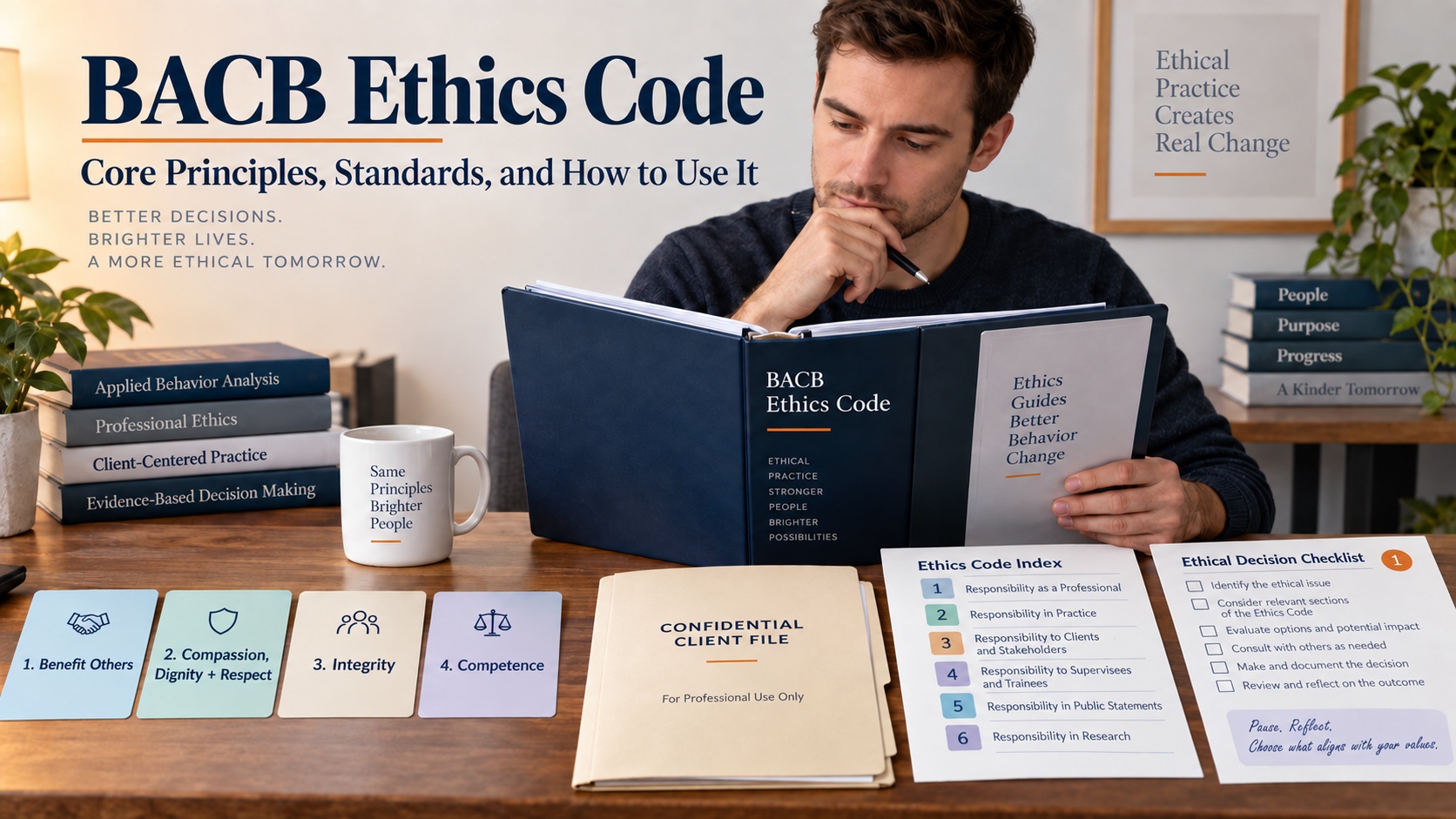
BACB Ethics Code: Core Principles, Standards, and How to Use It
The BACB Ethics Code is the professional standard that guides many activities of BCBA and BCaBA applicants and certificants. It helps behavior analysts think about client welfare, professional competence, confidentiality, supervision, public statements, research, and the responsibilities that come with a credential. It is not simply a list to memorize for an exam. In practice, the difficult part is often deciding which standards apply, what information is missing, who may be affected, and what action reduces risk.
The current BACB Ethics Codes page says the Ethics Code for Behavior Analysts replaced the 2014 Professional and Ethical Compliance Code and took effect January 1, 2022. This article maps the document in plain language, separates it from the RBT Ethics Code, and shows a careful way to study or respond to an ethics question. It is educational information, not legal advice, an individual ethics determination, or a substitute for the live BACB Code and enforcement procedures.
Table of Contents
Quick answer: what the BACB Ethics Code does
The Code gives behavior analysts a framework for:
- protecting clients, stakeholders, supervisees, trainees, and research participants;
- working honestly and within the boundaries of competence;
- using evidence, consent, data, and context rather than convenience alone;
- handling professional relationships, supervision, public statements, and digital content responsibly; and
- recognizing, documenting, consulting about, and addressing possible ethical concerns.
The Code is not exhaustive. A situation can still raise an ethical concern even when the exact behavior is not written as a one-line example. The Code directs readers to apply the wording and purpose of relevant standards, the core principles, applicable laws and licensure requirements, the client’s interests, and the context—including diversity and power differences.
Who the Code applies to
The current Code says it applies to people who hold BCBA or BCaBA certification and to people who have completed an application for either certification. The BACB uses “behavior analyst” as a shorthand for those people in the document. The BACB Ethics Codes page also identifies Authorized Continuing Education providers as subject to the Ethics Code for Behavior Analysts.
The scope is professional activity. That includes direct service delivery, consultation, supervision, training, management, editorial and peer-review work, research, and other work within the ABA profession. It also covers different delivery modes, such as written communication, phone, email, text messages, and video conferencing. The Code is not a general rule book for every personal action; its scope becomes relevant to personal behavior when the conduct clearly poses a potential risk to clients, stakeholders, supervisees, or trainees.
RBTs have a separate document: the RBT Ethics Code (2.0). An RBT applicant or certificant should use the RBT Code and related enforcement resources. The BCBA/BCaBA Code and RBT Code should not be blended into one undifferentiated checklist.
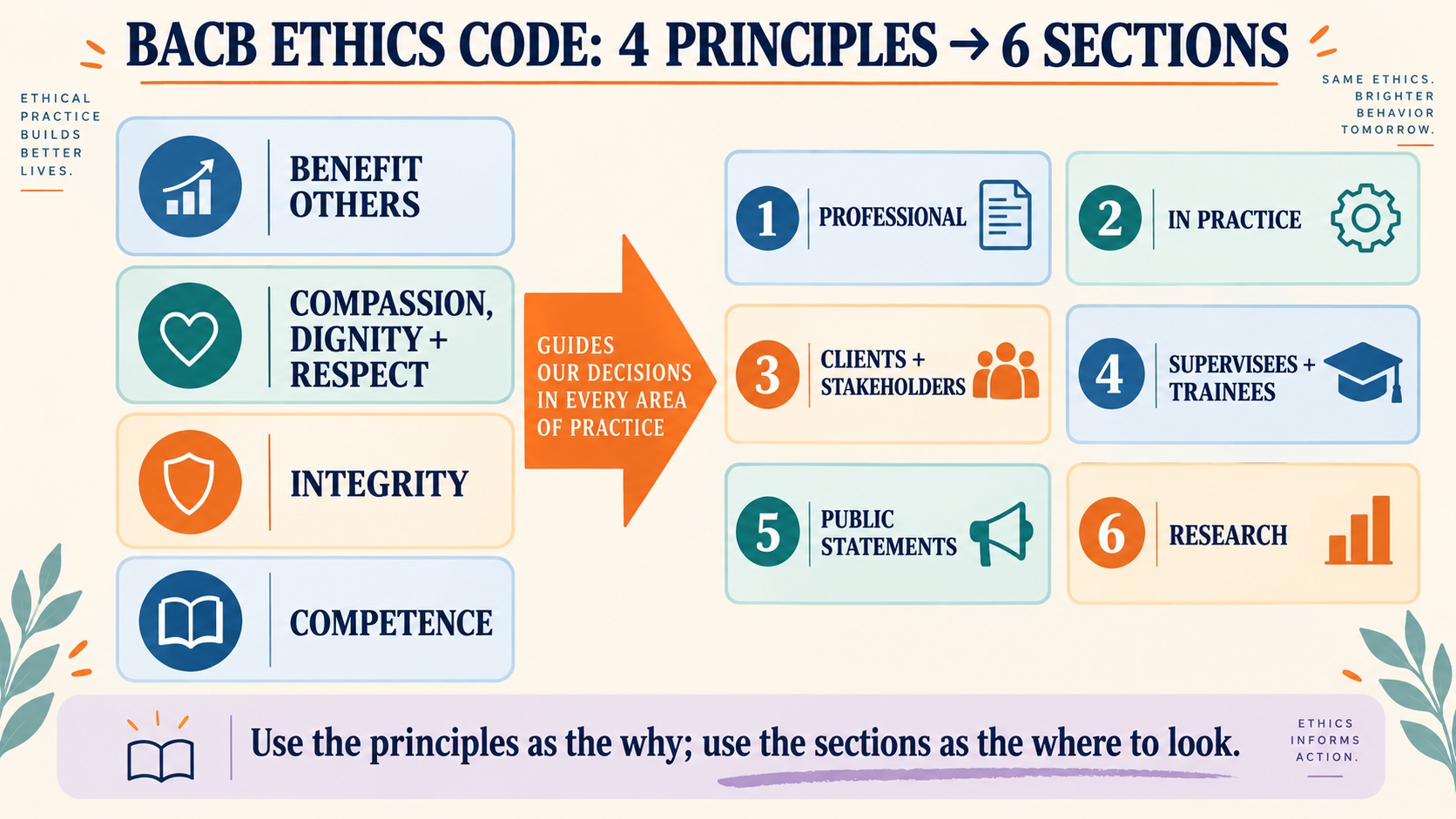
The four core principles
The Code says four foundational principles should guide how behavior analysts interpret and apply its standards. They are useful as a first-pass study map and as a reminder when a situation does not fit neatly into one numbered rule.
- Benefit others. Put client welfare and rights first, work to maximize benefit and minimize harm, consider short- and long-term effects, recognize conflicts of interest, and collaborate respectfully.
- Treat others with compassion, dignity, and respect. Respect privacy, confidentiality, self-determination, choice, diversity, and equitable participation. “Stakeholder involvement” is not a reason to erase the client’s voice.
- Behave with integrity. Be honest, trustworthy, accurate, accountable, and transparent about professional work. Correct errors instead of quietly allowing an inaccurate record or public statement to continue.
- Ensure your own competence. Stay within your scope, maintain current knowledge, evaluate the limits of your skills, pursue professional development, and keep increasing cultural responsiveness and technical competence.
These principles work together. For example, a clinician might be technically capable of delivering a procedure but still need to reconsider it because the plan creates unnecessary risk, does not reflect client preferences, or lacks informed consent. Conversely, good intentions do not excuse practicing outside competence or making a misleading public claim.
The six standards sections
The full Code contains many standards. A useful way to study it is to learn the job of each section before memorizing individual numbers:
- Section 1 — Responsibility as a Professional: role boundaries, competence, cultural responsiveness, discrimination, relationships, gifts, conflicts, self-reporting, and professional conduct.
- Section 2 — Responsibility in Practice: effective and timely services, confidentiality, documentation, billing, communication, consent, assessment, intervention, data, risk, and ongoing evaluation.
- Section 3 — Responsibility to Clients and Stakeholders: accepting clients, service agreements, financial arrangements, third-party contracts, collaboration, referrals, continuity, and appropriate transitions or discontinuation.
- Section 4 — Responsibility to Supervisees and Trainees: supervision requirements, competence, workload, documentation, training, feedback, delegation, diversity, continuity, and termination of supervision.
- Section 5 — Responsibility in Public Statements: truthful public communication, confidentiality, advertising, testimonials, intellectual property, websites, social media, and digital content.
- Section 6 — Responsibility in Research: legal and review requirements, consent, confidentiality, competence, conflicts, credit, plagiarism, data retention, accuracy, and use of research data.
This map is shorter than the Code. When a question involves a client record, Section 2 may be the starting point, but Section 3, Section 5, privacy law, organizational policy, and client context may also matter. Section numbers help you locate the document; they do not eliminate judgment.
How to use the Code in an ethics concern
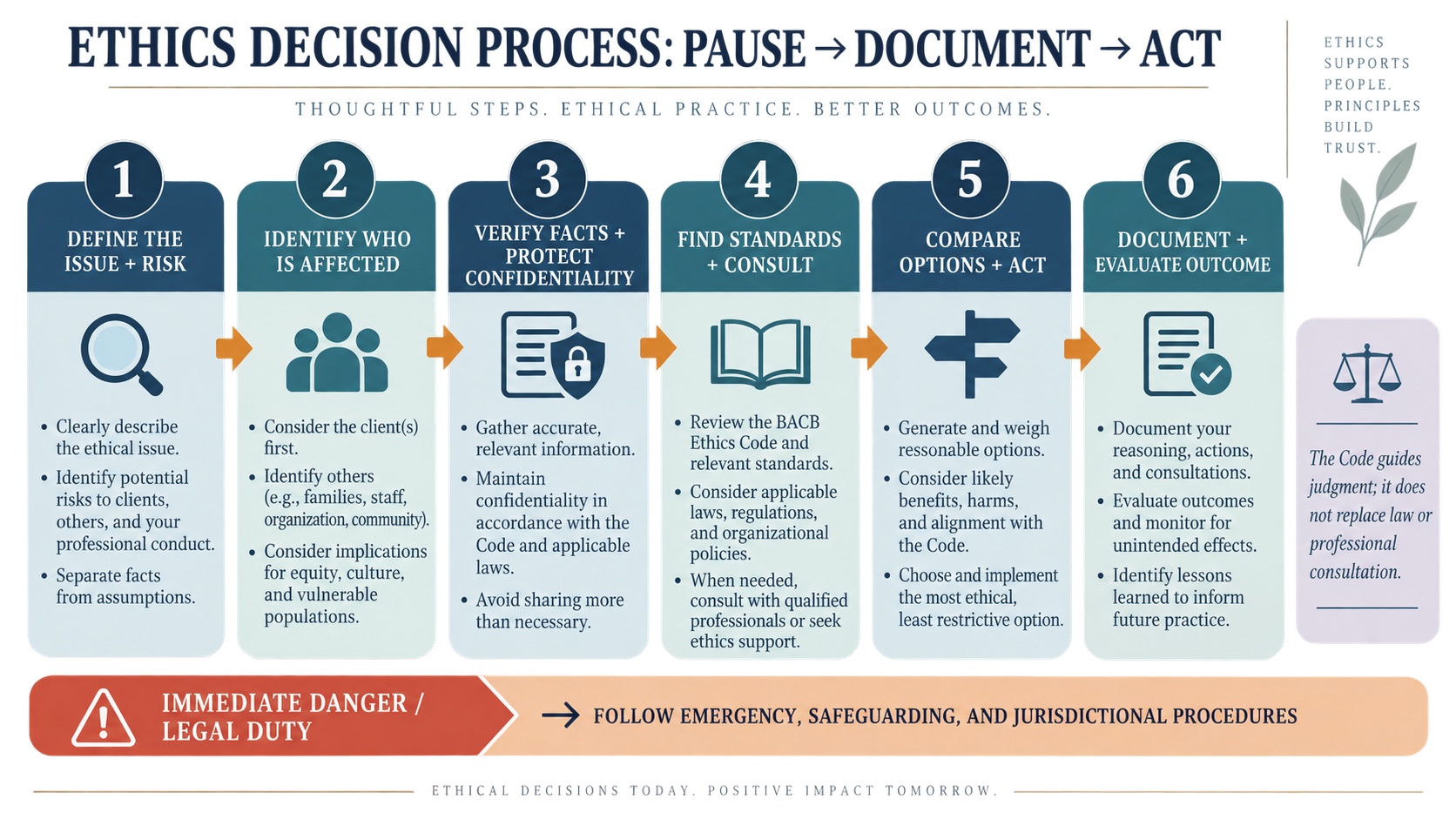
The Code describes a structured decision-making process. A practical version looks like this:
- Define the concern. State what happened, what decision is being requested, and what potential harm or risk is present.
- Identify the people affected. Include the client, stakeholders, supervisees, trainees, colleagues, organization, and anyone whose information or safety may be involved.
- Verify what you know. Separate direct observations and records from assumptions, rumors, or a single emotionally charged account.
- Protect information while documenting. Record dates, relevant communications, decisions, and outcomes without spreading unnecessary identifying details.
- Find the standards and principles. Read the exact current wording and consider the four principles, not just the first rule that seems similar.
- Consult appropriately. Use current research, a trusted qualified colleague, a supervisor, organizational resources, and the BACB procedures when appropriate.
- Develop and compare actions. Consider client preference, risk, restrictiveness, social validity, likely outcomes, legal duties, and whether the action can prevent recurrence.
- Act, document, and evaluate. Involve the relevant people, record the plan and due dates, take the selected action, and check whether it actually reduced the concern.
For example, suppose a team member asks you to send a client’s full treatment record through a personal messaging account. The ethical task is not simply “find the confidentiality rule.” You would identify who is requesting the information, verify the purpose and authorization, consider privacy and security, check organizational and legal requirements, choose a safer communication method, document the decision, and follow up. The example illustrates the process; it is not a universal answer for every record-sharing situation.
Peer-reviewed ethics literature similarly frames ethical decision making as more than rule recall. Evidence-based practice in ABA brings together the best available evidence, client values and context, and professional expertise. That does not replace the Code; it helps a behavior analyst make a better-supported, more client-centered decision within the Code.
Enforcement, reporting, and legal boundaries
The BACB’s Code-Enforcement Procedures explain how the Ethics Department processes a Notice of Alleged Violation and possible outcomes. The BACB Ethics Codes page states that failure to respond to a BACB notice or required action by the stated deadline can result in automatic suspension of certification, application eligibility, or another BACB status. Read the notice and current procedures, not a social-media summary.
The BACB is not a substitute for emergency services, a court, a state licensing board, or an attorney. If someone may face immediate danger, follow the applicable emergency and safeguarding procedures first. If the concern involves state licensure, mandatory reporting, employment law, privacy law, or another jurisdiction-specific issue, obtain advice from the appropriate authority. The BACB itself states that it cannot provide legal or ethics advice.
When reporting is being considered, protect confidentiality and use the BACB’s current reporting guidance. Do not publish identifying details or make a public accusation because a situation feels troubling. A careful record, consultation, and risk-based plan are safer starting points.
What the 2027 changes do—and do not—mean
The BACB’s recent-and-upcoming-changes page lists major BCBA and BCaBA eligibility and maintenance revisions effective January 1, 2027. Those changes include education, fieldwork, continuing education, and ongoing supervision requirements. They do not, by themselves, announce a new Ethics Code. The current Ethics Codes page and its revision history remain the source to check for Code updates.
This version-control habit matters for studying. A 2027 requirements article, a current Ethics Code PDF, an RBT code, and a state licensing rule may all be relevant to one situation, but they are not the same document. Record the title, effective date, and role covered by each source before applying it.
A study and practice checklist
- Save the current BACB Ethics Code and revision-history page.
- Write the four core principles in your own words.
- Build a six-section index and attach example topics to each section.
- Practice separating facts, assumptions, affected people, risk, and missing information.
- For each practice scenario, identify the relevant standard and at least one applicable law, policy, or supervision resource to verify.
- Write down what you would document, who you would consult, and how you would evaluate the outcome.
- Keep the BCBA/BCaBA Code separate from the RBT Ethics Code and from state licensure rules.
- Recheck the live BACB pages before using an older study note for a real decision.
For track-specific study, the BCBA learning path, BCaBA learning path, and free BCBA practice questions can provide review context. They are educational resources, not BACB-endorsed ethics interpretations.
BACB Ethics Code FAQ
What is the current BACB Ethics Code?
It is the Ethics Code for Behavior Analysts, which replaced the 2014 Professional and Ethical Compliance Code and took effect January 1, 2022 for BCBA and BCaBA applicants and certificants. Use the BACB Ethics Codes page for the current document and revision history.
What are the four core principles?
Benefit others; treat others with compassion, dignity, and respect; behave with integrity; and ensure your own competence.
Is the BACB Ethics Code the same as the RBT Ethics Code?
No. The BACB identifies the RBT Ethics Code (2.0) as a separate code for RBT applicants and certificants. Match the document to the role and credential involved.
Does the Code tell me exactly what to do in every situation?
No. The Code is not exhaustive. It provides principles, standards, and a decision-making framework that must be applied to the facts, risks, people, laws, and context of the situation.
Does the 2027 BACB update create a new Ethics Code?
Not based on the published requirements-change notices. The 2027 changes revise BCBA and BCaBA eligibility and maintenance requirements. Check the live Ethics Codes page and revision history for actual Code updates.