
Ethics Code in ABA: Current Scope, Principles, and Study Guide
When people search for the ethics code in ABA, they are often looking for a short list of rules to memorize. That is a useful starting point, but it misses how ethical practice works. The current BACB Ethics Code for Behavior Analysts provides standards and principles that must be interpreted in context, alongside applicable laws, regulations, licensure requirements, organization policies, and the facts of the situation.
The key study question is not only “Which rule applies?” It is also “Who is affected, what risks are present, what information is missing, and what action can be documented and evaluated?” This page is an educational map of the current Code. It is not legal advice, a formal ethics complaint decision, or a substitute for reading the current BACB source when a real concern arises.
Quick answer: the BACB Ethics Code for Behavior Analysts sets professional ethics standards for BCBA and BCaBA certificants and applicants under BACB jurisdiction. It covers professional conduct, practice, responsibility to clients and stakeholders, supervision, public statements, and research. The Code is designed to protect clients and stakeholders while supporting integrity, dignity, competence, and beneficial services.
Current scope and version boundary
The BACB’s current Ethics Codes page says that the Ethics Code for Behavior Analysts applies to BCBA and BCaBA certificants and applicants. It went into effect on January 1, 2022. The same page lists the RBT Ethics Code 2.0 as a separate code for RBT certificants and applicants. A study answer should therefore identify the role and the applicable code before discussing a standard.
The Code’s scope is broader than face-to-face treatment. It applies across professional activities such as direct service delivery, consultation, supervision, training, management, editorial and peer-review work, research, and communication through writing, email, phone, text, or video conferencing. The current PDF is marked Updated 08/2024, so an older study summary should not be treated as the final authority if wording or revisions matter.
This version boundary also matters for future-oriented questions. Do not invent a new edition or assume that a rumored change has taken effect. For current requirements, open the BACB’s official ethics page and the linked code, then check applicable local rules and organizational procedures.
Four core principles
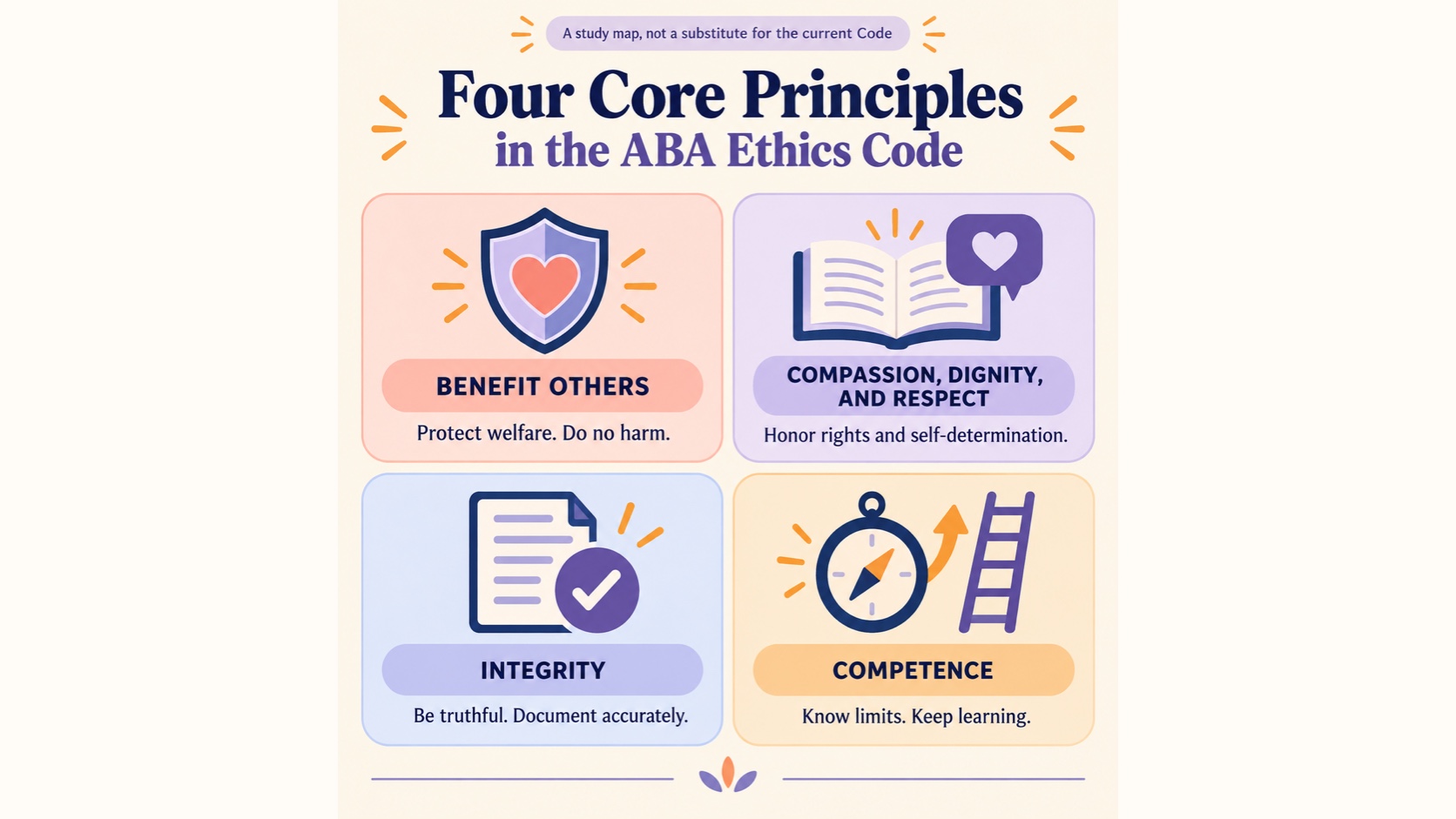
Benefit others. Behavior analysts work to maximize benefits and do no harm, while protecting client welfare and rights. In a study scenario, an intervention that is convenient for staff but creates avoidable risk for the client deserves closer examination.
Treat others with compassion, dignity, and respect. Ethical practice is not reduced to technical performance. Communication, privacy, assent when applicable, self-determination, and the person’s experience of the service all matter. Respect does not mean avoiding difficult information; it means communicating it in a way that recognizes the person’s rights and humanity.
Behave with integrity. Integrity includes truthful communication, accurate records, responsible public statements, and honest acknowledgment of limits. A professional should not present a study resource as an official BACB product, a practice result as a guarantee, or an uncertain interpretation as a verified fact.
Ensure one’s own competence. Competence is not a one-time credential. It includes working within defined roles, seeking training or consultation, recognizing personal limitations, and continuing to develop knowledge related to culturally responsive service and diverse groups.
How the Code is organized
The current Code organizes standards into six responsibility sections:
- Responsibility as a professional: truthful conduct, competence, conflicts, multiple relationships, and professional obligations.
- Responsibility in practice: effective services, confidentiality, consent, data, communication, and behavior-change decisions.
- Responsibility to clients and stakeholders: identifying stakeholders, prioritizing client welfare, and managing third-party relationships.
- Responsibility to supervisees and trainees: competent supervision, training, feedback, and evaluation.
- Responsibility in public statements: accurate advertising, privacy, testimonials, social media, and digital content.
- Responsibility in research: legal and institutional requirements, review, consent, confidentiality, competence, conflicts, credit, and data.
For an exam question, use the section as a navigation clue rather than as the whole answer. A confidentiality issue may involve practice documentation, public statements, research, and applicable privacy law depending on where the information is used.
An original ethics-study scenario
Imagine that a trainee is asked to post a short video from a service setting on a personal social-media account to promote a new program. The trainee believes the clip is harmless because no name appears. A careful analysis should not jump straight to “ethical violation” or “no problem.” It should identify the client and stakeholders, ask whether the video contains identifying or contextual information, check consent and organizational policy, consider how the clip could be copied or reused, and consult the applicable Code standards.
The next step is documentation. The professional should record the concern, the information reviewed, the people consulted, the decision, and any safeguards or follow-up. If the content is removed, the team may still need to evaluate whether it was copied, whether anyone was affected, and how the process can prevent a similar problem. The point of the exercise is to move from reaction to a reasoned, collaborative, and reviewable response.
Notice what the scenario does not do. It does not tell a student to investigate a real client, publish details, or make a legal determination. It demonstrates how the Code, privacy, consent, professional role, and digital context can intersect.
Recurring study themes
Confidentiality. Confidentiality extends beyond names. Records, data, live or recorded sessions, messages, images, and contextual details can identify or expose a client or stakeholder. The Code addresses protecting confidential information and limiting disclosure. Study the reason for the protection, not only the vocabulary.
Informed consent and assent. Consent involves explaining relevant information, including the purpose, procedures, expected time, risks, benefits, privacy limits, and opportunities to ask questions. The Code also addresses assent when applicable. Requirements can depend on the service, setting, law, organization, and research-review process, so a general article cannot replace the current source or qualified guidance.
Role and competence. A request from a supervisor, funder, family member, or employer does not automatically expand a professional’s competence or authority. Ask what role is defined, what training is available, who is responsible for the decision, and when consultation or referral is needed.
Cultural responsiveness and bias. Ethical decision making must consider language, culture, values, context, access, and personal bias. A technically familiar goal or communication method may not be socially meaningful or acceptable to the client and stakeholders. The question is not whether culture is an extra topic; it is how context changes interpretation, collaboration, and service quality.
Accurate public statements. Public-facing content must not misrepresent credentials, outcomes, evidence, or the nature of services. This matters for websites, social media, testimonials, course descriptions, and study resources. Clear boundaries protect readers and the profession.
A practical study checklist
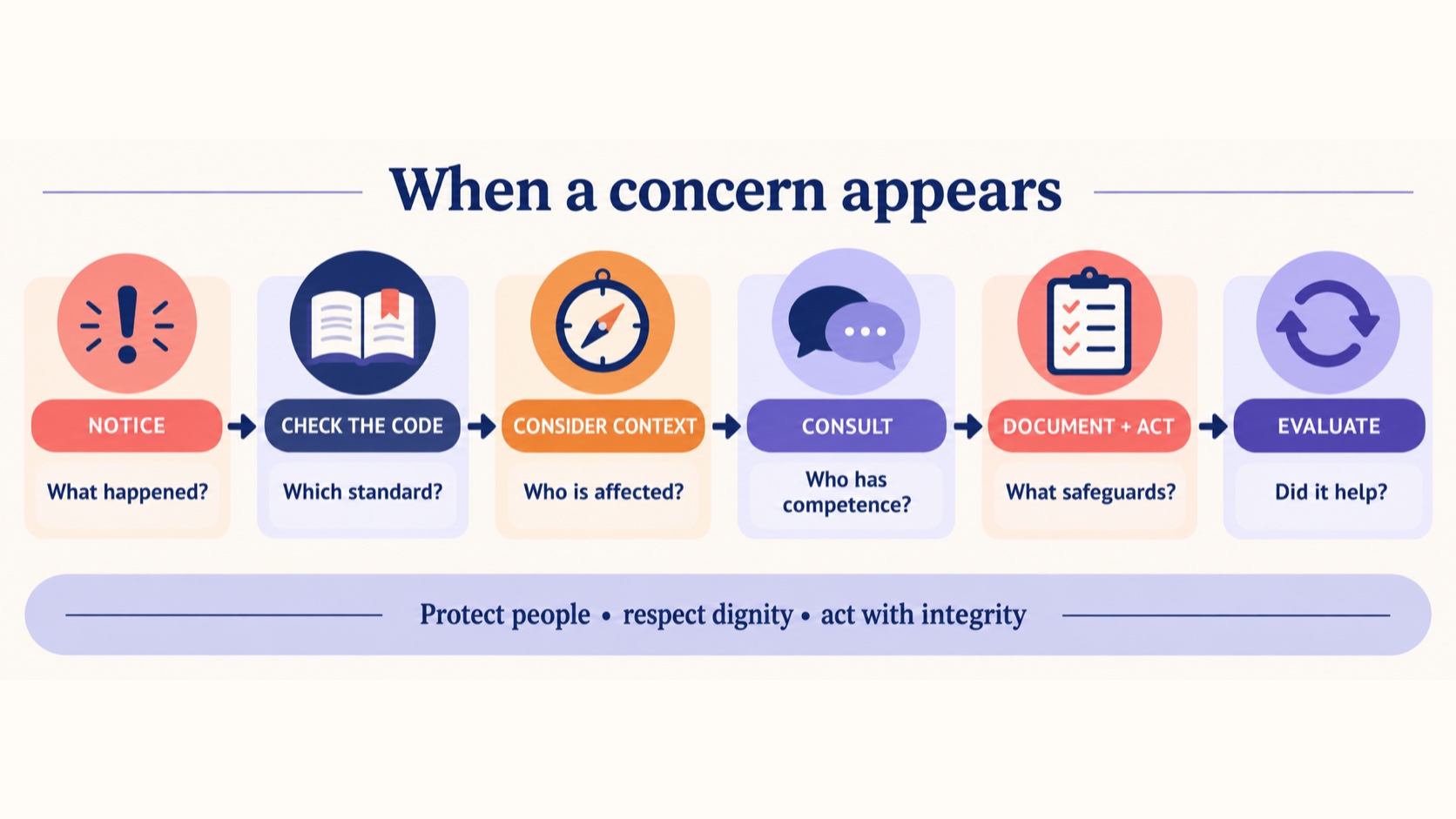
When reviewing a practice question, use six prompts:
- Who is the client, and who else is affected?
- What concrete behavior, communication, or decision is at issue?
- Which core principle and Code section are relevant?
- What law, regulation, policy, consent condition, or cultural variable may change the analysis?
- Who has the competence and responsibility to act, and what consultation is needed?
- What should be documented, and how will the outcome be evaluated?
Use the ABA Theory Blocks to organize ethics vocabulary, free ABA questions to practice scenario reasoning, and the ABA Definition Search when terms such as informed consent, confidentiality, assent, or multiple relationships need another pass. The ABA Study Online app can support flashcards and section practice, but official BACB sources remain the reference for current Code wording and certification-related decisions.
Common mistakes and FAQ
- Memorizing an old code: identify the applicable role and current official version.
- Reducing ethics to punishment: study client protection, dignity, prevention, consultation, and repair as well as enforcement.
- Ignoring context: the same action can raise different questions in service delivery, research, supervision, or public communication.
- Calling a legal conclusion an exam answer: describe the concern, source, consultation, and limits of the information.
What is the ABA Ethics Code?
The BACB Ethics Code for Behavior Analysts is the current ethics standard for BCBA and BCaBA certificants and applicants under BACB jurisdiction. It guides professional conduct and supports consumer protection.
What are the four core principles?
Benefit others; treat others with compassion, dignity, and respect; behave with integrity; and ensure one’s own competence.
Does this Code apply to RBTs?
The BACB lists a separate RBT Ethics Code 2.0. Do not answer a role-specific question by automatically applying the BCBA and BCaBA Code.
What should I do with a real ethical concern?
Review the current Code and applicable rules, protect immediate safety and confidentiality, consult qualified supervision or relevant authorities, document actions, and follow current BACB or organizational procedures. A study article cannot decide the matter for you.
Sources
- BACB Ethics Codes
- Ethics Code for Behavior Analysts, Updated 08/2024
- BACB BCBA Test Content Outline (6th ed.)
- Ethical Behavior Analysis: Evidence-Based Practice as a Framework for Ethical Decision Making
- Ignorance and Cultural Diversity: the Ethical Obligations of the Behavior Analyst
- Clinical Informed Consent and ABA