Ethics CEUs for BCBAs: What Counts and How to Verify a Course
When BCBAs search for ethics CEUs, they usually need two answers: how many ethics hours are required, and whether a specific event actually qualifies. The current BACB requirements reviewed for this page say that BCBA certificants need 32 CEUs in each two-year recertification cycle, including 4 Ethics CEUs. Supervisors also need the applicable supervision CEUs. The number is only the beginning; the event’s content, provider status, documentation, and cycle timing still matter.
Ethics continuing education is not simply any course that mentions the word “ethics.” Current BACB guidance describes content related to BACB ethics requirements and/or cultural or contextual responsiveness. It must connect to behavior-analytic practice or applied research and be linked directly to relevant literature or established practice. Use the live BACB source and your account’s current requirements before you register.
Table of Contents
How many ethics CEUs does a BCBA need?
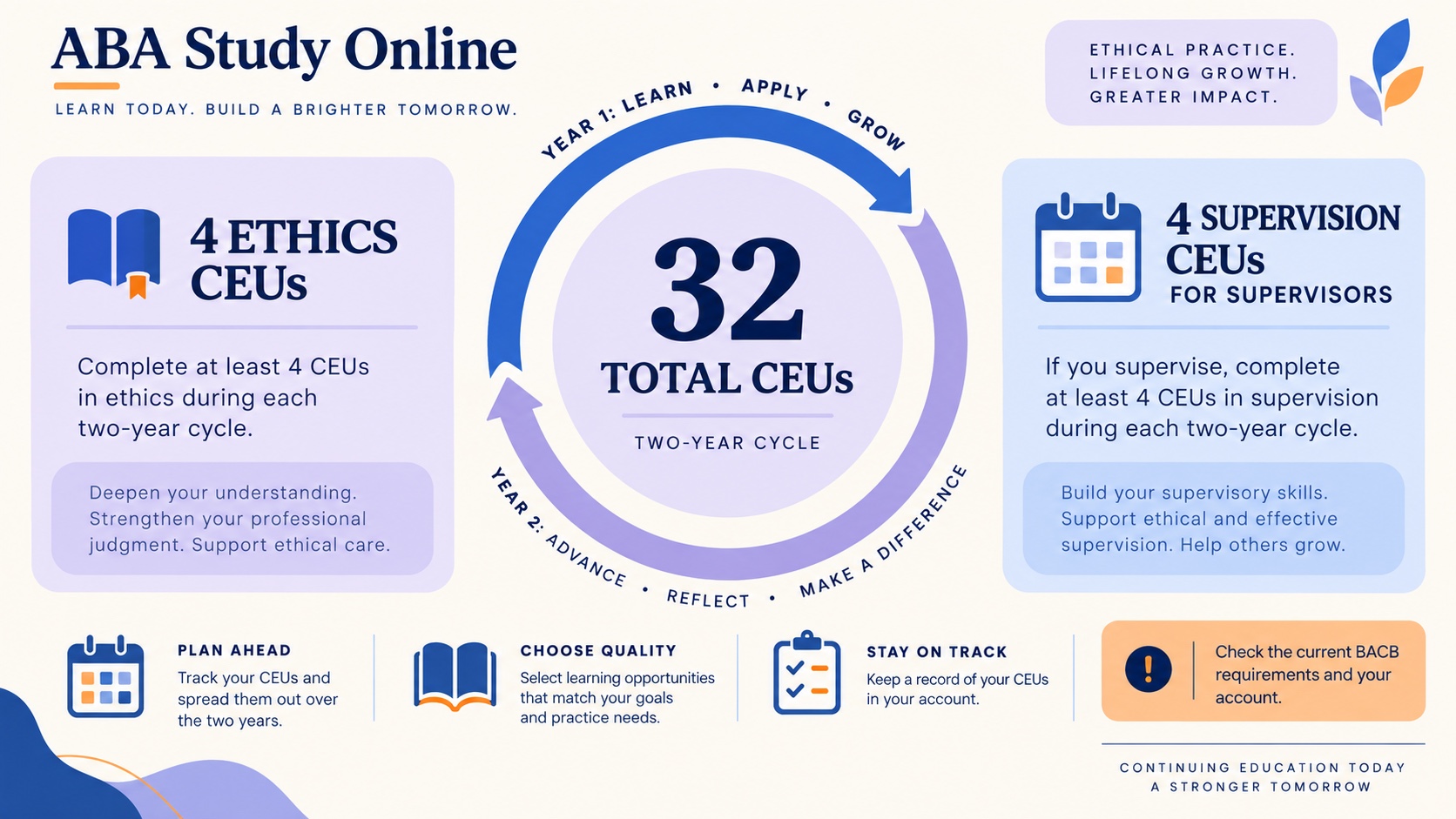
The current 2027 BCBA requirements page describes:
- 32 total CEUs within each two-year recertification cycle.
- 4 Ethics CEUs within that total.
- 4 Supervision CEUs for BCBAs who supervise, according to the applicable requirements.
These are maintenance requirements, not an invitation to wait until the final week of your cycle. Check your BACB account for the recertification date and category progress. A course certificate does not automatically correct a missing entry, an incorrect category, or a provider that was not authorized for the event.
Remember that CEU rules can be updated. A colleague’s previous cycle, a course page saved from an earlier year, or a general continuing-education article may not describe the requirements that apply to you. Use the live BACB handbook or requirements page, note the version you checked, and ask BACB or your provider for clarification when the category or timing is unclear.
What makes CE content ethics-focused?
Current BACB guidance says that most of an Ethics CE event should focus on ethics or cultural/contextual responsiveness. A general ABA lecture that spends five minutes reminding participants to follow the Ethics Code is not automatically an Ethics CE event. The ethics dimension should be substantive, connected to behavior-analytic practice or applied research, and grounded in relevant literature or established practice.
Before enrolling, ask whether the course addresses topics such as:
- ethical decision-making and responsibilities under the current Ethics Code;
- confidentiality, documentation, billing, supervision, or professional boundaries;
- cultural and contextual responsiveness in assessment, goal selection, communication, or intervention;
- assent, dignity, risk, stakeholder collaboration, or less-intrusive alternatives;
- the behavior-analytic literature and established practice that support the discussion.
A topic can be important and still not qualify as an Ethics CEU. “Professional development,” “clinical update,” and “ethics included” are marketing phrases, not the BACB definition. Read the event description and completion documentation before paying.
How to verify an ACE provider
The BACB’s Authorized Continuing Education program allows certificants to verify ACE Provider status through the registry. Search the provider or individual in the official registry, check that the authorization applies to the type of CE you intend to earn, and keep a record of what you verified. Do not rely on a logo, an old certificate template, or a provider’s statement that it is “BACB approved.”
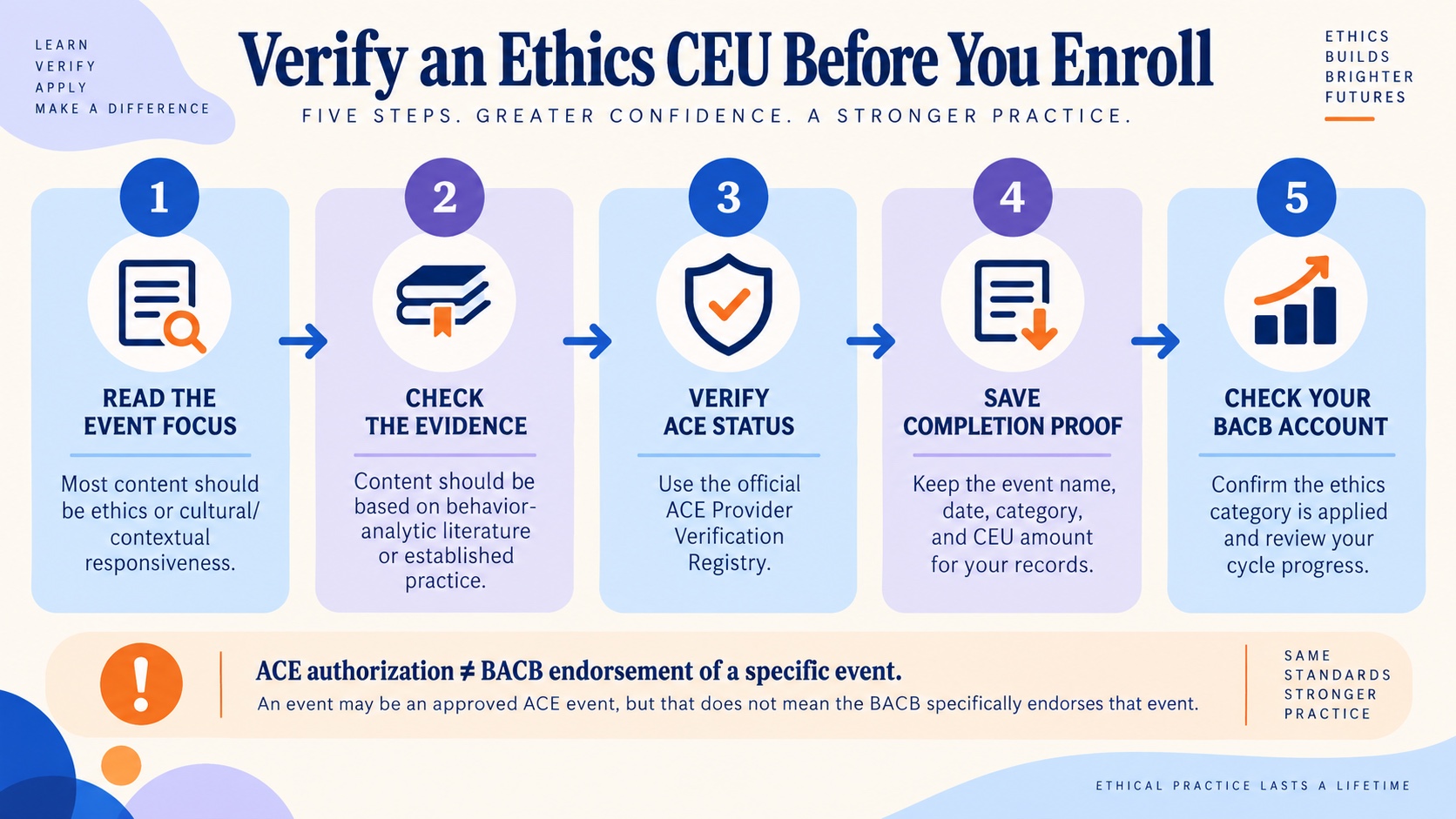
Verification has limits. The BACB registry can help confirm authorization, but the ACE Provider page also states that authorization does not imply BACB endorsement or approval of the content. You remain responsible for checking the event description, category, certificate, and account entry against the current requirements.
Read the event description for the level and audience, too. Some learning is aimed at parents, educators, or beginning staff and may not be designed as BCBA or BCaBA Learning CE. Other events are valuable professional conversations but do not provide a CEU category. The right question is not only “Is this helpful?” but also “What does the provider identify this event as, and can I verify that description against the current BACB framework?”
If you supervise others, make a separate note about supervision CEUs. Ethics and supervision are related, but one course should not be counted in both categories unless the current rules and event documentation expressly support that treatment. When a certificate is ambiguous, request clarification before entering the event into your account.
A course-quality checklist
- Audience: Is the event designed for BCBA or BCaBA learning CE, rather than RBT professional development or a general audience?
- Substance: Does most of the event address ethics or cultural/contextual responsiveness?
- Evidence: Does the description identify behavior-analytic literature or established practice?
- Provider: Can you verify current ACE authorization in the official registry?
- Documentation: Will you receive a clear completion record with the event name, date, category, and CEU amount?
- Fit: Does the event help your professional-development plan instead of merely filling a number?
Do not buy a course solely because its title contains “ethics.” If the description is vague, ask the provider for the learning objectives, category, literature basis, and completion-document details in writing.
Also consider the practical fit. A course that meets the category may still be a poor choice if it does not address the populations, settings, supervision responsibilities, or cultural questions that shape your work. Choose learning that strengthens judgment rather than treating the requirement as a checkbox.
How to protect your records
Save the event description as well as the completion certificate. Keep the provider name, registry check, event date, category, number of CEUs, and any account-entry confirmation. Store records securely and do not include confidential client information in your CE portfolio. If the event is later renamed or the provider’s website changes, your saved evidence helps you explain what you completed.
Also check your BACB account after the event. A provider may report attendance, but you should still review the category and total. If something is missing or incorrect, contact the provider through its documented support route and compare the issue with current BACB instructions.
Keep your records long enough to answer an audit or a future renewal question. Use consistent file names, such as the event date and provider name, and store a plain-language note about the learning objective. This is simple administrative work, but it makes it easier to distinguish a substantive ethics event from a general course when your cycle is busy.
A thoughtful record also helps you plan the next event. You can see which ethical questions you have already studied, which issues need deeper literature review, and which topics would benefit from discussion with a supervisor or colleague. That is the professional-development value behind the numbers.
It keeps the cycle connected to the work you actually do.
That connection is worth protecting when you choose continuing education.
Plan for quality, evidence, and accurate records.
That is safer than treating a certificate as proof by itself, without context, during recertification.
How to plan the recertification cycle
Start by writing down your recertification date, the current total CEU requirement, the Ethics category, the Supervision category if applicable, and the evidence you already have. Then schedule ethics learning across the cycle. A quarterly review can reveal a missing category while there is still time to choose a suitable event.
Use ethics learning as a practice conversation, not just a certificate hunt. After a course, record one decision rule, one question about your service setting, one cultural or contextual consideration, and one action to discuss in supervision or team consultation. That turns continuing education into a professional-development plan.
Continue your BCBA ethics review
ABA Study Online can help you review BCBA ethics concepts, terminology, and decision scenarios in a structured study rhythm. The ABA Study Online app is a review tool, not an ACE provider and not a claim that app activity earns CEUs. Before using any course for recertification, verify its provider status and category through the current BACB sources.
FAQ and official sources
How many ethics CEUs are required for BCBAs?
The current BCBA requirements reviewed here specify 4 Ethics CEUs within 32 CEUs per two-year recertification cycle. Check your current BACB account and handbook for the rules that apply to your cycle.
Does any course that mentions ethics count?
No. The event must meet the current Ethics CE definition and the provider/event documentation requirements.
Does ACE authorization mean BACB endorses the course?
No. Verify provider status, but read the BACB disclaimer: authorization does not imply endorsement or approval of a specific CEU event or content.