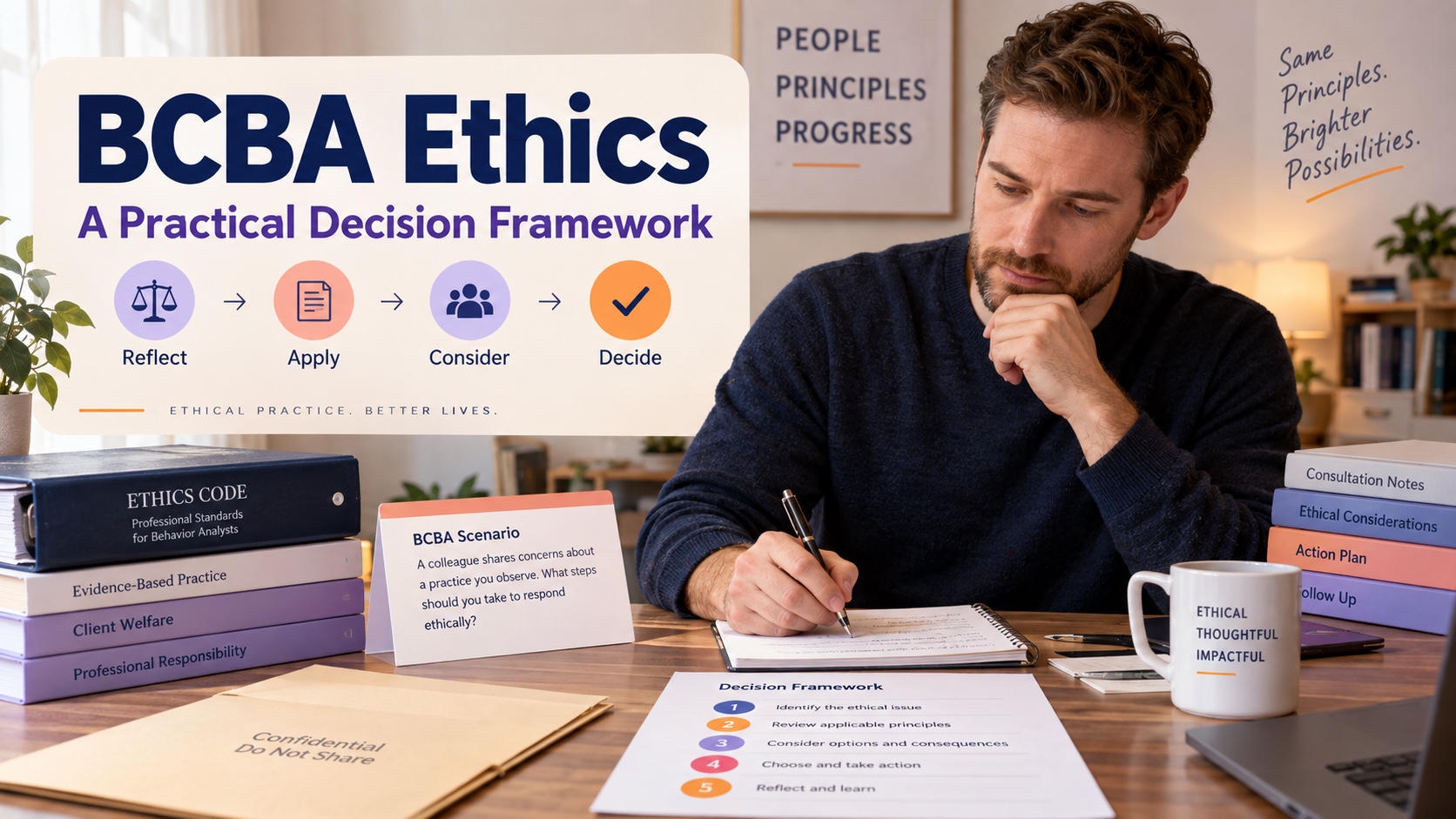
BCBA Ethics: A Practical Decision Framework
When people search for ethics BCBA, they may be looking for the current Ethics Code, the ethics portion of the BCBA exam, or help choosing the next step in a professional scenario. Those are connected questions, but they are not identical. The Ethics Code for Behavior Analysts applies to BCBA and BCaBA certificants and applicants, while the BCBA Test Content Outline identifies the exam tasks that require ethical and professional reasoning.
A useful way to study is to learn the current source, understand the core principles, and then practice a repeatable decision process. This article focuses on that bridge. It does not replace the BACB Ethics Code, a BCBA Handbook, applicable law or licensure rules, or advice from a qualified supervisor or attorney.
Table of Contents
Short answer: what BCBA ethics study should accomplish
BCBA ethics study should help you do more than name a standard. You should be able to identify who may be affected, describe the potential risk, separate verified facts from assumptions, locate the relevant Code principle or standard, consult appropriate resources, choose a response that protects client interests, document the steps, and evaluate what happened next.
That is why an ethics scenario can feel harder than a definition question. Several answers may sound polite or reasonable, but the best answer usually attends to safety, client welfare, confidentiality, scope of competence, applicable law, and the responsibilities of the people involved. Start with the facts and the risk before jumping to the most familiar ethical phrase.
What the Ethics Code covers
The current Ethics Code for Behavior Analysts went into effect January 1, 2022. It applies to people who hold BCBA or BCaBA certification and people who have completed an application for those certifications. The Code covers professional activities across direct service, consultation, supervision, training, management, public statements, research, and other behavior-analytic work. It applies across delivery modes, including writing, email, phone, and video conferencing.
The Code is organized into six areas of responsibility:
- Responsibility as a Professional
- Responsibility in Practice
- Responsibility to Clients and Stakeholders
- Responsibility to Supervisees and Trainees
- Responsibility in Public Statements
- Responsibility in Research
These headings are a map, not a substitute for reading the wording and context of the actual standard. The BACB explains that the standards are not exhaustive and should be applied functionally and contextually. A situation can also involve state licensure, funding rules, workplace policies, mandatory-reporting requirements, or other laws. Ethical exam reasoning should therefore identify the relevant professional issue without pretending that one short answer resolves every jurisdictional question.
The four core principles
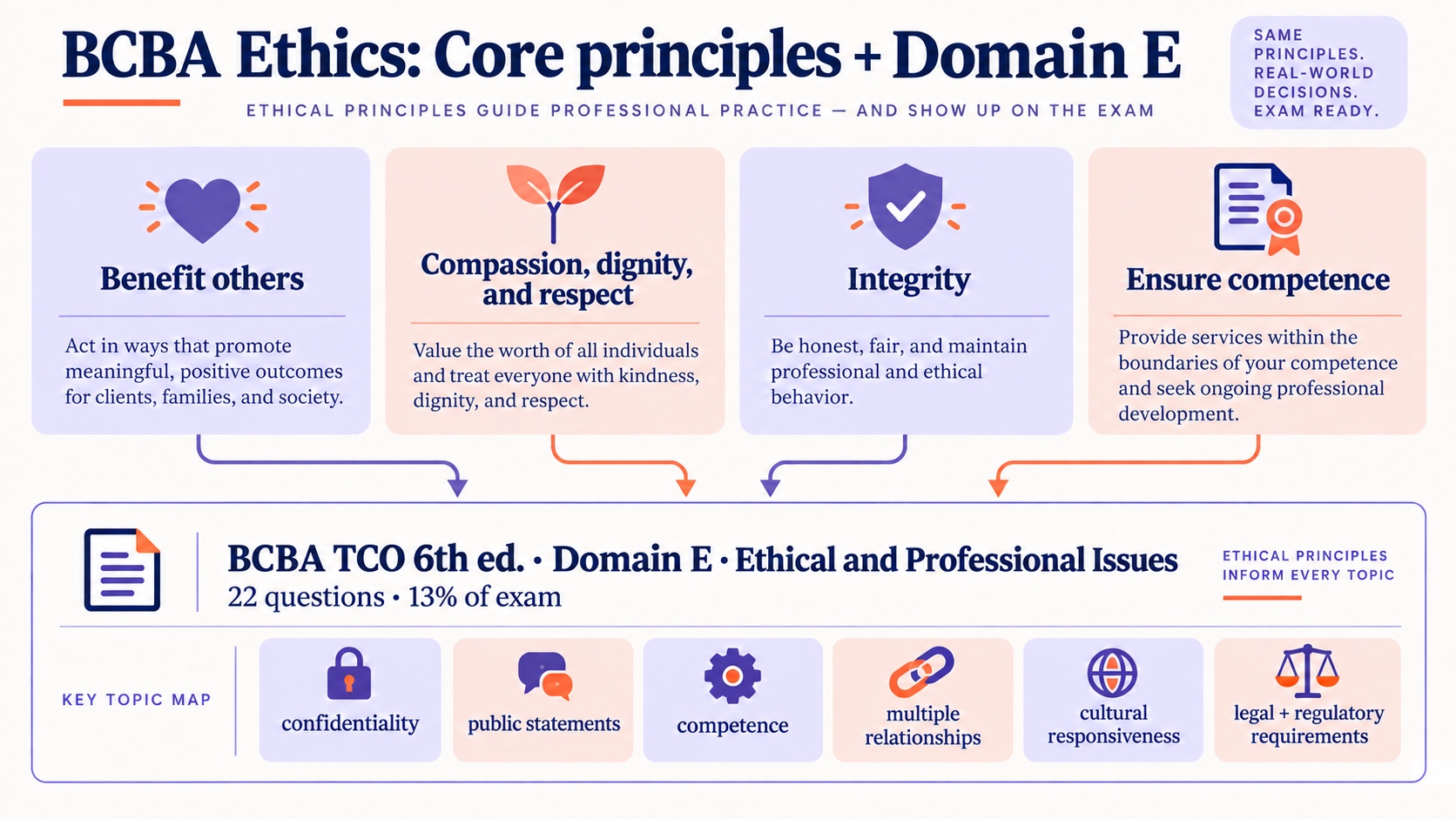
The Code gives four foundational principles that help behavior analysts interpret standards:
- Benefit others: protect client welfare and rights, consider short- and long-term effects, and address conflicts that could create harm.
- Treat others with compassion, dignity, and respect: respect privacy, self-determination, informed choice, and equitable treatment.
- Behave with integrity: be truthful, follow through, correct errors, and avoid misrepresenting yourself, your work, or someone else’s work.
- Ensure your own competence: remain within your scope, keep current with best practices, seek professional development, and recognize the boundaries of your knowledge.
Use the principles as an initial filter. If an answer hides relevant information, ignores client risk, exceeds competence, or treats a stakeholder’s convenience as more important than client welfare, it deserves careful scrutiny even before you match it to a numbered standard.
How ethics appears in BCBA Domain E
The BCBA TCO 6th edition calls Domain E “Ethical and Professional Issues.” It contains 22 questions, or 13% of the exam. That percentage is a blueprint description, not a promise that every candidate will see the same question order or wording. The TCO’s tasks include:
- applying the core principles and identifying risks from unethical behavior;
- developing competence through professional development and consultation;
- protecting, using, collecting, and disclosing confidential information;
- making accurate public statements about credentials, services, and outcomes;
- recognizing when services or supervision should be discontinued and planning a transition;
- identifying and mitigating multiple-relationship risks;
- building professional relationships through listening, feedback, collaboration, cultural humility, and inclusive practice; and
- applying relevant legal, regulatory, licensure, funding, and certification requirements.
Notice the verbs: identify, apply, develop, maintain, comply, and recognize. A good study session should therefore alternate between learning the concept and applying it to a short scenario. Ask not only “Which standard is this?” but also “What risk is present, what evidence is missing, and what action would reduce the risk?”
A structured framework for ethics scenarios
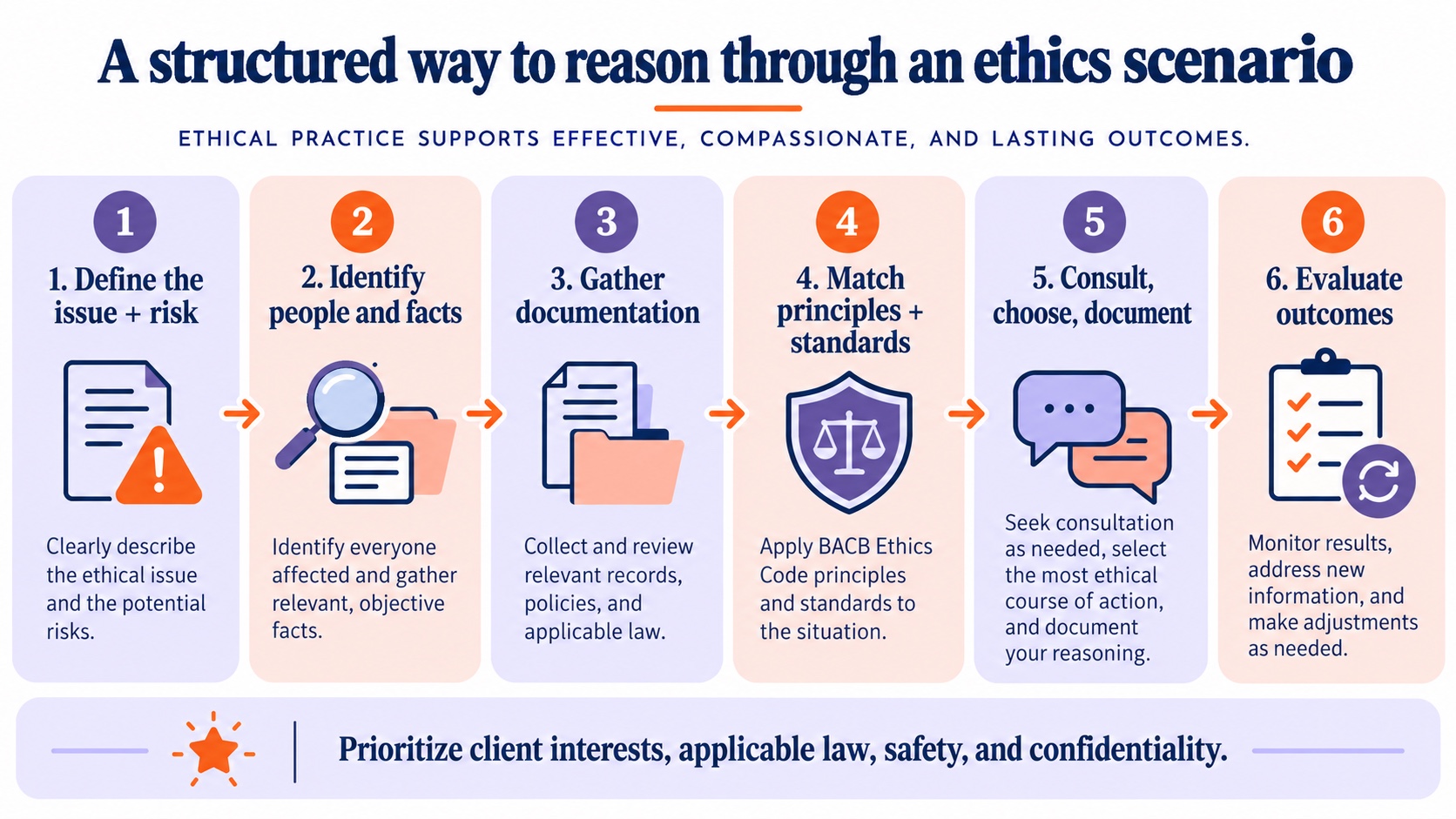
The Ethics Code includes a structured decision-making process. You can turn it into a study routine with six practical passes:
- Define the issue and risk. State what happened without exaggeration. Identify possible harm to the client, stakeholder, supervisee, trainee, public, or profession.
- Identify people and facts. List who is affected and separate direct observations from second-hand reports, opinions, and missing information.
- Gather documentation. Review relevant records, policies, consent information, data, communications, and applicable law. Protect confidentiality while doing so.
- Match principles and standards. Connect the facts to the Code’s principles and the specific professional, practice, client, supervision, public-statement, or research issue.
- Consult, choose, and document. Use research, trusted colleagues, supervisors, legal or regulatory resources, and the appropriate reporting channel. Select an action that protects client interests and document dates, people, decisions, and next steps.
- Evaluate outcomes. Check whether the action reduced risk and addressed the concern. Respond to new information and adjust the plan when needed.
This sequence does not mean you must delay urgent protection while collecting paperwork. The Code recognizes that serious concerns or immediate risks may need to be reported to the relevant authority first. In a study scenario, prioritize immediate safety and applicable law, then identify the documentation and consultation steps that follow.
A bounded practice example
Imagine a generic scenario in which a stakeholder asks a BCBA to add a service that the BCBA has not been trained to deliver, while the request could change the client’s current plan. A weak response would immediately agree because the stakeholder is paying, or immediately refuse without checking the facts. A stronger reasoning path would first describe the requested change and possible risks, identify the client and affected stakeholders, review the existing plan and relevant consent or funding information, and consider whether the request is within the BCBA’s competence.
The BCBA would then consult an appropriate supervisor, colleague, organization resource, licensing or regulatory source, or legal professional as needed. The next action might involve explaining the limits of competence, recommending additional training or consultation, referring to another professional, or revising the service plan through the proper process. The BCBA would document the decision and later evaluate whether the client’s interests and safety were protected. The point of the example is the reasoning sequence, not a personalized answer to a real case.
Common BCBA ethics mistakes
- Choosing an answer because it sounds kind without checking client risk, law, or competence.
- Quoting a familiar standard while ignoring the facts that make the scenario different.
- Treating a workplace policy as if it automatically overrides the Ethics Code or applicable law.
- Sharing identifiable client information while asking for public advice or consultation.
- Assuming the absence of an exact sentence in the Code means the behavior is automatically ethical.
- Acting on a rumor without confirming the concern or documenting the source.
- Forgetting cultural humility, client preference, power differences, or stakeholder context.
- Failing to evaluate whether the chosen response actually reduced harm.
For exam practice, write one sentence for the risk, one sentence for the missing fact, one sentence for the relevant principle, and one sentence for the next safe action. This keeps you from drifting into a long moral explanation that never answers what the BCBA should do next.
BCBA ethics FAQ
What ethics code applies to a BCBA?
The BACB Ethics Code for Behavior Analysts applies to BCBA and BCaBA certificants and applicants under BACB jurisdiction. Check the BACB Ethics Codes page for the current version and revision history.
How much of the BCBA exam is ethics?
The BCBA TCO 6th edition lists Domain E, Ethical and Professional Issues, as 22 questions or 13% of the exam. The outline is a content blueprint, not a guarantee of question wording or order.
What are the four core principles?
They are benefit others; treat others with compassion, dignity, and respect; behave with integrity; and ensure your own competence.
Is the Ethics Code legal advice?
No. The Code is a professional ethics standard. State law, licensure rules, funding requirements, and other regulations may also apply, and the BACB does not provide legal or ethics advice for an individual situation.
Should I memorize every ethics standard?
Know the Code’s structure and key standards, but also practice applying them to context. Strong BCBA ethics reasoning requires identifying risk, verifying facts, protecting confidentiality, consulting, documenting, and evaluating outcomes.
For study practice, the BCBA learning path can organize ethics alongside measurement, assessment, intervention, and supervision. The BCBA practice questions can help you rehearse the “best next step” reasoning pattern without treating a practice explanation as official legal advice.