
Empiricism Definition in ABA: What It Means
If you are studying ABA concepts, the word empiricism can sound more abstract than it really is. In plain language, it means building and checking knowledge from experience and evidence that can be observed, described, and evaluated. In behavior analysis, that commitment helps a team move from “I think this worked” to a more careful question: What changed, how was it measured, and what does the evidence actually support?
Empiricism is one of the philosophical assumptions that supports behavior analysis. It is not a promise that every observation is perfect, and it is not a synonym for “doing an experiment.” It is an evidence-oriented way of thinking that keeps explanations connected to observable events while leaving room for better measurement, new observations, and revised conclusions.
Quick answer: what is empiricism in ABA?
Empiricism in ABA is the philosophical assumption that knowledge about behavior should be grounded in observable experience, objective description, and measurement that can be inspected and evaluated. For a learner or practitioner, this means conclusions about behavior should not rest only on confidence, tradition, intuition, or a compelling story.
The current BCBA Test Content Outline places empiricism among the philosophical assumptions underlying behavior analysis. For an exam question, the safest core idea is “knowledge is based on observation and experience.” Then add the ABA boundary: the observation should be defined and measured clearly enough that another person can understand what was counted or recorded.
Empiricism does not mean that a learner’s preferences, family report, cultural context, or private experiences are irrelevant. Those sources can help identify meaningful questions and guide respectful planning. The point is to match the claim to the evidence. If a team is making a claim about a measurable change in behavior, it needs evidence about that behavior rather than only a general impression.
What empiricism means in practice
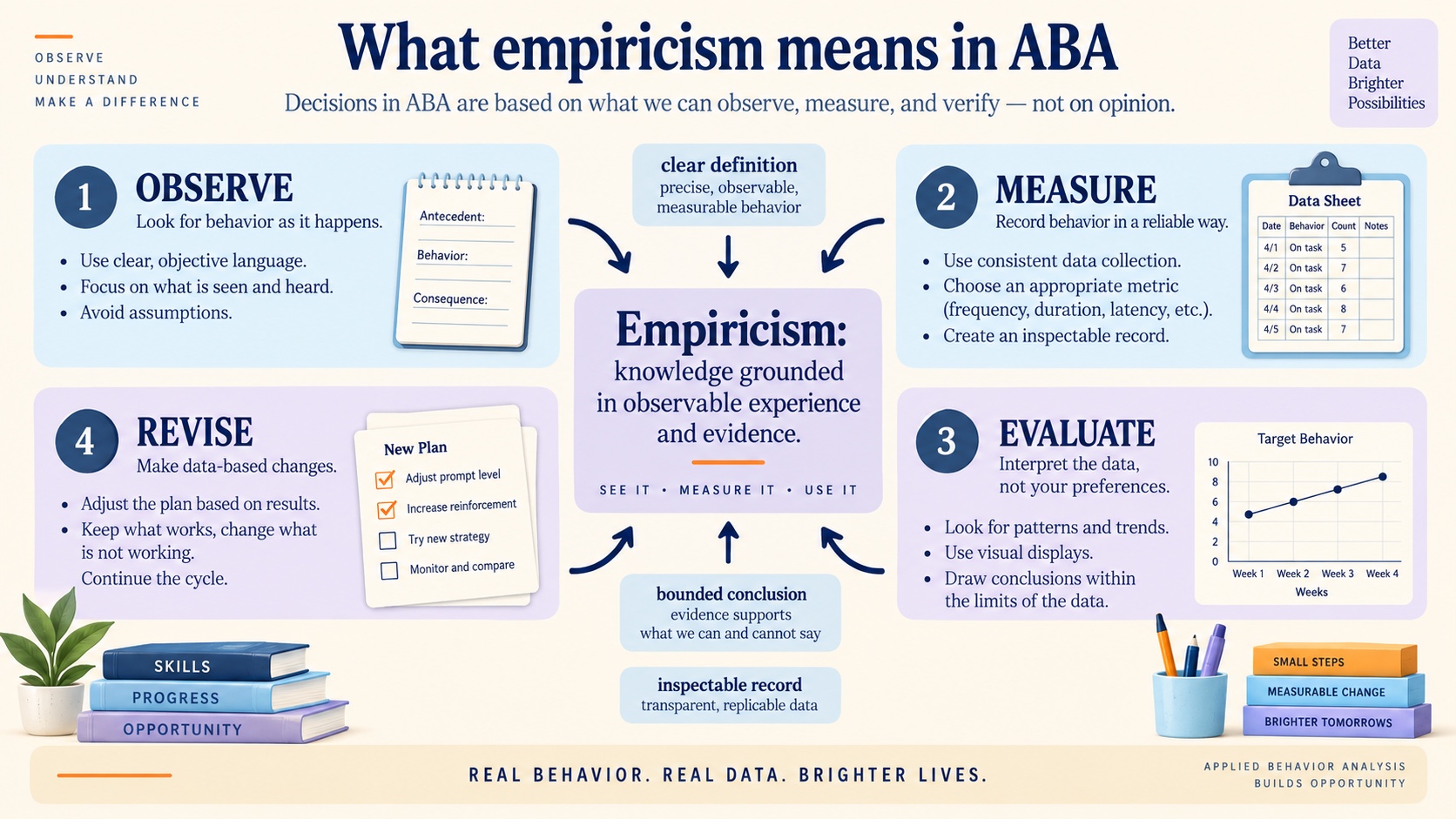
Empirical thinking usually begins with a question about an event that can be described. “Why is the learner unmotivated?” is broad and may include several assumptions. “How often does the learner begin the assigned task within 10 seconds of the instruction?” points toward an observable response and a possible measurement rule.
The question then needs a practical definition. What counts as beginning? Does the opportunity start when the instruction is delivered or when the materials are placed in front of the learner? Does the observer score the first movement toward the task, the first completed step, or something else? These details matter because a number is only useful when the team knows what the number represents.
Measurement should also fit the behavior dimension. A count may be appropriate for discrete responses. Duration may be better when the issue is how long a behavior continues. Latency can describe the time between an instruction and a response. Percentage can summarize correct responses across opportunities. An empirical approach does not require one universal measurement system; it requires a defensible connection between the question, the behavior, and the measure.
Finally, the record should be open to review. A graph, observation form, or session note can help others inspect the conditions and pattern. The team should be able to discuss whether the definition was clear, whether data were collected consistently, whether the opportunities were comparable, and whether the intervention was implemented as planned.
This is why empiricism is broader than simply “collecting data.” A worksheet can contain numbers and still fail to answer the question if the target is vague, the measure is mismatched, or the conditions are hidden. Empirical reasoning includes careful observation, measurement choices, transparent description, and a willingness to check the conclusion.
A simple ABA example
Imagine a fictional student who sometimes leaves an independent-work area before finishing a task. On Monday, a teacher adds a visual cue showing the work sequence and the upcoming break. The student stays in the area and completes more work than usual. A staff member says, “The visual cue fixed the problem.”
The improvement is worth noticing, but one successful morning is not enough to support that broad conclusion. An empiricism-guided follow-up would define the target response, record the number of opportunities, and note what happened under the relevant conditions. Was the task shorter? Was the preferred break available? Was the cue used consistently? Did another adult provide more prompts? Were the same scoring rules used across days?
After repeated observations, the team might see a more stable pattern, a mixed pattern, or no meaningful change. Each result provides information. A stable change may support continuing the support while monitoring. A mixed pattern may suggest that the cue helps only with certain tasks or needs to be combined with another arrangement. No clear change may prompt a review of the target definition, measurement system, or intervention fit.
The empirical claim should stay bounded. “Task starts were more frequent on days when the cue was used under these conditions” is a description of evidence. “The cue caused the improvement” is a stronger causal claim and requires an appropriate design and analysis. Empiricism encourages the first statement when that is all the evidence can support.
Empiricism versus related terms
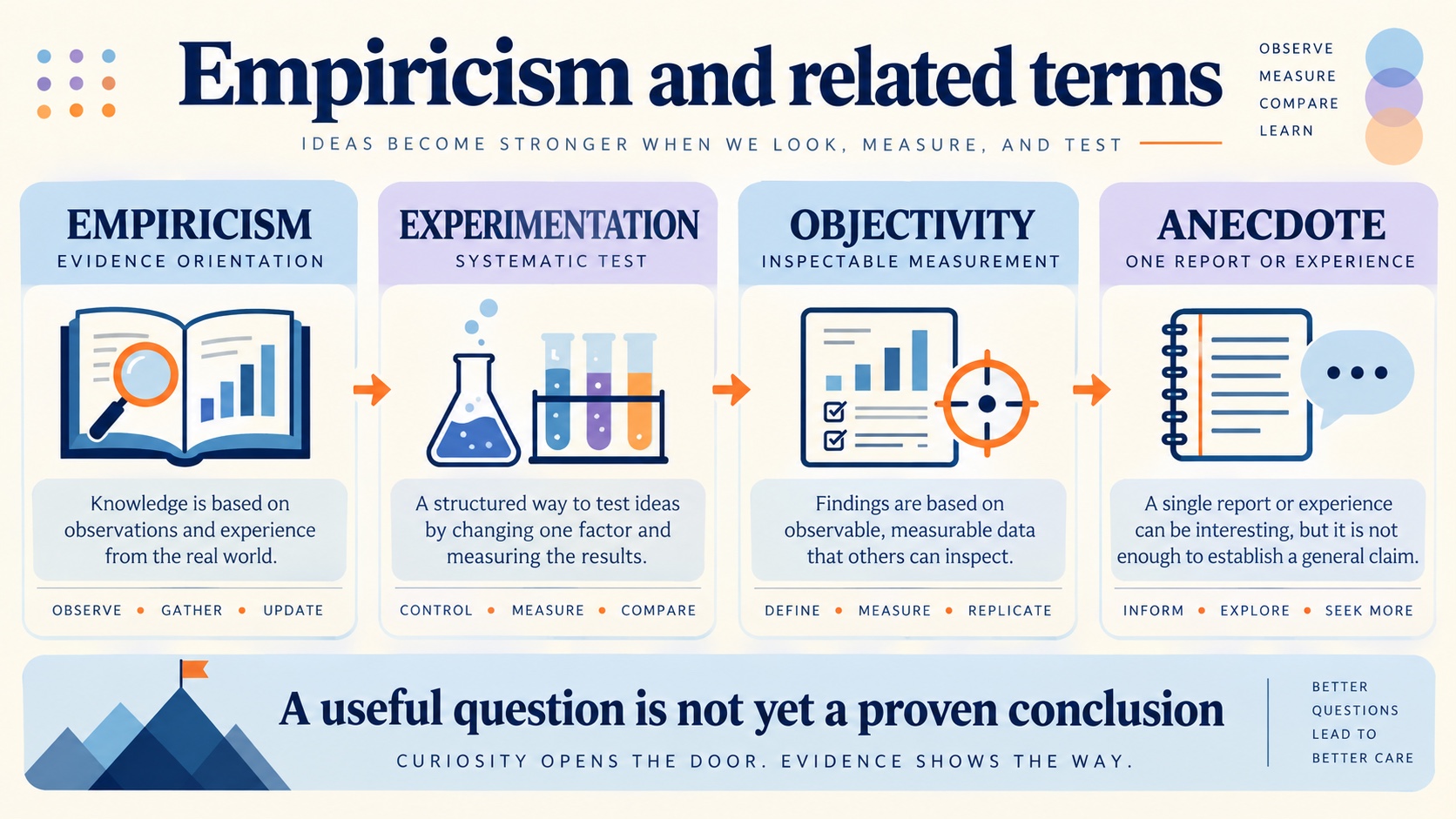
Empiricism versus experimentation: Empiricism is an orientation toward grounding knowledge in observable evidence. Experimentation is a method for testing relations by arranging conditions systematically. An experiment can generate empirical evidence, but a person can also use empirical observation without conducting a formal experiment. Do not treat the two terms as interchangeable.
Empiricism versus objectivity: Objectivity concerns describing and measuring events in a way that reduces dependence on one person’s private impression. Empiricism depends on evidence that can be examined, so objective definitions and reliable measurement support empirical reasoning. Objectivity is not the same as pretending that context, values, or human judgment disappear.
Empiricism versus anecdote: An anecdote is a report about an individual event or experience. It may help a team identify a concern or generate a hypothesis. It is weaker as the sole support for a general conclusion when it is selective, unstructured, difficult to verify, or not tied to a defined measure. “It happened once” can start a question; it does not automatically settle the question.
Empiricism versus intuition: Intuition may direct attention to a useful possibility. A practitioner might sense that a task is too difficult or that a cue is helping. Empirical reasoning asks the practitioner to translate that impression into an observable question and gather evidence before treating it as a dependable explanation.
Empiricism versus personal preference: A family or learner’s preference is important when deciding what is acceptable, meaningful, and feasible. Preference and empirical evidence answer different questions. Preference can guide goals and choices; measurement can help evaluate what occurred under the selected conditions.
Common mistakes and an exam checklist
- “Any number is empirical.” A number still needs a clear definition, a suitable measurement dimension, and interpretable conditions.
- “One observation proves the intervention worked.” One observation can be informative without establishing a broad or causal conclusion.
- “Empiricism means only laboratory experiments.” Empirical evidence can come from careful observation and measurement as well as experimental evaluation.
- “Anecdotes are worthless.” They can communicate lived experience or generate a question; they should not automatically be treated as sufficient evidence for a general claim.
- “Data speak for themselves.” Data still require definitions, context, quality checks, and a cautious interpretation.
- “Evidence replaces the learner’s voice.” Ethical and socially meaningful decision-making keeps communication, dignity, context, and stakeholder priorities in view.
For an exam scenario, use this short checklist:
- What observable event or behavior is the question about?
- How is the target defined, and what measurement is being used?
- Could another observer understand the scoring rule?
- Are the observation conditions and implementation details clear?
- Does the evidence describe a pattern, support a prediction, or justify a causal claim?
- What additional observation would make the conclusion stronger?
That reasoning captures the heart of empiricism: start with an observable question, make the evidence inspectable, and keep the conclusion no larger than the data allow. For more ABA foundations, visit ABA Theory Blocks, review free ABA questions, or search a related term in the ABA Definition Search. These are natural study links, not a sales claim or a guarantee of exam performance.
FAQ and sources
What is the simplest empiricism definition in ABA? It is the idea that knowledge about behavior should be based on observable experience and evidence that can be measured and evaluated.
Is empiricism the same as direct observation? No. Direct observation is one way to gather evidence. Empiricism is the broader philosophical assumption that knowledge claims should be grounded in evidence that can be inspected.
Does empiricism prove that a treatment caused change? Not by itself. Empirical observation supports evidence-based reasoning, while causal conclusions depend on the design, control, analysis, and replication appropriate to the question.
Can a caregiver report be empirical? A caregiver report can provide meaningful information and may be structured or paired with direct measurement. The label depends on how the evidence is collected and used, not simply on who reported it.