
Empiricism in ABA: Definition, Examples, and Data-Based Decisions
In ABA, empiricism is more than “using data.” It is a philosophical commitment to grounding knowledge claims in experience, objective observation, and measurement that can be examined. When a team says that an intervention helped, empiricism asks what was observed, how it was measured, under which conditions, and what evidence supports the conclusion.
This matters because everyday experience is useful but imperfect. A memorable session, a confident opinion, or a single improvement may help a team decide what question to ask next. It does not automatically answer the question. Empiricism gives learners a disciplined way to move from impression to evidence without pretending that every data point is complete or bias-free.
Quick answer: what is empiricism in ABA?
Empiricism in ABA is the assumption that knowledge about behavior should be built and checked through objective observation, measurement, and evidence rather than opinion, hunches, or unsupported explanations. In the current BCBA Test Content Outline, empiricism is listed among the philosophical assumptions underlying behavior analysis.
Empiricism does not mean that a practitioner must ignore context, history, culture, private events, or the learner’s experience. It means that conclusions about behavior and intervention effects should be stated at the level the available evidence can support. A strong answer often sounds modest: “Across these conditions, the measured response increased,” not “We now know the one true reason.”
The empiricism decision loop
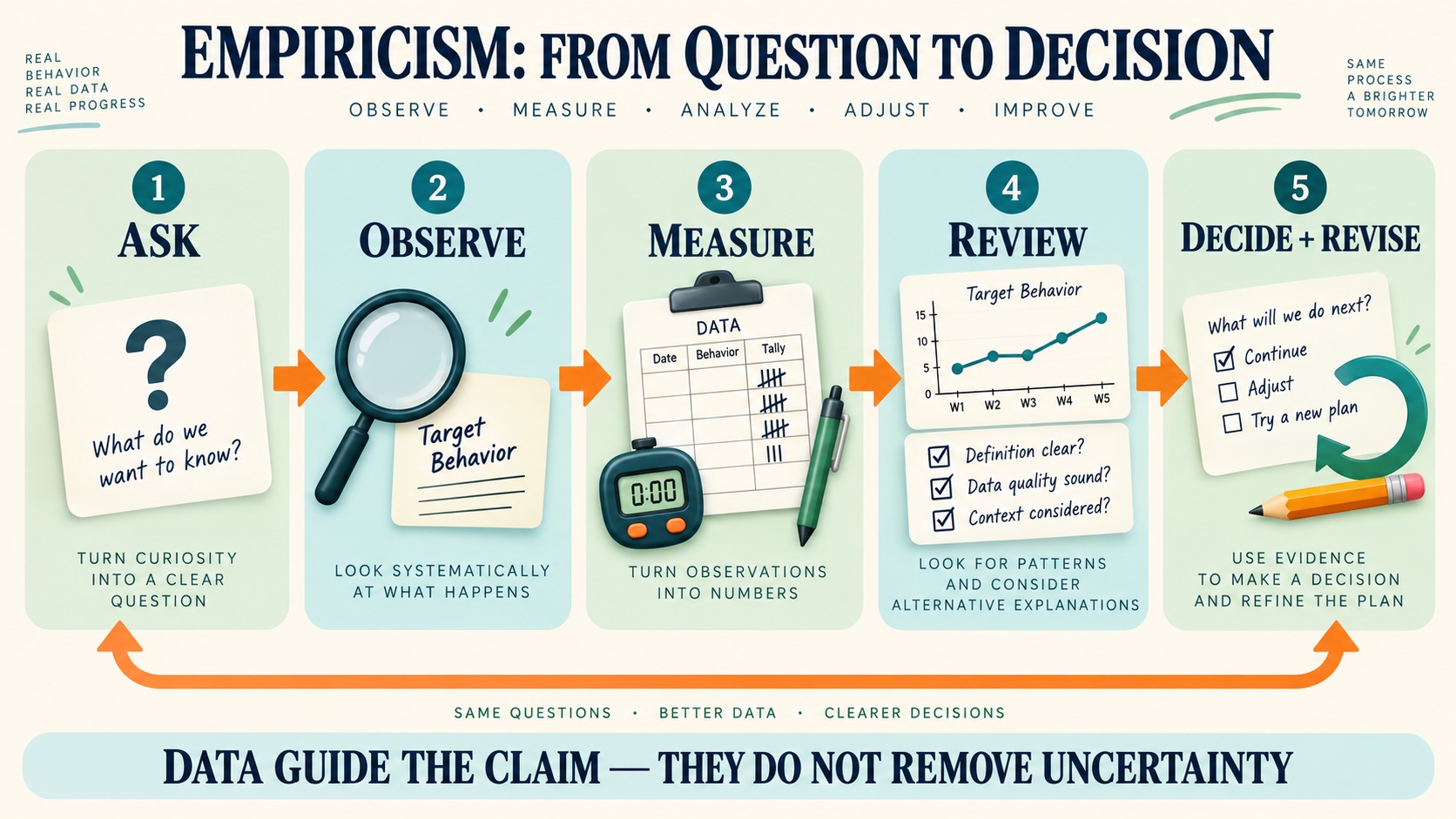
- Ask an observable question. Replace “Is the learner more motivated?” with “How many independent task starts occur within 10 seconds of the instruction?”
- Define what will be observed. State the target response, the opportunity, the setting, and the scoring rule. A clear definition lets another observer understand what counts.
- Select a fitting measurement system. Frequency, rate, duration, latency, percentage, interval recording, or a product measure may fit different behavior dimensions. The method should match the question and the practical conditions.
- Collect data under stated conditions. Record enough opportunities to see a pattern and note relevant changes in materials, people, schedule, or implementation.
- Check data quality. Ask whether the measurement was reliable, whether the procedure was implemented as written, and whether the observations represent the behavior of interest.
- Make a bounded decision. Continue, modify, or further assess based on the pattern. State what the data show and what they do not show.
- Repeat and revise. Empirical knowledge remains open to better measurement, new observations, replication, and a changed conclusion.
Observation, measurement, and evidence quality
Observation is the starting point, not the finish line. Two people can watch the same routine and remember different details. A measurement system makes the target and scoring rule more explicit, but it can still be poorly matched to the behavior or applied inconsistently.
For example, if the question concerns how long a learner stays engaged, a simple count of “good moments” may not capture duration. If the question concerns how quickly a learner begins a task, latency may be more informative than total completed work. Empiricism therefore includes measurement selection, not just the presence of a worksheet or graph.
Evidence quality also depends on context. A behavior may change when the task is shorter, a preferred material is available, a new staff member is present, or the schedule is different. Those changes do not automatically invalidate the data, but they should be described. If several variables change at once, the team should be cautious about attributing the outcome to one element.
Graphs help communicate level, trend, variability, and changes across time. They do not magically remove measurement error or prove a functional relation. Review the definition, observation conditions, data display, procedural integrity, and decision rule together.
Empiricism also helps separate three different statements. “The response occurred more often after the schedule was introduced” is a description of a measured pattern. “The response is likely to continue under these conditions” is a prediction based on that pattern. “The schedule caused the change” is a stronger claim that may require an appropriate experimental design and replication. All three statements can be useful, but they do not require the same evidence.
This distinction is central to careful ABA reasoning and protects learners from decisions built on overconfident stories.
An original ABA example
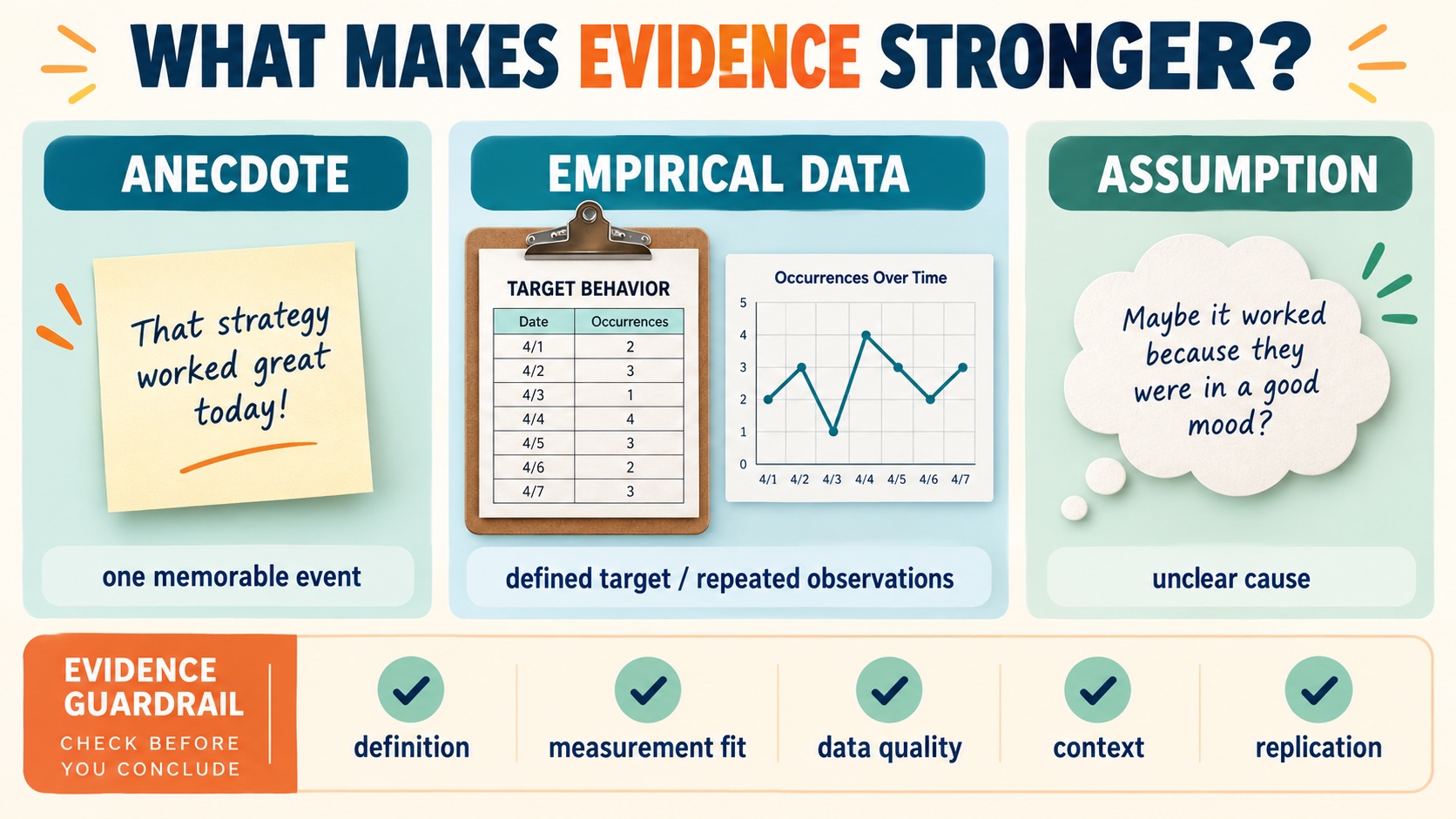
Imagine a fictional student who often leaves independent work. A teacher introduces a visual schedule. After one successful morning, someone says, “The schedule worked.” That statement may be an encouraging observation, but it is not yet a complete empirical conclusion.
An empiricism-guided plan would define the target, such as leaving the work area before the programmed break, and record opportunities, task starts, completed steps, and relevant context across several days. The team would note whether the visual schedule was available, whether the work changed, whether breaks were delivered consistently, and whether the observer used the same scoring rule. If the response improves when the schedule is present and the implementation is consistent, the data may support continuing the plan. If the pattern is mixed, the decision should remain open and the team should identify the next question.
The point is not to make the classroom feel like a laboratory or to reduce the learner to a number. The point is to avoid claiming more than the observation supports. Clear data can make it easier to notice whether a support is useful, whether it works only under certain conditions, and whether the learner experiences a meaningful improvement.
Empiricism versus anecdote and intuition
An anecdote is a report about an individual event or experience. It can be valuable for generating a question, identifying a concern, or learning what matters to a family or learner. It becomes weaker as a basis for a broad claim when it is unstructured, selective, difficult to verify, or detached from a defined measure.
Intuition can also guide attention. A practitioner may notice that a task seems too difficult or that a new cue appears helpful. Empiricism does not require pretending that this first impression never happened. It asks the practitioner to translate the impression into an observable question and collect evidence before treating it as a reliable conclusion.
“I saw it” is not the same as “it was measured well.” A single observer may miss responses, a definition may be ambiguous, a graph may hide changes in opportunity, or the procedure may not have been implemented as planned. Good science includes skepticism about one’s own data and willingness to improve the measurement system.
Common mistakes and study checklist
- Calling an opinion empirical: describe the observation and measurement that support the statement.
- Assuming any number is good data: check the definition, dimension, opportunity, observer, and consistency.
- Overclaiming from one session: use repeated observation and the planned decision rule.
- Ignoring implementation: distinguish a weak intervention from a procedure that was not delivered as planned.
- Confusing a pattern with causation: a descriptive change may suggest a question without proving a functional relation.
- Using data to override the learner: keep social significance, context, communication, and dignity in the decision.
Ask these six questions in an exam scenario:
- What observable behavior or event is being studied?
- How is it defined and measured?
- Are the observation conditions clear and representative?
- Is the measurement system reliable and suitable for the behavior dimension?
- What does the data pattern support, and what remains uncertain?
- What next observation or decision would make the conclusion stronger?
For another pass through ABA foundations, use the ABA Theory Blocks, practice evidence distinctions with free ABA questions, or search related terms in the ABA Definition Search. The ABA Study Online app can support flashcards and section practice. Real-world data collection and intervention decisions should follow the role, setting, and supervision requirements that apply.
FAQ and sources
What is empiricism in simple terms? It is using observable experience and measurement to build and check knowledge claims, instead of treating opinions or hunches as evidence.
What is an ABA example of empiricism? Defining a target response, recording it consistently across opportunities, reviewing the pattern, and using that evidence to decide whether to continue or adjust a support.
Is empiricism the same as direct observation? Direct observation is one important way to gather evidence. Empiricism is the broader assumption that knowledge claims should be grounded in observable, measurable evidence that can be evaluated.
Does empiricism guarantee an unbiased conclusion? No. It encourages objective definitions, reliable measurement, transparent conditions, repeated review, and willingness to revise conclusions when the evidence changes.