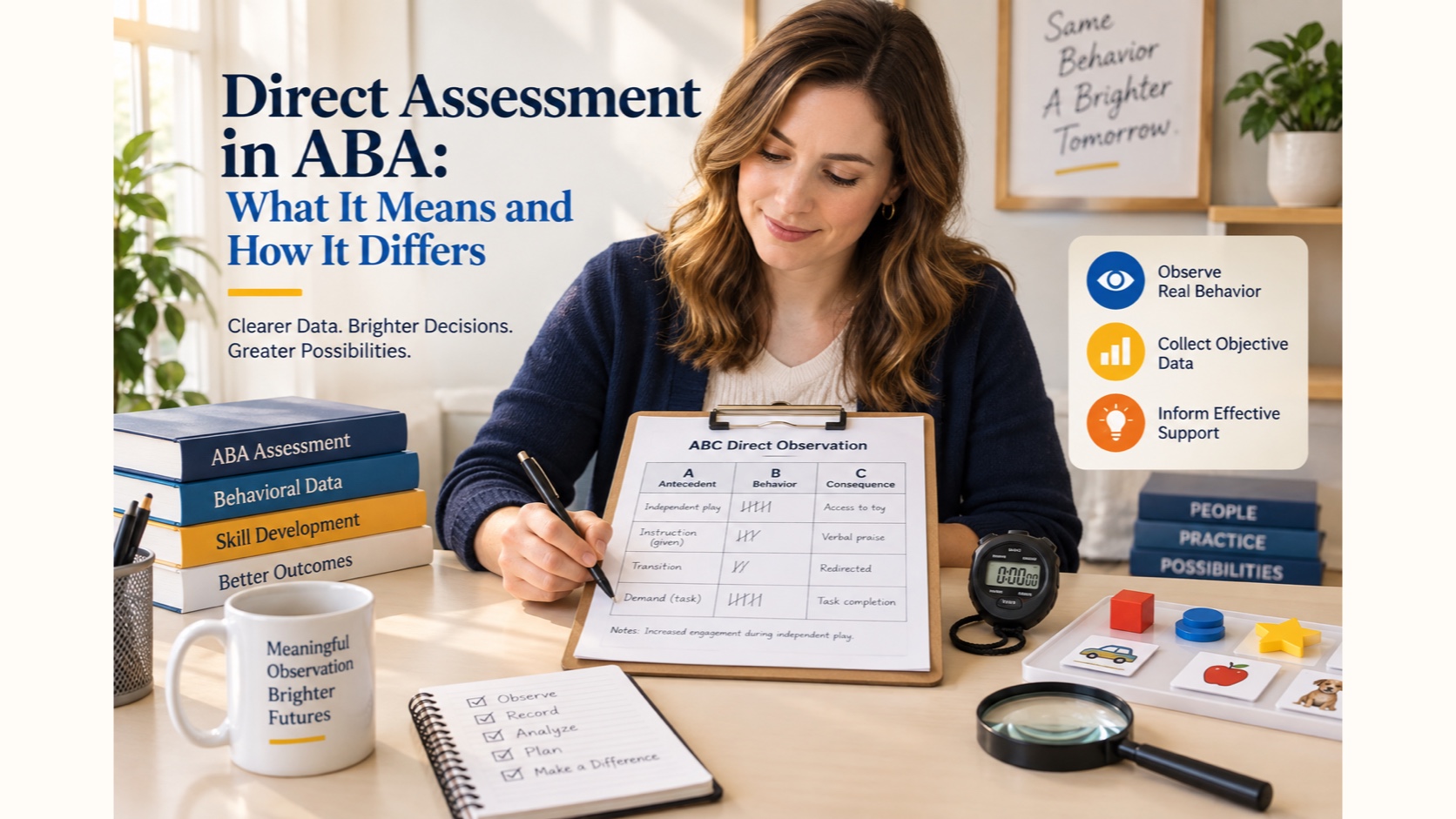
Direct Assessment in ABA: What It Means and How It Differs
Direct assessment in ABA means collecting information by observing or measuring behavior itself, or by presenting a stimulus and observing the person’s response to it. The phrase sounds simple, but it can point to more than one assessment context. A direct observation of a target behavior and a direct preference assessment both use contact with observable responding, yet they answer different questions.
The study boundary is just as important as the definition. Direct assessment is not the same as asking a caregiver what usually happens, measuring only the lasting product of a response, or arranging an experimental functional analysis. The safest way to study the term is to ask: where did the evidence come from, what exactly was measured, and what conclusion can that evidence support?
Quick answer: direct assessment uses direct contact with observable behavior or responding. An observer might record what a learner does during a naturally occurring routine, or a practitioner might present several stimuli and record approach, selection, or engagement during a preference assessment. Direct evidence can be more specific than a report, but it is only as useful as the definition, observation plan, measurement system, and interpretation attached to it.
Where the term appears in ABA study
The current BCBA Test Content Outline places “distinguish among direct, indirect, and product measures of behavior” in the Measurement, Data Display, and Interpretation domain. The same outline separately lists preference assessments, descriptive assessments, and functional analyses in the Behavior Assessment domain. That organization is a useful exam clue: measurement source and assessment method are related, but they are not interchangeable labels.
For example, a learner may be asked to identify whether a frequency count is direct or whether a completed worksheet is a product measure. In another question, the learner may need to recognize that a caregiver interview is indirect while a choice assessment involves direct observation of approach or engagement. Read the stem for the evidence source before choosing an answer.
Direct, indirect, and product measures
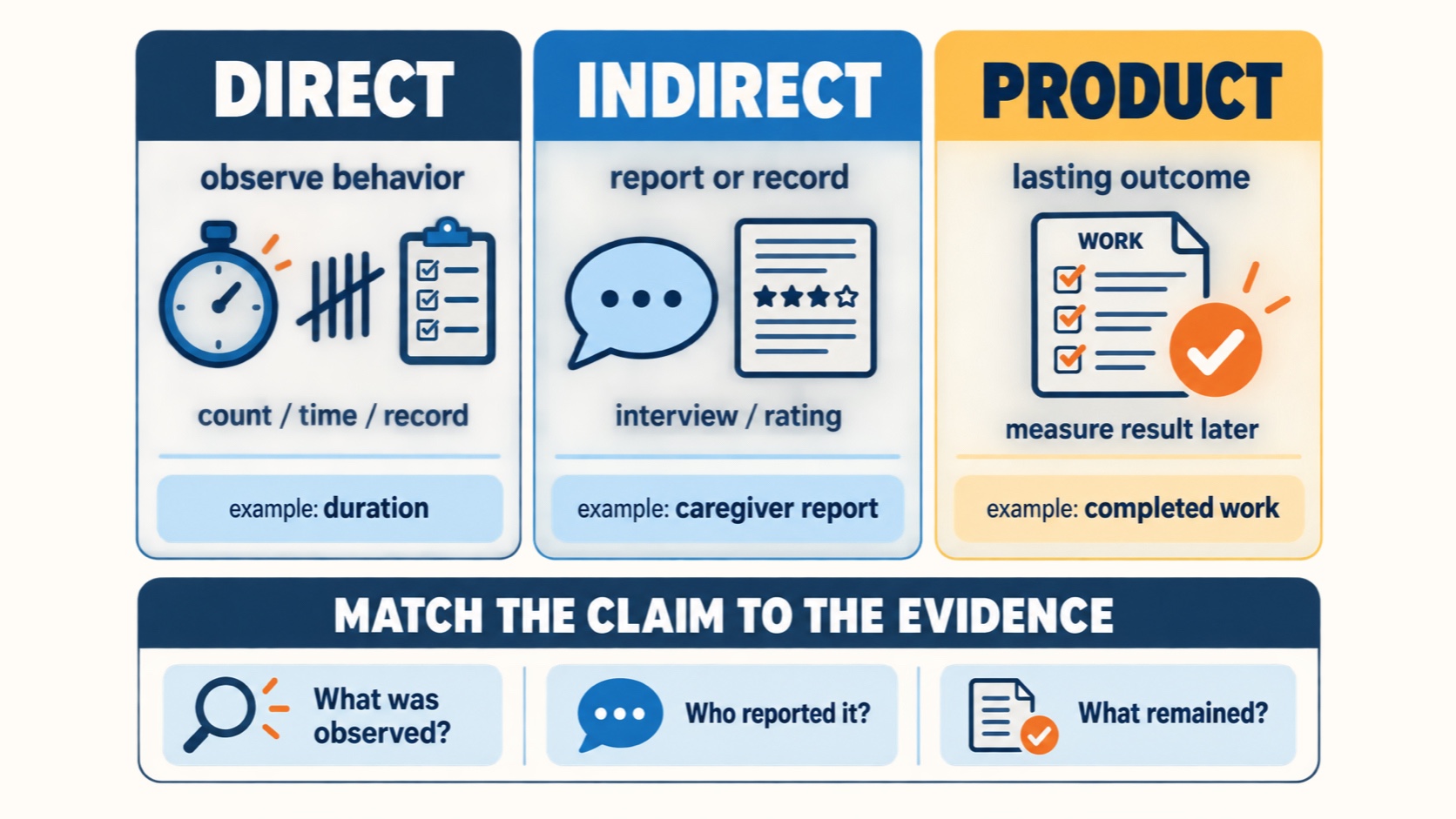
Direct measure: the measurement is taken from the behavior as it occurs. Examples include counting instances of a defined response, timing duration, recording latency, or marking whether a response occurred during an observation interval. Direct measurement does not require the observer to guess why the behavior occurred.
Indirect measure: information comes through another person’s report, a questionnaire, an interview, a rating scale, or existing records rather than from observing the target response at the moment it occurs. Indirect information can provide history, context, and efficient screening. It can also differ from what direct observation later shows, so the source should be named honestly.
Product measure: the observer measures a lasting effect or product that remains after the behavior has occurred. The number of completed problems, assembled items, or correctly sorted materials might be counted without watching every response. Product measures can be efficient, but they may not show the exact response process, errors, prompts, or time spent.
These categories are not a ranking from “good” to “bad.” The right choice depends on the critical dimension of the behavior, the environmental constraints, and the question being asked. A permanent product may be the most practical measure for completed work; direct observation may be necessary when the process, timing, or quality of each response matters.
Two examples of direct assessment
In a direct observation, the observer uses an operational definition and records behavior in the setting where it occurs. The record might include antecedent context, the observable response, immediate events afterward, duration, latency, or other dimensions. Direct observation can show patterns across time and conditions, but a pattern in naturally occurring events does not automatically prove a functional relation.
In a direct preference assessment, selected items or activities are presented in a defined arrangement and the person’s approach, selection, or engagement is observed and measured. This is different from asking a caregiver to rank items based on memory. Research comparing teacher report with direct preference assessment found that the rankings did not always correspond, which is a useful reminder to label report-based and directly observed evidence separately.
A preference result is not the same as a guarantee that an item will reinforce every behavior in every context. Preference can change with deprivation, satiation, competing activities, illness, effort, social context, and the person’s current goals. The evidence supports a current preference pattern under the assessment conditions; it should not be inflated into a universal conclusion.
An original observation scenario
Imagine that a learner is completing a short reading activity. During one observation, the teacher places a worksheet on the desk, says, “Start with number one,” and points to the first item. The learner pushes the worksheet away. The teacher removes it and offers a short break. A direct record would describe those events in sequence and might also record the time, task length, response form, and what happened after the break.
“The learner escaped because the work was too hard” is not the direct observation. It is a hypothesis about function and task difficulty. The direct record might support questions about task demands, break access, communication opportunities, response effort, or the teacher’s sequence of events. Repeated observations across tasks and days would be more informative than one memorable episode.
Now change the question. Suppose a practitioner presents a small choice array of activities and records which item the learner approaches first and how long the learner engages. That is a different direct assessment question: which options appear more preferred under these conditions? It does not answer why worksheet refusal occurred, and it does not by itself establish that the selected activity will maintain a target response.
How to make direct data useful
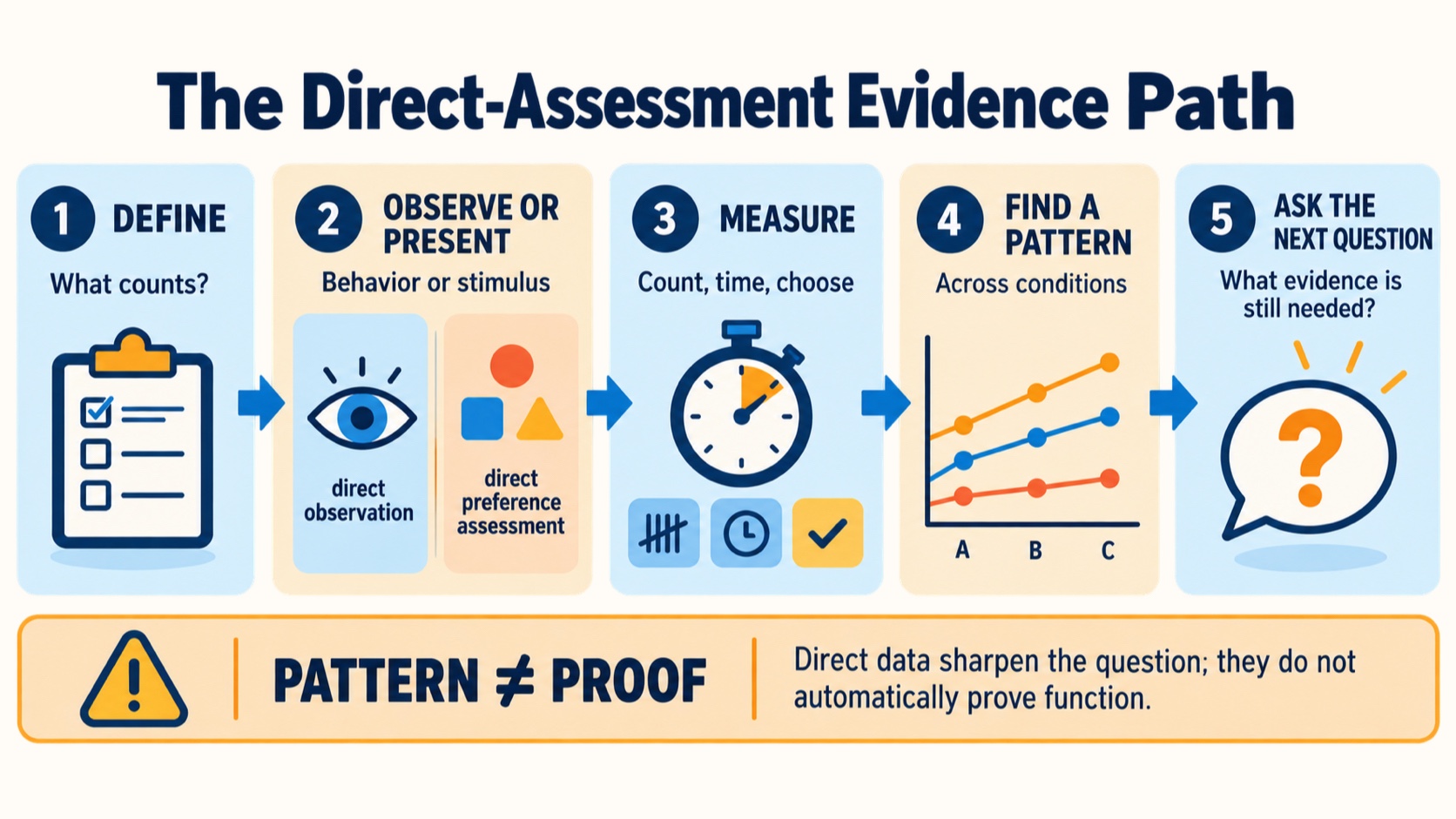
Use this checklist when studying or designing a measurement example:
- Define the response: describe what counts and what does not, using observable features rather than inferred motives.
- Choose the dimension: decide whether frequency, rate, duration, latency, interresponse time, accuracy, selection, or engagement matches the question.
- Plan representative observation: specify when, where, and across which relevant conditions data will be collected.
- Record consistently: use the same rules across observers and sessions, and document prompts, errors, missing opportunities, or unusual events when they affect interpretation.
- Check data quality: training, procedural integrity, and agreement checks may be appropriate depending on the purpose and system.
- Match the claim to the evidence: describe a pattern as a pattern unless the design supports a stronger conclusion.
What direct assessment can and cannot show
Direct assessment can show what happened under observed or arranged assessment conditions. It can help establish a baseline, identify patterns, compare choices, or evaluate whether a response changed across repeated observations. Direct data are especially valuable when a report is vague, when timing matters, or when the response process cannot be recovered from a finished product.
Direct assessment alone does not automatically show function, causation, treatment effectiveness, or future behavior in a new setting. A descriptive observation of a demand followed by refusal and a break shows temporal sequence. It does not by itself isolate which event was functionally important. A direct preference assessment shows observed choices under its conditions. It does not automatically prove reinforcer value.
Functional analysis is a separate experimental assessment in which conditions are arranged to evaluate functional relations. Direct observation may be part of the measurement system in a functional analysis, but the two terms are not synonyms. For study questions, keep the distinction clear: direct describes where the response data came from; functional analysis describes an experimental assessment logic.
Common mistakes and a study routine
- Calling an interview direct: information can be detailed and still be indirect if it comes from another person’s report.
- Confusing a product with the response: a completed page may show an outcome while hiding prompts, errors, pauses, or effort.
- Putting the hypothesis in the data: record what was seen or heard, then label interpretation as interpretation.
- Treating one observation as proof: repeated and representative data make patterns more defensible.
- Calling every direct assessment a functional analysis: direct observation and experimental analysis answer different questions.
For a short study routine, sort practice examples into three cards: direct, indirect, or product. For each card, write the evidence source, the measurement dimension, and the strongest conclusion that is justified. Then add one sentence describing what additional evidence would be needed for a stronger claim. Use the ABA Theory Blocks for measurement vocabulary, free ABA questions for scenario reasoning, and the ABA Definition Search when direct observation, descriptive assessment, or functional analysis begins to blur together. The ABC Data Sheet can support objective practice, but it is not an official BACB form or a substitute for professional assessment.
Direct assessment in ABA FAQ
What is direct assessment in ABA?
It is an assessment context in which behavior or responding is directly observed and measured, or in which stimuli are presented and the person’s observable response is measured. The exact procedure depends on the question.
What is an example of direct assessment?
Recording the duration of a defined response during a natural routine or measuring approach and engagement during a direct preference assessment are examples.
What is the difference between direct and indirect assessment?
Direct assessment uses direct observation or direct measurement of responding. Indirect assessment relies on reports, interviews, questionnaires, rating scales, or existing information from another source.
Is direct assessment the same as functional analysis?
No. Direct describes the evidence source or observation of responding. Functional analysis is an experimental assessment that arranges conditions to evaluate functional relations. Direct measurement can occur inside a functional analysis, but the terms are not interchangeable.
Sources
- BACB BCBA Test Content Outline (6th ed.)
- BACB Examination Information
- Applying Signal-Detection Theory to the Study of Observer Accuracy and Bias in Behavioral Assessment
- Assessing Preferences of Individuals With Developmental Disabilities: A Survey of Current Practices
- Teacher Report and Direct Assessment of Preferences for Identifying Reinforcers for Young Children