
Descriptive Assessment in ABA: What It Shows and What It Cannot Prove
Descriptive assessment in ABA is a way to observe and record behavior as it happens in a natural setting. Instead of arranging special test conditions, the observer documents the context, the observable response, and what happened immediately afterward. That record can reveal useful patterns and help a team decide what question to ask next.
The important boundary is easy to lose: a descriptive pattern is not automatically proof of behavioral function. If a behavior often follows a difficult instruction, the observation may support an escape-related hypothesis. It does not, by itself, demonstrate that escape is reinforcing the behavior. Good ABA study starts by keeping observation and interpretation in separate boxes.
Quick answer: descriptive assessment is the systematic observation and documentation of behavior and surrounding events in naturally occurring conditions. Common approaches include ABC recording, direct observation, and scatterplot-style recording. The purpose is to describe patterns and generate reasonable hypotheses. Descriptive assessment does not experimentally demonstrate that a particular consequence caused or maintains behavior.
Where the topic appears in ABA study
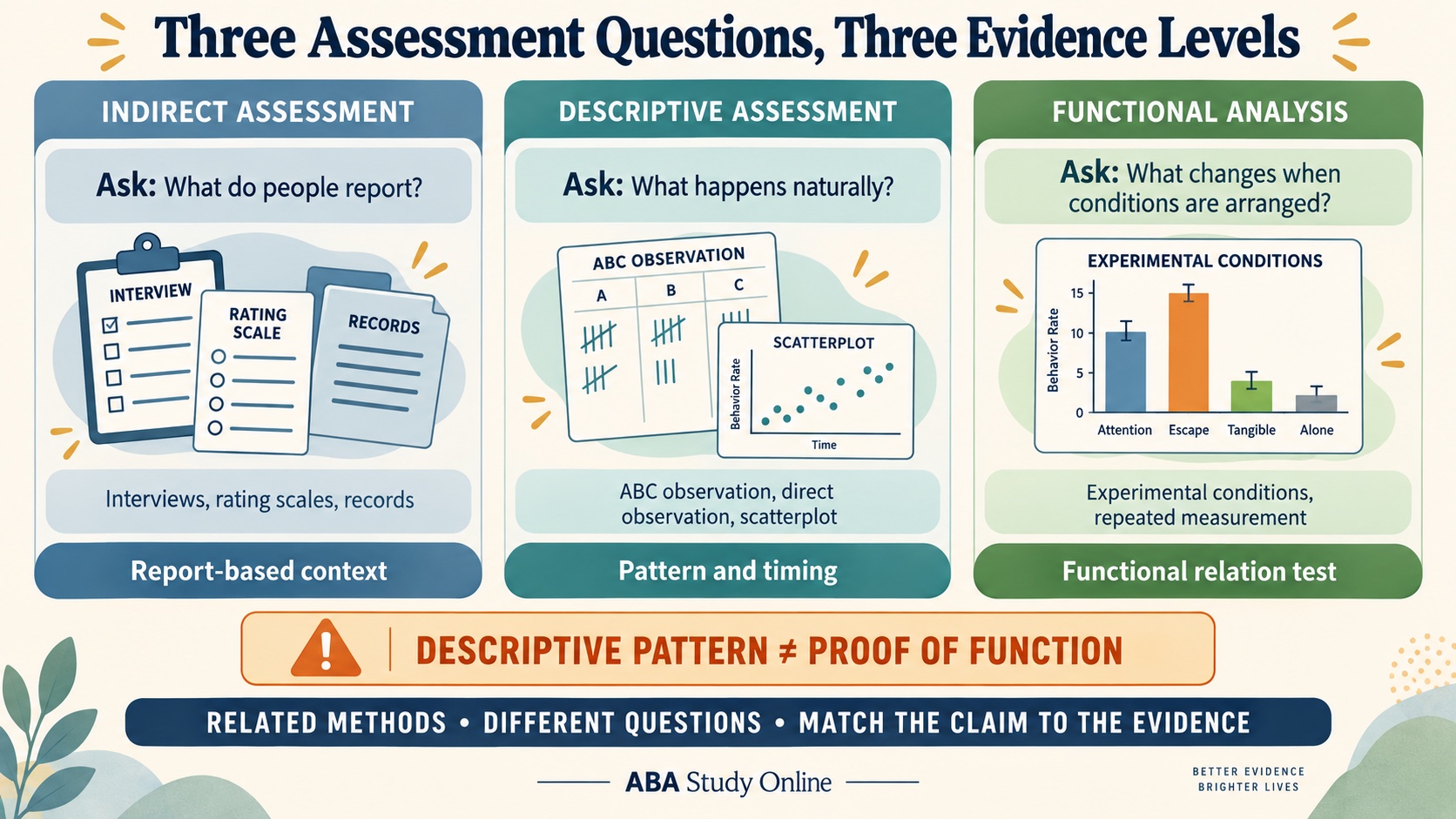
The current BCBA Test Content Outline places descriptive assessment in the Behavior Assessment domain. Task F.5 addresses designing and evaluating descriptive assessments, while F.6 separately addresses designing and evaluating functional analyses. The BCaBA outline also treats functional assessment as a family that can include indirect, descriptive, and experimental analyses.
That wording matters because “assessment” is not one single procedure. A learner may need information from records, interviews, skill assessment, preference assessment, descriptive observation, or an experimental analysis. The method should follow the question. A study page can help you recognize the distinctions, but it cannot choose an assessment plan for a real client.
What a descriptive record contains
A descriptive record begins with an operational definition. The observer needs to know what counts as the target response and what does not. “Was upset” is too broad to produce consistent observation. “Pushed the worksheet off the desk with one or both hands” gives the observer something concrete to record. The definition should describe the response, not the assumed reason for it.
In an ABC record, the A is the relevant antecedent or context immediately before the response. The B is the observable behavior itself. The C is what happened immediately afterward. The record may also include time, setting, people present, task demands, communication opportunities, duration, latency, or other variables that make the observation more useful.
Write the record as close to the event as possible. “Teacher presented a three-step worksheet and said, ‘Start with number one’” is an observation. “Teacher triggered refusal” is already an interpretation. The first sentence can be reviewed by another observer; the second silently turns a hypothesis into a fact.
Repeated observations are more informative than one memorable event. A scatterplot-style record may show when a behavior is more likely across periods of the day, activities, or settings. Direct ABC observation may show what commonly occurs around individual episodes. Neither format automatically reveals a functional relation. Both can help a team identify patterns worth examining.
An original ABC observation scenario
Imagine a learner who calls out during a small-group reading activity. During one observation, the teacher asks a question, the learner calls out, and the teacher turns toward the learner and responds. If the observer writes “the learner wanted attention,” the data sheet has already jumped to a conclusion.
A more objective record might say: “At 10:14, after the teacher asked the group to identify the main character, the learner said, ‘Me, me,’ before being called on. The teacher looked toward the learner and said, ‘Wait for your turn.’ The group continued after a brief pause.” That description can later be compared with other observations.
Suppose several observations show calling out after group questions, but other observations show it also occurs when the learner has an answer and when peers receive turns. That pattern may suggest several possible variables, including access to teacher interaction, difficulty waiting, task participation, or a communication skill that needs teaching. The descriptive record narrows the next question; it does not select one function by itself.
For study purposes, practice writing three versions of the same event: a biased interpretation, an objective ABC record, and a cautious hypothesis. This exercise makes the boundary visible and prepares you for questions that ask which statement is observable, which is inferential, and which method would provide stronger evidence.
Descriptive assessment compared with other methods
Indirect assessment gathers information from another person through interviews, rating scales, questionnaires, or record review. It can be efficient and can reveal history or context that is not visible in one observation. Because it depends on report or existing information, it may not show exactly what happens during the event.
Descriptive assessment observes naturally occurring events. It can capture the timing and sequence of context, response, and consequence in the setting where behavior matters. Its limitation is that many variables may change together. If a behavior follows a demand and is followed by a break, the observation shows a relation in time. It does not isolate which variable is functionally responsible.
Functional analysis arranges environmental conditions and measures responding under those conditions to evaluate functional relations. It is an experimental assessment, not simply a more detailed ABC form. The design, safety, setting, consent, professional competence, and client context all matter. A reader should not treat a general article as permission to conduct one.
What the data can and cannot support
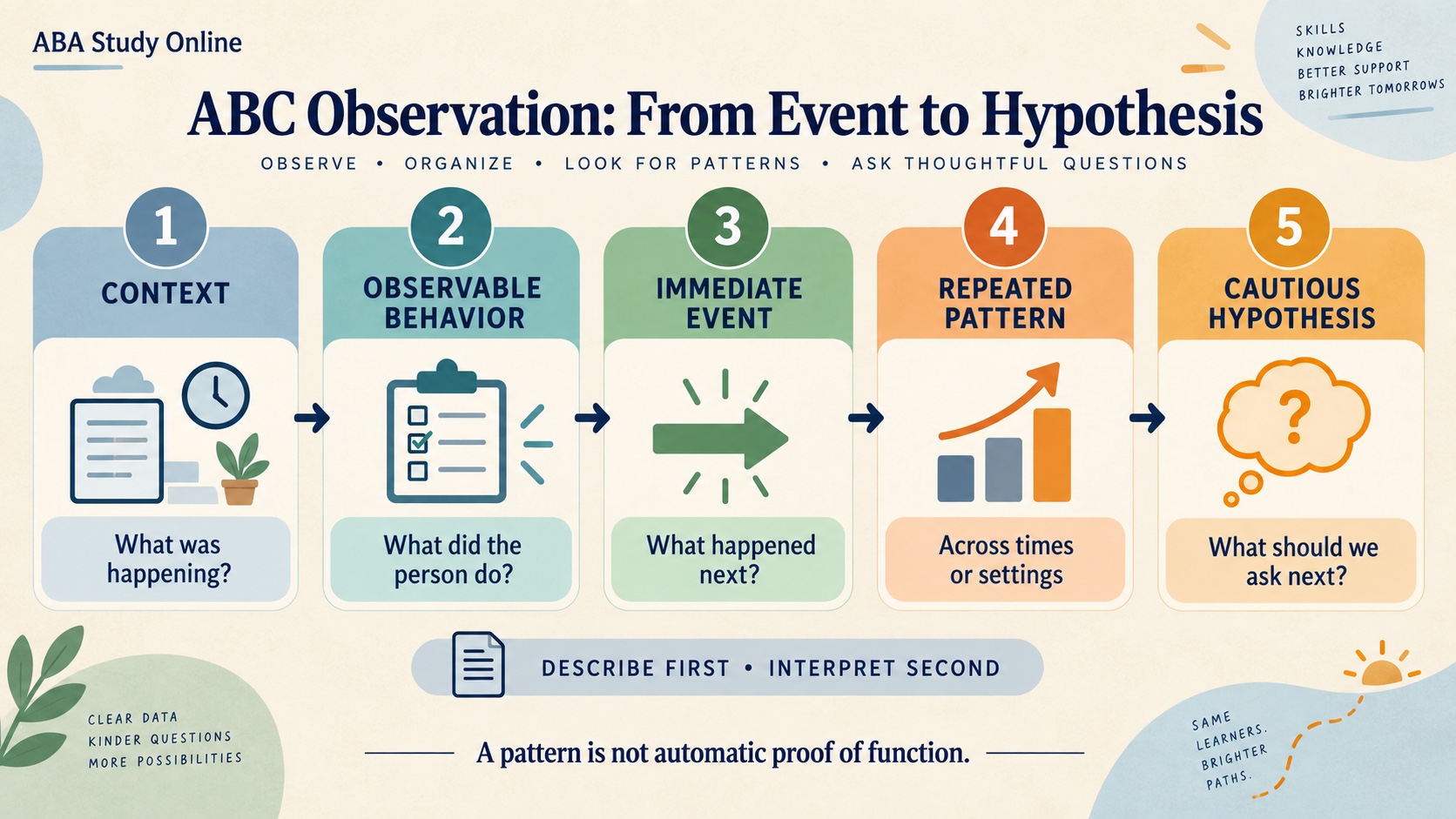
Descriptive data can support statements such as:
- the response occurred most often during a particular activity or time period;
- a particular antecedent or context was frequently present before the response;
- a particular consequence commonly followed the response; or
- the pattern changed across settings, people, tasks, or times.
Descriptive data do not automatically support statements such as “attention is the function,” “the demand caused the behavior,” or “removing the task will reduce the response.” Those statements go beyond what naturally occurring observation alone can establish. Interpretation should identify the limits of the record and the next defensible question.
Quality also depends on the measurement system. If the target definition is vague, the observation window is too narrow, or the observer records only dramatic episodes, the pattern may not represent the learner’s typical experience. Cultural and contextual variables matter too: the same routine, communication form, or adult response may have different meanings across families, classrooms, and communities.
Common descriptive-assessment mistakes
- Putting function in the behavior column: write what the person did, not what you think the person wanted.
- Treating sequence as causation: a consequence that follows a response is not automatically a reinforcer.
- Overgeneralizing from one observation: look for repeated observations across relevant contexts.
- Confusing ABC data with a functional analysis: naturally occurring observation and experimental arrangement answer different questions.
- Ignoring the observation system: poor definitions, inconsistent timing, and selective recording can distort the pattern.
- Forgetting the person and context: socially meaningful goals and culturally responsive collaboration matter alongside technical measurement.
How to study the concept
Use a two-column practice routine. In the first column, write only what an observer could see or hear: the instruction, response, and immediate event afterward. In the second, write one or more hypotheses and label them clearly as hypotheses. Then ask what additional method or observation would make the conclusion stronger.
Next, sort short examples into three cards: indirect, descriptive, or experimental. For each card, write the question the method can answer and the limit on the inference. The goal is not to memorize that one method is “best.” The goal is to choose language that matches the evidence.
Use the ABA Theory Blocks to review assessment vocabulary, free ABA questions to practice observation-versus-interpretation scenarios, and the ABA Definition Search when terms such as antecedent, consequence, function, or functional analysis need another pass. The ABC Data Sheet can support learning practice, but it is not a clinical assessment protocol or an official BACB form.
Descriptive assessment FAQ
What is descriptive assessment in ABA?
It is the systematic observation and documentation of behavior and surrounding events in naturally occurring conditions. It describes patterns that may help guide the next assessment question.
What is ABC data used for?
ABC data can document what occurred before a defined response, the response itself, and what occurred immediately afterward. Repeated records may reveal patterns for further evaluation.
Can descriptive assessment determine the function of behavior?
It can support hypotheses about possible function, but naturally occurring descriptive data do not automatically demonstrate a functional relation. Stronger conclusions require appropriate additional evidence.
Is descriptive assessment the same as functional analysis?
No. Descriptive assessment observes naturally occurring events. Functional analysis experimentally arranges conditions to evaluate functional relations. They are related assessment methods, not interchangeable names.