
Conditioned Motivating Operations in ABA: CMO-S, CMO-R, and CMO-T
Conditioned motivating operations, often shortened to CMOs, are learned antecedent events that temporarily change the value of a consequence and alter behavior related to that consequence. The word conditioned is the key: the event does not have its motivational effect simply because of its physical form. Its effect develops through a person’s learning history.
For exam questions and clinical reasoning, start with the function rather than the label. Ask what consequence became more or less valuable, what behavior changed, and what learning history explains the relation. Then ask whether the example fits a surrogate, reflexive, or transitive CMO. This keeps “motivation” connected to observable variables instead of using it as a vague explanation for behavior.
Quick answer: what is a conditioned motivating operation?
A conditioned motivating operation is a learned antecedent event that momentarily alters the effectiveness of a consequence as reinforcement or punishment and changes the current frequency of behavior related to that consequence. The event’s effect depends on the individual’s history with other stimuli, consequences, or conditions.
For example, a locked box is not automatically a reinforcer or a motivating operation. If a person has learned that a particular key opens the box and that the box contains a preferred item, the locked box may make the key valuable. The box changes what the key can do in the current situation and may evoke behavior that has produced access to the key before. That is the kind of functional relation examined when studying a transitive CMO.
CMOs are part of the broader motivating-operation concept. A motivating operation changes both the current value of a consequence and the likelihood of behavior that has historically produced that consequence. When the effect is learned, the operation is conditioned; when the relevant effect does not depend on learning history, it is classified as unconditioned.
The two effects of a CMO
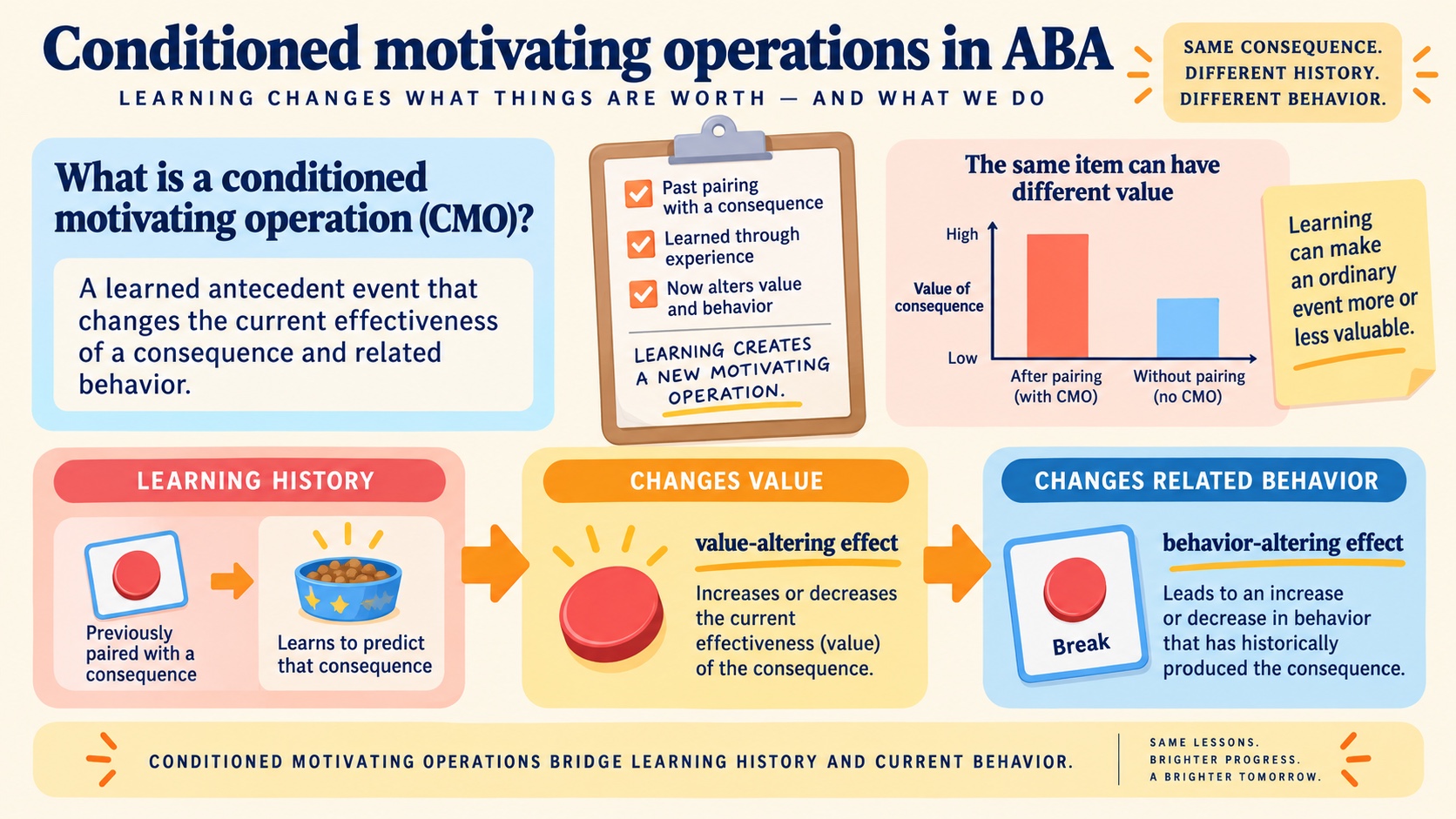
It helps to separate the two effects instead of treating the phrase “motivating operation” as a feeling:
- Value-altering effect: the antecedent temporarily changes how effective a particular consequence is as reinforcement or punishment. A consequence may become more valuable, less valuable, or otherwise change in current effectiveness.
- Behavior-altering effect: the antecedent changes the current frequency of behavior that has produced that consequence in the past. When a consequence becomes more effective, relevant behavior may be evoked; when it becomes less effective, that behavior may be abated.
Suppose a learner has a history of using a communication card to obtain a preferred activity. A learned condition can make that activity especially valuable or make the card useful for accessing it. If the learner then uses the card more often, the analyst would still need to describe the relevant history and consequence rather than simply saying, “The learner was motivated.” The functional description is the important part.
The effect is also temporary or momentary in the technical sense: it describes the current conditions, not a permanent trait of the person or object. A card, timer, lock, demand, or warning symbol may function differently at another time or for another learner because the relevant learning history and consequences differ.
CMO-S, CMO-R, and CMO-T
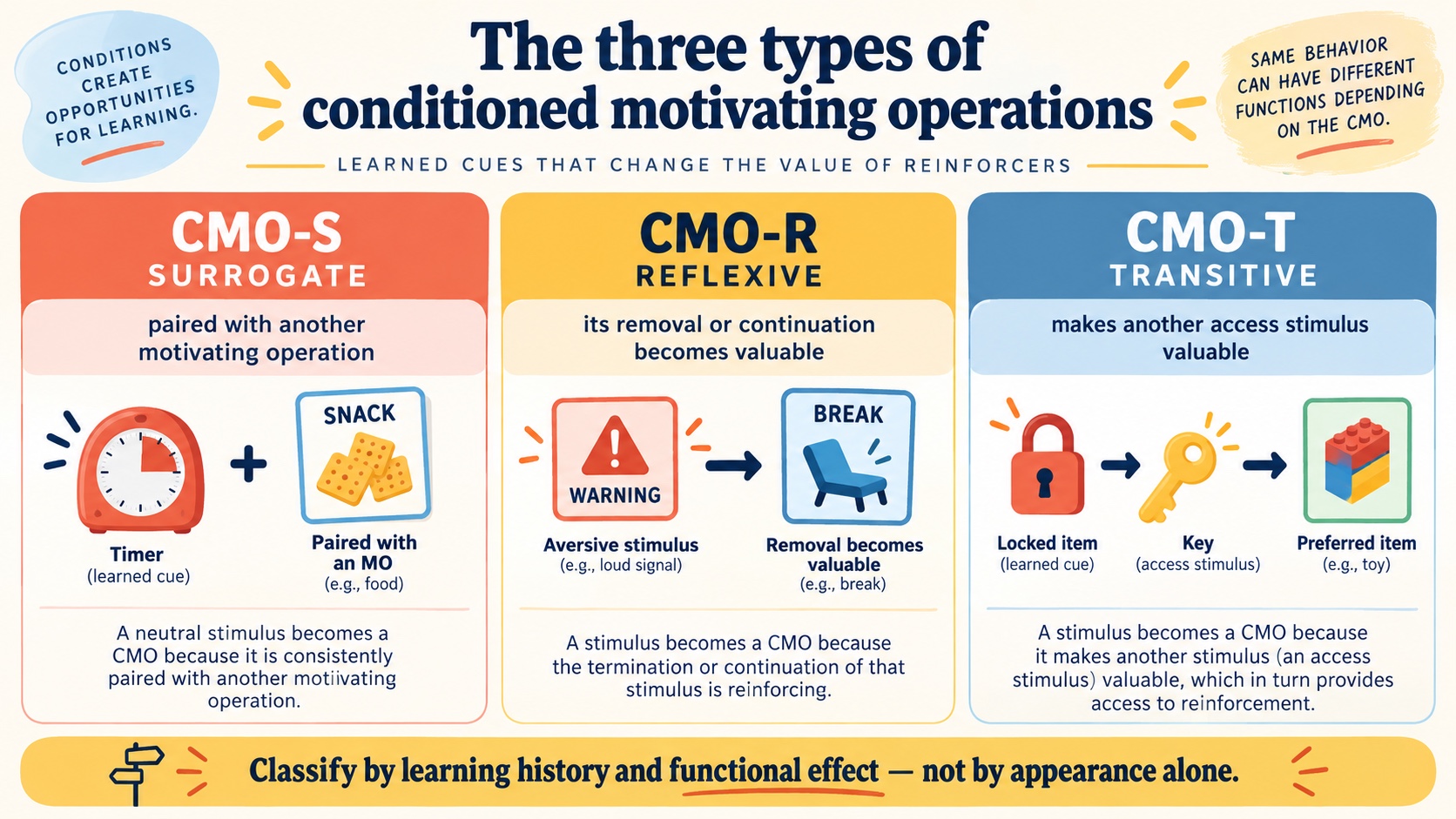
Many ABA study materials organize conditioned motivating operations into three types. The labels are useful only when tied to the function and learning history.
CMO-S: surrogate conditioned motivating operation
A CMO-S acquires motivational effects by being paired with another motivating operation. It comes to have similar effects because it has accompanied a condition that already changes the value of a consequence. The CMO-S may later alter the value of consequences controlled by the motivating operation with which it was paired.
Fictional example: A classroom timer has repeatedly been present immediately before snack preparation. Over time, the timer sound may take on some of the motivational effects associated with the upcoming snack routine. Hearing the timer could increase behavior that has historically produced participation in that routine. The timer is not a CMO-S merely because it is a timer; the classification depends on the learned pairing and the observed functional effect.
CMO-R: reflexive conditioned motivating operation
A CMO-R changes the value of its own removal or continuation. It often appears in a warning or aversive context. A stimulus that signals worsening conditions may make relief from that stimulus valuable and evoke behavior that has previously ended or avoided it. A stimulus that signals improvement may make its continuation valuable and evoke behavior that maintains it.
Fictional example: A warning card has repeatedly preceded a difficult demand and has been followed by the learner asking for a break. If the card itself begins to make the removal of the card or the break more valuable, it may evoke the break-request response. The analyst should still describe the history and the response-consequence relation; the card’s appearance alone does not prove a CMO-R.
CMO-T: transitive conditioned motivating operation
A CMO-T makes another stimulus or event valuable because that stimulus is needed to obtain a particular consequence. The CMO-T changes the value of a second stimulus that provides access to reinforcement or punishment and evokes behavior that has produced that second stimulus in the past.
Fictional example: A preferred item is visible inside a locked container. Because the learner has a history showing that a key opens the container, the locked container can make the key valuable in that moment. The container may evoke asking for, searching for, or using the key. The key functions as an important access stimulus, while the locked condition supplies the learned relation that makes the key valuable.
A quick classification question is: Is the event paired with another MO, does its own removal or continuation become valuable, or does it make another access stimulus valuable? The answer points toward CMO-S, CMO-R, or CMO-T respectively. If the scenario does not provide the needed learning history, do not force a label.
CMO versus SD, UMO, EO, and AO
CMO versus SD: An SD signals that a particular consequence is available for a response because that response has been reinforced in its presence. A CMO changes the current effectiveness of the consequence and the behavior related to it. They can occur together: one event may make a consequence valuable while another signals that the response can produce it.
CMO versus UMO: A conditioned MO depends on learning history. An unconditioned motivating operation, or UMO, has a value-altering effect that does not require the same type of individual learning history. Deprivation, satiation, and some forms of painful stimulation are commonly used as study examples, but classification still depends on the consequence and functional effects being discussed.
CMO versus EO and AO: Establishing operation and abolishing operation describe the direction of the value-altering effect. An EO increases the effectiveness of a consequence; an AO decreases it. Conditioned and unconditioned describe the source of the motivating effect. These are related distinctions, not interchangeable labels.
CMO versus a “motivating person” or object: ABA does not need a broad trait explanation such as “the learner likes the card.” Describe the event, the relevant consequence, the learning history, and the behavior change. The same physical object can function differently depending on what the person has learned and what consequences are currently available.
Common mistakes and an exam checklist
- Labeling every antecedent an MO: an MO must change consequence effectiveness and related behavior.
- Calling an SD a CMO: ask whether the stimulus signals availability or changes the current value of the consequence.
- Ignoring learning history: “conditioned” is not just a synonym for “seen before”; explain the relevant functional history.
- Memorizing the CMO letters without the effect: classify the relation first, then select S, R, or T.
- Confusing a preferred item with a CMO-T: a CMO-T makes another stimulus valuable because it provides access to a consequence.
- Assuming one object has one permanent function: current conditions and individual history matter.
For an exam scenario, ask:
- What consequence became more or less effective?
- What behavior changed because of that value change?
- What learning history gives the antecedent its effect?
- Does the event resemble a paired CMO-S, a removal/continuation CMO-R, or an access-stimulus CMO-T?
- Is the event being confused with an SD, UMO, EO, or AO?
- What observation would help confirm the proposed function?
For more ABA concept review, visit ABA Theory Blocks, practice distinctions with free ABA questions, or look up related terms in the ABA Definition Search. These are natural study links; this informational page does not promise certification, exam success, or a particular clinical outcome.
FAQ and sources
What is a conditioned motivating operation in simple terms? It is a learned event that temporarily changes how valuable a consequence is and changes behavior related to getting or avoiding that consequence.
What are the three types of CMO? The common study taxonomy includes CMO-S, surrogate; CMO-R, reflexive; and CMO-T, transitive. Each type is identified by its learning-history relation and functional effect.
What is the difference between a CMO and an SD? A CMO changes the current effectiveness of a consequence and related behavior. An SD signals that a consequence is available for a response. They can interact in the same contingency.
Can the same stimulus be an MO for one learner but not another? Yes. Conditioned effects depend on learning history, current consequences, and the functional relation in the situation. The label should not be assigned from appearance alone.
Sources
- BACB Test Content Outlines for BACB Certifications
- McGill: A Tutorial on the Concept of the Motivating Operation and its Importance to Application
- Motivating Operations and Discriminative Stimuli: Distinguishable but Interactive Variables
- Michael: Establishing Operations
- A Clinical Tutorial on Methods to Capture and Contrive Establishing Operations to Teach Mands