
Concentrated vs. Supervised Fieldwork: BACB Comparison for BCBA Candidates
If you are comparing concentrated vs supervised fieldwork for BCBA eligibility, the central difference is not that one is “better.” The current BACB Handbook describes two fieldwork types with different total-hour pathways and different supervision structures. Your choice should match the experience arrangement you can document consistently and the certification requirements that apply to your application date.
The current handbook reviewed for this article describes 2,000 hours of Supervised Fieldwork or 1,500 hours of Concentrated Supervised Fieldwork, when the associated requirements are met. The exact rules, forms, ratios, and transition dates are time-sensitive. Use the current BCBA Handbook and the BACB BCBA fieldwork page as the source of truth, especially while 2027 requirements and transition guidance are in circulation.
Table of Contents
What is the difference?
Both pathways are supervised applied behavior-analysis experience for candidates pursuing BCBA certification. The difference is the structure used to accrue and document the fieldwork. Concentrated fieldwork has a higher supervision requirement and a lower raw-hour requirement. Supervised Fieldwork has a lower supervision percentage and a larger raw-hour requirement.
That does not mean concentrated hours are “easier.” More supervision can mean more meetings, observations, planning, and documentation in each supervisory period. It may be a good fit for a high-contact training arrangement, but it can be difficult to sustain if a supervisor cannot reliably provide the required structure. Conversely, the longer supervised route still requires careful monthly compliance and meaningful training activities.
Current comparison at a glance
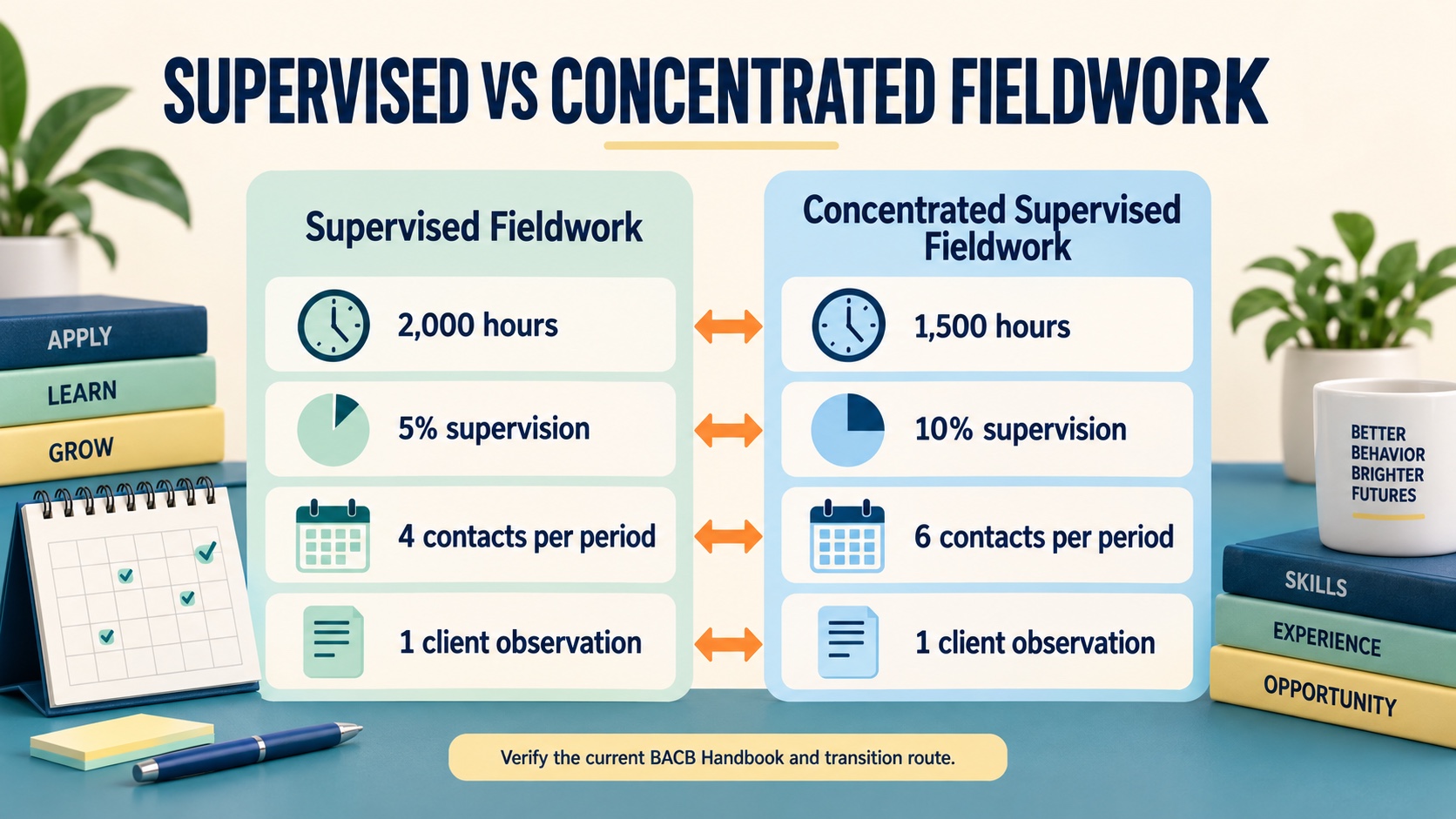
The current comparison commonly used in BCBA fieldwork planning includes:
- Supervised Fieldwork: 2,000 hours, at least 5% supervision per supervisory period, four supervisor contacts, and one observation with a client per period under the current handbook structure.
- Concentrated Supervised Fieldwork: 1,500 hours, at least 10% supervision per supervisory period, six supervisor contacts, and one observation with a client per period under the current handbook structure.
- Supervision quality: both types require qualified supervision, appropriate contacts, client-related observation, acceptable activities, documentation, and compliance with the applicable handbook.
These numbers are not a permission to calculate your own eligibility with a shortcut. The handbook may define supervisory periods, individual and group supervision, allowable hours, monthly minimums and maximums, and documentation details that affect whether a month is compliant.
How Supervised Fieldwork works
Supervised Fieldwork spreads the experience requirement across a larger raw-hour total with a lower supervision percentage than the concentrated route. A candidate might choose it because the work setting and supervisor can provide a stable monthly arrangement without the higher contact and supervision demands of concentrated fieldwork.
The route still requires active planning. Before the month starts, clarify the expected activities, contacts, observation, supervision format, and documentation. During the month, record hours as they occur rather than reconstructing them from memory. At the end of the supervisory period, check that the hours, activities, contacts, signatures, and forms agree.
Do not interpret a lower percentage as “minimal supervision.” The purpose is ongoing feedback and development. The acceptable-activity rules, restricted/unrestricted balance, supervisor qualifications, and fieldwork documentation still matter.
How Concentrated Supervised Fieldwork works
Concentrated Supervised Fieldwork uses a higher supervision structure and a lower raw-hour requirement. The current handbook also describes a 1.33 multiplier treatment for concentrated hours in the applicable calculation, but the multiplier is not a free reduction that can be applied to any hour. It is used only as the handbook describes and still depends on satisfying the concentrated requirements.
A concentrated plan may fit a candidate with frequent access to a qualified supervisor, sufficient client-facing and analytic activities, and a workplace that can support regular observation and contacts. It may be a poor fit when supervisor availability changes, hours are sporadic, or the candidate cannot keep documentation current.
Ask the supervisor to review the structure before you begin: What counts as a contact? Which meetings are individual or group? How will the observation occur? How will hours be prorated if a month contains more than one fieldwork type or supervisory structure? Written clarity before the first month can prevent a costly correction later.
How to choose a structure
Use a fit checklist rather than choosing the shorter raw-hour number automatically:
- Supervisor capacity: Can the supervisor reliably meet the required contacts, observation, and percentage every month?
- Work setting: Does the setting provide enough acceptable activities and client-related observation?
- Schedule stability: Are your hours predictable enough to meet minimums and avoid rushed end-of-month documentation?
- Documentation system: Can you track dates, activities, contacts, supervision, observations, and signatures in a way both parties can audit?
- Application timing: Which handbook and transition rules will govern when you apply?
- Quality of feedback: Will the structure create meaningful supervision, not just a higher number of meetings?
Two candidates can choose different routes and both be making a reasonable decision. The best structure is the one you can complete compliantly and learn from, not the one with the most attractive headline timeline.
Can you combine fieldwork types?
The current BCBA Handbook allows fieldwork types to be combined when the requirements for each type are met and the hours are documented correctly. The 1.33 treatment for concentrated hours applies only as the handbook explains and is used to reach the required mixed total under the applicable rules. You cannot label a low-supervision month “concentrated” after the fact simply to make the arithmetic work.
If your arrangement changes, pause and ask how the change will be recorded. A new supervisor, setting, or supervision structure can affect the monthly calculation. Keep the signed documentation that explains the route used for each period and do not overwrite an earlier record to make the totals look cleaner.
Documentation and supervision planning
Use the current BACB forms and handbook to create a monthly audit:
- Write the fieldwork type and supervisory structure used for the period.
- Record acceptable activities and distinguish restricted from unrestricted work.
- Track hours, supervisor contacts, individual/group supervision, and the client observation.
- Check the supervision percentage before the period closes.
- Collect signatures and store the final form with supporting records.
ABA Study Online’s BCBA resources, free questions, and app review tools can help with terminology and exam learning. They do not replace a qualified supervisor, BACB forms, or the current handbook.
Why 2027 guidance matters
The BACB BCBA fieldwork page currently points candidates to 2027 requirements and transition guidance. If you will apply under a future route, do not assume the current 2,000/1,500 comparison, forms, or eligibility pathway will be the final rule for you. Save the handbook version you used, check your application date, and ask the BACB or your supervisor when the transition language is unclear.
Common mistakes
- Choosing concentrated only because it is shorter: the supervision structure is more intensive.
- Using the wrong percentage: supervised and concentrated fieldwork have different supervision requirements.
- Applying the multiplier casually: concentrated-hour calculations still require compliance with the handbook.
- Reconstructing months later: missing contacts, observations, or signatures can be difficult to repair.
- Mixing routes without a plan: each month and structure must be documented correctly.
- Using old requirements: check the current BCBA Handbook and 2027 transition page before you rely on a saved table.
FAQ and sources
Is concentrated fieldwork easier?
Not automatically. It has fewer raw hours under the current comparison but a higher supervision percentage and more contacts per supervisory period. Fit depends on supervisor capacity, setting, schedule, and documentation.
How many hours are required?
The current BCBA Handbook reviewed for this article describes 2,000 Supervised Fieldwork hours or 1,500 Concentrated Supervised Fieldwork hours when all associated requirements are met. Verify the handbook and transition route that apply to your application.
Can I combine supervised and concentrated hours?
The current handbook permits combination when each fieldwork type’s requirements are met and the hours are documented correctly. Do not apply the concentrated treatment to hours that did not meet concentrated requirements.