Competency Assessment RBT: 7 Things to Verify First
If you search for competency assessment RBT, you may be trying to answer a practical question: “Am I ready to arrange the assessment, and what could make my paperwork unusable?” The current RBT Initial Competency Assessment is not the written RBT examination or a general employer checklist. It is a supervised evaluation based on the current BACB packet, with specific rules for training, assessors, task formats, timing, signatures, and submission.
Use this page as a pre-assessment readiness check. It summarizes the current 2026 boundaries without pretending to conduct an assessment or replace the responsible assessor. The official BACB packet remains the authority, and the final judgment of competent performance belongs to the qualified assessor who follows that packet.
Table of Contents
What the RBT competency assessment checks
The current Initial Competency Assessment Packet is effective January 1, 2026. It states that all 19 task items must be completed as part of the requirements to qualify for RBT certification. The tasks cover practical performance areas such as continuous and discontinuous measurement, data and graphs, preference assessment, ABC data, teaching procedures, behavior-reduction procedures, documentation, and professional conduct.
This is different from the written RBT examination. A multiple-choice question can ask you to identify a measurement procedure. A competency assessment may require you to implement that procedure, enter data, update a graph, or explain what you would do within the approved protocol. Studying definitions can support preparation, but it does not by itself demonstrate competent performance.
It is also different from 40-hour training. Training provides instruction and practice opportunities; the competency assessment is the formal performance check that must be completed and documented according to the current packet. A worksheet or online practice tool can help you rehearse, but it cannot sign the official form or decide that you are competent.
Seven readiness gates
Before arranging a session, check these seven gates with the person responsible for your assessment.
- Correct packet: confirm that you are using the current Initial Competency Assessment Packet effective January 1, 2026, not a saved form from an older training folder or a recertification packet.
- Training complete: the initial assessment must happen after the required 40-hour training is complete. Keep the relevant training documentation available for the application process.
- Qualified responsible assessor: the packet identifies an active BCaBA or BCBA certificant who has completed the required 8-hour supervision training. That person oversees the process, signs the assessment, maintains records, and remains responsible for quality.
- Relationship fits: the responsible assessor, applicant, and client context must meet the packet’s organization or contractual relationship requirements. A person holding the right title is not automatically qualified to assess every applicant in every setting.
- Task formats planned: identify which tasks will be evaluated with a client, through role-play, or through another format allowed by the packet. Do not assume that one format can replace every other format.
- Timing is valid: the initial assessment must be completed after training and no more than 90 days before the RBT certification application is submitted. Schedule the work so the dates fit the application window.
- Documentation and privacy are ready: plan for task initials, the responsible assessor’s final signature and date, the official form, required record retention, and protection of client information. Non-BACB forms will not be accepted in place of the official packet.
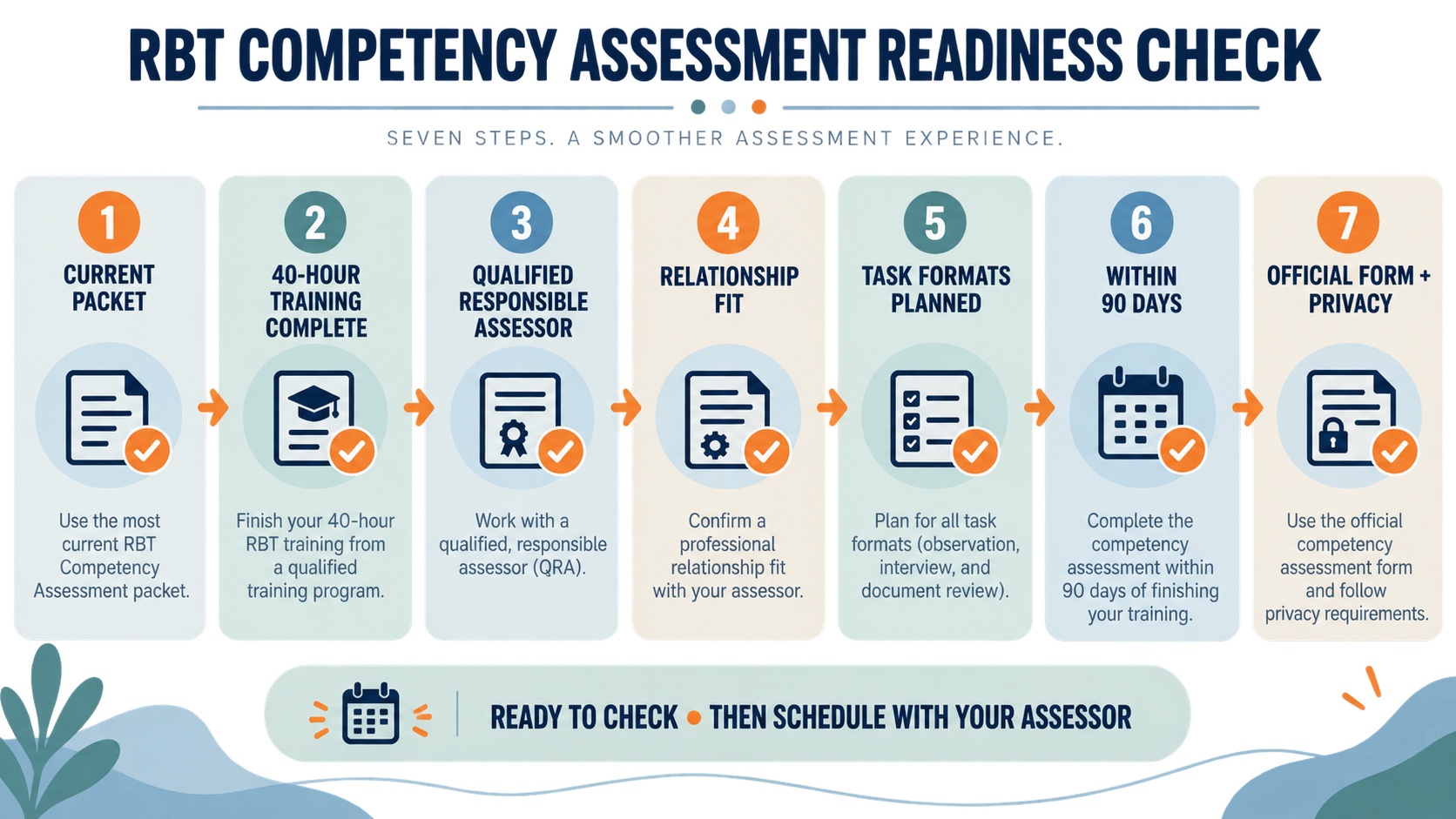
These gates are deliberately administrative and practical. Many applicants spend their energy memorizing procedures but discover too late that they have the wrong version of the form, an invalid date range, or an assessor relationship that does not fit the packet. Check the conditions before you invest in a long practice session.
Client, role-play, and other formats
The current packet allows the assessment to be conducted over one or more sessions. Depending on the task and the packet’s instructions, evaluation may take place in person, live through the internet, or through observation of recorded videos created specifically for the assessment. The responsible assessor remains accountable for following the current requirements and ensuring that the process is a quality evaluation.
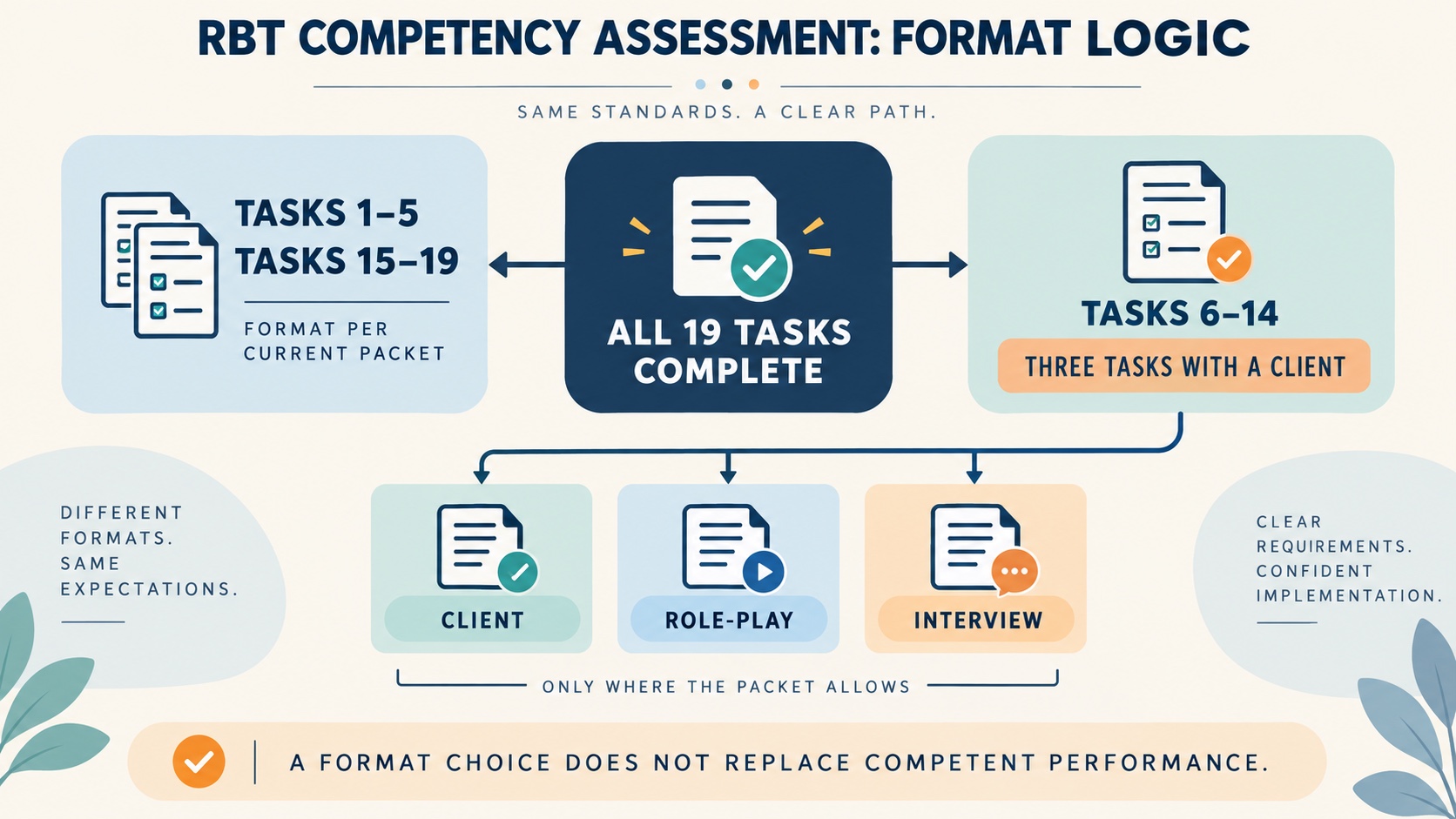
One client rule is easy to misread. Three tasks from the Skill Acquisition and Behavior Reduction section, tasks 6–14, must be demonstrated with a client. That does not mean all 19 task items must be performed with a client. For the other items, use the assessment type the current packet allows and confirm the plan with the responsible assessor.
Think of a format decision as a small evidence question:
- Client demonstration: the assessor observes the required performance in a client-service context that fits the rules.
- Role-play: the applicant demonstrates the skill in a structured simulated situation when the packet allows it.
- Interview or discussion: the applicant explains a concept, boundary, or professional response when that is the listed assessment option.
A role-play is not automatically a client demonstration, and an explanation is not automatically an implementation. If the format is unclear, ask before the session. Do not try to “upgrade” a task by improvising a different procedure or using an unapproved client situation.
What to rehearse before the session
A good rehearsal makes competent performance more observable. Work with your trainer, supervisor, or responsible assessor on the following layers:
- Observable steps: describe what you would do and say, not only the name of the procedure.
- Data accuracy: practice recording the selected dimension, entering data, and checking that the display matches the observation.
- Protocol fidelity: use the approved materials and written procedures for the setting. Do not invent an intervention to make a demonstration look advanced.
- Prompting and teaching: rehearse how you implement a prompt and how you follow the planned fading procedure without taking over the learner’s response.
- Professional communication: practice objective notes, client dignity, confidentiality, boundaries, and how to seek clinical direction when a situation exceeds your training or protocol.
- Feedback response: listen to corrective feedback, ask for clarification, and repeat the task later when the assessor schedules another opportunity.
Keep preparation notes separate from client records. Use fictional examples or the minimum information needed for the approved training context. A public checklist should never contain identifying details, and a study website cannot determine whether a specific client situation is appropriate for assessment.
A fictional readiness example
Imagine that Maya has completed the 40-hour training and wants to schedule her initial assessment. Before choosing a date, she opens the current BACB packet with the responsible assessor. Together they confirm the assessor’s credential and supervision training, review the organization relationship, identify the tasks that require a client, and check that the planned completion date will fall within 90 days of the application submission.
Maya then rehearses continuous measurement, ABC data, objective session notes, prompting, and a teaching procedure using the approved protocol. She asks which items will use role-play and which will be demonstrated with a client. During the actual assessment, the assessor—not Maya or a website—decides whether each performance is competent and initials the official form. If a task needs corrective feedback, the assessor explains the next practice opportunity rather than treating a practice worksheet as a final decision.
Common preparation mistakes
- Using a generic online form: use the current BACB packet; a third-party checklist can organize rehearsal but cannot replace it.
- Confusing the assessment with the exam: prepare both practical performance and written knowledge, but keep the evaluation rules separate.
- Assuming all 19 tasks need clients: the current client rule applies to three tasks from the 6–14 skill-acquisition and behavior-reduction group.
- Scheduling too early: the assessment comes after the 40-hour training and has a 90-day application boundary.
- Choosing an assessor by title alone: supervision training, organization relationships, oversight, and sign-off responsibilities also matter.
- Practicing without protocol: the goal is competent implementation within training and supervision, not creative improvisation.
- Sharing client information: protect privacy in notes, examples, videos, and communication about the assessment.
FAQ and official sources
How many items are in the current RBT competency assessment?
The current BACB Initial Competency Assessment Packet states that all 19 task items must be completed.
Do all tasks require a client?
No. Three tasks from the Skill Acquisition and Behavior Reduction section, tasks 6–14, must be demonstrated with a client. The format for other tasks follows the current packet.
Can a website conduct or sign my assessment?
No. A website can provide independent explanations and rehearsal ideas. The official evaluation must be conducted, documented, and signed according to the current BACB packet by the responsible assessor.
When should the initial assessment be completed?
It must be completed after the 40-hour training and no more than 90 days before submitting the RBT certification application. Confirm dates against the current packet before scheduling.
- BACB RBT Initial Competency Assessment Packet, effective January 1, 2026
- BACB RBT application resources
- BACB supervision, assessment, training, and oversight
- BACB application processing and document versions
- BACB RBT Handbook
For related study, use the RBT study path, practice with RBT questions, or review terms in the ABA Definition Search. These resources support learning; they do not provide assessor sign-off or determine certification eligibility.