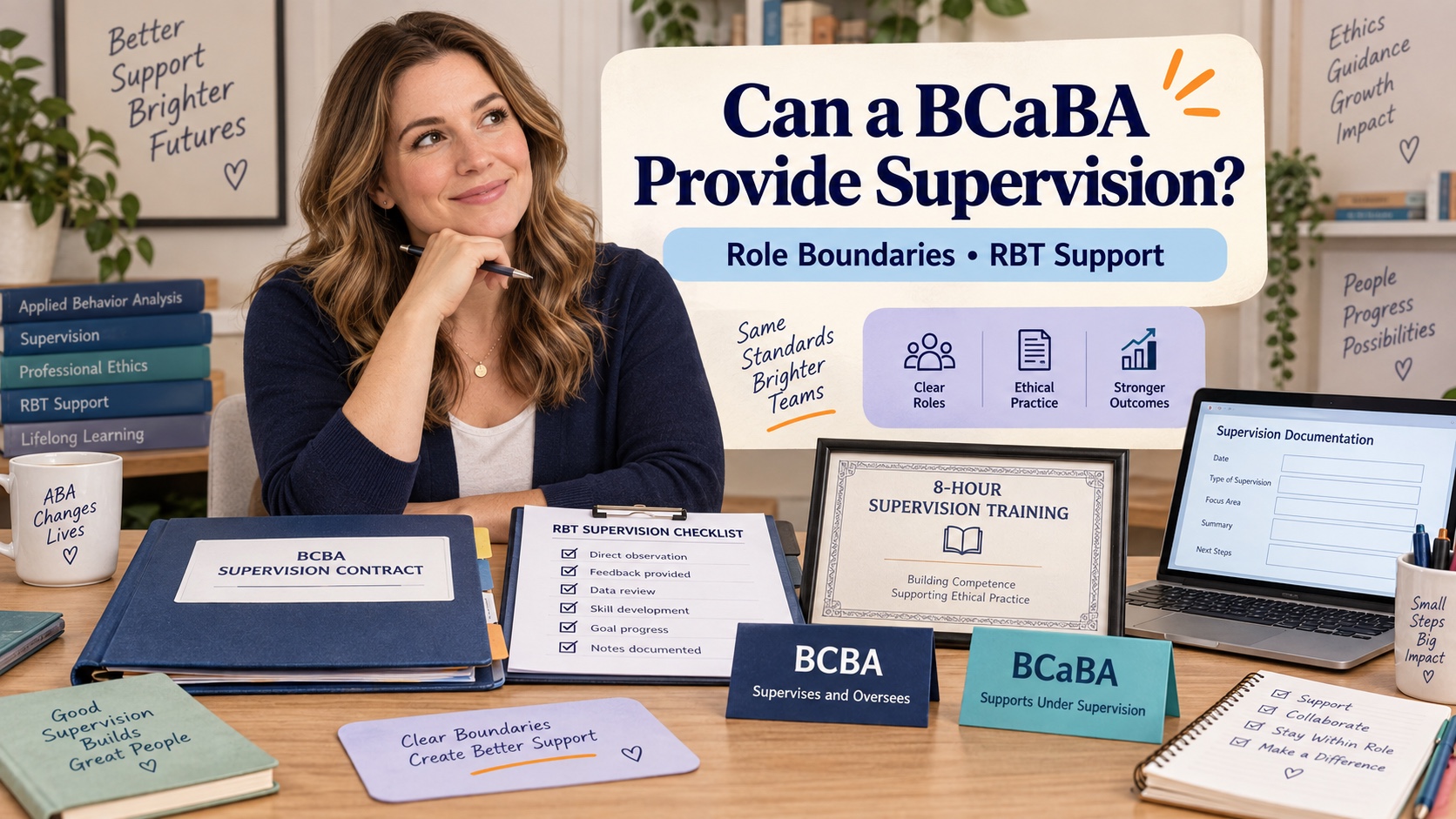
Can a BCaBA Provide Supervision? The Current Role Boundary
Yes—a BCaBA may supervise the work of an RBT under the current BACB role guidance. But that answer has an important second half: a BCaBA is not an independent BCBA, and a BCaBA must provide behavior-analytic services under the supervision of a qualified BCBA. The RBT-supervision permission does not erase the BCaBA’s own supervision relationship or authorize the BCaBA to supervise BCaBA trainees or BCBA fieldwork.
This distinction can feel confusing because “supervision” is used for several different relationships. The practical question is not only “What credential does this person hold?” It is also “Who is this person supervising, under which BACB rule, and what oversight and training are in place?”
Table of Contents
What is the short answer?
| Question | Current answer |
|---|---|
| Can a BCaBA supervise an RBT? | Yes, a BCaBA may serve as an RBT Supervisor when the current BACB requirements are met. |
| Can a BCaBA practice independently as a BCBA? | No. BCaBA services remain under qualified BCBA supervision. |
| Can a BCaBA supervise BCaBA fieldwork or BCBA fieldwork? | No. The current role matrix assigns supervision of certification fieldwork to a BCBA. |
| Does an employer title create supervision authority? | No. A job title cannot replace certification, training, documentation, or applicable state and payer rules. |
How do the two supervision directions work?
Picture two arrows pointing in different directions:
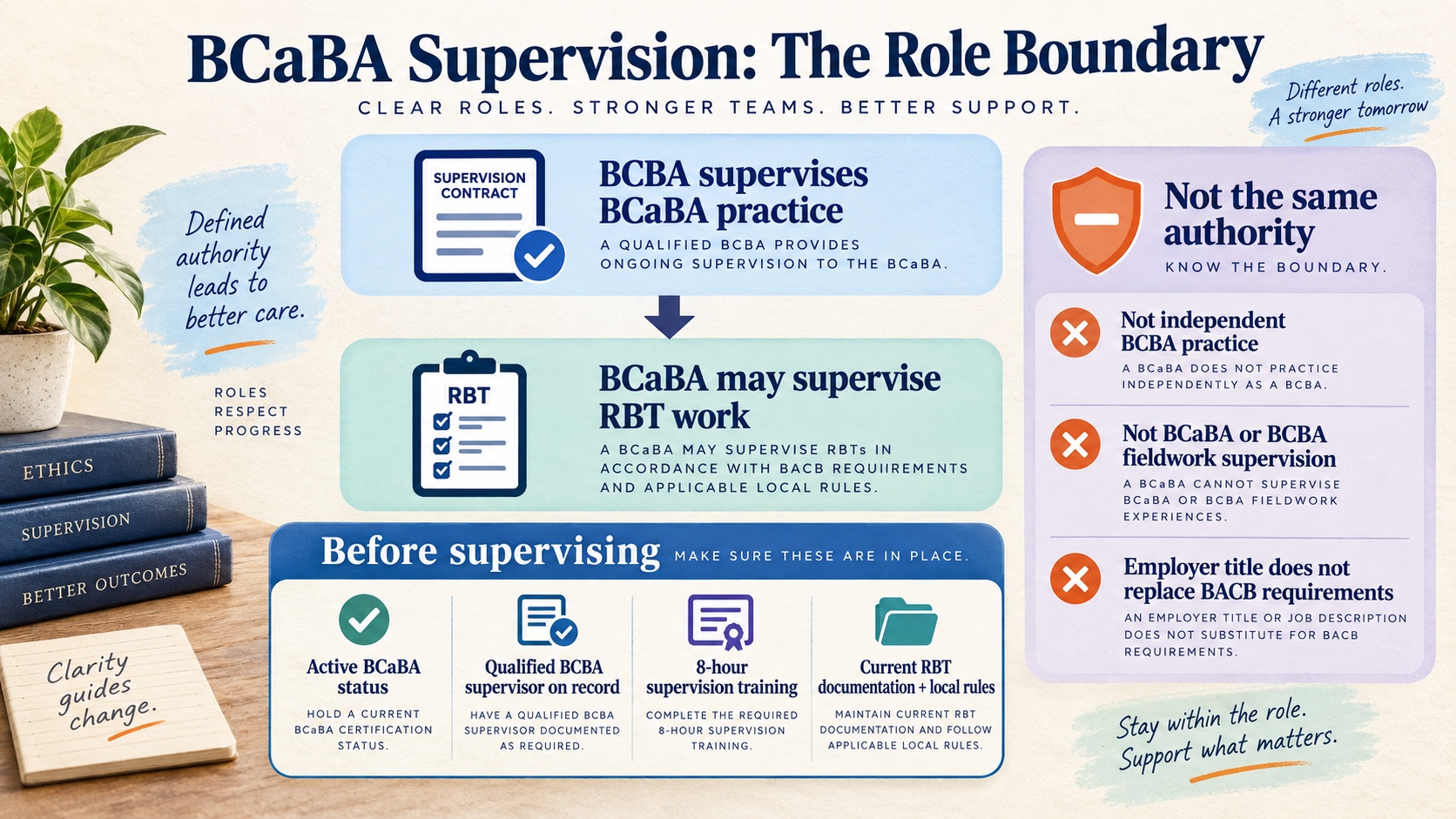
- BCBA → BCaBA: a qualified BCBA supervises the BCaBA’s behavior-analytic practice. The BCBA is responsible for the services the BCaBA provides and the supervisory relationship must be documented under the current BCaBA Handbook.
- BCaBA → RBT: the BCaBA may supervise RBT work within the RBT supervision system. The BCaBA follows the RBT requirements, uses the required records, gives feedback, and operates within the written clinical and organizational structure.
The second arrow does not cancel the first one. A BCaBA can be a supervisor to an RBT and a supervisee to a BCBA at the same time. That layered relationship is normal in a service organization, but it must be clear to everyone involved. The RBT should know who is responsible for supervision, and the BCBA should know how the BCaBA’s supervision and RBT responsibilities fit together.
What must be in place to supervise an RBT?
The BACB’s current Supervision, Assessment, Training, and Oversight page lists BCaBA as a role that may serve as an RBT Supervisor. That permission is not a shortcut around the rest of the requirements. Before accepting responsibility for an RBT, confirm the following:
- Active BCaBA status and BCBA oversight: the BCaBA has a qualified BCBA supervisor on record and is practicing under that relationship. The BCaBA Handbook says that a BCaBA without a qualified supervisor is inactive and may not use the certification, including to supervise RBTs.
- Required supervision training: the supervisor has completed the current 8-hour supervision training based on the Supervisor Training Curriculum Outline (2.0) before supervising an RBT who requires ongoing supervision.
- Clear responsibilities: the BCBA, BCaBA, RBT Supervisor, and RBT Requirements Coordinator understand who observes the RBT, reviews performance, handles concerns, and maintains the BACB records.
- Current RBT documentation: use the applicable RBT Handbook, supervision forms, contact requirements, feedback records, and organizational procedures. Keep documentation as the work occurs rather than trying to reconstruct it later.
- Competence and local compliance: the supervisor works within defined competence and checks state licensure, employer policy, and payer rules. BACB certification alone does not answer every local practice question.
“I am a BCaBA” is therefore only the starting credential question. The safer question is “Am I an active BCaBA with the required BCBA oversight, supervision training, role competence, and documentation system for this RBT relationship?”
What can a BCaBA not supervise?
A BCaBA should not present the RBT-supervisor role as permission to supervise candidates collecting BCaBA or BCBA fieldwork. The BACB role matrix assigns supervision of that certification fieldwork to a BCBA. A BCaBA also should not represent themselves as an independent BCBA, make decisions reserved for a qualified supervisor, or sign a document simply because an employer asks for a signature outside the current BACB process.
The boundary also applies to RBT training and assessment. The current BCaBA Handbook says that an inactive BCaBA may not provide RBT 40-hour training, complete RBT competency assessments, or complete RBT Certification Application Attestation forms. An active BCaBA may have additional responsibilities in these areas only when the current BACB role and training requirements are met.
What does this look like in practice?
Imagine an organization where a BCBA oversees a BCaBA, and the BCaBA provides day-to-day supervision to an RBT. The BCBA and BCaBA document their supervisory relationship. The BCaBA has completed the required supervision training, is added through the organization’s current RBT process, observes the RBT, gives feedback tied to the written plan, and escalates clinical or ethical concerns to the BCBA. The RBT knows both the immediate supervisor and the BCBA responsible for the larger service structure.
Now change one fact: the BCaBA no longer has a qualified BCBA supervisor on record. The BCaBA should not continue using the certification or supervising RBTs until the status and supervision relationship are corrected. A busy schedule or a supervisor’s informal verbal agreement does not replace the current handbook requirements.
What should you check around the 2027 changes?
The BACB is publishing updated BCaBA requirements and transition guidance for 2027. Do not assume that a summary written before the transition answers every future supervision question. Before starting or renewing a supervisory relationship, open the current BCaBA Handbook, RBT Handbook, and BACB Supervision, Assessment, Training, and Oversight page. Then confirm any state, employer, and payer rules that also apply.
For role and credential study, see the ABA Study Online BCaBA learning path and the RBT learning path. These resources can explain concepts and study distinctions, but they cannot create a BACB supervisory relationship or replace individualized professional guidance.
BCaBA supervision FAQ
Can a BCaBA supervise an RBT? Yes, the current BACB role guidance allows a BCaBA to serve as an RBT Supervisor when applicable supervision training, active status, documentation, competence, and local rules are satisfied.
Does a BCaBA still need a BCBA supervisor? Yes. The BCaBA provides services under BCBA supervision. Without a qualified supervisor, the BCaBA is inactive and may not use the certification.
Can a BCaBA supervise another BCaBA? Do not assume so. The current role matrix assigns supervision of BCaBAs to a BCBA or a qualified licensed psychologist under the stated requirements.
Does a BCaBA need 8-hour supervision training? A supervisor of current BCaBA or RBT certificants who require ongoing supervision must complete the current 8-hour supervision training before providing that supervision. Check the live BACB page and handbook for the exact role and implementation details.