BOOST ABA Exam Prep: What It Includes and How to Compare It
If you searched for BOOST ABA Exam Prep, you may be trying to find the official product site, decide whether a format fits your certification track, or understand how the product line differs from a single mock exam. The name appears across study tools, practice tests, flashcards, bundles, and institutional support, so the first useful step is to identify which job you need the product to do.
This guide summarizes the current public BOOST information from ABA Technologies and gives you a neutral comparison framework. It is not an ABA Technologies page, a BACB resource, or a promise that any commercial prep product will produce a particular exam result. Your official eligibility, registration, examination terms, and certification requirements come from the BACB and the current source for your certification track.
Quick answer: what BOOST is
BOOST ABA Exam Prep is a commercial study and assessment product line from ABA Technologies. Its public overview describes resources for people preparing for RBT, BCBA, BCaBA, and QBA certification, while the product catalog lists several study formats rather than one single course. Depending on your goal, you may encounter a guided study tool, mock exams, bundles, flashcards, or program-level support.
The most important distinction is simple: BOOST is a preparation resource, not the official BACB examination. A product can be designed around a current test content outline and still use original questions, its own scoring, its own feedback model, and its own access rules. Read the provider’s current product page for what is included, then use BACB sources for the rules that determine whether and how you may test.
The BOOST product-line map
ABA Technologies’ public catalog currently presents a family of tools. Names, availability, and access terms can change, so treat this as a routing map rather than a permanent price or feature sheet.
| Product or format | Useful question to ask | What to verify on the current page |
|---|---|---|
| ABA Pro Builder | Do I need guided study, practice, or fluency work? | Track alignment, included modules, feedback, access, and whether it is sold for individuals or programs. |
| Mock Exam A or B | Do I need a full-length rehearsal and post-test diagnosis? | Question count, blueprint edition, timing, attempts, review rules, score reporting, and access period. |
| Mock-exam bundles | Would multiple forms support a baseline-and-repair cycle? | Which products are included, whether forms are distinct, and how long the bundle remains available. |
| Behavior Tech Mock Exam | Is my target the behavior-technician exam rather than BCBA preparation? | Current track, current RBT outline, question format, and the boundary between practice and certification. |
| BOOST SAFMEDS | Would fluency practice help me retrieve terms quickly? | Card scope, response method, feedback, device access, and how the cards connect to deeper application practice. |
| Institutional or partnership support | Am I choosing resources for a cohort, university, or company? | Customization, analytics, guided review, group purchasing, and who receives learner data. |
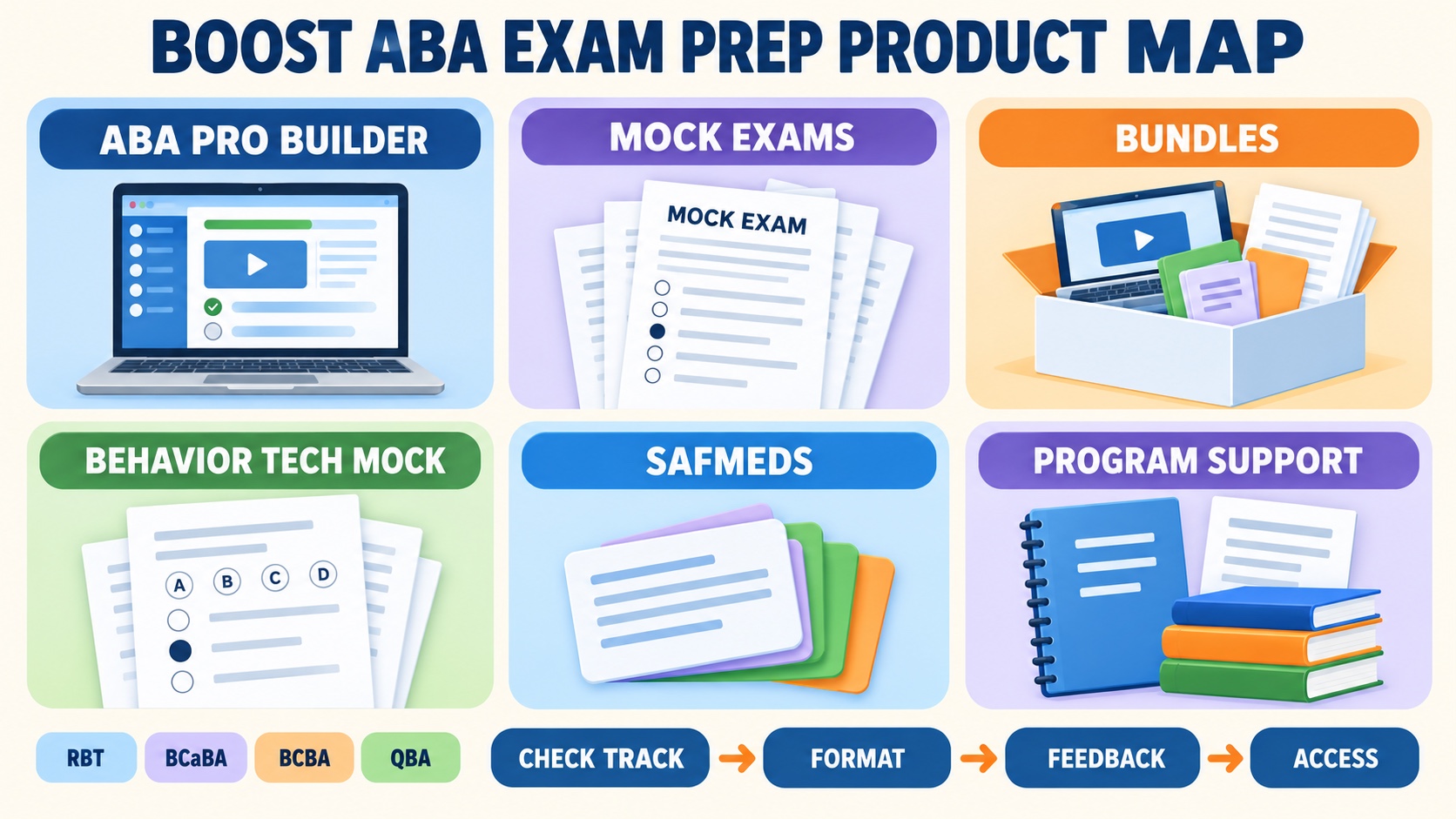
The product map also explains why a generic recommendation can be misleading. Someone who needs short retrieval practice may not need the same format as someone who wants a timed rehearsal. A university or employer may care about cohort analytics and guided review in a way that an individual learner does not. Start with the study problem, not only the product name.
How to choose a track and format
BCBA or BCaBA preparation
If you are preparing for the BCBA or BCaBA examination, first identify the current test content outline for your credential. Then ask whether the product you are considering names that edition and whether its practice spans the full blueprint or only selected topics. For BCBA learners, the current 6th-edition outline organizes 104 tasks into nine domains. For BCaBA learners, the 6th-edition outline has its own task and question distribution. A tool that is appropriate for one credential should not automatically be described as equivalent preparation for the other.
Use the accepted BCBA learning route or BCaBA learning route to separate concept review from official application and examination steps. If the question you really have is about full-length BOOST mocks, the narrower mock-exam comparison route is the better next page than repeating the entire product-line overview here.
RBT preparation
RBT preparation has its own current outline and certification process. A behavior-technician mock or flashcard product may be useful, but it does not replace the training, competency assessment, supervision, application, or examination requirements that apply to the credential. Check whether a study tool names the current RBT edition and whether its examples reflect the response format you need.
Short practice can be especially useful when you are learning terminology or measurement procedures. Full-length practice is more useful when you need to rehearse pacing and sustained decision-making. The best sequence depends on how much of the material you already understand; do not use a full-length score as your first and only diagnosis.
QBA or another route
The BOOST overview also names QBA preparation. That is a reminder to verify the governing organization and current examination source for your specific credential. BACB materials govern BACB credentials; a provider’s general “ABA exam prep” label does not make every product interchangeable across organizations. Keep the credential, blueprint, eligibility rule, and practice tool in separate columns when you compare them.
The official BACB boundary
The BACB content-outline index currently lists the BCBA and BCaBA 6th-edition outlines and the RBT 3rd-edition outline beginning January 1, 2026. The BCBA outline states that the examination includes 175 scored questions and 10 unscored pilot questions across nine domains. Those official documents describe the examination content; they do not turn a commercial study product into an official BACB resource.
When a product page says that it is aligned with a blueprint, ask what that means in practice. It might mean that the provider maps questions to domains, uses similar task labels, or builds a study sequence around the outline. It does not mean the product contains official exam questions, that the BACB reviewed the product, or that a score on the product predicts your official result.
Keep three decisions separate:
- Eligibility: whether your education, fieldwork, training, assessment, and application meet the official requirements.
- Registration: how and when you schedule the official examination, including current terms and accommodations information.
- Preparation: how you learn, practice, measure, and repair your own weak areas.
A commercial tool belongs in the third column. It can support preparation, but it cannot approve the first two.
What to compare before choosing
Before you pay, enroll, or ask a program to purchase a product, use this checklist:
- Edition and date: Does the provider identify the current outline and say when the page was checked?
- Track fit: Is the product designed for your credential, or is a broad ABA label doing too much work?
- Practice format: Do you need flashcards, short quizzes, guided lessons, full-length mocks, or a mixture?
- Feedback quality: Does feedback explain why an answer is right, why alternatives fail, and what concept to revisit?
- Diagnostic usefulness: Can the results identify a domain, task, error type, or confidence pattern?
- Access rules: Check attempts, expiration, review access, device requirements, and refund or transfer terms.
- Independence: The page should clearly distinguish provider materials from BACB-owned examination content.
- Next action: Do you know what you will do after a low score, uncertain answer, or repeated error?
Question count is only one part of the decision. A large bank can still be difficult to use if explanations are shallow or results do not connect to a concrete repair plan. Conversely, a smaller tool may be useful if it gives you clear feedback and makes it easy to return to the exact skill you missed.
How to use a prep tool well
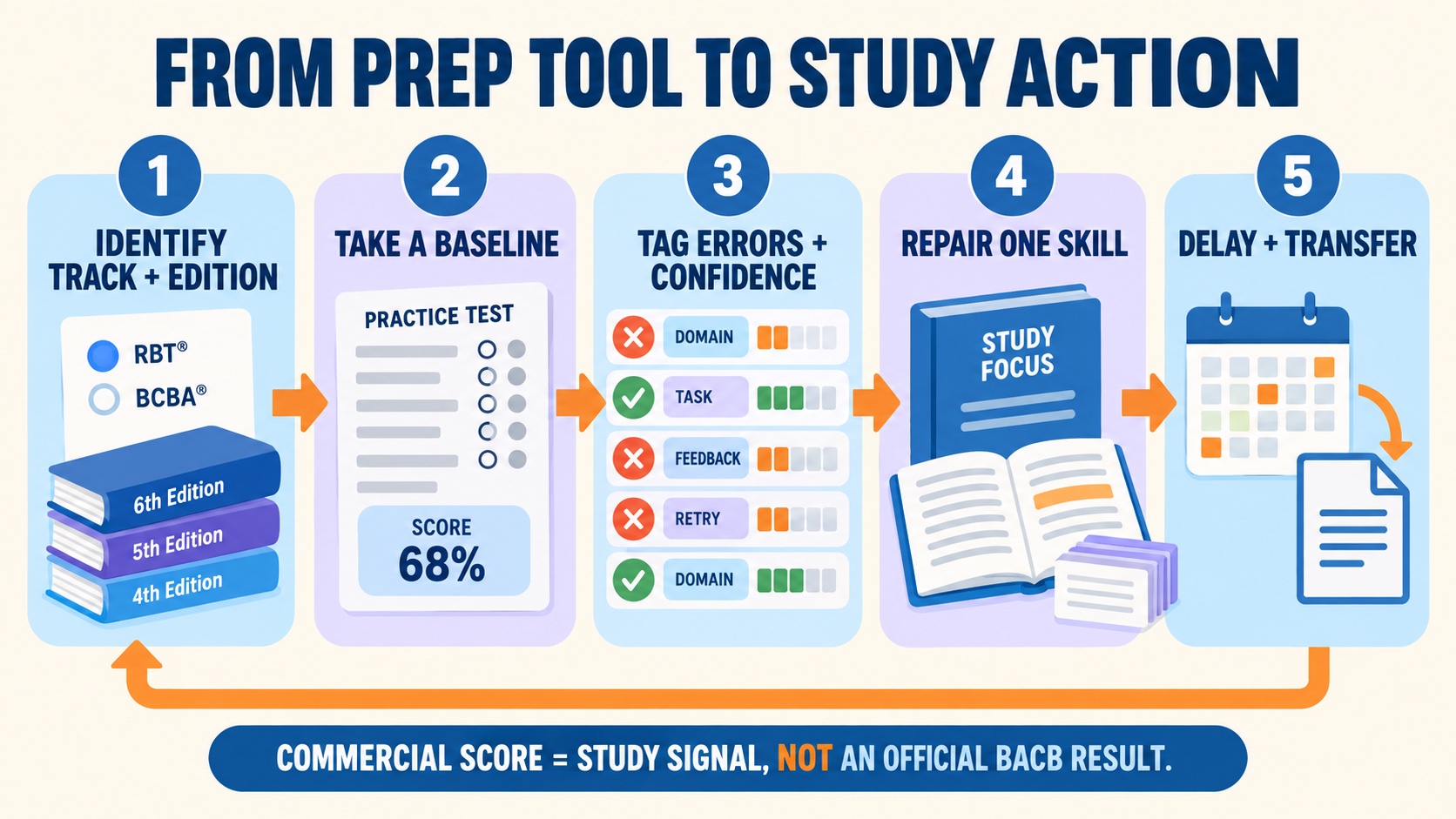
Use a simple loop: baseline, tag, repair, delay, and transfer. Begin with a reasonable sample under conditions that you can describe. After each missed or uncertain item, record the track, domain, concept, error type, and confidence before seeing the explanation. A wrong answer caused by a terminology confusion needs a different repair from a wrong answer caused by rushing through a graph.
Choose one repair action instead of rereading everything. You might explain the distinction aloud, work a new scenario, draw the contingency, label a data display, or complete a short set without looking at the answer. Wait before trying a similar set. Then test whether the skill transfers to a new context rather than only repeating the original wording.
If the tool provides analytics, treat them as study signals. A domain percentage can tell you where to look; it cannot tell you why every error happened or what the official exam will do. Keep your own error log so the next study session is based on observable patterns rather than anxiety or a single score.
FAQ
What is BOOST ABA Exam Prep?
BOOST ABA Exam Prep is a commercial ABA study and assessment product line from ABA Technologies. Its public overview names RBT, BCBA, BCaBA, and QBA preparation, while its catalog lists multiple formats such as study tools, mock exams, bundles, and SAFMEDS.
Is BOOST an official BACB exam?
No. BOOST is preparation material. Even when a product is aligned with a current BACB outline, it is not the official examination, does not grant certification, and should not be presented as BACB endorsement.
Is BOOST only for BCBA students?
No. The public overview names several certification routes, but you still need to verify the exact track and product before studying. RBT, BCaBA, BCBA, and QBA requirements are not interchangeable.
Should I start with a mock exam?
Not necessarily. A mock can be useful as a baseline when you know enough of the content to interpret the result. If you are still learning core terms, short lessons or retrieval practice may produce a more useful first diagnosis. In either case, plan how you will review feedback before you begin.
Does a prep score predict my official result?
No. Use it as evidence about performance on that product, form, and testing condition. It can help you choose the next study action, but it cannot establish eligibility, official readiness, or a pass guarantee.
Sources and next steps
- ABA Technologies BOOST ABA Exam Prep overview
- ABA Technologies BOOST partnerships and program offerings
- ABA Technologies exam-prep and study-tools catalog
- ABA Technologies BOOST mock exams
- BACB BCBA Test Content Outline (6th ed.)
- BACB test content outlines
- BACB examination information
- ABA Study Online BCBA practice questions
- ABA Study Online app practice loop
Build your next practice step
If you want an independent place to establish a baseline, review explanations, and plan targeted follow-up, explore ABA Study Online’s mock-exam and practice resources. Our materials are unofficial and independent of the BACB; they do not guarantee a pass or replace official certification requirements.