Board Certified Behavior Analyst Examination: What the BCBA Exam Is—and What It Is Not
The phrase Board Certified Behavior Analyst examination sounds formal, but it usually points to a familiar search: the BCBA examination. The important follow-up is not only “How many questions are on it?” It is also “Which official document tells me that?” and “Is passing the exam the same as becoming certified?”
The current BACB materials separate those answers across the BCBA Handbook, the Examination Information page, the BCBA Test Content Outline (TCO), and the certification-requirements pages. This guide maps those documents, summarizes the current exam boundary, and explains how to read 6th-edition and 2027 language without turning a pathway update into an unsupported claim about a new examination edition.
This is independent educational information. It is not a BACB publication, does not determine eligibility, and cannot promise a passing result.
Quick answer: The Board Certified Behavior Analyst examination is the BCBA certification examination administered through the BACB’s examination process. The current handbook describes a four-hour, English, computer-based examination with 185 multiple-choice questions: 175 scored questions and 10 unscored pilot questions. The current BCBA TCO (6th ed.) describes the knowledge and skills represented on that examination. Passing the examination is one part of a certification process; it is not, by itself, a complete eligibility decision.
The examination versus the certification pathway
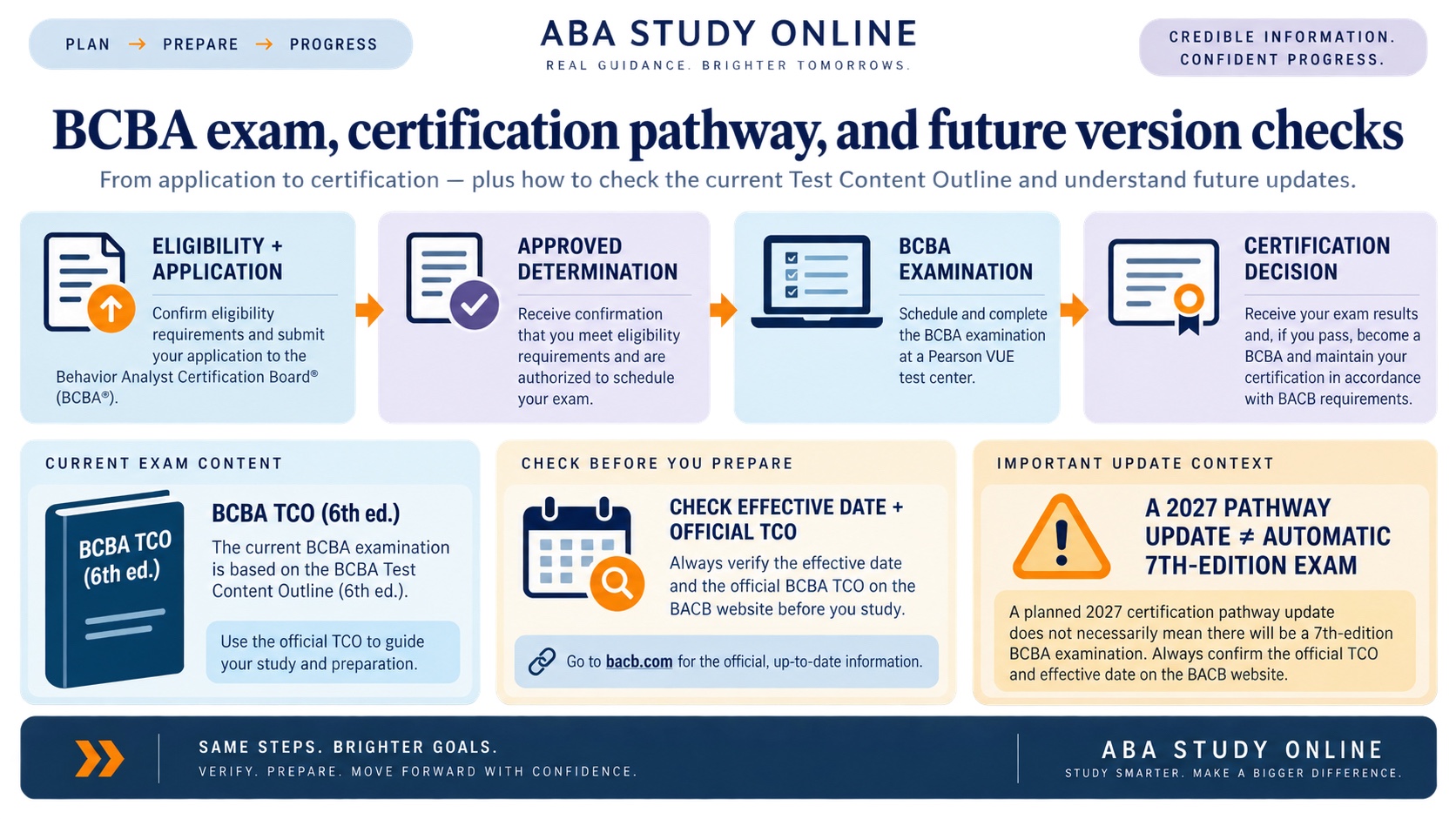
“BCBA exam” and “BCBA certification” are related terms, but they are not interchangeable. The examination is an assessment event. Certification is the larger professional process that includes meeting the applicable eligibility requirements, submitting an application, receiving an approved determination, taking the examination, and maintaining the credential under current BACB rules.
The BACB Examination Information page describes the sequence in practical terms: once an applicant meets the applicable requirements and receives an approved determination, the applicant schedules and pays for the examination through Pearson VUE. That order matters. A person cannot use a practice score or a study plan as proof that an application has been approved.
For the requirements themselves, use the current BCBA certification requirements checklist and confirm the final details on the BACB’s live certification pages. Requirements can include education, coursework, fieldwork, documentation, and application steps. Those details belong to the eligibility pathway, not to the exam question count.
The current official exam snapshot
The current BCBA Handbook gives the details a candidate usually wants when searching for the examination name:
- Language: The examination is offered in English.
- Length: The allocated time is four hours.
- Questions: There are 185 multiple-choice questions in total: 175 scored and 10 unscored questions.
- Answer format: Each question has four possible answers and one correct answer.
- Delivery: The BACB uses computer-based testing at authorized Pearson VUE testing sites and certain military bases that meet the stated security requirements.
The time allocation is not necessarily four hours of uninterrupted answering. The handbook explains that the appointment includes items such as the terms and conditions, a navigation tutorial, loading time, the examination, and any review. Breaks are taken on the candidate’s own time, so the clock does not stop for a break. Always read the live handbook and Pearson VUE instructions before test day because procedures can change.
The 10 unscored questions are not a separate section that you can identify in advance. For study planning, treat every item as worth careful reasoning. For score interpretation, do not try to reverse-engineer which questions were scored or use a guessed raw cutoff. The BACB’s passing standard is criterion referenced; an independent practice percentage is not the official passing standard.
What the 6th-edition TCO controls
The BCBA Test Content Outline (6th ed.) is the document to open when your question is “What content and tasks does the examination represent?” BACB says this outline describes content appearing on the BCBA certification examination beginning in 2025. It contains 104 tasks organized into nine domains.
| Domain | Scored-question planning signal | What it covers at a high level |
|---|---|---|
| A. Behaviorism and Philosophical Foundations | 8 / 175 | Scientific goals, assumptions, radical behaviorism, and ABA dimensions |
| B. Concepts and Principles | 24 / 175 | Behavioral concepts, contingencies, schedules, verbal behavior, and related processes |
| C. Measurement, Data Display, and Interpretation | 21 / 175 | Measurement choices, data displays, and interpretation |
| D. Experimental Design | 13 / 175 | Design logic, threats, and interpretation of experimental arrangements |
| E. Ethical and Professional Issues | 22 / 175 | Ethical decisions, professional conduct, and responsibilities |
| F. Behavior Assessment | 23 / 175 | Assessment questions, data, and decision-making |
| G. Behavior-Change Procedures | 25 / 175 | Procedures used to establish, increase, decrease, or maintain behavior |
| H. Selecting and Implementing Interventions | 20 / 175 | Intervention selection, implementation, monitoring, and adjustment |
| I. Personnel Supervision and Management | 19 / 175 | Supervision, training, performance, and management systems |
The counts above are a planning signal for the 175 scored questions, not nine separate pass marks. The TCO does not tell you which task will appear next, and a study plan should not pretend to know the live item bank. Use the domains to check coverage and use the individual task statements to decide what you can explain or apply.
Which official document answers which question
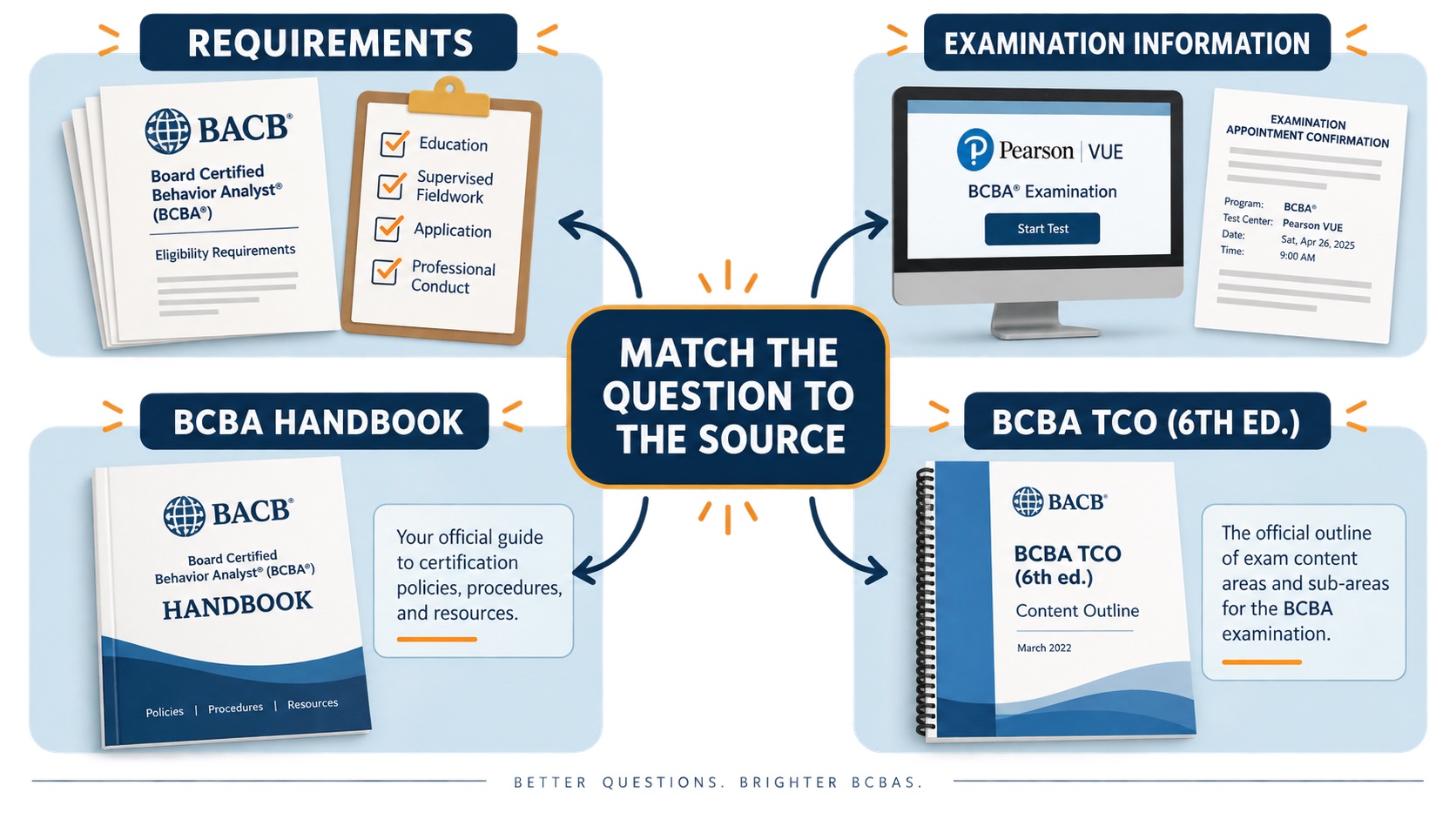
Many confusing search results come from using the right document for the wrong question. A simple source map helps:
- “Am I eligible, and what do I submit?” Start with the current BCBA certification requirements and handbook sections about eligibility and application.
- “What happens when I schedule or arrive?” Read the BCBA Handbook and the BACB Examination Information page. These cover delivery, identification, breaks, security, cancellation or rescheduling boundaries, and accommodations.
- “What content should I study?” Read the BCBA TCO (6th ed.) and its 104 task statements. Pair it with the current Ethics Code and your training materials when the task requires them.
- “Where do I register?” Follow the current BACB examination resource page to Pearson VUE. Do not rely on an old screenshot, an unofficial registration link, or a study-site claim.
- “What score do I need?” Use BACB’s official examination information. Do not replace its criterion-referenced process with a fixed percentage copied from an independent quiz.
The BACB also says that it cannot endorse specific study guides and that purchasing a study product does not guarantee a pass. That boundary is useful when comparing courses, question banks, apps, or mock exams: ask whether the product identifies its sources, explains its questions, and states what it cannot promise.
How to study from the official boundary
Start with the TCO as a coverage map, not as a list to memorize without context. For each task, write a short explanation, a concrete example, and one contrast with a likely distractor. For instance, if a task asks you to distinguish two procedures, practice identifying the purpose, the observable arrangement, and the evidence that would support each choice. This is more informative than copying a definition into a flashcard and never applying it.
Use retrieval practice with feedback. Answer a question before looking at the explanation, mark answers that felt uncertain even when correct, and record the reason for each error. Then return to the source and answer a new scenario later. Research on learning techniques supports retrieval practice and feedback as useful study methods, but it does not turn one mock score into an official prediction.
For a detailed current-exam orientation, see BCBA Test: Current Exam Structure, Content, and Study Boundaries. For a question-first routine, use BCBA test preparation. If you need a mock result, read the scope notes on the ABA Study Online mock-exam area and review the errors rather than treating the percentage as a guarantee.
2027 and the edition question
Searchers sometimes see a 2027 BCBA requirement or transition page and conclude that the examination must already be based on a “7th edition.” That conclusion is too strong without an official BACB statement. The current BACB TCO index lists the BCBA TCO (6th ed.) under the sixth-edition outline heading effective January 1, 2025. It separately identifies the RBT TCO (3rd ed.) beginning January 1, 2026.
A pathway or eligibility change can affect what an applicant must do without automatically replacing the examination-content outline. Check the effective date and the exact document name. The BACB’s February 2026 newsletter also clarifies that the current examination documents are Test Content Outlines rather than documents that should continue to be called task lists. That terminology update is not, by itself, evidence of a BCBA 7th-edition exam.
For any future transition, use the live BACB source as the final authority. A responsible study page should show the date it checked the source, link to the current document, and avoid writing “the 7th edition is confirmed” until BACB confirms that exact change.
Common mistakes
- Using the formal name as if it were a different credential: It generally refers to the BCBA examination, not a separate “board certified behavior analyst” test.
- Confusing the exam with certification: Passing the examination does not replace the eligibility and application process.
- Studying from an old task list without checking the TCO: Use the current BACB outline and terminology.
- Inventing a raw passing percentage: Practice percentages and official passing standards are not interchangeable.
- Treating a 2027 pathway change as a confirmed 7th edition: Confirm the exact outline, effective date, and source.
- Trusting an “updated” study product without a source map: Look for direct links to BACB documents and clear scope limits.
FAQ
Is the Board Certified Behavior Analyst examination the same as the BCBA exam?
Yes. The formal phrase normally refers to the examination required in the BCBA certification process. The BACB’s own pages use “BCBA examination” and “BCBA certification examination” language.
How many questions are on the current BCBA examination?
The current BCBA Handbook describes 185 multiple-choice questions: 175 scored and 10 unscored. It also states that each question has four possible answers and one correct answer.
Is the BCBA TCO the same thing as a study guide?
No. The TCO is a content outline. It identifies tasks and domains represented on the examination; it does not teach every concept, provide live questions, or guarantee that a candidate is ready.
Does a 2027 update mean the BCBA exam is now 7th edition?
Not automatically. A requirements or transition update and an examination-content-outline change are separate claims. Check the current BACB TCO index and any official transition notice before using a new-edition label.
Can an online mock score tell me whether I will pass?
No. An independent mock score is a study signal for that particular set and day. Review the source alignment, error pattern, and explanations, then use official BACB materials for examination and certification decisions.
Sources
- BACB BCBA examination resources
- BACB Board Certified Behavior Analyst Handbook
- BACB Examination Information
- BACB BCBA Test Content Outline (6th ed.)
- BACB Test Content Outlines for BACB Certifications
- BACB February 2026 Newsletter
- Dunlosky et al. (2013), learning techniques review
- Roediger & Butler (2011), retrieval practice review