Best BCBA Mock Exams: How to Choose Practice That Actually Helps
Searching for the best BCBA mock exams usually means you want practice that feels serious, matches the current exam blueprint, and tells you what to study next. A long question count alone cannot answer that. The useful comparison is whether a mock exam maps to the current BCBA Test Content Outline (6th ed.), asks you to apply concepts to scenarios, explains why an answer is best, and turns your results into a focused study plan.
This guide gives you a practical way to evaluate mock exams, whether you are buying a standalone test, using an app, or comparing a free sample with a paid product. It does not rank a third-party provider, claim that any mock is identical to the live examination, or guarantee a passing result. The BACB recommends using the current TCO, Ethics Code, and training materials, and it does not endorse specific study guides or preparation products.
Quick answer: the best BCBA mock exam for you should use the current BCBA TCO (6th ed.), cover the nine domains in a sensible way, require scenario-based application, provide accurate rationales, show domain-level feedback, offer realistic timing, and make it easy to review mistakes. It should also state its version, access terms, price, and limitations clearly. Treat a mock score as study data—not as a prediction or promise about the live exam.
Start with the current BCBA blueprint
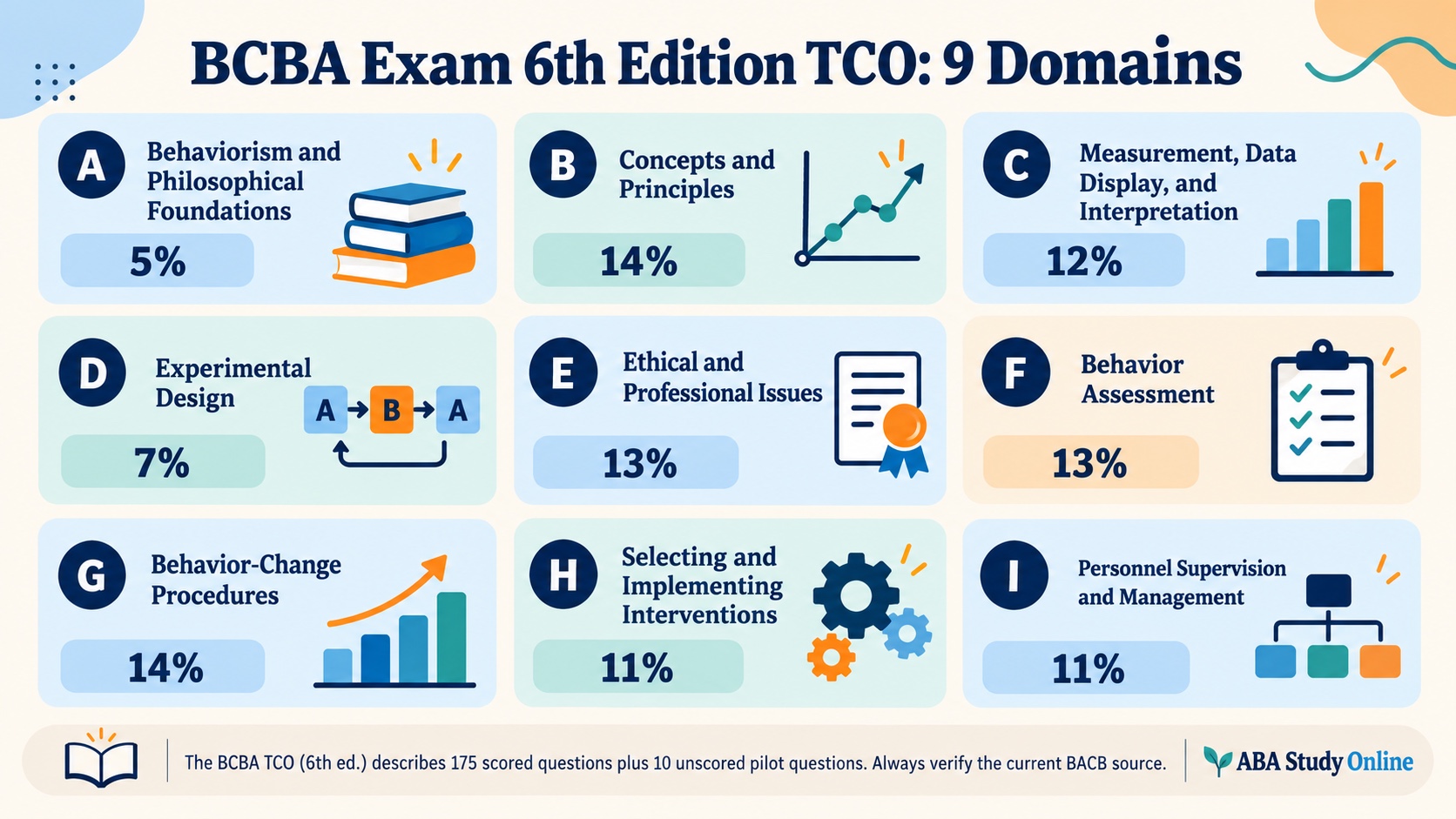
The BCBA TCO (6th ed.) describes 104 tasks across nine domains. It lists 175 scored questions and 10 unscored pilot questions. The current BCBA Handbook describes the examination as 185 multiple-choice questions completed in four hours, with four answer choices and one correct answer per question. A serious mock should explain what it mirrors and which parts are practice design rather than an official BACB exam feature.
The domain weighting gives you a useful first comparison:
- A. Behaviorism and Philosophical Foundations: 5%
- B. Concepts and Principles: 14%
- C. Measurement, Data Display, and Interpretation: 12%
- D. Experimental Design: 7%
- E. Ethical and Professional Issues: 13%
- F. Behavior Assessment: 13%
- G. Behavior-Change Procedures: 14%
- H. Selecting and Implementing Interventions: 11%
- I. Personnel Supervision and Management: 11%
Weighting is not the same as quality. A mock can match percentages and still use weak distractors, vague stems, outdated terminology, or explanations that merely repeat the correct answer. Use the blueprint as a coverage check, then inspect the thinking the items require.
Six features worth comparing
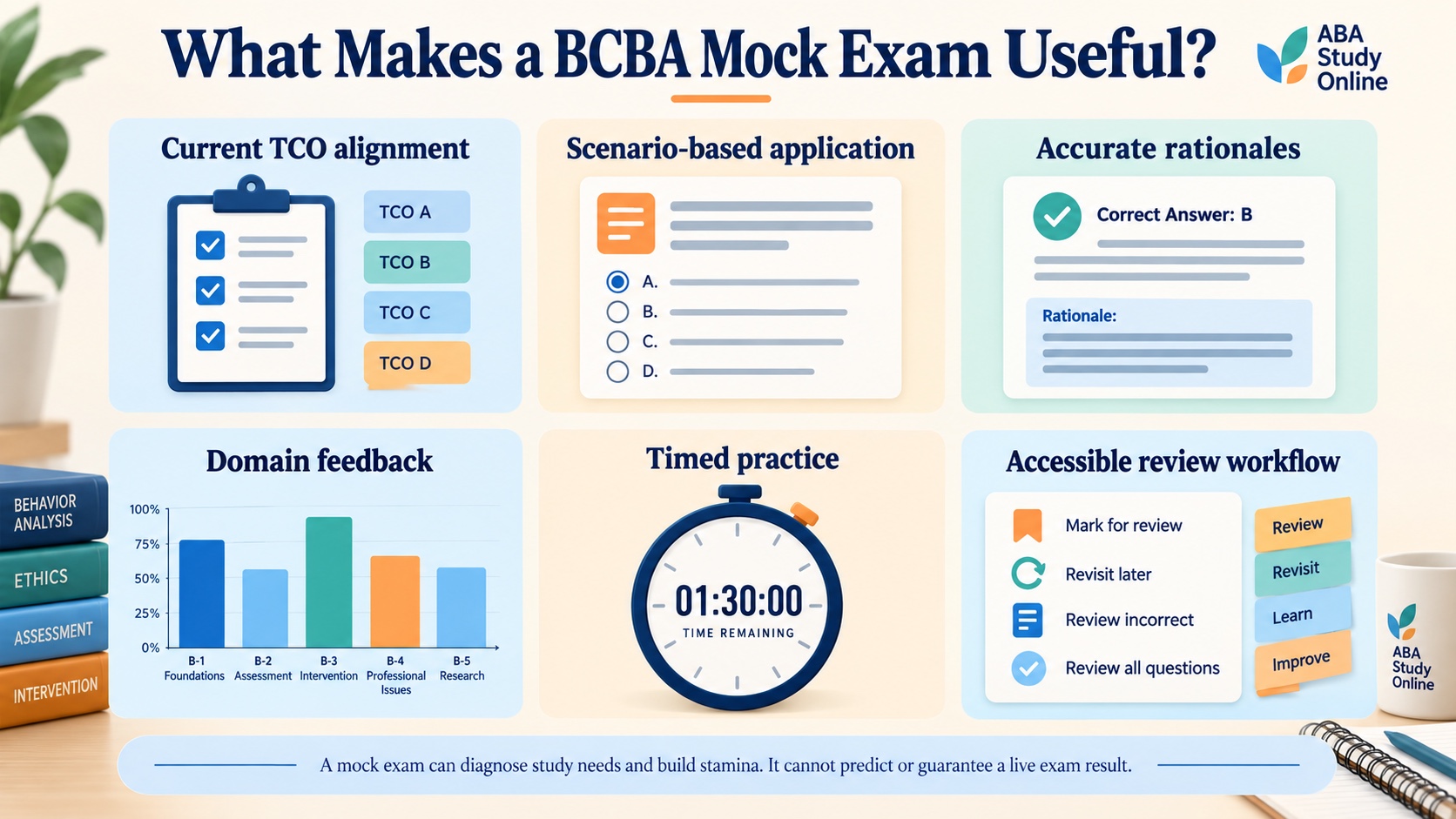
1. Current TCO alignment
Look for the exact TCO edition, domain labels, task references, and a revision date. “BCBA aligned” is not enough. A provider should tell you whether questions are tagged by domain, task, skill, or an internal category. If a product still highlights a retired outline without explaining the transition, treat that as a warning.
2. Scenario-based application
BCBA questions are not only vocabulary checks. Strong practice asks you to interpret data, identify the most appropriate assessment, select an intervention, apply ethical reasoning, or choose the best supervisory response. Good distractors should be plausible but wrong for a specific reason. If every item can be answered by spotting a memorized definition, the mock may not be challenging the reasoning you need.
3. Accurate rationales
A rationale should explain why the best answer fits the facts and why the alternatives do not. It should use precise ABA terminology, distinguish similar procedures, and point to a source or TCO area when appropriate. A short rationale can be excellent if it teaches the decision rule; a long paragraph can still be unhelpful if it only restates the answer.
4. Domain-level feedback
After a mock, you need more than a total percentage. The report should help you see whether misses cluster around measurement, assessment, ethics, interventions, supervision, or another domain. Domain feedback is not a diagnosis of your future exam result, but it can help you choose the next study block.
5. Realistic timing
Timed practice is useful because fatigue and pacing influence how you read long scenarios. Look for a full-length option, a visible timer, instructions about breaks, and a review mode that does not erase your answers. Short quizzes still have value, but they should not be marketed as a full simulation.
6. An accessible review workflow
Can you mark an item, return to it, review the rationale, filter missed questions, and revisit a domain later? Can you use the material on your device and understand the charts or feedback? Review features turn a mock from a one-time score into a reusable learning tool.
What strong questions should require
Read a free sample before buying if one is available. Ask what mental work the item requires:
- Can you identify the relevant facts and ignore distracting details?
- Do you need to distinguish two procedures that share vocabulary?
- Must you interpret a graph, measurement choice, or assessment result?
- Does the item ask for the best response based on ethics, client goals, evidence, or scope?
- Are the distractors wrong for teachable reasons rather than because they are obviously silly?
For example, a question about functional communication training should not be solved by recognizing the phrase alone. The learner should read the consequence arrangement, identify the replacement response, consider whether it contacts the relevant function, and rule out options that merely suppress behavior without teaching a socially meaningful alternative. The point of the mock is to practice the reasoning chain.
How to interpret mock scores
Use your first full mock as a baseline. Note accuracy, time remaining, unanswered items, confidence, and the domains represented in your misses. A low first score is not a verdict; it is information about where to begin. A high score is encouraging, but it is not proof that the live exam will feel the same.
Compare scores only when the conditions are similar. A short untimed quiz, an open-book domain set, and a full timed mock measure different things. Also remember that provider-created scores are not automatically comparable across products. Difficulty, item quality, blueprint coverage, and scoring rules vary.
Do not chase a magic “passing prediction” number. The BACB does not publish a universal mock-exam score that guarantees readiness. Use the results to ask better questions: Which tasks do I miss repeatedly? Do I understand the rationale after review? Can I apply the concept in a new scenario? Is my timing improving without sacrificing accuracy?
A better post-mock review workflow
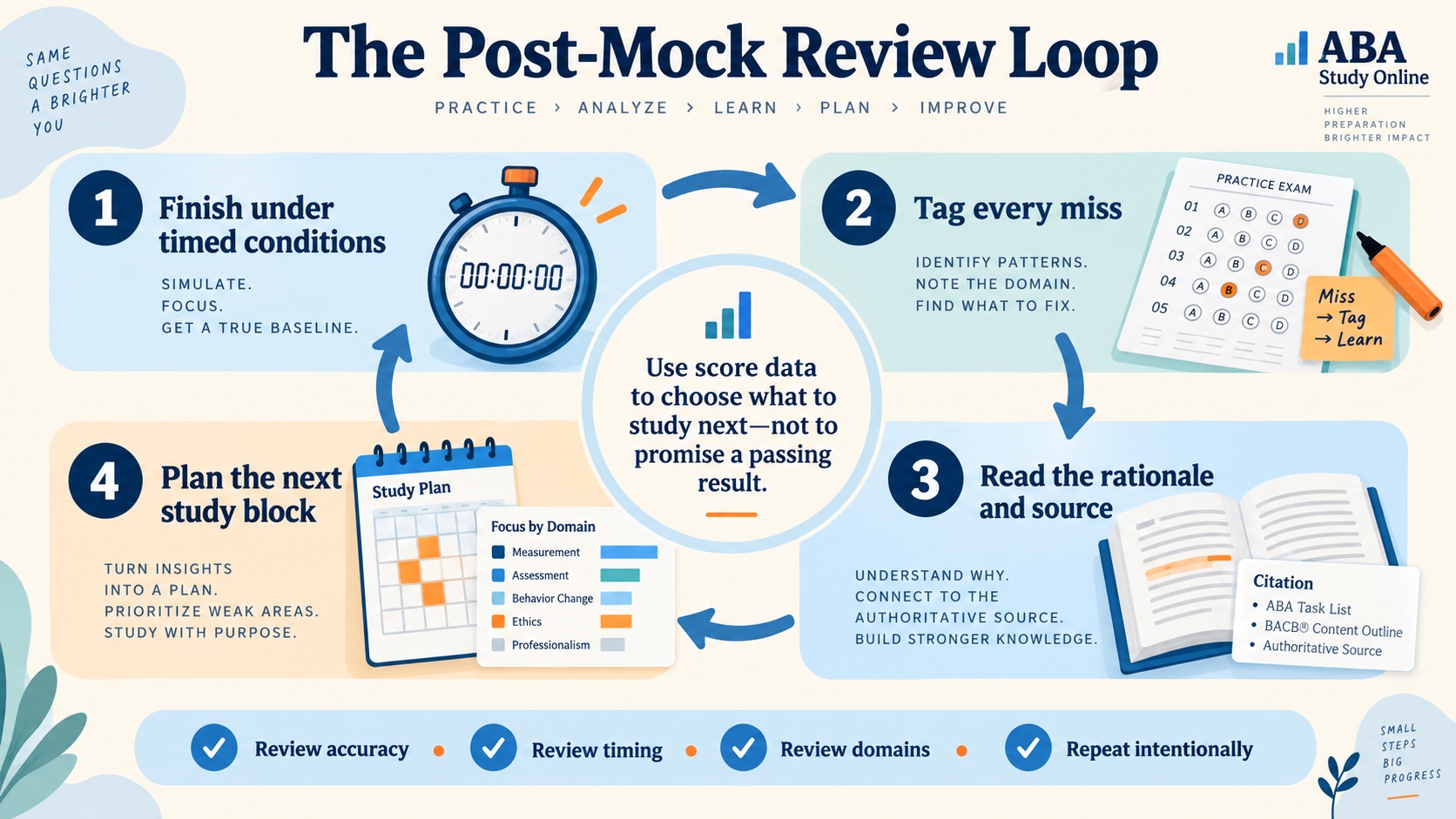
- Finish under timed conditions: create a baseline that tells you how pacing and fatigue affect performance.
- Tag every miss: mark knowledge gap, misread stem, weak discrimination, timing issue, or careless error.
- Read the rationale and source: explain the decision in your own words and check the relevant TCO or training reference.
- Plan the next study block: choose a small number of domains or tasks and practice them in a different context.
- Repeat intentionally: take another timed set after learning, not immediately after memorizing the answer.
What to check before you buy
Use this checklist on a product page or sales call:
- Which BCBA TCO edition and handbook version does it use?
- How many full-length and domain-level practice options are included?
- Are answers explained, and can you review every option?
- Are questions tagged to domains or tasks?
- Can you see score trends and repeat missed questions?
- How long does access last, and what happens after a revision?
- Is the price clear, and can you cancel or change the plan?
- Does the provider clearly say that it is independent and does not guarantee a result?
For learners who want a structured next step, the ABA Study Online mock-exam area can connect practice with domain review. Treat it as a study product, not an official BACB exam or a guarantee. The value should come from accurate questions, useful explanations, and a review process that helps you act on the result.
How free practice fits
Free sample questions are useful for testing a provider’s writing and rationale quality before paying. Free articles and glossary entries can also strengthen terminology and reduce the amount of time you spend looking up basic concepts during review. Use them to build understanding, then add timed and domain-specific practice as your exam date approaches.
Free practice is not automatically a full mock, and a mock is not automatically a complete study plan. Keep the sources separate: official BACB documents for current requirements, academic or training materials for explanation, and practice products for retrieval, application, and feedback.
Common mock-exam mistakes
- Choosing by question count alone: 1,000 weak items do not replace a smaller set with accurate rationales.
- Using the wrong blueprint: confirm the current BCBA TCO (6th ed.) and revision date.
- Taking only untimed quizzes: add full timed practice so pacing becomes a learnable skill.
- Reviewing only the correct answer: study why the distractors fail and what fact would change the decision.
- Repeating a test until the score feels good: memory of the items can inflate the result.
- Treating a mock score as a promise: use it to guide study, never as a pass guarantee.
FAQ
What are the best BCBA mock exams?
The best fit depends on your study stage and needs. Prioritize current TCO alignment, scenario-based items, accurate rationales, domain feedback, realistic timing, and a review workflow. No provider can honestly guarantee that a mock predicts your live result.
How many questions should a BCBA mock exam have?
A full-length simulation should explain how it relates to the current BCBA examination format. Shorter domain sets are still useful for learning. Use both if the product clearly labels the purpose of each format.
Is the BCBA exam based on the 6th Edition TCO?
The BACB’s BCBA TCO (6th ed.) describes the content that appears on the BCBA examination beginning in 2025. Check the current BCBA Handbook and BACB examination resources for the version that applies to your administration.
Can a mock exam guarantee that I will pass?
No. A mock can provide practice, feedback, pacing information, and a way to find weak areas. It cannot guarantee a live exam result.