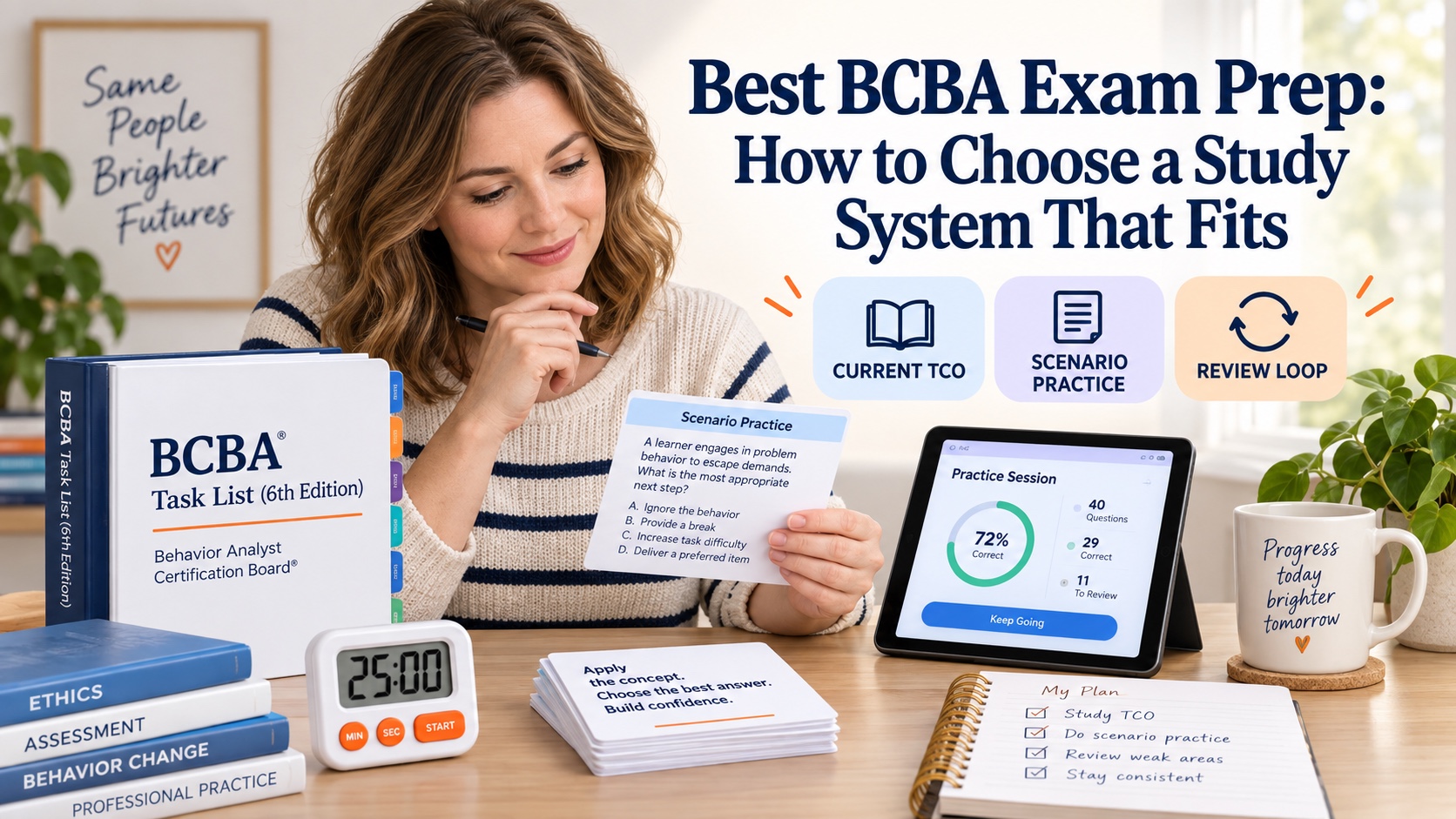
Best BCBA Exam Prep: How to Choose a Study System That Fits
If you search for the best BCBA exam prep, you will see books, courses, question banks, flashcards, apps, mock exams, study groups, and confident claims about what helped someone pass. The hard part is not finding another resource. It is deciding whether a resource will help you learn a concept, reason through a scenario, diagnose a weak domain, or rehearse the conditions of a long exam.
There is no single best product for every BCBA candidate. A useful preparation system is current, track-specific, aligned to the BCBA Test Content Outline, rich in applied explanations, and organized around what your errors show. Use the BACB for the official exam boundary, then compare independent resources by the learning job they actually perform.
Table of Contents
What “best” should mean
Before comparing a course or app, name your current problem. A learner early in preparation may need a clear explanation of measurement, assessment, ethics, or behavior-change procedures. A learner who knows the definitions may need scenario discrimination: choosing the most appropriate action, spotting the missing information, and ruling out attractive but poorly supported answers. A learner near the exam may need timed mixed practice and a calm way to review mistakes.
These are different jobs. A dense textbook can be excellent for reference and still be inefficient for a ten-minute review session. A large question bank can offer repetition and still be weak if explanations only reveal the answer letter. A full mock exam can show pacing and stamina and still be a poor first step if you have not learned how to classify your errors.
A BCBA prep resource scorecard
Use the following questions before you buy or commit time to a resource:
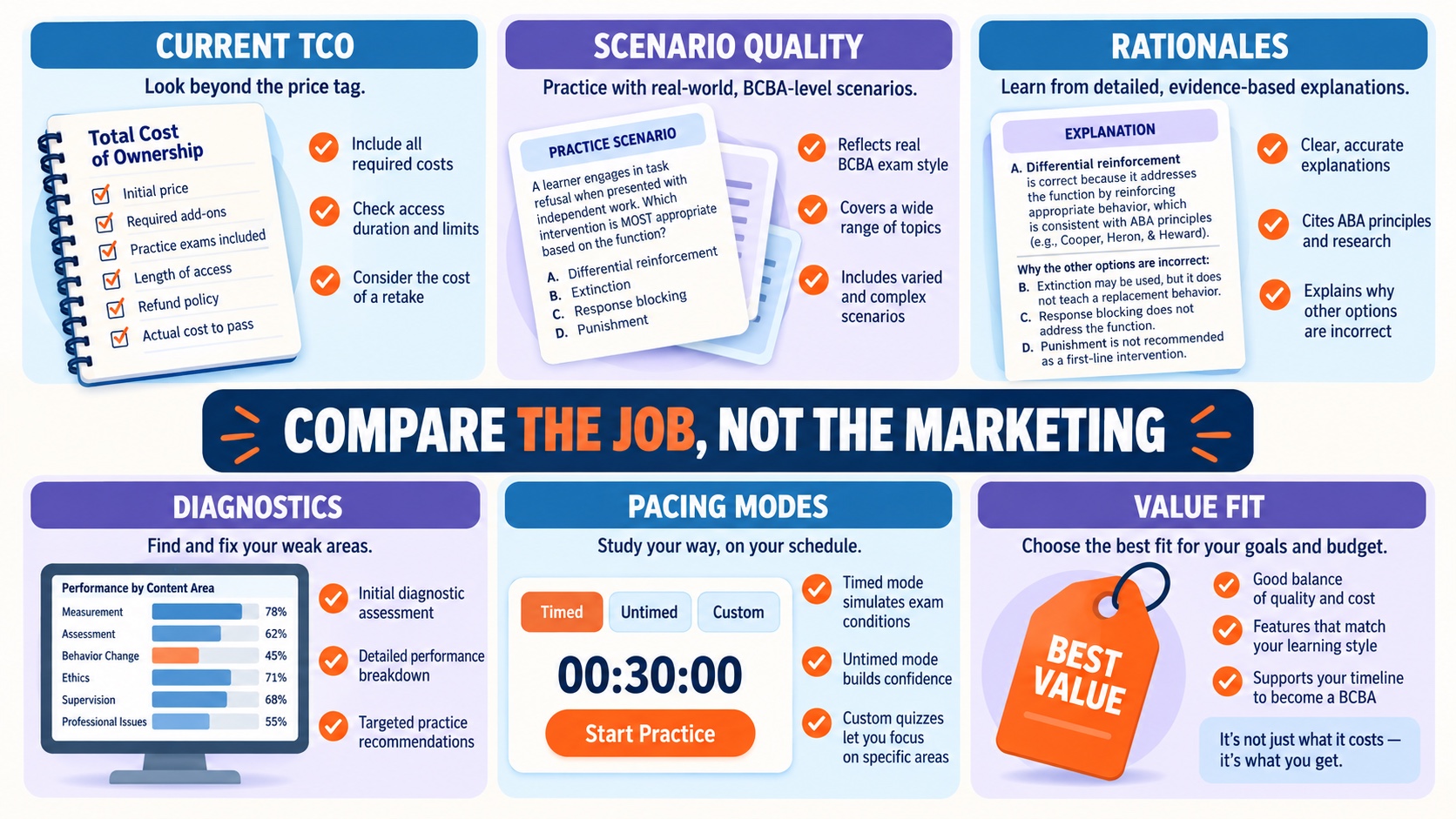
- Does it state the current outline? The BACB’s BCBA TCO6 describes 104 tasks across nine domains. A page that does not name its outline or update boundary is difficult to evaluate.
- Are scenarios doing real work? Strong practice asks you to interpret a situation, not only recall a definition. Look for plausible distractors and enough context to justify a decision.
- Do rationales teach? A useful explanation names the relevant concept, points to the decisive fact, and explains why the other options are weaker or premature.
- Can you diagnose patterns? You should be able to tag missed items by domain, concept, reasoning error, or careless reading rather than seeing one unexplained percentage.
- Can it support different conditions? You need untimed learning, mixed review, and timed rehearsal at different stages. One mode cannot do every job.
- Is the cost proportional to your need? A resource can be valuable without being the most expensive option. Compare the depth of feedback, access period, structure, and how often you will realistically use it.
Build a TCO-led study stack
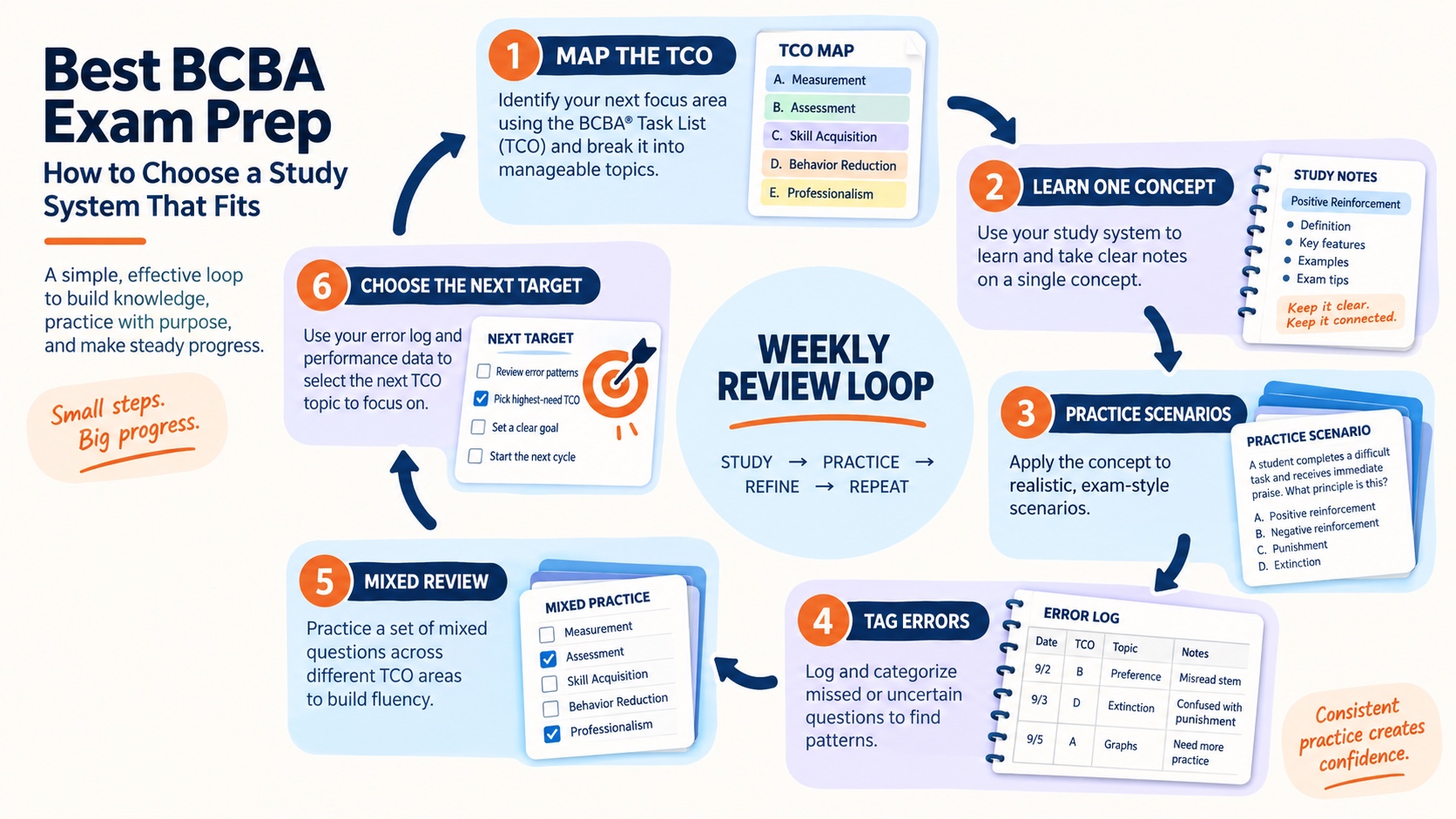
Start with the current BCBA TCO, not with a provider’s topic labels. Make a simple map of the nine domains, then mark each one as learning, practicing, or maintaining. That map gives every resource a role.
- Reference layer: a textbook, course lesson, lecture, or carefully written concept note for building and repairing understanding.
- Practice layer: original scenario questions with explanations. Use it to turn knowledge into discrimination and decision-making.
- Fluency layer: flashcards, short quizzes, or app review for definitions, distinctions, and repeated retrieval.
- Simulation layer: mixed and timed mock sessions for pacing, attention, and applying a process across domains.
- Reflection layer: an error log that records the task, why your answer was tempting, what evidence you missed, and what you will try next.
This structure prevents a common waste pattern: collecting resources without assigning them a job. If two tools both provide only passive reading, adding a third may not solve a scenario-reasoning problem. If your issue is weak measurement decisions, spending more time on general flashcards may feel productive while leaving the actual gap untouched.
Use a weekly review loop
A realistic week can combine short sessions and one longer review. Begin by choosing one or two TCO domains and one reasoning target, such as identifying the relevant measurement system or separating assessment from intervention selection. Study the concept, complete a small set of applied questions, and write an explanation for each error. At the end of the week, complete a mixed set that includes older topics.
As the exam approaches, increase mixed and timed practice gradually. Do not turn every session into a simulation. Learning requires feedback; simulation requires restraint. Keep both, and label the conditions so you know what a score represents.
Read scores as study data
A practice percentage is a signal inside a defined set of conditions. Record whether the set was open-book or closed-book, focused or mixed, timed or untimed, and whether you had seen the items before. A 70% on a familiar, untimed domain quiz does not mean the same thing as 70% on a new, mixed, timed set.
Review missed and guessed items together. Tag each one as a content gap, a task-identification error, a reading error, a calculation or data-display error, a “best next step” error, or a pacing problem. Then choose one repair action. If you cannot explain why the correct option is better than the distractors, the score has not finished teaching you yet.
Keep 2027 transition questions separate
The BACB has published 2027 transition guidance for BCBA eligibility and fieldwork. That guidance affects application planning and requirements; it does not automatically mean that the current BCBA exam outline has become a new edition. For exam prep, verify the current TCO and BACB Examination Information. For eligibility or fieldwork, use the applicable handbook and transition resource.
Keep two notes: exam content to learn and certification process to verify. This protects your study plan from changing every time you see a transition headline, while still giving you a place to record an application action or a question for your supervisor or program.
Common prep mistakes
- Choosing by question count alone: volume without explanations and review structure can create false confidence.
- Using a different track’s material: BCBA preparation must be labeled for the BCBA TCO and role.
- Skipping the official outline: a provider’s categories are not a substitute for the BACB task list.
- Only studying what feels comfortable: use error patterns to decide what deserves the next session.
- Treating a mock score as a pass prediction: independent practice is feedback, not an official result or guarantee.
BCBA exam prep FAQ
What is the best BCBA exam prep resource?
The best resource is the one that matches your current job and gives you evidence about what to do next. Most candidates benefit from a combination of TCO-guided reference material, original scenario practice, explanations, error tracking, and mixed or timed rehearsal.
Should I use an app or a textbook?
They solve different problems. Use a textbook or course for depth and an app for retrieval, short practice, progress tracking, and review between longer sessions. The deciding factor is whether each tool has a clear role in your weekly loop.
How many practice questions should I complete?
There is no universal number that guarantees readiness. Choose enough questions to reveal patterns, then spend time reviewing the reasoning. A smaller set with strong rationales can be more useful than a large set you rush through.
Does 2027 change the BCBA exam edition?
Do not infer that from a transition announcement. Check the current BCBA TCO and examination information for exam content; check the 2027 transition resource for eligibility and fieldwork changes.
Choose your next practice step
Once you know your weak domain and reasoning target, choose one focused set, review every error, and schedule a mixed retry. That small loop is more actionable than buying another resource without a plan.