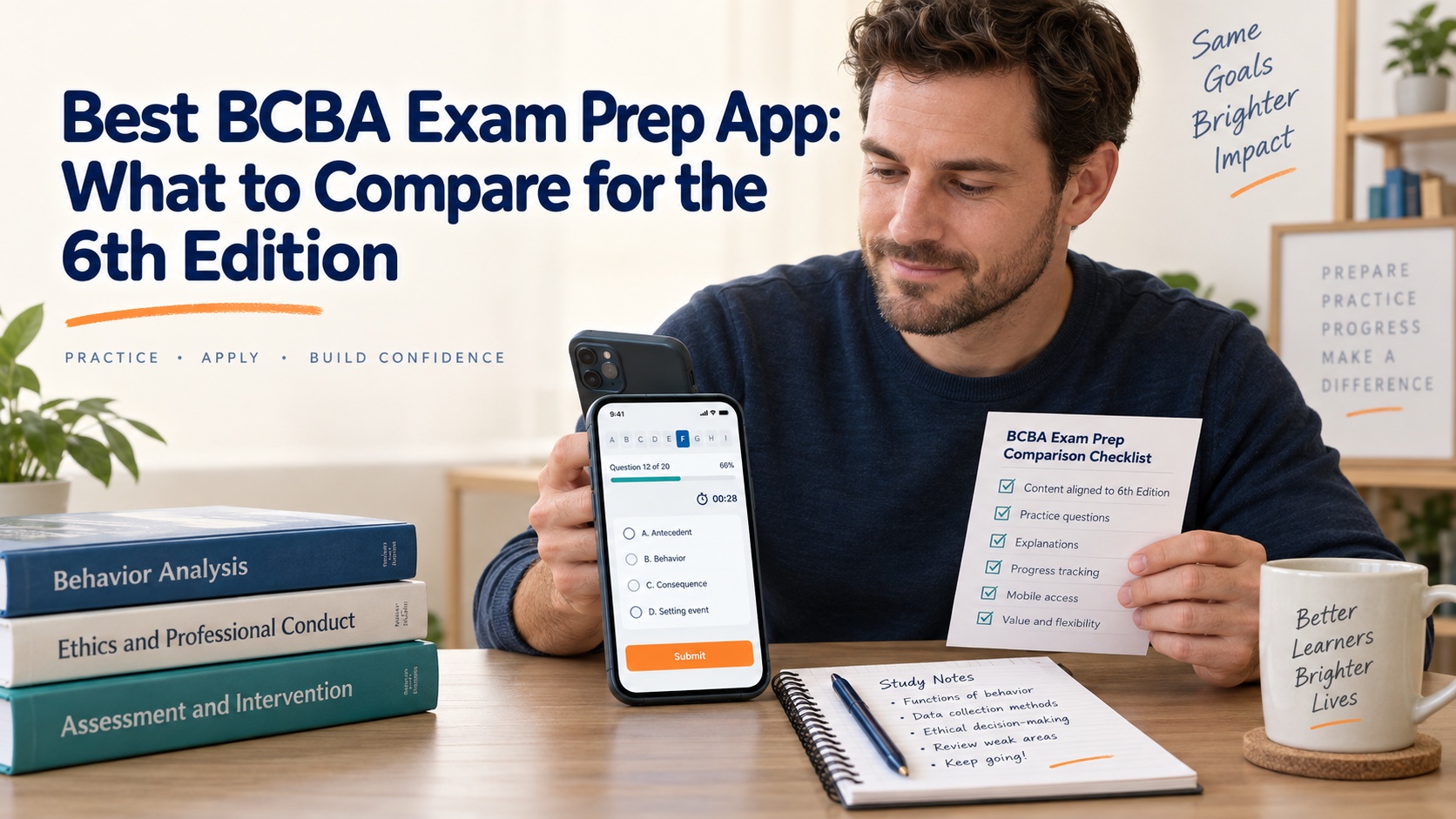
Best BCBA Exam Prep App: What to Compare for the 6th Edition
Searching for the best BCBA exam prep app usually means you are trying to make a practical decision: Which tool will help me study consistently, review mistakes honestly, and stay aligned with the current exam outline? The answer is not automatically the app with the biggest question count or the loudest promise.
Start with fit. A useful app should connect practice to a current content map, explain why an answer works, help you return to weak patterns, and work with the time and devices you actually have. This guide gives you a comparison checklist for the current BCBA 6th-edition context. It does not identify a BACB-endorsed app, promise a passing result, or treat a third-party score as an official result.
Quick answer: the best BCBA exam prep app for you is the one that matches the current outline, uses meaningful scenarios, gives readable rationales, supports mistake review, makes progress visible, and fits your study routine. A strong app should help you decide what to do next—not just congratulate you for opening it.
When you compare products, write down the one problem you want the app to solve. Do you need short recall sessions between work shifts? More practice applying a concept to a scenario? A way to revisit uncertain answers? A consistent place to see what you have reviewed? Your answer changes which feature matters most.
The current BCBA exam context
The current BCBA examination is tied to the BCBA Test Content Outline (6th ed.). The outline contains 104 tasks across nine domains. The examination format includes 175 scored questions plus 10 unscored pilot questions, or 185 questions total, with four answer choices and four hours. These facts are useful when you check whether an app describes its coverage accurately.
They are not a reason to treat a commercial app as official. The BACB publishes its own current examination and certification information; it does not turn a private app into an endorsed product. Also be careful with future-facing language. A 2027 update or eligibility transition should not be casually renamed a “7th edition” exam unless the BACB officially uses that term for the relevant examination content.
Domain labels are a map for planning. They are not nine separate official pass thresholds. An app that shows a low domain percentage may be giving you a useful review signal, but that chart should not be presented as a BACB result.
Seven criteria for comparing apps
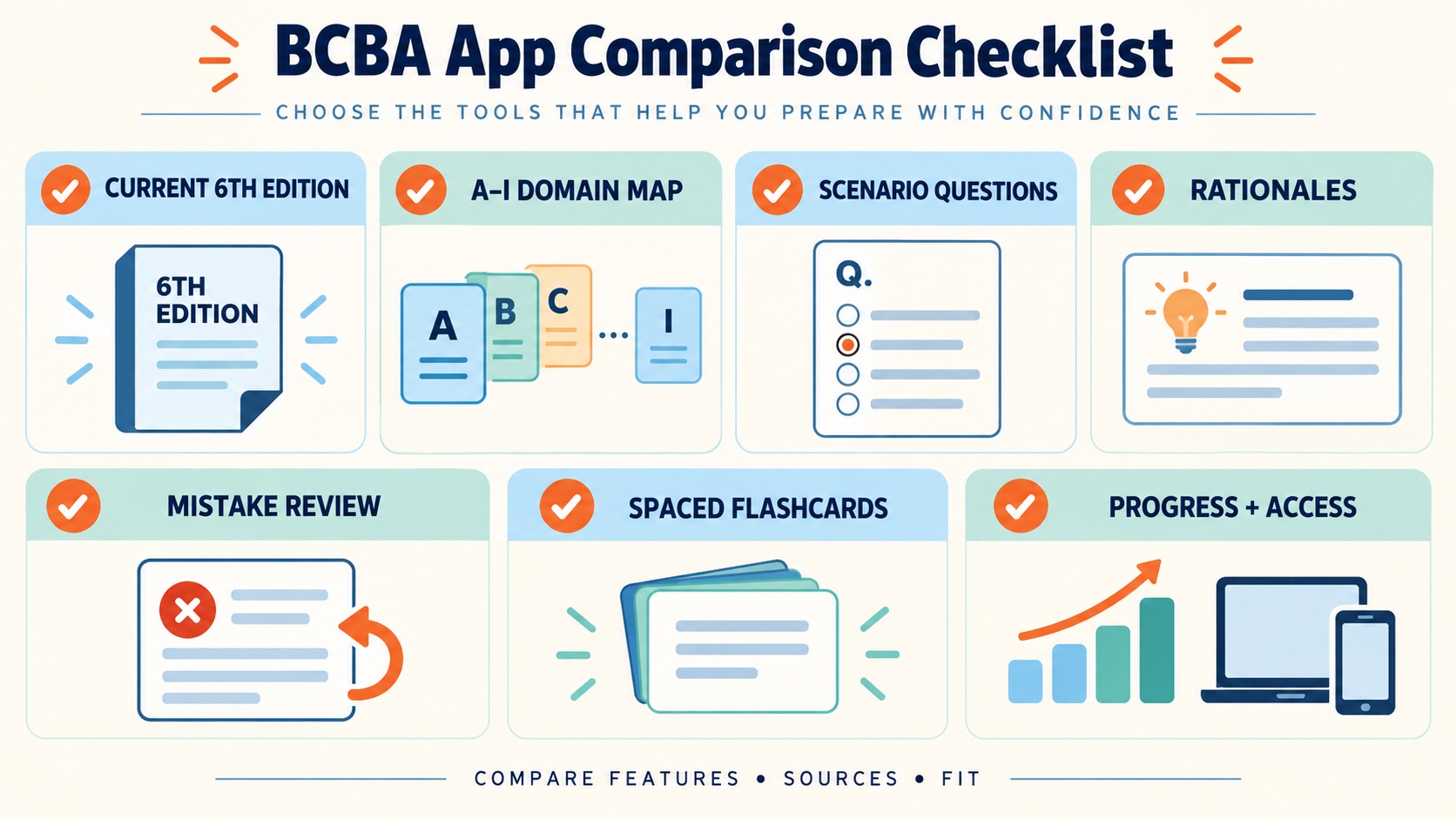
- Current-version mapping: Look for a clear statement of which outline, task list, and exam period the material follows. A vague “updated” badge is not enough. Check the source and the date.
- Scenario quality: BCBA preparation needs more than isolated vocabulary. Look for applied situations where you identify the relevant evidence, task, ethical boundary, or intervention decision.
- Rationales: A correct letter is not a lesson. Explanations should show why the best option fits and why the distractors miss the controlling detail.
- Mistake review: You should be able to save, tag, or otherwise return to questions that were wrong, uncertain, or correct for the wrong reason.
- Retrieval and spacing: Flashcards or scheduled review can make short sessions more useful. The important question is whether the design brings a concept back after a delay, rather than displaying the same card endlessly.
- Progress signals: A useful dashboard separates activity from understanding. Sessions completed, domains visited, confidence, and repeated error patterns tell different stories.
- Practical fit: Check device support, readability, audio needs, login friction, privacy information, pricing terms, and whether you can study in the places you actually use.
This checklist keeps “best” connected to a learner’s purpose. Someone who needs a five-minute recall session may prefer a different experience from someone who needs a long timed simulation. Neither preference makes a product universally best.
How to evaluate the main features
Question banks: Ask whether the questions are organized by domain or skill, whether the wording requires applied reasoning, and whether the explanations are available immediately or only after a long test. A large bank can still be difficult to use if you cannot find the pattern behind your misses.
Flashcards: Look for cards that ask you to retrieve a distinction, not only recognize a definition. For example, a card might ask you to choose the measurement that matches a recording problem, then explain the boundary. Cards are most useful when they lead into a short application task.
Mock exams: Confirm whether the app offers a short diagnostic, a timed domain set, or a full-length simulation. These are different products. A full mock should state its question count, timer, review controls, and unofficial status. On ABA Study Online, the full mock-exam experience belongs on the website; the app supports the review loop that follows through section practice, flashcards, audio, progress, and tools.
Analytics: Treat analytics as prompts for inspection. “Strong in Domain B” is not meaningful if you answered only a few items or guessed correctly. Look for enough context to understand the sample, confidence, date, and recurring error type.
How to test an app before committing
Give a candidate app one small, repeatable test. Choose one concept you know reasonably well and one concept you often confuse. Complete a short set without looking up answers. Mark confidence before feedback. Then check four things:
- Did the explanation identify the evidence that controlled the answer?
- Could you save the uncertainty or error for later review?
- Did the app show what to do next, or only display a score?
- Could you read, hear, and navigate the material without unnecessary friction?
Repeat the same test after a day or two. If the app helps you retrieve the distinction and apply it to a new scenario, that is stronger evidence of fit than a polished welcome screen. If it encourages you to chase a readiness number without explaining the basis, ask what decision the number is supposed to support.
Comparison mistakes to avoid
- Choosing by question count alone: quantity cannot tell you whether the questions are current, clear, or well explained.
- Assuming “updated” means 6th edition: ask for the outline and source boundary, especially when a product mixes old and new labels.
- Trusting a pass guarantee: no app can guarantee your BACB result. Treat a guarantee as a reason to inspect the terms and evidence, not as a study plan.
- Confusing activity with mastery: opening an app every day is encouraging, but it is not the same as retrieving and applying a concept.
- Using a score without reviewing the rationale: the reason behind a correct answer matters, especially when the choice was a guess.
- Mixing website and app roles: know where the full mock, section practice, audio, tools, and progress features actually live before you build a routine.
A realistic app study routine
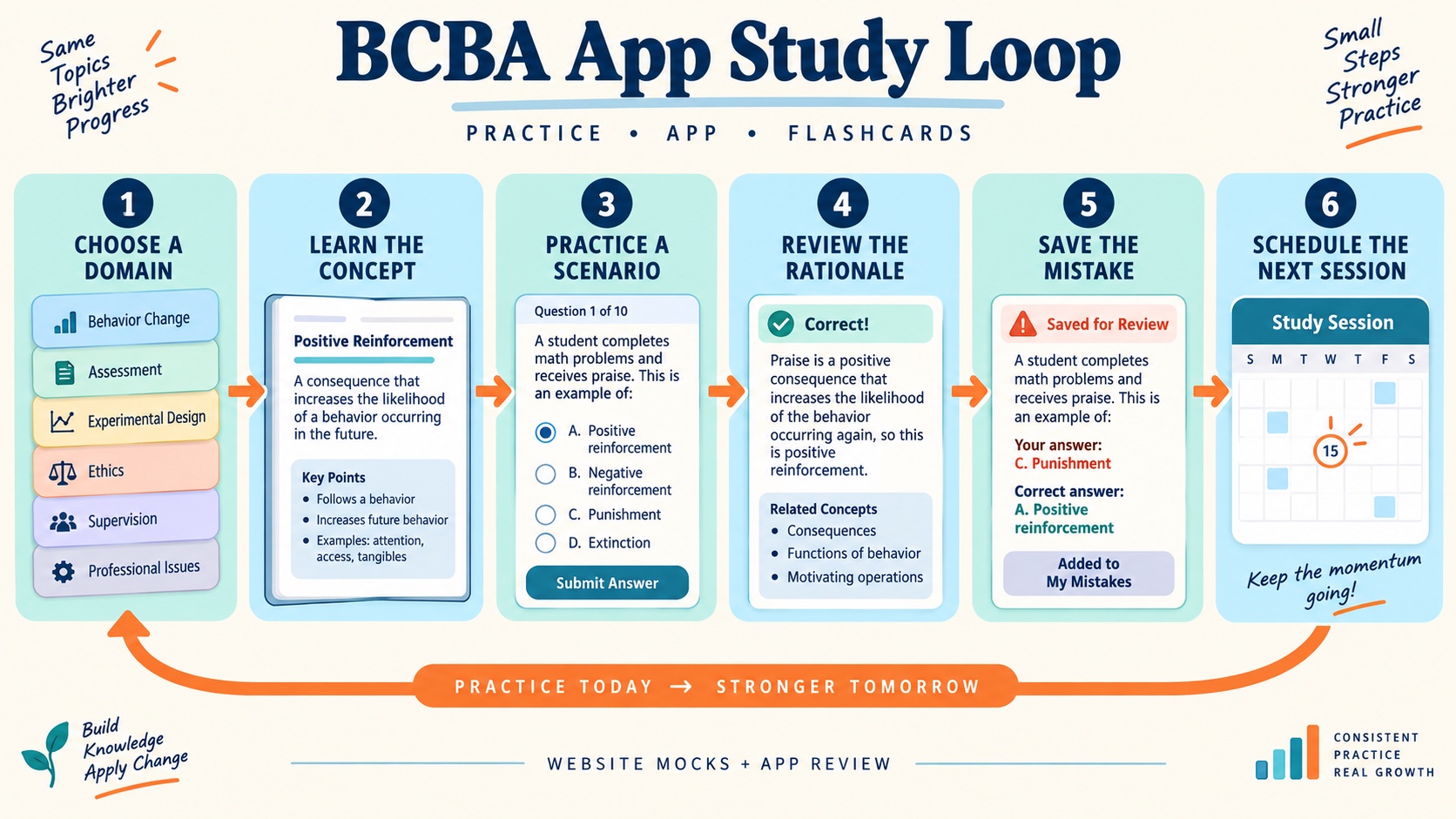
Try a 25-minute cycle when you need consistency:
- Choose one target: select a domain, task distinction, or error pattern instead of opening the whole catalog.
- Retrieve first: use flashcards or a short prompt before rereading the explanation.
- Apply next: answer a scenario or section set and record confidence before revealing feedback.
- Explain the miss: write the evidence, boundary, or distractor that changed the decision.
- Schedule the return: save the item and choose a later session for a fresh example.
Research on retrieval practice, spacing, feedback, and learning techniques supports this kind of deliberate review as a general approach. It is not a BACB requirement, and it is not a promise that one routine will work for every learner. Adjust the session length, audio support, and number of questions to your access needs and responsibilities.
BCBA exam-prep app FAQ
What is the best BCBA exam prep app?
There is no universal winner. Compare current-outline coverage, scenario quality, rationales, mistake review, spaced retrieval, progress clarity, accessibility, and price terms against your own study problem.
Should an app have a full BCBA mock exam?
It can be useful, but check whether the app actually provides a full simulation or only a shorter quiz. The experience should label its format and unofficial status clearly. ABA Study Online keeps full mock exams on the website and uses the app for the continuing practice and review loop.
Is the BCBA exam changing to a 7th edition in 2027?
Do not assume that from a year label alone. Check the current BACB examination pages, handbook, and official transition notices. This guide uses the current 6th-edition examination context and avoids inventing a future edition label.
Can an app tell me whether I will pass?
No. App scores and readiness indicators are practice signals. They are not BACB scaled scores, official results, or guarantees.
Where ABA Study Online fits
ABA Study Online is designed as a connected study system rather than one isolated score screen. The website provides discovery, theory blocks, free question previews, teaching tools, and the full mock-exam destination. The app is the repeatable layer for Today, Learn, flashcards, section-by-section practice, audio review, progress, and the shared tools library.
That division is useful when you want a clear next step: take a website mock when you need a longer diagnostic, then return to the app to retrieve concepts, practice one section, review the rationale, and revisit a saved mistake. The right fit still depends on your goals, current preparation, schedule, and preference for study formats.