Behavioral Buzz RBT Mock Exam: How to Check It Against the 2026 Outline
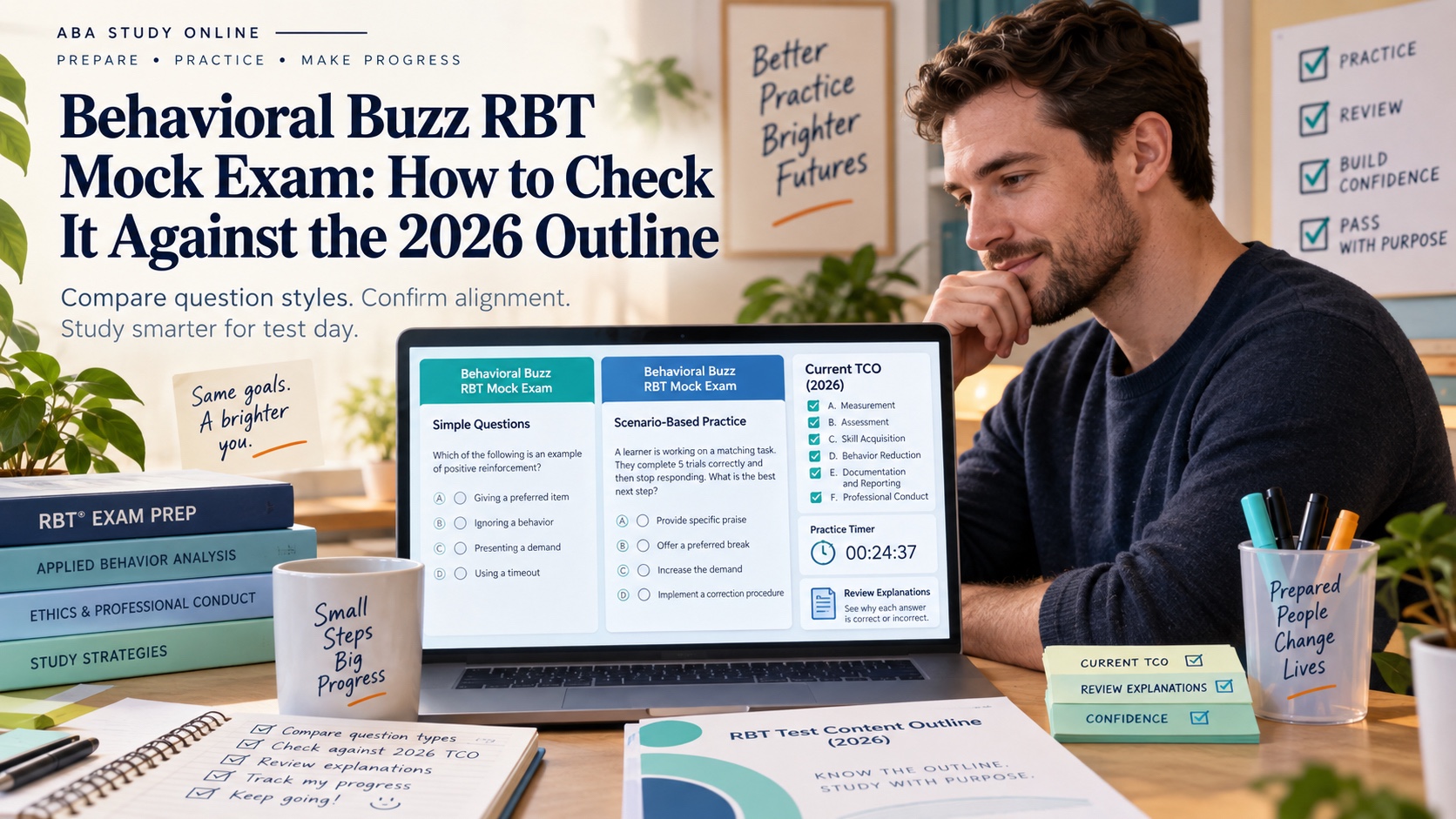
If you are searching for a Behavioral Buzz RBT mock exam, you may want to know what the resource offers and whether it fits the current RBT exam. Behavioral Buzz’s public mock-exam portal presents two formats: a timed simple-question-and-answer mock exam and a timed scenario-based mock exam. Its RBT resource page also groups mock exams, study guides, flashcards, and an RBT Toolkit app.
That description tells you the format, not whether a practice result predicts your BACB outcome. The safer evaluation is source-first: check the version, map coverage to the current six-domain RBT Test Content Outline (3rd ed.), verify timing, examine explanations, and reject official-sounding or guaranteed-pass claims. This page evaluates the study decision without copying the provider’s questions or treating the provider as BACB-endorsed.
The quick answer
Behavioral Buzz can be treated as an independent RBT practice resource, not as the BACB examination itself. Its portal describes a simple-question mock and a scenario-based mock, both timed and intended for practice. If you use either format, add one step that the marketing page cannot complete for you: compare the resource with the current official outline and review what each missed question is actually testing.
Do not treat a timer, an 85-question layout, or a score screen as proof that the practice set is official. Format similarity can help you rehearse pacing, but the BACB controls the certification examination. The current RBT examination information and handbook should remain your authority for current structure, requirements, and policies.
What the named resource offers
The Behavioral Buzz portal separates two useful practice modes. A simple-question format can help you check direct recall and basic discrimination. A scenario-based format can ask you to select an action in a more applied context. Both can serve a purpose, but they should not be confused with different levels of certification or with a guarantee that scenario wording matches the live examination.
The site also advertises instant results and feedback. That is valuable only when you use the feedback actively. After a question, ask which RBT domain it belongs to, what cue determined the answer, why the distractors were weaker, and whether the explanation matches the current source. If the explanation is vague, old, or outside the RBT role, record the uncertainty and verify it before memorizing the item.
Check the current version
The BACB’s current RBT materials state that the RBT examination is based on the RBT Test Content Outline (3rd ed.) beginning January 1, 2026. The outline includes six domains: Data Collection and Graphing, Behavior Assessment, Behavior Acquisition, Behavior Reduction, Documentation and Reporting, and Ethics. A third-party page may still use the older phrase “RBT Task List” because its copy or question bank was written earlier. That does not automatically make every question unusable, but it does mean you should verify alignment.
Write the current six domain names in your notes. When you finish a Behavioral Buzz mock, label each missed item with one domain and one repair action. If you cannot place an item in the current outline, ask whether it is a general ABA question, an old-version question, or a poorly scoped question. This is a more reliable use of the resource than chasing a target score.
Five checks before you rely on a mock
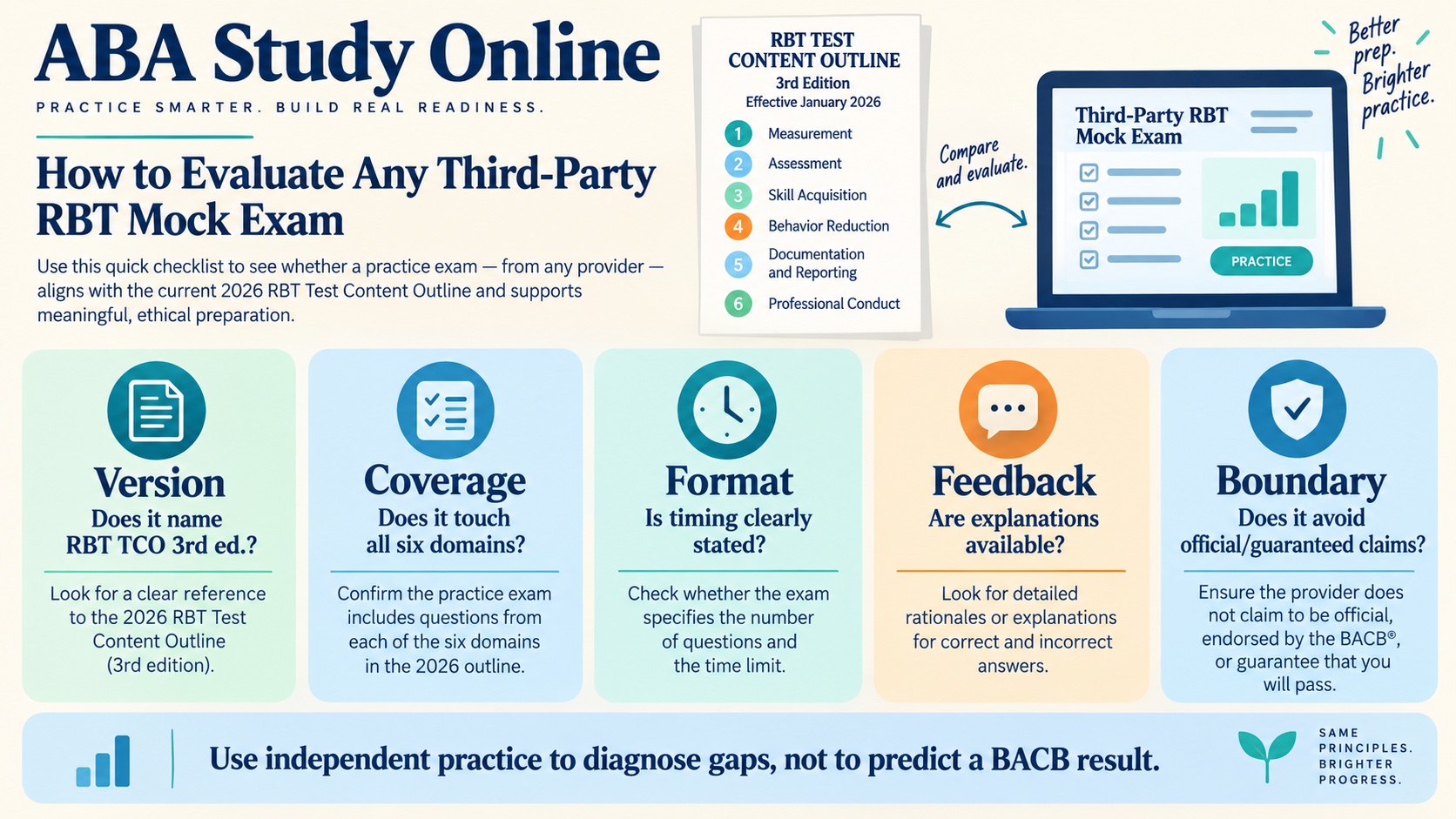
- Version: does the page name the RBT TCO 3rd edition or clearly state when it was updated?
- Coverage: can you connect questions to all six current domains rather than only vocabulary or measurement?
- Format: does it state the number of questions and the time limit instead of using “realistic” as a vague promise?
- Feedback: does it explain correct and incorrect choices well enough to repair your reasoning?
- Boundary: does it clearly say that the resource is independent and avoid “official,” “leaked,” or guaranteed-pass claims?
These checks also help you compare Behavioral Buzz with another free mock. One site may be better for short recall blocks; another may be better for scenario practice. “Best” depends on the learning task. If you keep missing documentation or ethics questions, a new full-length mock may be less useful than a focused set and a careful source review.
Keep a dated note of the resource version you used. That simple record makes it easier to revisit your preparation later if the provider updates its questions, changes the timer, or reorganizes its links.
How to review a score
Record more than the percentage. Mark each item as correct, guessed, or incorrect, then sort the misses into four causes: knowledge gap, confused concepts, missed scenario cue, or timing/attention problem. A score that rises because you remember a repeated item is different from a score that rises after you can explain a new scenario.
For a knowledge gap, return to the relevant training material and explain the task without notes. For a confused procedure, make a contrast table. For a missed cue, underline the detail that changed the answer. For timing, use shorter timed sets and practice identifying the question’s task before reading every distractor. Keep the correction loop separate from the score celebration; the correction is where most of the learning happens.
Keep the official boundary visible
The BACB’s RBT materials are the source for certification requirements, examination rules, and the current content outline. Behavioral Buzz is an independent resource provider. The existence of a named mock exam does not establish BACB approval, access to secure questions, or a pass prediction. Do not copy questions from a live or protected examination, and do not treat a third-party explanation as authority for a current policy.
For a second practice route, use ABA Study Online’s RBT question practice and compare any resource using the same five checks. The point is not to collect every mock. It is to build enough varied practice to recognize the task, explain the decision, and repair the gap.
FAQ
Is the Behavioral Buzz RBT mock exam official?
It is presented as an independent free practice resource. Use the BACB website for official certification, examination, and outline information.
Does Behavioral Buzz have more than one RBT mock format?
Its public portal describes a timed simple-question-and-answer mock and a timed scenario-based mock. Check the live resource for its current details and update language.
Can the mock score predict whether I will pass?
No. Use the score to identify domains and reasoning problems. It is not a BACB result and does not guarantee certification.
What should I do if the page says “Task List”?
Check the date and compare the resource with the RBT Test Content Outline 3rd edition, which governs RBT examination content beginning in 2026. Keep useful practice only after confirming that the scope still fits.