
Behavior Analyst Supervisor Mock Exam: What to Practice Before the 8-Hour Training
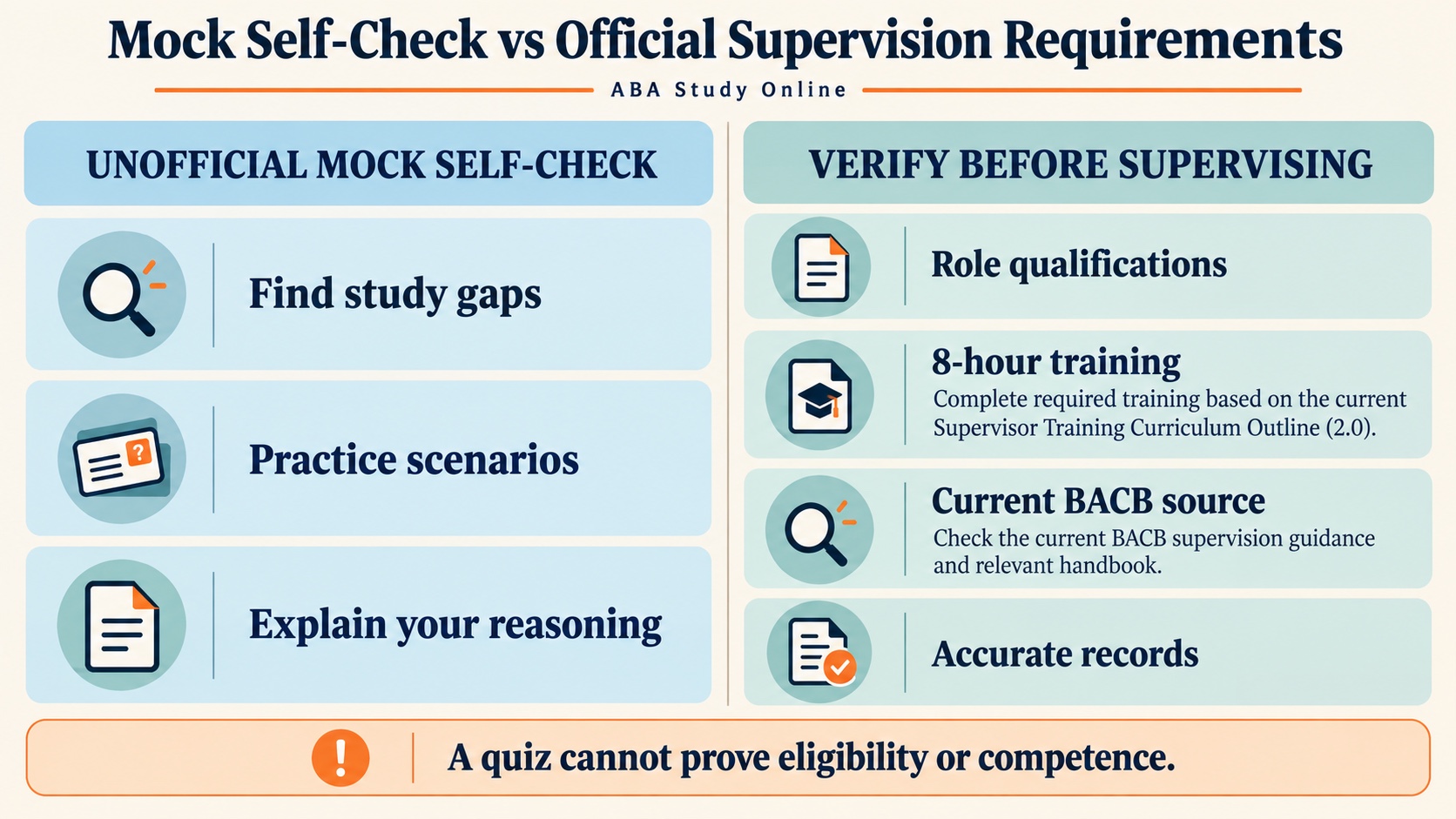
If you searched for a behavior analyst supervisor mock exam, you may be looking for questions that make supervision rules feel more practical. That is a reasonable study goal, but there is an important boundary: the BACB does not describe a separate “supervisor certification exam” that a practice quiz can simulate. A mock exam for this topic is best treated as an unofficial self-check for supervision knowledge and decision-making.
The current BACB guidance says covered supervisors must complete an 8-hour supervision training based on the Supervisor Training Curriculum Outline (2.0) before providing applicable supervision. This article shows what a useful self-check can cover, how to read scenario questions, and what a quiz cannot prove about your eligibility, competence, or authorization to supervise.
Quick answer: a behavior analyst supervisor mock exam can help you review supervision scenarios, documentation, feedback, ethics, and training decisions. It is not an official BACB exam, does not issue a certificate, and cannot determine whether you meet the requirements for a particular supervisory role. Use it to find study gaps, then verify the current BACB guidance and your professional responsibilities.
Mock practice versus required supervision training
The phrase “supervisor exam” can create the wrong expectation. A multiple-choice quiz may test whether you recognize a good supervision decision, but it cannot recreate the relationship, context, observation, feedback, and practical competence involved in real supervision. It also cannot replace the training and documentation rules attached to a supervisory role.
According to the BACB’s supervision-and-training guidance, supervisors who oversee people acquiring BCBA or BCaBA fieldwork, and supervisors of current BCaBA or RBT certificants who require ongoing supervision, must complete an 8-hour supervision training based on the current Supervisor Training Curriculum Outline (2.0) before providing that covered supervision. The guidance also lists role-specific resources for supervising RBTs, assessing or training RBTs, supervising BCaBAs, and supervising fieldwork.
The training may be offered by an Authorized Continuing Education (ACE) Provider. The current outline describes learning objectives and tasks such as developing a supervision contract, documenting the relationship, setting training objectives, measuring progress, providing fieldwork opportunities, using behavioral skills training, and giving feedback. A course or practice quiz should be described accurately: completion is not the same as passing an “official supervisor exam,” and a certificate alone does not make every person qualified for every supervisory role.
What to study in a supervisor self-check
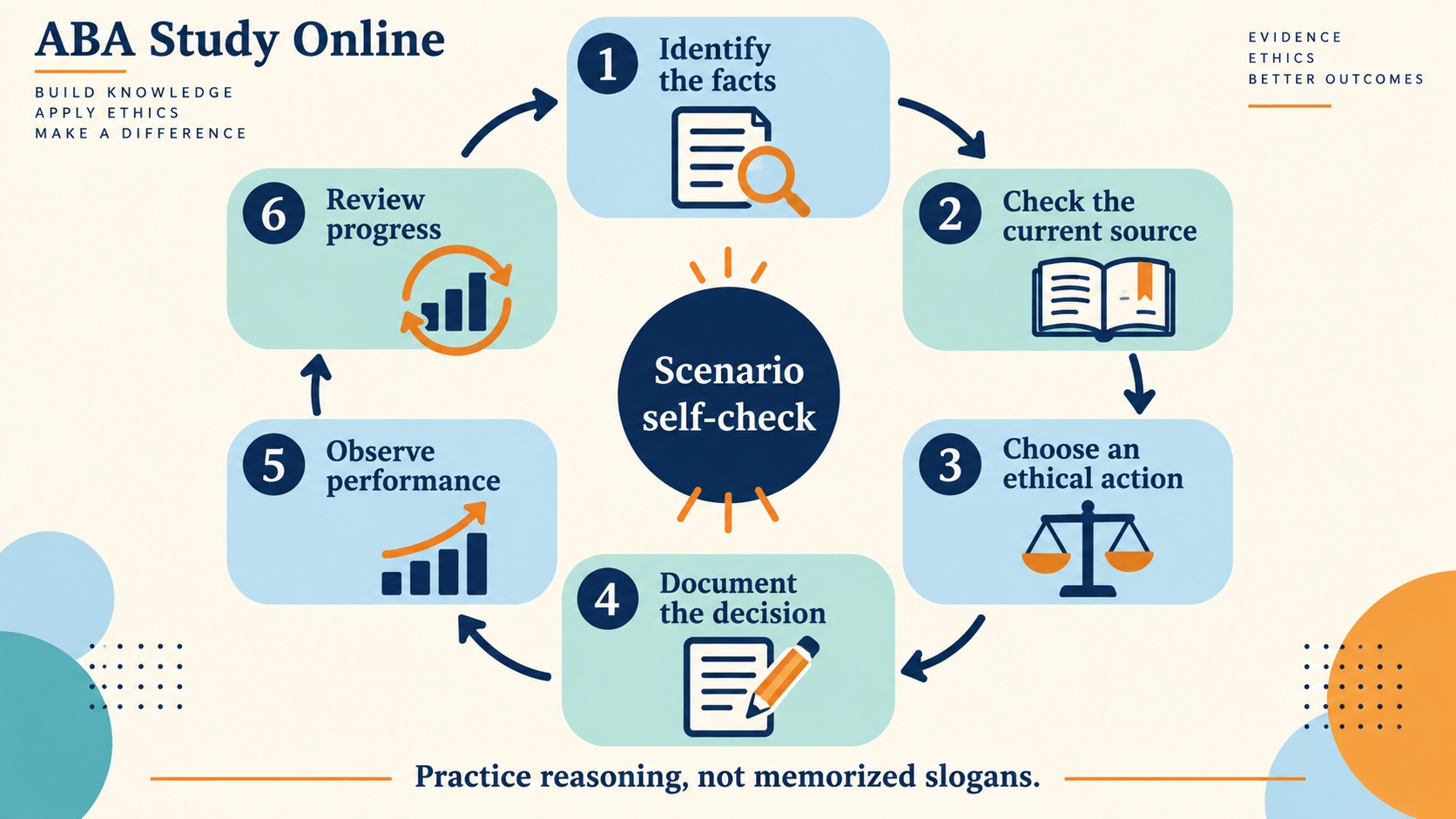
A strong self-check should ask what the supervisor would do next, what evidence is missing, and how the decision affects the supervisee or client. It should not reward memorizing a slogan without considering the facts. These topic areas are useful starting points:
1. The supervision relationship and contract
Practice identifying when a contract should be discussed and signed, what the scope of supervision includes, who is responsible for each task, and how limits are communicated. A scenario may look like a scheduling question but actually test whether the parties have clarified expectations, documentation, contact, feedback, and the conditions under which a supervisor can or cannot sign a form.
2. Goals, measurement, and progress
Supervision is not only a meeting calendar. A useful question might ask you to choose between a vague goal such as “become better at assessment” and a measurable goal tied to a performance, criterion, observation, or knowledge check. Look for evidence that the supervisor is monitoring progress and adjusting training opportunities rather than simply recording attendance.
3. Behavioral skills training and feedback
Scenario practice should include instruction, modeling, rehearsal, and feedback. If a supervisee makes an error, the best response is usually more specific than “try harder.” Ask whether the supervisor observed the performance, described the relevant skill, arranged a chance to rehearse, delivered respectful feedback, and scheduled a follow-up measure. A quiz answer should not imply that one conversation guarantees competence.
4. Documentation and fieldwork opportunities
Review the difference between a supervision meeting note, a fieldwork verification record, a training assignment, and evidence of performance. A supervisor should be able to explain why an activity is appropriate, how it relates to the training objective, what evidence will be retained, and who is responsible for the record. Do not assume that any ABA-related task is automatically appropriate fieldwork or that a completed form proves the underlying work occurred.
5. Ethics, boundaries, and context
Ethical supervision includes attention to competence, conflicts, privacy, power differences, accessibility, culture, language, and the effect of the setting on learning. A practice question should make you consider who is affected by the decision and whether the supervisor has enough information. When the facts are incomplete, the responsible answer may be to pause, consult the current code or handbook, document the concern, and arrange qualified support.
Three practice scenarios with rationales
The following examples are original study prompts, not BACB examination questions. Read the facts before selecting an answer. The goal is to practice reasoning, not to memorize a special score.
Scenario 1: The unsigned agreement. A trainee begins counting fieldwork hours after an introductory video call. The supervisor plans to “finish the paperwork later.” What is the strongest next step?
Rationale: Clarify the supervisory relationship, scope, responsibilities, and required documentation before relying on the hours. A practice test should steer you toward checking the current handbook and contract requirements, not toward treating a verbal plan as complete evidence.
Scenario 2: The repeated skill error. A supervisee repeatedly records an observation incorrectly. The supervisor sends a long email explaining that accuracy matters but never observes another attempt. What should the supervisor add?
Rationale: Arrange a concrete teaching and performance cycle: clarify the target, model or demonstrate the procedure, have the supervisee rehearse, provide specific feedback, and measure the next performance. The exact intervention depends on the skill and context, but a message alone does not show that the skill has been learned.
Scenario 3: The rushed signature. A supervisor is asked to sign a verification form even though the supervisor did not observe the work and the records contain conflicting dates. The trainee says a deadline is tomorrow. What is the strongest response?
Rationale: Do not sign unsupported information. Pause, reconcile the records, identify what can be verified, explain the limitation, and use the current form instructions and consultation channels. A deadline does not turn uncertain documentation into reliable documentation.
A practical study plan
- Start with the role. Decide whether you are studying supervision of fieldwork, ongoing BCaBA or RBT supervision, RBT assessment, or RBT training. The relevant role changes the documents you need.
- Read the current source. Use the BACB supervision-and-training page and the current Supervisor Training Curriculum Outline (2.0). Put the date on your notes because requirements and forms can change.
- Take a short self-check. Mark each answer as confident, uncertain, or source-needed. Do not treat the percentage as an eligibility determination.
- Explain every answer. For each missed question, write the fact that changed the decision, the document you should check, and the record or conversation that would follow.
- Practice the performance. Turn one weak area into a rehearsal: write a measurable goal, model a feedback conversation, complete a documentation example, or plan an observation.
- Separate study from authorization. Before supervising, verify your current credential, the role-specific requirements, required training, relationship boundaries, and any employer or jurisdiction rules.
For broader certification study, you can continue with the BCBA learning path, the BCaBA learning path, or the relevant practice-question hub. Those resources are study aids; they do not replace BACB review or professional supervision.
Common mistakes
- Searching for a passing score: an unofficial quiz has no BACB passing score and no certification effect.
- Calling a course an exam: the 8-hour supervision training and a self-check answer different questions.
- Using a generic BCBA mock exam: broad certification practice does not automatically test supervision relationship and performance skills.
- Signing because of time pressure: deadlines do not justify unsupported or inaccurate documentation.
- Ignoring role boundaries: supervising fieldwork, supervising an RBT, assessing an RBT, and training an RBT have different resources and responsibilities.
- Studying an old edition label: verify current BACB terminology and effective dates instead of assuming a “seventh edition” supervisor exam exists.
FAQ
Does the BACB have an official behavior analyst supervisor exam?
The BACB’s current supervision guidance describes an 8-hour supervision training and role-specific responsibilities. It does not describe a separate supervisor certification exam that an online mock exam can reproduce. Use practice questions as an unofficial learning tool.
Can I take the 8-hour supervision training online?
The current Supervisor Training Curriculum Outline (2.0) allows the training to be delivered in person or online, subject to the outline and provider requirements. Confirm the current provider and completion-document rules before enrolling.
Does passing a supervisor mock exam qualify me to supervise?
No. A quiz score cannot establish your credential status, role-specific qualification, completion of required training, competence, or compliance with current BACB and jurisdictional rules.
What should a supervision practice test cover?
Useful coverage includes contracts and scope, measurable training objectives, feedback and behavioral skills training, documentation, fieldwork opportunities, performance monitoring, ethics, boundaries, and cultural or contextual factors. Every answer should be checked against the current source.