
Behavior Analyst Study: Build a Plan That Actually Teaches You
Behavior analyst study can mean several different things. You might be preparing for the BCBA or BCaBA examination, working toward RBT certification, taking an ABA course, or trying to understand behavior analysis before choosing a professional path. Those goals share concepts, but they do not share one identical checklist.
The most useful study plan starts by naming the track and the decision you need to make. Then it connects the current BACB outline or course objectives to active practice, error review, and spaced return. This guide helps you build that system without treating general ABA notes as certification advice. Use the BACB’s credential overview, current Test Content Outlines, and Examination Information for official boundaries. Study content can support preparation, but it does not grant a credential, determine eligibility, or guarantee a pass.
Table of Contents
Choose the study track first
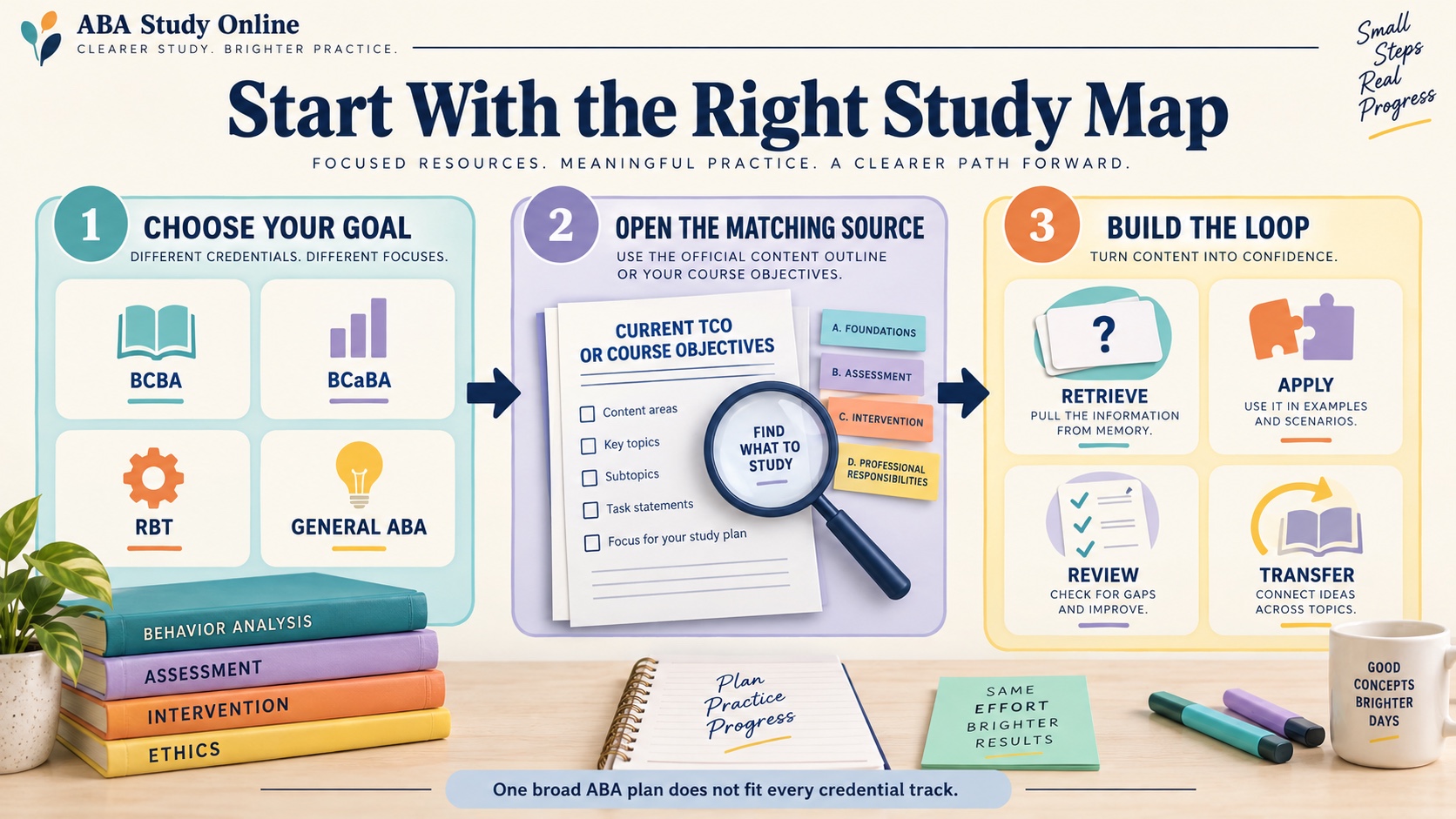
The BACB describes three certification tracks with different roles and requirements: BCBA, BCaBA, and RBT. A BCBA is a graduate-level certification and independent practitioner role. A BCaBA is an undergraduate-level certification practiced under required supervision. An RBT is a paraprofessional role practiced under close, ongoing supervision. Those differences affect what you study, how you interpret scenarios, and which handbook or outline controls your exam questions.
If your goal is a credential, write the track at the top of your study plan. If you are taking a university ABA course or learning for work, write the course objectives and role boundaries instead. “ABA study” is too broad to tell you whether you should be solving BCBA data-interpretation questions, reviewing RBT measurement tasks, or learning foundational terminology.
Do not combine a certification study plan with an eligibility checklist. The BCBA and BCaBA handbooks cover education, coursework, fieldwork, application, examination, and maintenance in more detail than a practice page can. RBT materials have their own training and competency boundaries. Use the official source that matches the task in front of you.
Build a source map before collecting materials
Start with one authoritative map. For BCBA and BCaBA, open the current TCO for the credential. For RBT, use the current RBT TCO and handbook. For a university or workplace course, use the syllabus, assigned texts, and competency objectives. Put the source date and edition in your notes so an old PDF does not quietly become your plan.
Next, divide the map into learnable questions:
- Can I define it? State the term in plain language without copying a sentence.
- Can I identify it? Recognize the concept in a new example.
- Can I distinguish it? Explain how it differs from a tempting neighbor.
- Can I apply it? Choose a measurement, assessment step, procedure, or professional action under specific conditions.
- Can I evaluate it? Read data, check procedural integrity, consider ethics, or decide what information is still missing.
This turns a long outline into a set of observable study behaviors. A note that says “review reinforcement” is hard to evaluate. A note that says “distinguish positive reinforcement from negative reinforcement in three new scenarios and explain the future behavior change” gives you a clear check.
Use a study loop, not a content pile
Reading and watching can introduce a concept, but recognition is not the same as flexible use. Build each session around a short loop:
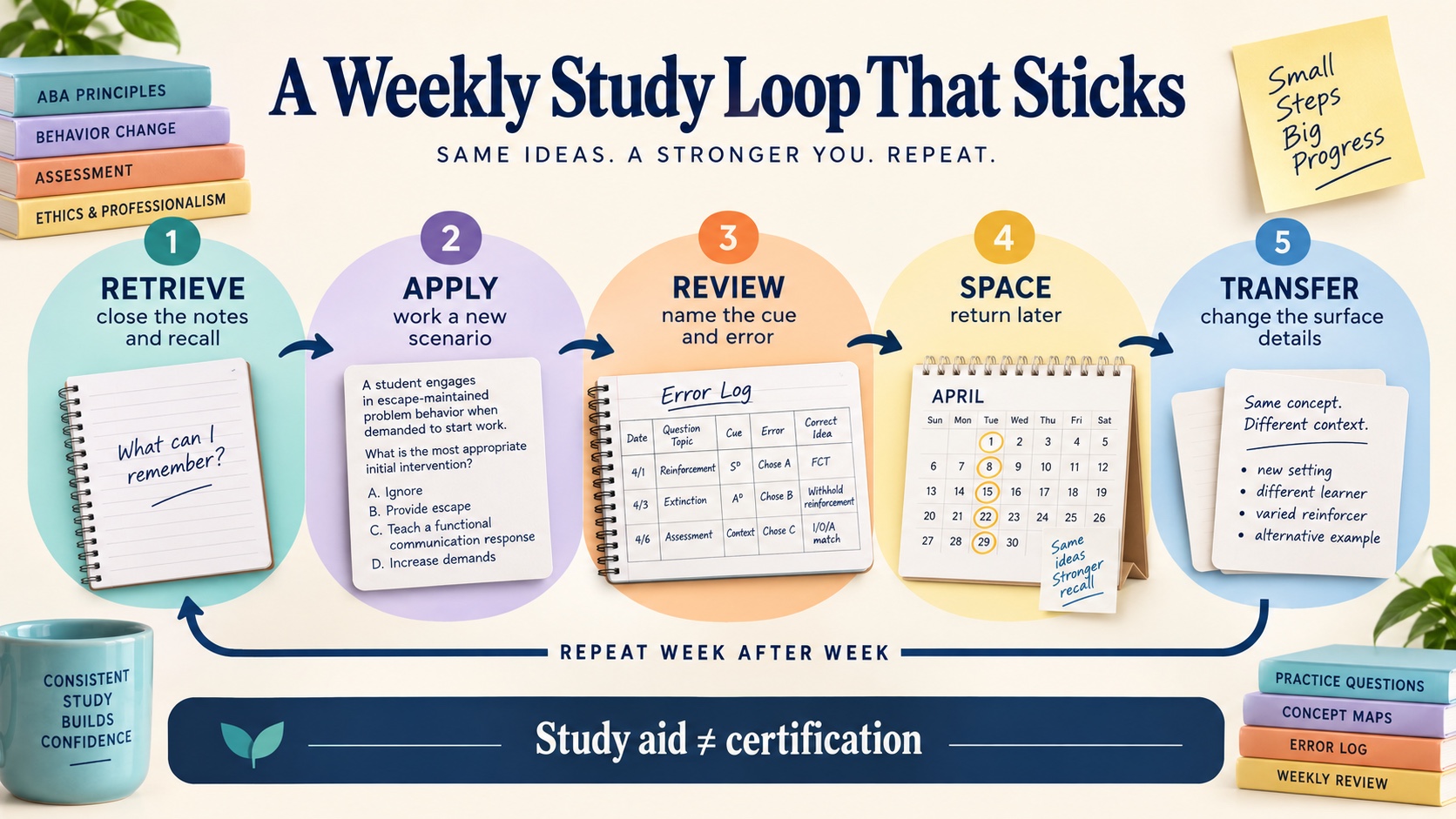
- Retrieve. Close the notes and write what you remember or answer a small question set.
- Apply. Work a scenario, graph, measurement choice, or short example.
- Review. Compare your answer with the rationale and name the decisive cue.
- Space. Return to the idea later instead of repeating it immediately until it feels familiar.
- Transfer. Solve a new example with different surface details.
Keep the session small enough to finish the review. Ten carefully examined questions may be more useful than fifty questions you mark and never analyze. If you use flashcards, place contrasts and examples on them, not only isolated terms. If you watch a video, pause before the explanation and predict the next step. If you read a chapter, create a few questions that force you to choose between similar procedures.
Turn definitions into decisions
Behavior analysis contains many terms that sound close when they are listed together. Your study materials should repeatedly ask what changed, what was measured, what the practitioner is trying to accomplish, and what evidence supports the choice.
For measurement, label the events that start and end the measure. Ask whether the question calls for frequency, rate, duration, latency, interresponse time, an interval procedure, or a product measure. For assessment, identify the purpose and the information already available before jumping to an intervention. For behavior-change procedures, connect the procedure to the goal, function, context, social validity, and plan for maintenance or generalization.
For ethics and supervision, add the role and the professional boundary to your notes. Consider client welfare, confidentiality, consent, competence, cultural responsiveness, documentation, feedback, and consultation. The best study question is often not “What is the definition?” but “What would change the answer in this situation?”
Plan a realistic study week
A weekly plan should show when study happens, what kind of work you will do, and how you will know it happened. A simple pattern might be:
- Day 1: concept repair. Learn or revisit one small cluster and write two contrasts.
- Day 2: focused practice. Answer questions from that cluster and review every uncertain answer.
- Day 3: spaced retrieval. Reconstruct the key ideas from memory before reopening notes.
- Day 4: mixed application. Switch among domains or course objectives so you must identify which concept matters.
- Day 5: error repair. Choose one error pattern and complete a new example.
- Weekend: short checkpoint. Review progress, select next priorities, and keep some time for rest.
Adjust the number of sessions to your life. A plan that requires two hours every weekday is not realistic if you have a rotating schedule. Put a minimum version beside the full version: for example, one concept contrast, five practice questions, and one error note. The minimum keeps the routine alive without pretending that every day has the same capacity.
Let errors choose the next task
Keep an error log with five fields: the topic or source task, your answer, the best answer, the cue you missed, and the next action. Add a confidence label before reading the explanation. A correct answer chosen with low confidence deserves review too; otherwise a lucky guess can look like mastery.
Use practical error labels such as knowledge gap, confused two concepts, measurement mismatch, missed scenario cue, ethics or role boundary, data interpretation, reading error, or careless response. The label should lead to an action. A knowledge gap may need a short lesson. A confused concept needs a contrast. A missed cue needs another scenario. A data error needs a graph or calculation. A reading error may need practice slowing down and restating the question.
After repair, return to a new example. If you answer the same question again, memory of the wording can hide the gap. Change the learner, setting, behavior, or surface details while preserving the underlying distinction. That is how practice starts to resemble flexible performance.
Keep study, training, and certification separate
Study resources can explain behavior-analytic concepts, organize practice, and help you notice patterns. They do not replace qualifying education, supervised fieldwork, competency assessment, an application review, or the official examination. The BACB’s supervision and training resources also separate responsibilities across roles; do not infer that reading a guide authorizes you to supervise, assess, train, or practice independently.
Be skeptical of any page that promises a pass, calls itself official without evidence, or blends BCBA, BCaBA, and RBT rules into one undifferentiated list. Write down the credential and source for every high-stakes claim. When requirements change, return to the current handbook and official transition page rather than relying on an old social post or unlabeled PDF.
FAQ and official sources
What should I study first in behavior analysis?
Start by naming your goal: BCBA, BCaBA, RBT, a course, or general ABA learning. Then open the matching official outline or course objectives and choose one small concept cluster to retrieve and apply.
Should I read, watch videos, or do practice questions?
Use all three when they serve different jobs. Reading or video can introduce an idea; practice reveals whether you can use it; error review tells you what to revisit. Do not count passive hours as evidence of mastery.
Can ABA Study Online certify me as a behavior analyst?
No. ABA Study Online provides educational resources and practice support. Certification eligibility, applications, examinations, supervision, and credential decisions belong to the applicable authority and current official documents.
Where can I organize track-specific study?
Use the BCBA learning path, BCBA practice questions, BCaBA resources, ABA Study Online app, and ABA glossary as study destinations, then verify current credential rules against BACB sources.
Sources checked for this guide: Behavior Analyst Certification Board, Consumer Resources; Test Content Outlines for BACB Certifications; Examination Information; Supervision, Assessment, Training, and Oversight; and current track-specific handbooks.