Behavior Analyst News: How to Find Updates You Can Trust
Searching for behavior analyst news can lead you to very different kinds of information: a BACB announcement, a research article, a state licensing proposal, a professional newsletter, a provider’s marketing post, or a short social-media summary. They may all use similar words, but they do not answer the same question. A reliable update habit begins by identifying what kind of news you are reading and which source controls the next step.
This guide is not a headline feed and does not replace a current handbook, ethics code, licensing rule, supervisor’s direction, or formal application review. Instead, it gives students, RBTs, BCaBAs, BCBAs, families, and employers a practical way to find the original update, test the claim, and decide whether it actually changes anything for them.
Table of Contents
Short answer: what counts as reliable news?
Reliable behavior analyst news is information you can trace to an identifiable, current source that has authority over the claim. For certification requirements, start with the BACB. For a state or provincial license, start with the relevant government or regulatory authority. For research findings, read the paper, journal, or university source rather than a headline alone. For a person’s credential status, use the official registry. A repost can help you discover an item, but it is not automatically the source of truth.
Reliability also depends on fit. A genuine BACB announcement about BCBA requirements may not apply to an RBT. A study about a specific population or setting may not justify a universal treatment claim. A proposed rule is not the same as a final rule. Good news reading keeps those boundaries visible.
Know the source type first
Certification and ethics updates
The BACB News archive and newsletter archive are useful starting points for certification, ethics, examination, portal, and professional-development announcements. When a news item points to a handbook, transition guide, or formal policy, open that linked document. The headline is a signpost; the controlling document contains the details, dates, exceptions, and scope.
Licensure and regulation
Certification and licensure are related but separate. If an update concerns a state, province, payer, or employer credentialing rule, the relevant authority may be outside the BACB. Look for the regulator’s proposed or final rule, effective date, implementation notice, and definition of the affected professional or service.
Research and practice news
Research news should be read with attention to the study design, participants, setting, outcome measure, and limitations. A journal article can contribute useful evidence without proving that one procedure works for every learner. A professional summary is helpful when it links clearly to the original paper and does not erase the limitations.
Marketing and community discussion
Training providers, employers, podcasts, and online communities can surface useful questions. They may also have a commercial or personal point of view. Treat “new,” “required,” “guaranteed,” and “official” as claims to verify, not as facts supplied by the post itself.
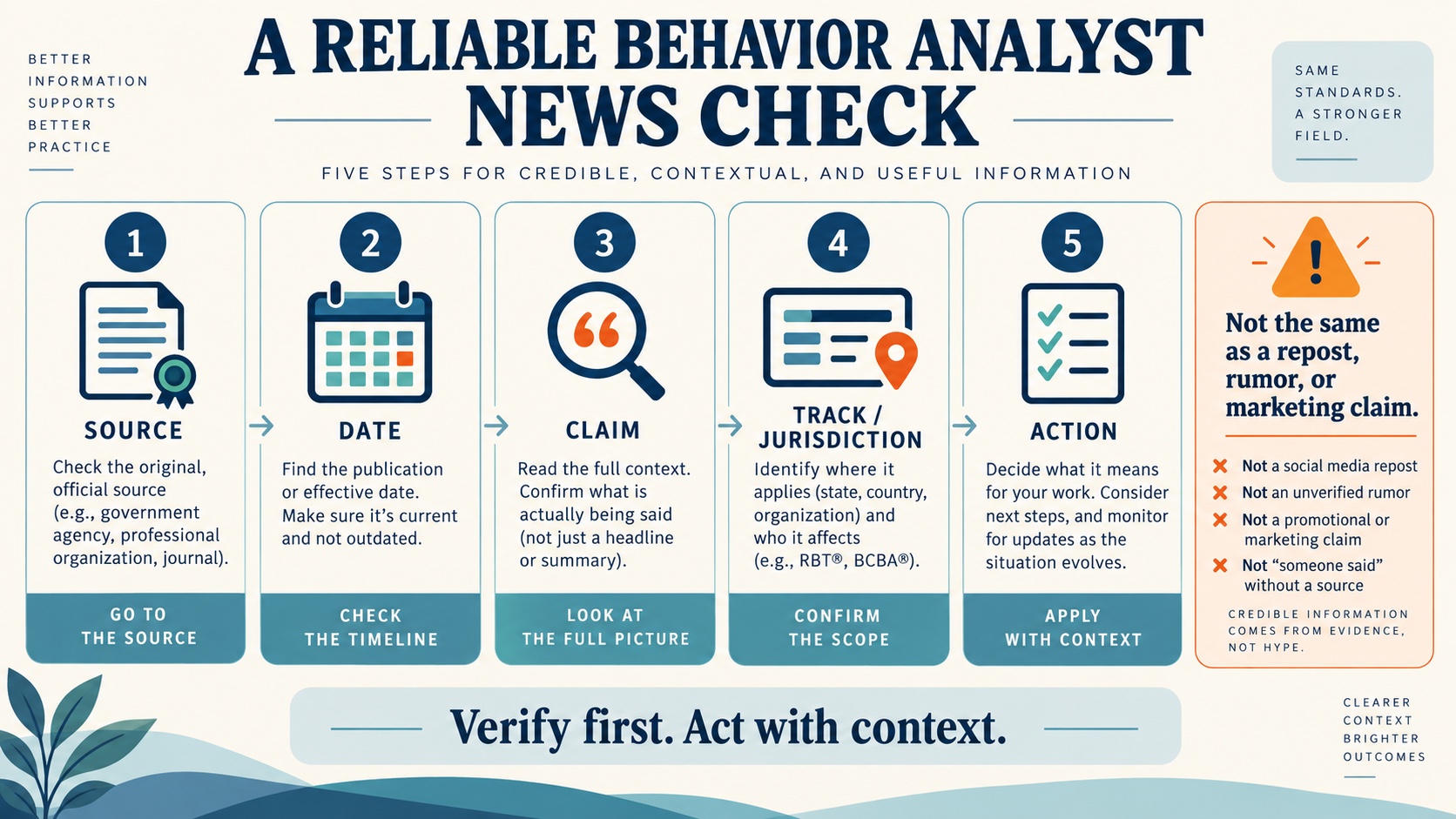
Use a five-part news check
- Source: Who published the original item, and do they have authority over this topic?
- Date: Is it a publication date, an update date, a proposed effective date, or merely the date someone reposted it?
- Claim: What exactly changed? Copy the sentence or requirement instead of relying on a dramatic summary.
- Track or jurisdiction: Does it concern RBT, BCaBA, BCBA, a particular state, a payer, a workplace, or a research population?
- Action: What should you do now—save the document, ask a supervisor, check a license board, update a study plan, or wait for a final rule?
Writing those five answers in a short note prevents a common error: remembering the action while forgetting the condition that made the action relevant. It also makes it easier to revisit an update when the official page changes.
Match the update to the right track
Behavior analysis news is often shared across certification levels, but the requirements are not interchangeable. An RBT exam or maintenance update belongs with the RBT handbook and outline. A BCaBA supervision or coursework update belongs with BCaBA materials. A BCBA fieldwork or 2027 transition notice belongs with the BCBA handbook and transition guidance. If a post uses “behavior analyst” as a broad label, open the source and identify the actual track before changing your plan.
The same rule applies to professional roles. An RBT implementing a written behavior plan, a BCaBA practicing under supervision, and a BCBA independently providing behavior-analytic services may encounter the same news item but have different responsibilities. A news summary should not be used to expand someone’s scope of practice.
Read research news without overclaiming
When a research headline says that an intervention “works,” ask three quieter questions. Who participated? What outcome was measured? What comparison or design supports the conclusion? A single-case design, group study, systematic review, and commentary answer different evidence questions. None should be reduced to a universal promise without checking the paper.
Also separate evidence from implementation. A study can suggest that a procedure deserves consideration, while a learner’s plan still requires assessment, consent or assent processes, supervision, data collection, and individualized decision-making. Research news can improve a question for a team; it does not authorize an unplanned procedure.
Turn an update into a safe action
Use this small workflow when an update appears in your inbox or feed:
- Save the original link and note the access date.
- Write the exact claim in one sentence.
- Identify who is affected and who is not.
- Find the controlling handbook, rule, paper, or registry page.
- Ask the appropriate supervisor, regulator, or institution when the next step is personal or high-stakes.
- Update your study notes only after the scope and effective date are clear.
For students, this can become a monthly review habit. For practitioners, it can be a short team agenda item. For families and employers, it creates a record of which source was used to answer a credential or service question.
When the update could affect a certification application, client safety, employment, billing, or licensure, pause before acting. Save the source, ask the person or authority responsible for the decision, and document the answer. A careful delay is often more useful than a fast response to an incomplete summary.
Common behavior analyst news mistakes
Sharing a screenshot without the source
A cropped screenshot may omit a date, footnote, exception, or link. Find and save the original page.
Confusing a proposal with a final rule
Proposals, public comments, final rules, and implementation notices have different status. Do not treat them as interchangeable.
Applying one track’s update to another
Certification levels have different handbooks, outlines, and role boundaries. Confirm the affected track before changing a plan.
Turning a research headline into a promise
Read the design, sample, outcome, and limitations before making a clinical or educational claim.
Letting urgency replace verification
“Act now” language is not evidence. If a change is real and important, the authoritative source should explain its scope and timing.
FAQ and reliable sources
Where should I start for BACB news?
Start with the BACB News archive and BACB newsletter archive. Follow links in the announcement to the current handbook, transition guide, or policy page.
Where should I check 2027 certification changes?
Use the BACB Recent and Upcoming Changes to BACB Requirements page and the applicable current handbook. Do not rely on a summary that omits the affected track or transition date.
Is every behavior-analysis news story relevant to my work?
No. Match the story to your certification track, setting, jurisdiction, role, and population. Relevance is part of accuracy.
Can ABA Study Online provide official certification advice?
No. ABA Study Online can help organize learning and explain concepts, but official certification and licensure decisions belong to the relevant board, regulator, institution, or supervisor. Visit the ABA Study Online BCBA learning hub for educational resources.