
Behavior Analyst Exam: Which BACB Track Is Yours?
“Behavior analyst exam” is a useful search phrase, but it does not name one universal test. The current Behavior Analyst Certification Board (BACB) system has separate certification examinations for the BCBA, BCaBA, and RBT tracks. The right study map depends on the credential you are pursuing, the role you want to perform, and the current handbook and Test Content Outline (TCO) for that track.
This guide gives you a clean starting point: compare the three current examination snapshots, identify the outline edition that applies, and build a source-checked study sequence before you open a question bank. The numbers below describe the official examination structure; independent practice materials are not BACB content and cannot guarantee a certification result.
Table of Contents
What “behavior analyst exam” means
In everyday conversation, people may use “behavior analyst” to describe a range of behavior-analysis work. In the BACB certification system, the exam question becomes clearer when you name the credential:
- BCBA: a graduate-level certification with its own eligibility, examination, supervision, ethics, and maintenance rules.
- BCaBA: an undergraduate-level certification with a separate examination and a defined supervision relationship.
- RBT: a paraprofessional certification with its own training, competency, examination, and ongoing requirements.
These tracks share behavior-analytic language, but they are not interchangeable. A BCBA practice set is not automatically appropriate for a BCaBA learner, and a general “ABA exam” page should not be used as a substitute for the current RBT outline. Start by writing the target credential at the top of your study file. That small step prevents an entire week of studying the wrong domain map.
Compare the three current BACB examinations
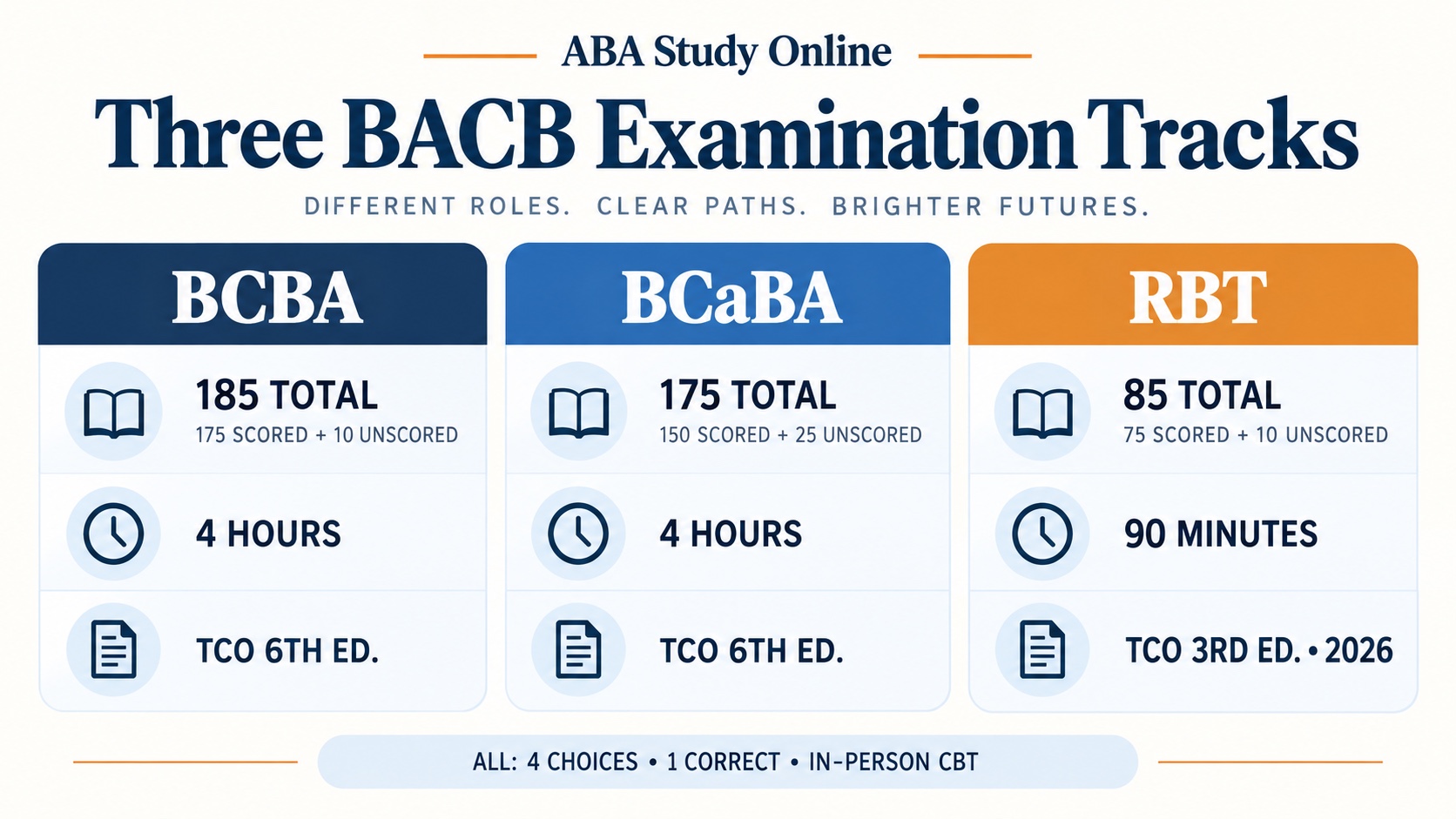
The BACB’s current Examination Information page gives a useful format snapshot. Each examination is multiple choice, with four possible answers and one correct answer, and the BACB uses in-person computer-based testing at authorized Pearson VUE sites. The official content outlines supply the scored and unscored breakdowns and the content edition.
| Track | Total questions | Time | Current content outline | Study boundary |
|---|---|---|---|---|
| BCBA | 185 total 175 scored + 10 unscored |
4 hours | BCBA TCO, 6th ed. | Graduate-level behavior-analytic content and current BCBA handbook |
| BCaBA | 175 total 150 scored + 25 unscored |
4 hours | BCaBA TCO, 6th ed. | Undergraduate-level content and current BCaBA handbook |
| RBT | 85 total 75 scored + 10 unscored |
90 minutes | RBT TCO, 3rd ed., beginning 2026 | RBT role, competency, and current RBT handbook |
The examination length is not the only meaningful difference. The current BCBA and BCaBA TCOs are organized around their own task sets and domain weights. The RBT outline is a separate document and changed to its 3rd edition for the 2026 examination. If a study product uses one generic “behavior analyst exam” label without naming the track and edition, treat that as a reason to investigate further.
What the examinations have in common
There are a few shared format rules, but shared format does not mean shared content. The current BACB examination information states that questions have four possible answers and one correct answer. Examinations are delivered through computer-based testing in person at authorized sites. For examination-day policies, accommodations, rescheduling, and what happens after an application is approved, use the relevant handbook and the BACB’s current examination pages.
The examinations also share an important scoring boundary: an independent practice percentage is not an official BACB result. The BACB uses multiple forms and a criterion-referenced process to establish passing standards. Because forms can differ in difficulty, the number of correct answers required can vary, and the BACB does not report a universal raw correct-answer threshold as the pass rule.
This does not make practice scores useless. A score can show whether a particular set felt easy, difficult, or unstable. The more useful information is usually underneath it: which track and domain the item belonged to, what evidence controlled the answer, whether you were confident, and what you should practice next.
Choose the correct study map
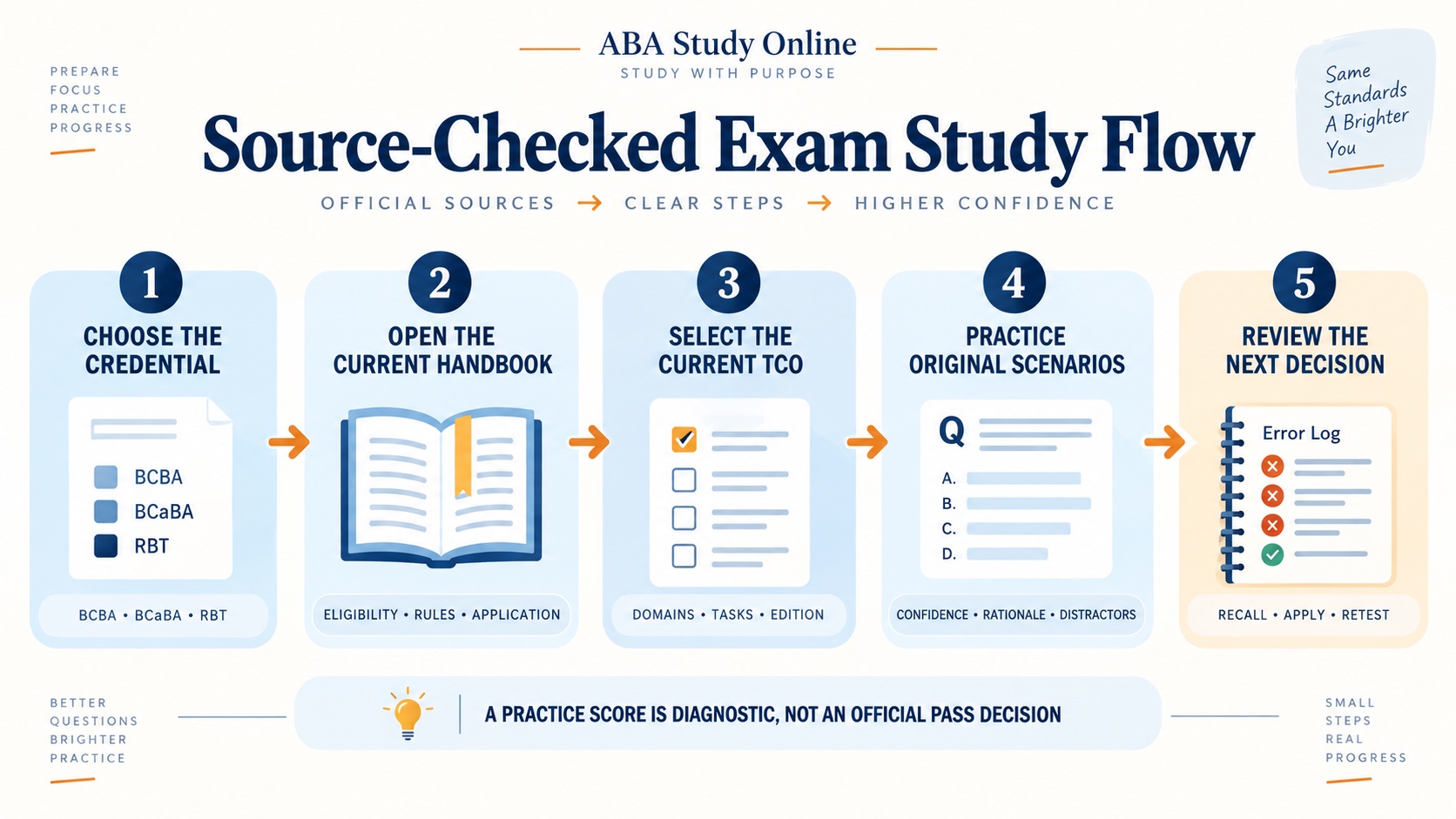
Use this sequence before purchasing a course or opening a large practice bank:
- Name the credential: write BCBA, BCaBA, or RBT. If you are still comparing roles, start with the BACB’s credential overview and the relevant certification page.
- Open the current handbook: use it for eligibility, application, examination procedures, role boundaries, maintenance, and candidate rules.
- Open the current TCO: use it for examination content, task codes, domains, and approximate content weighting.
- Build a practice tag: every question should carry a track, domain, and a short description of the reasoning problem.
- Review the source when the question changes: if you are unsure whether a statement is an exam-content fact, an application rule, or a future requirement, return to the document that owns that decision.
For example, a learner who wants to become a BCaBA should not use a BCBA question set merely because both documents have domains labeled A through I. The task counts, domain names, and role context differ. A learner studying for the RBT examination should also check the current RBT TCO and handbook instead of assuming that a BCBA or BCaBA summary is a higher-quality version of the same material.
Use practice scores responsibly
Practice is most useful when it answers a small decision. Ask yourself what the session is meant to measure:
- Orientation: Do I recognize the vocabulary and the outline’s domain structure?
- Discrimination: Can I tell two similar concepts or procedures apart in a short scenario?
- Application: Can I select the best next action when the stem includes context, data, or role boundaries?
- Stamina: Can I sustain attention through a long mixed session under the official time boundary?
Do not use a full mock to answer every question at once. A short diagnostic can reveal a vocabulary or discrimination gap. A domain set can help repair that gap. A mixed set can test whether the distinction transfers when the heading disappears. A long timed rehearsal can then measure pacing and concentration. After each item, record the controlling fact and why the distractors fail. That record is more reusable than a percentage alone.
A source-checked one-week starting plan
If you are beginning from a broad behavior-analyst-exam search, use one week to make the target concrete:
- Day 1 — choose the track: write the credential, current handbook, and current TCO link in one place.
- Day 2 — map the content: list the domains and mark which tasks use identify, distinguish, implement, interpret, or apply verbs.
- Day 3 — run a small diagnostic: use original questions, mark confidence before feedback, and log the type of error.
- Day 4 — repair one distinction: read the source, explain the concept in plain language, and answer new examples.
- Day 5 — mix the context: practice questions from more than one domain and identify what evidence controlled each answer.
- Day 6 — review the log: group errors into recall, discrimination, application, reading, or pacing.
- Day 7 — choose the next format: return to theory, use targeted questions, or schedule a longer mixed session based on the error pattern.
A simple example: if a learner repeatedly chooses a procedure before checking whether the available data support that decision, the next session should focus on evidence boundaries and assessment-to-intervention reasoning. Another full mock may only produce more misses. The goal is not to create a dramatic number; it is to make the next study action more precise.
Common behavior-analyst-exam mistakes
- Assuming the phrase names one exam: always identify the BACB credential before choosing materials.
- Mixing outline editions: BCBA and BCaBA use 6th-edition TCOs; RBT uses the 3rd-edition TCO beginning in 2026.
- Using a practice label as an official claim: “real,” “official,” and “guaranteed pass” language needs evidence and should not be assumed.
- Confusing an outline with eligibility: exam content does not decide whether your degree, coursework, fieldwork, or application qualifies.
- Chasing a universal raw passing number: use current BACB scoring information and treat practice performance as diagnostic evidence.
- Studying only one track’s examples: once your credential is chosen, keep every note and question tagged to that track.
FAQ and official sources
Is the behavior analyst exam the same as the BCBA exam?
Not necessarily. People often use the phrase as shorthand for the BCBA examination, but the BACB also administers separate BCaBA and RBT examinations. Confirm the credential before studying.
How many questions are on the current behavior-analysis certification exams?
The current BACB examination table lists 185 questions for BCBA, 175 for BCaBA, and 85 for RBT. The current TCOs explain the scored and unscored portions for each track.
Can a practice score tell me whether I will pass?
No. A practice score describes one independent set. Use it to identify study decisions, and keep the official BACB scoring and handbook information separate from any provider’s percentage.
Where should I start if I do not know which credential fits?
Start with the BACB’s credential overview, then compare the BCBA, BCaBA, and RBT pages and handbooks. Consider the role, education, supervision, and current eligibility rules before choosing an examination study map.
- BACB Examination Information
- BACB Test Content Outlines
- BACB Consumer Resources and certification overview
- BACB RBT examination resources
- Pearson VUE BACB examinations
For independent study support, use the appropriate BCBA, BCaBA, or RBT study path, practice with free questions, or check a term in the ABA Definition Search. These resources organize learning; official BACB documents remain the authority for certification and examination decisions.