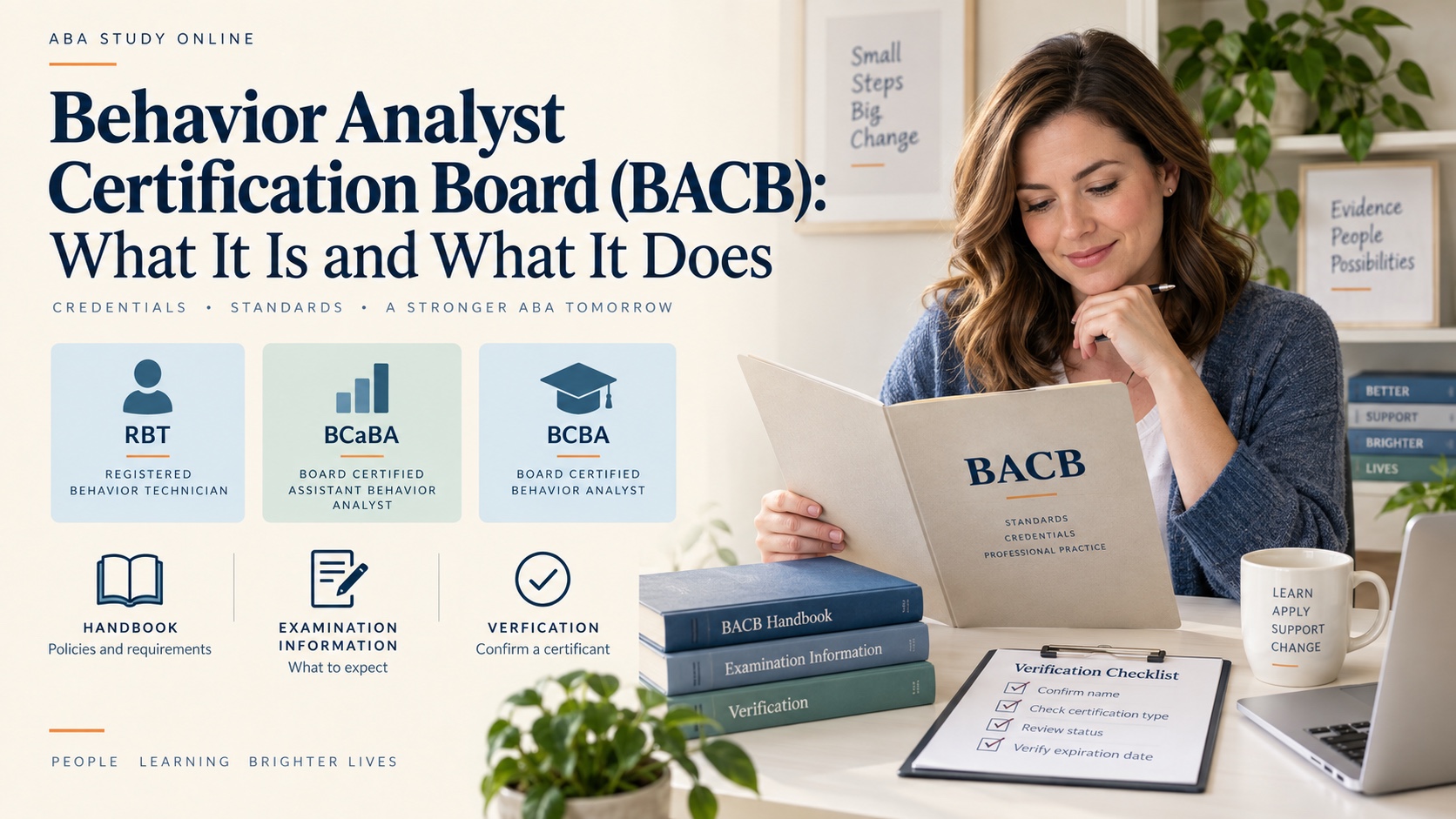
Behavior Analyst Certification Board (BACB): What It Is and What It Does
If you searched for the Behavior Analyst Certification Board BACB, you may be trying to decode a name that appears on an exam page, a job posting, a handbook, or a credential lookup. The short answer is that the Behavior Analyst Certification Board (BACB) is a nonprofit credentialing organization for behavior analysis. It operates certification programs, sets professional and ethics requirements for those programs, administers certification examinations, and provides ways to verify certifications.
That answer is useful because several different ideas are often blended together: a certification, a state license, a university program, a training course, and a person’s job role are not interchangeable. This guide separates them and shows you where to go next when your question is about RBT, BCaBA, BCBA, exam content, requirements, or verification.
Quick answer: BACB stands for Behavior Analyst Certification Board. According to its own description, it was established in 1998 to meet professional certification needs identified by behavior analysts, governments, and consumers of behavior-analytic services. Its role is to operate certification programs and related standards, examinations, ethics requirements, and disciplinary systems. It is not a college, a state licensing board for every jurisdiction, or a substitute for checking local practice rules.
What the BACB does
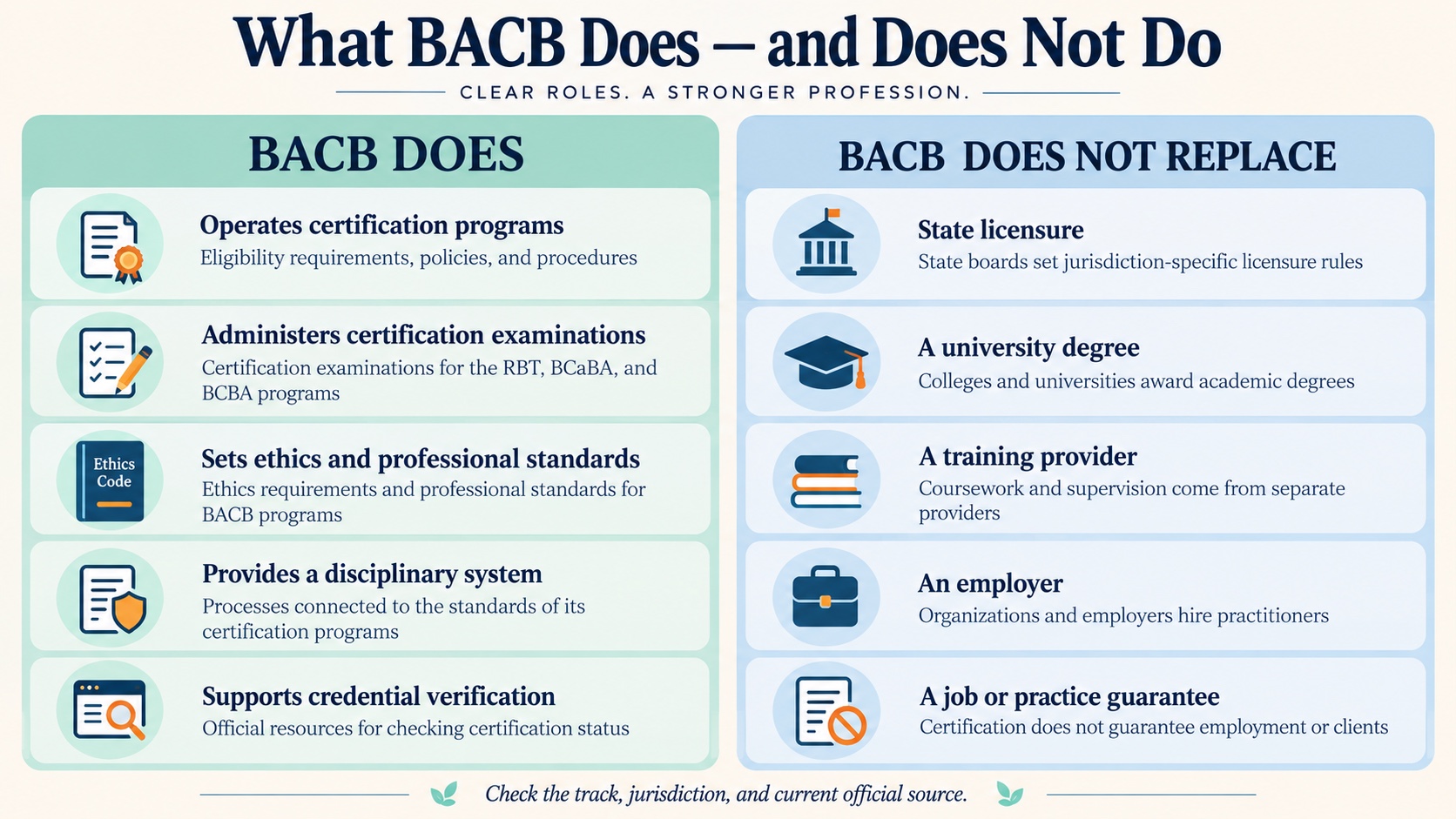
The simplest way to understand the BACB is to think of it as the organization that runs several professional certification systems in behavior analysis. That work has more than one part.
It operates certification programs
The BACB defines the standards and pathways for its certification programs. That includes the eligibility requirements, application process, examination process, ethics expectations, maintenance rules, and documentation associated with each credential. The details are track-specific, so an RBT question should be answered from RBT materials, while a BCaBA or BCBA question should be checked against the matching handbook and current requirements page.
It administers certification examinations
The BACB examination information page describes the examinations as computer-based, multiple-choice examinations delivered in person through authorized Pearson VUE testing sites. The current overview lists three certification examinations: RBT, BCaBA, and BCBA. The same page provides track-specific examination information and points candidates toward the relevant handbook. Pearson VUE handles scheduling and appointment operations after a candidate is authorized to test; the BACB remains the certification program owner.
It establishes ethics and professional standards
A certification is not only an exam result. BACB certification programs include ethics requirements and maintenance obligations, and the BACB operates a disciplinary system connected to those standards. For a consumer or employer, this is why a credential lookup can be more useful than a claim printed on a résumé: the official registry can help confirm a certification status and reportable disciplinary information when available.
It protects the public through credentialing infrastructure
The BACB states that its mission is to protect consumers of behavior-analytic services by systematically establishing, promoting, and disseminating professional standards. The BCBA, BCaBA, and RBT certification programs are accredited by the National Commission for Certifying Agencies. Accreditation is not a promise that every practitioner, course, or employer will be a good fit. It is part of the structure used to review a certification program.
The three BACB certification tracks
The BACB homepage presents three main certification tracks at different levels of responsibility. These are not three names for the same job.
| Track | Plain-language role description | Supervision boundary |
|---|---|---|
| RBT | A paraprofessional in behavior analysis | Practices under close, ongoing supervision by a qualified supervising professional |
| BCaBA | An undergraduate-level professional in behavior analysis | Practices under the supervision of a BCBA or other permitted supervisor |
| BCBA | A graduate-level professional in behavior analysis | May practice independently and provide supervision for BCaBAs and RBTs |
This table is an orientation, not an eligibility checklist. The role description does not tell you whether you personally qualify. For that, open the official page and handbook for your track. It also does not tell you what a particular state permits; certification and licensure must be checked separately.
You may also see BCBA-D. The BACB describes BCBA-D as a designation for certain BCBAs with doctoral or postdoctoral training in behavior analysis. It is not a separate certification and does not grant privileges beyond BCBA certification. That distinction matters when a search result makes a designation look like a fourth certification level.
What BACB certification is not
It is not the same as a state license
Many, but not all, U.S. states require behavior analysts to be licensed. A BACB certification may be part of a state’s requirements, but it does not automatically answer every state-law question. If you are planning to work in a specific state, check that state’s licensing board and employer requirements in addition to the BACB materials.
It is not a degree or a training provider
The BACB does not replace a university degree, qualifying coursework, supervised fieldwork, or a required training course. A handbook may tell you what evidence is needed, but the organization is not the same thing as the school or provider that supplies that evidence. This is why pages promising a “BACB degree” or suggesting that the BACB itself enrolls students should be read carefully.
It is not an employer or a guarantee of practice
Certification does not guarantee a job, a salary, a payer contract, or permission to provide every type of service. The actual work setting, supervision arrangement, payer rules, state law, and employer policy still matter. Certification is one piece of professional infrastructure, not a complete employment contract.
Which official document should you read?
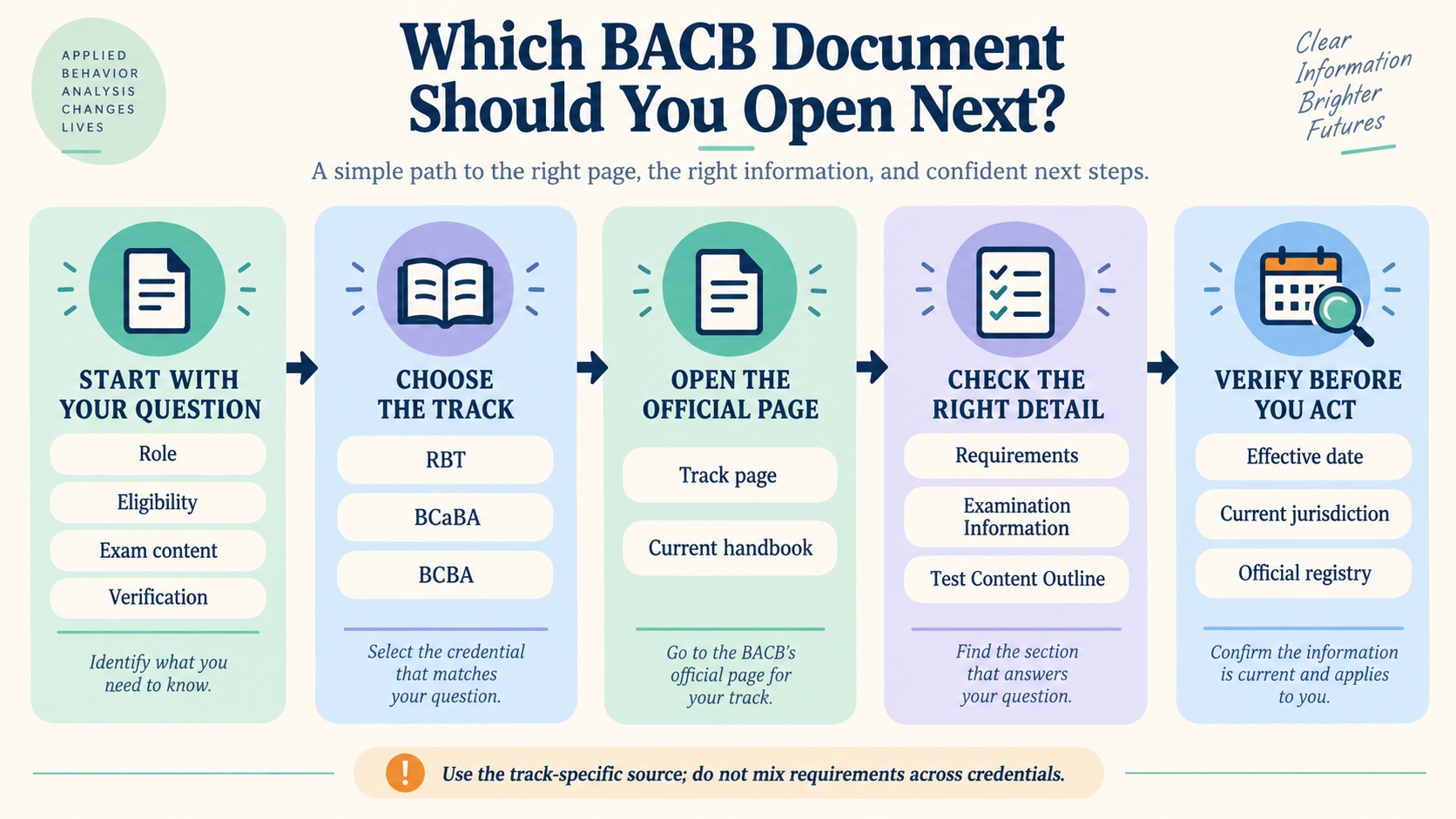
Once you know what BACB is, the next question is usually more specific. Use the question—not the keyword alone—to choose the document.
- “What is this credential?” Start with the BACB track page for RBT, BCaBA, or BCBA.
- “Do I qualify?” Open the current handbook and requirements page for that track. Do not borrow a BCBA rule for a BCaBA application.
- “What is on the exam?” Open the current BACB Test Content Outlines index and then select the correct track and edition.
- “How do I schedule or understand test day?” Use BACB Examination Information and the matching handbook, then follow Pearson VUE instructions for the appointment.
- “Is this person certified?” Use the BACB Certificant Registry or the official verification resource rather than relying on a screenshot or an unverified directory.
The 2026–2027 version boundary
Search results can mix older pages, current handbooks, and future-transition material. The BACB’s current test-content index lists the RBT Task List (2nd edition) through December 31, 2025, the RBT Test Content Outline (3rd edition) beginning January 1, 2026, and the BCaBA and BCBA Test Content Outlines (6th edition). That is a document-version statement, not a claim that every eligibility rule changes at the same time.
The BACB homepage also currently highlights significant BCBA and BCaBA certification-requirement changes taking effect January 1, 2027. If your application crosses that date, read the current transition guidance and handbook for your credential. A general BACB explainer should point you to those sources, not flatten different tracks and dates into one “new BACB rule.”
Common misunderstandings
- Calling BACB a license: BACB certification and state licensure are related in some jurisdictions but are not the same credential.
- Treating all tracks as one: RBT, BCaBA, and BCBA have different roles, supervision boundaries, requirements, and examination documents.
- Using an old task list automatically: check the effective date and current TCO index before building a study plan.
- Assuming an exam-prep course is official: independent study providers can be useful, but they are not the BACB itself.
- Using a job post as the rulebook: an employer’s preference may be narrower or broader than the certification requirements and does not replace official guidance.
FAQ
What does BACB stand for?
BACB stands for Behavior Analyst Certification Board. The organization operates certification programs in behavior analysis and publishes the related standards, examination information, ethics requirements, and credential-verification resources.
Is BACB a government agency?
The BACB describes itself as a nonprofit corporation. It has a regulatory-like professional role, but it is not a state government licensing board for every jurisdiction. Check local licensing requirements separately.
Does the BACB offer RBT, BCaBA, and BCBA certifications?
Yes. The BACB identifies RBT, BCaBA, and BCBA as its three certification programs and examinations. Their eligibility and practice boundaries are different, so use the matching official track materials.
Is BCBA-D a separate BACB certification?
No. BCBA-D is a designation associated with BCBA certification; the BACB says it does not grant privileges beyond BCBA certification.
Where should I check the latest BACB rules?
Start with the BACB website, the page for your track, the current handbook, the Examination Information page, and the current Test Content Outline index. Check effective dates before relying on a study guide or search snippet.