Behavior Analyst Board Certification: BCBA, BCaBA, and RBT Explained
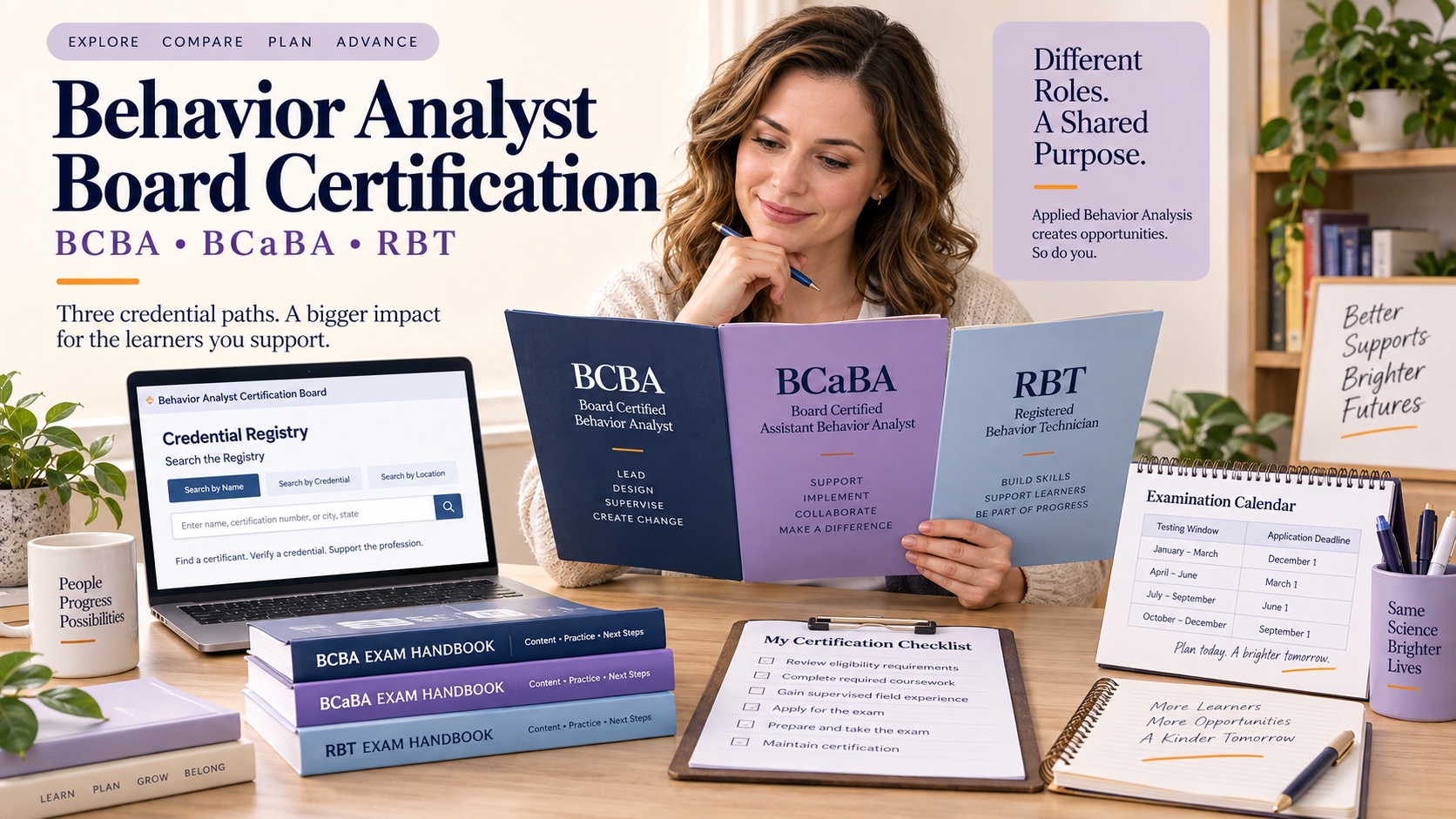
The phrase behavior analyst board certification can sound like one universal credential, but it usually refers to a certification track administered by the Behavior Analyst Certification Board (BACB). The BACB currently offers three certifications at different experience levels: BCBA, BCaBA, and RBT. Each has its own education or training requirements, application process, examination, ethics responsibilities, and maintenance rules.
This guide gives you a practical map before you choose a program or study resource. It explains what the credentials mean, how their roles differ, how official verification works, and where an educational website such as ABA Study Online fits. It does not make an individual eligibility decision or promise certification.
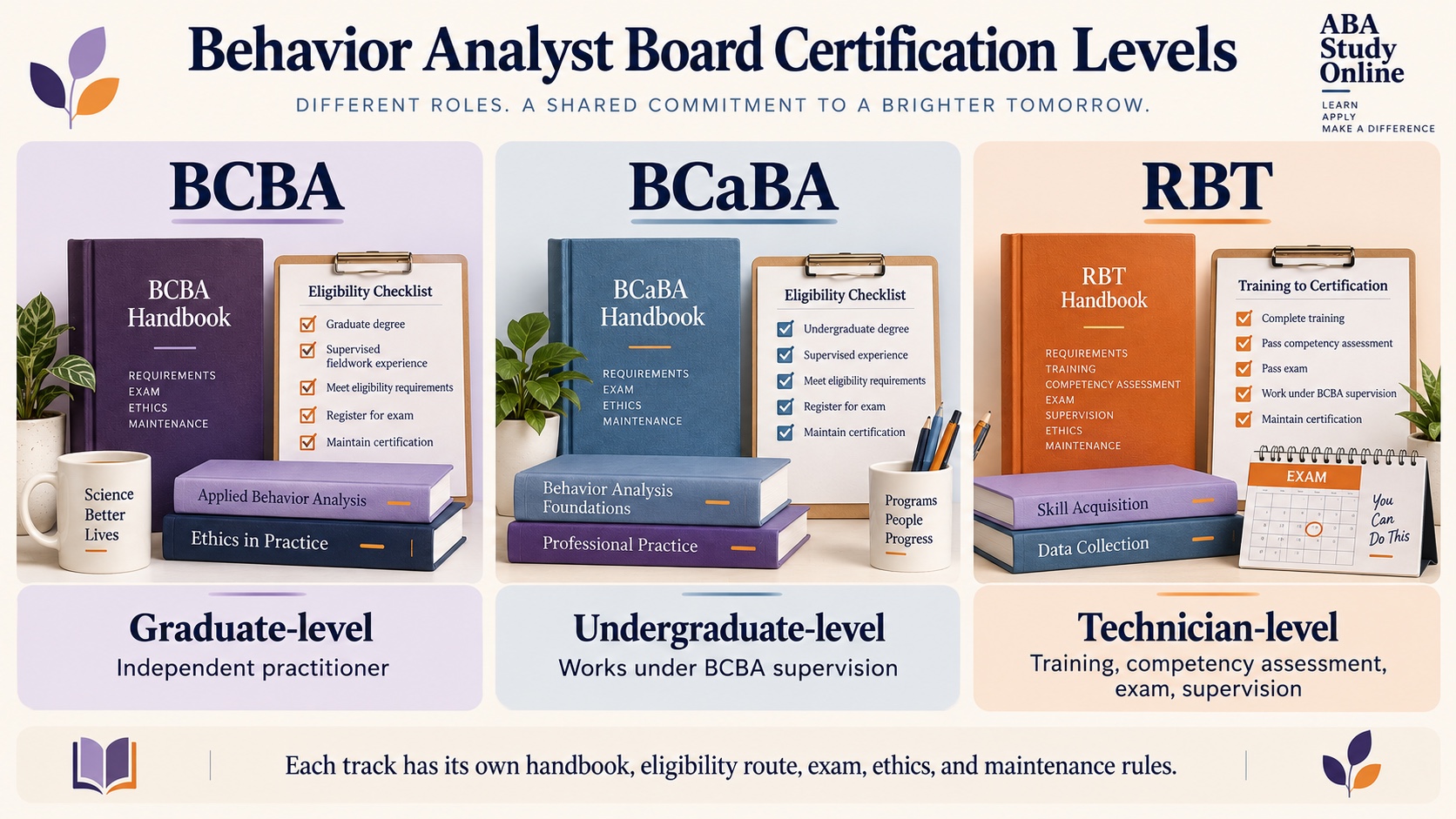
Quick answer: behavior analyst board certification is a professional credential showing that an applicant met the applicable eligibility requirements, passed the relevant examination, and continues to follow maintenance and ethics requirements. The BCBA is a graduate-level certification for independent practitioners. The BCaBA is an undergraduate-level certification for professionals who provide services under BCBA supervision. The RBT is a technician-level credential with its own training, competency, application, exam, and supervision requirements.
The three BACB certification levels
BCBA: graduate-level certification
The Board Certified Behavior Analyst (BCBA) certification is a graduate-level credential. According to the BACB’s current role description, BCBAs are independent practitioners who provide behavior-analytic services and may supervise RBTs, BCaBAs, and other professionals who implement behavior-analytic interventions. “Independent” describes the professional role within the credential’s scope; it does not erase ethics duties, employer policies, payer rules, or state and local requirements.
A person considering the BCBA route should begin with the current BCBA Handbook, then check the applicable education, coursework, fieldwork, application, examination, and maintenance rules. The 2027 transition materials are a separate planning source for applicants whose timeline crosses the requirement boundary.
BCaBA: undergraduate-level certification
The Board Certified Assistant Behavior Analyst (BCaBA) certification is an undergraduate-level credential. BCaBAs provide behavior-analytic services under the supervision of a BCBA and may supervise the work of RBTs. That supervision relationship is a key role boundary: a BCaBA is not simply a “junior BCBA,” and a study guide should not imply identical authority or requirements.
BCaBA applicants should use the current BCaBA Handbook and transition guidance for the pathway, coursework, fieldwork, examination, and maintenance details that apply to their application period. If the question is about 2027 coursework or fieldwork, label the document with the date instead of blending old and new figures.
RBT: technician-level credential
The Registered Behavior Technician (RBT) credential is a technician-level track. Its path includes current training, an initial competency assessment, application documents, examination, and ongoing supervision and maintenance. An RBT is not a BCBA or BCaBA, and completing an RBT course does not create either higher-level certification.
How the certification process works
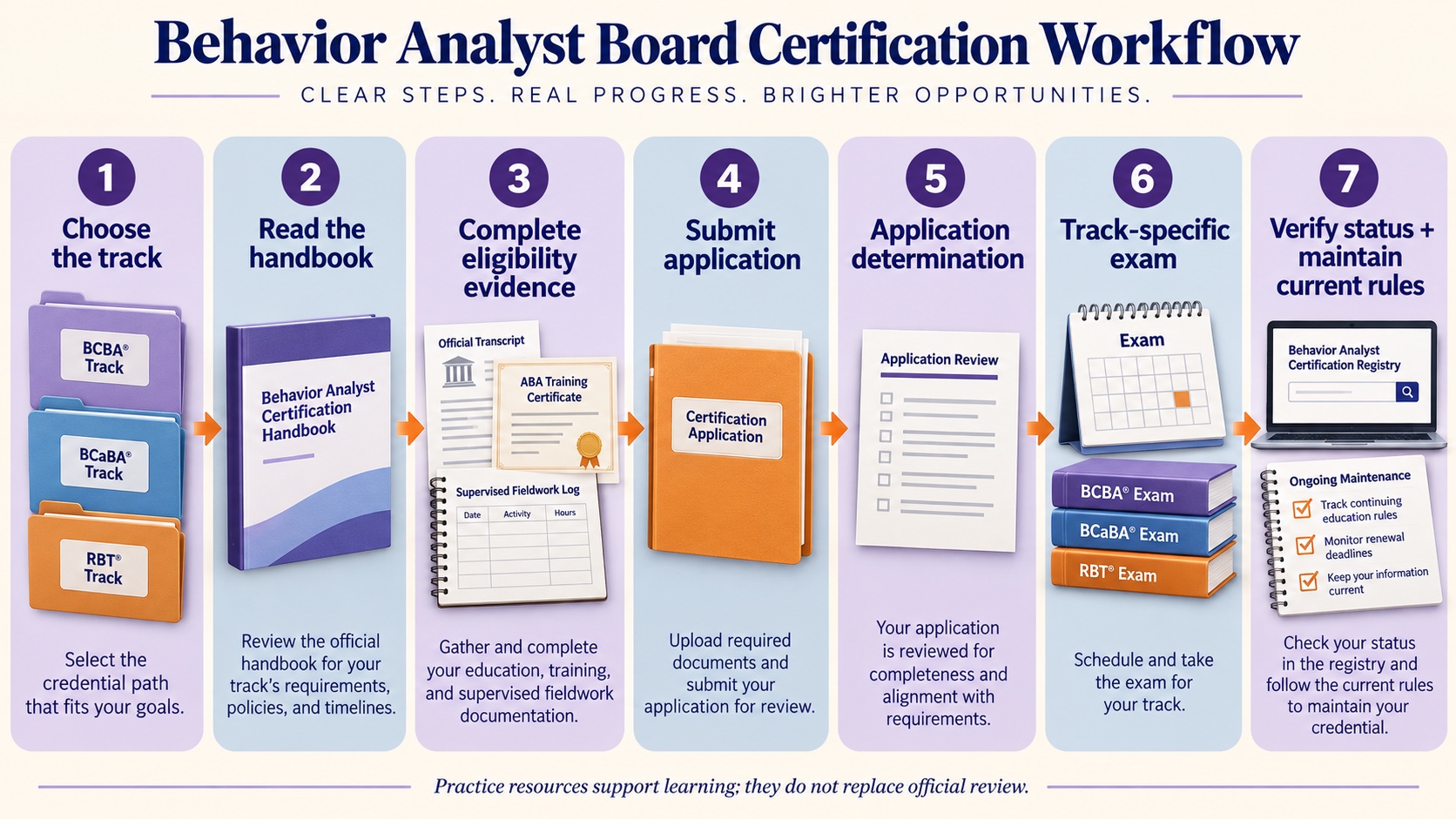
The details vary by track, but the overall logic is similar. First, identify the certification you actually want. Next, read the current handbook and confirm the eligibility route. Then complete the required education, training, coursework, fieldwork, or competency steps for that track. Gather the official documents, submit the application, receive the appropriate determination, and follow the examination instructions.
The examination is not the first step. The BACB’s examination information says that candidates must meet applicable eligibility requirements, submit a certification application, and receive an approved determination before taking the examination. BACB examinations are delivered by Pearson VUE at authorized testing sites, using computer-based testing. The current examination page lists separate time and question details for BCBA, BCaBA, and RBT candidates, so a generic “ABA exam” description is not enough.
- Choose the track: BCBA, BCaBA, or RBT.
- Read the current handbook: identify education, training, fieldwork, assessment, and document requirements.
- Build evidence: keep transcripts, certificates, fieldwork forms, competency records, attestations, and application copies.
- Submit the application: use the current portal instructions and wait for the applicable determination.
- Prepare for the right exam: use the track-specific Test Content Outline and examination rules.
- Maintain the credential: follow the applicable ethics, supervision, continuing education, renewal, and recertification requirements.
This sequence also explains why a school or app should avoid phrases such as “become certified instantly.” A course may help with learning, but it cannot replace a formal application review or an examination result.
How to verify a credential
Credential verification is different from reading a résumé or trusting a logo. The BACB provides a Certificant Registry so consumers, employers, and other stakeholders can check certification status and see whether reportable disciplinary actions are associated with a certificant. When verification matters, search the registry using the person’s current identifying information and review the result carefully.
For an employer or caregiver, useful questions include: Which credential does the person hold? Is it current? Does the role match the credential? Who provides supervision? Are there state, payer, or organizational requirements in addition to BACB certification? A registry result answers an important credential question, but it does not answer every question about clinical fit, availability, or service quality.
What certification does not mean
- It is not a universal license: local laws, licensure boards, funders, employers, and payers may add requirements.
- It is not a pass guarantee: a course, app, or practice score cannot guarantee an examination result.
- It is not a provider endorsement: the BACB handbook and official pages are the authority, not a marketing badge.
- It is not interchangeable across levels: BCBA, BCaBA, and RBT have different roles and supervision boundaries.
- It is not permanent without maintenance: certificants must follow the current track-specific renewal and ethics requirements.
- It is not a clinical recommendation: credential status is one part of choosing services or a workplace.
Certification versus licensure
Certification and licensure answer different questions. A certification board evaluates whether a person meets the board’s professional standard and ongoing requirements. A state or other jurisdiction may separately regulate who can practice, what title can be used, which services can be billed, or what supervision is required. The relationship between these systems differs by location and can change, so a person should check the applicable government, licensing, payer, and employer rules before beginning services or advertising a role.
This distinction is also important for content planning. An educational article can explain how credentials work and point readers to official resources. It should not tell a reader that a certification automatically authorizes every service in every location. Good study content keeps the credential facts, role examples, and jurisdiction-specific questions visibly separate for every reader and every setting before making decisions in practice and online with confidence.
How to choose study materials
Start with the official Test Content Outline for the track, then choose materials that help you retrieve definitions, discriminate similar concepts, apply principles to examples, and review errors. A strong resource labels which track it supports and the date of the outline it uses. It should separate official requirements from teaching explanations and clearly mark practice questions as unofficial.
ABA Study Online can support that learning layer with track-specific explanations, free previews, practice questions, flashcards, and app-based review. The website and app should route learners toward the correct BCBA, BCaBA, or RBT destination instead of treating “ABA certification” as one blended course. Keep official application evidence in its own folder and use the study platform for learning and practice.
A practical study loop is simple: read one outline section, explain the concept in plain language, answer a small set of questions, record the error pattern, and return to the source. Repeat with realistic examples. That process improves understanding without implying that an app or article can determine eligibility.
FAQ
Is BCBA the same as behavior analyst board certification?
BCBA is one BACB certification track. The broader phrase can also refer to BCaBA or RBT, so identify the credential level before interpreting requirements or job responsibilities.
Which certification is the highest level?
Among the three BACB certifications, BCBA is the graduate-level independent-practice credential. BCaBA is undergraduate-level and works under BCBA supervision, while RBT is a technician-level credential with its own supervision and training structure.
Can a practice app certify me?
No. An app can teach concepts and provide practice, but certification depends on the applicable requirements, application determination, examination, and maintenance rules.
How do I know whether someone is certified?
Use the BACB Certificant Registry and check the current status. Then consider role, supervision, state, payer, and employer requirements separately.