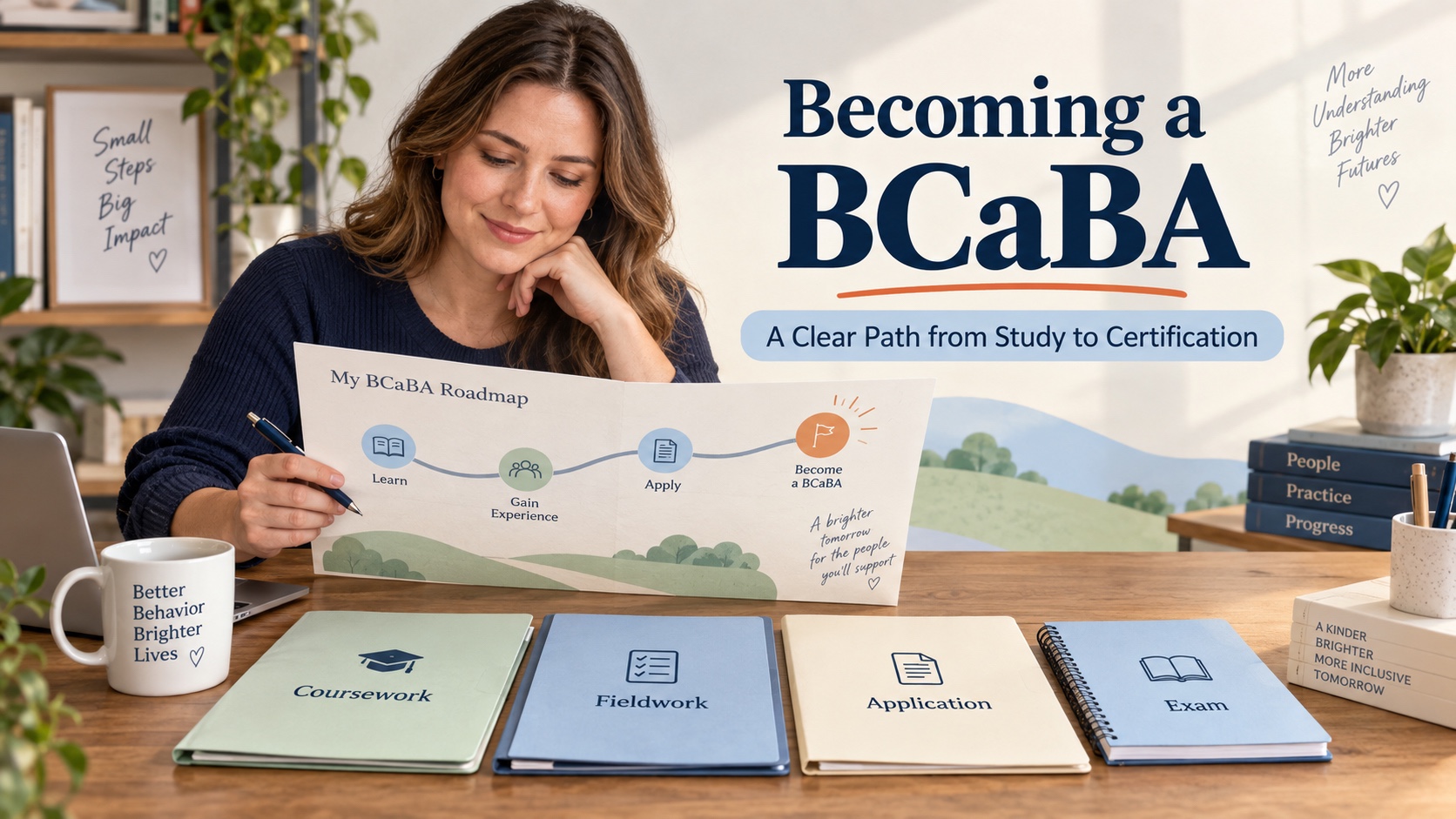
Becoming a BCaBA: A Clear Path from Study to Certification
If you are exploring becoming a BCaBA, think of the process as a roadmap rather than one test. You need the right undergraduate education or pathway-specific coursework, supervised fieldwork, an approved certification application, and a passing BCaBA examination. The exact evidence depends on the pathway and the rules in effect when you apply, so the current BACB Handbook should be your final source for personal eligibility.
A BCaBA is an undergraduate-level behavior-analysis certification. BCaBAs may provide behavior-analytic services only under the supervision of a BCBA, and BCaBAs may supervise RBT work within the applicable requirements. This is different from BCBA certification, which is a graduate-level credential and does not require you to become a BCaBA first.
Table of Contents
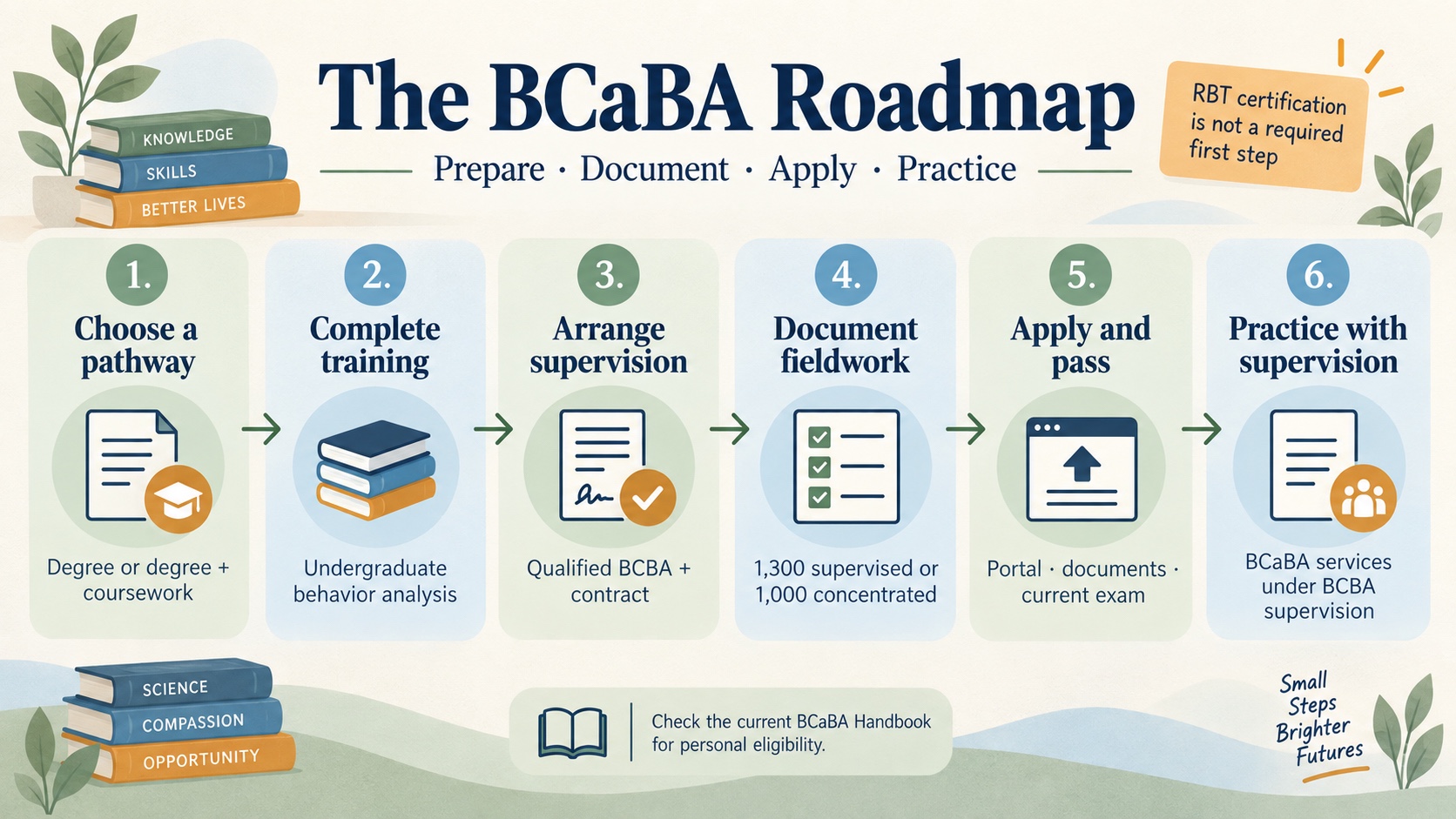
The BCaBA roadmap at a glance
- Choose the pathway that matches your education and training.
- Complete the required degree and behavior-analytic coursework, if your pathway requires coursework.
- Arrange a qualified BCBA supervisor and a written supervision relationship before counting fieldwork.
- Document fieldwork, supervision, observations, and unrestricted activities as they occur.
- Submit the BCaBA application and required official documents through your BACB Portal account.
- After approval, schedule and pass the current BCaBA examination through Pearson VUE.
- Maintain the certification and supervision requirements that apply to your status.
Choose an eligibility pathway
The current BCaBA Handbook describes two main eligibility pathways. Pathway 1 uses a bachelor’s degree or higher from an ABAI-accredited program and supervised fieldwork. Pathway 2 uses an acceptable bachelor’s degree or higher, qualifying undergraduate-level or higher behavior-analytic coursework, and supervised fieldwork. A program advisor or Pathway 2 Program Contact can help you understand how your coursework is documented; an internet checklist cannot make the final determination for you.
At the beginning, ask your program three practical questions: Which pathway does this program support? Who is responsible for the coursework attestation, if one is required? Which records will I receive for fieldwork and application review? Save the answers with the program documents you use. A clear record of the pathway makes later decisions easier, especially if you change programs, move between supervisors, or apply near a requirements transition.
Create a simple timeline for yourself: education milestones, supervisor start date, monthly fieldwork records, final verification, application submission, and examination authorization. The timeline is not a BACB form, but it helps you notice a missing signature or an approaching transition date while there is still time to ask your program or supervisor for clarification.
Do not assume that becoming an RBT is a required first step. RBT experience can be useful professional experience, but the BCaBA eligibility pathway is determined by the BACB’s education, coursework, fieldwork, application, and examination requirements. Also keep the role boundaries clear: earning a BCaBA does not make someone a BCBA or authorize independent BCBA-level practice.
Complete supervised fieldwork
Under the current Handbook, a trainee completes either 1,300 hours of Supervised Fieldwork or 1,000 hours of Concentrated Supervised Fieldwork, or a permitted combination. At least 40% of total supervised fieldwork must be unrestricted activities. Fieldwork is not simply time spent near clients; it must meet the current supervision, observation, documentation, and activity rules.
Before you count hours, secure a qualified supervisor, sign the required supervision contract, and begin qualifying behavior-analytic coursework as the Handbook describes. Keep monthly records, supervisor signatures, observation information, and the final verification documents. A missing observation or incomplete record can affect whether hours qualify, so build the documentation habit at the beginning rather than reconstructing it before applying.
Unrestricted activities are important because they should build the analytic, assessment, program-development, training, and communication skills expected at the BCaBA level. Ask your supervisor how each activity connects to the client and the behavior-analytic work, and document what you actually did. Your fieldwork plan should also include regular feedback, opportunities to discuss ethical decisions, and a clear route for reporting changes or concerns.
Apply and pass the examination
When your education and fieldwork evidence are ready, complete the BCaBA certification application in your BACB Portal account, pay the applicable fee, and follow the instructions for official transcripts and supplemental documents. Your name and personal information should match your official identification. The BACB reviews the application and issues a determination; only after approval do you receive instructions for scheduling with Pearson VUE.
The current BCaBA examination is based on the BCaBA Test Content Outline (6th ed.). It includes 150 scored questions and 25 unscored questions, has a four-hour time limit, and covers 90 tasks across nine content areas. Use the current BCaBA Handbook, TCO, Ethics Code, and training materials to prepare. Independent practice resources can help you learn, but they are not BACB examination content and cannot guarantee a pass.
Once you are approved, study with the blueprint rather than treating every topic as equally familiar. Practice measurement and data interpretation, concepts and principles, behavior-change procedures, assessment, ethics, and supervisory relationships with short scenarios. Review why each wrong answer fails, and keep a separate note for role boundaries. A practice score is feedback about your preparation; it is not an official BACB result.
What to know about 2027
The BCaBA 2027 transition changes parts of the coursework and fieldwork requirements, but the official transition guidance says the two eligibility pathways remain Pathway 1 and Pathway 2. If your application timing is close to January 1, 2027, compare your records with the official transition guide and the current Handbook. Pay attention to the forms and coursework structure that apply to the date you will apply.
The same official guidance states that, as of January 1, 2025, the BCaBA examination is based on the 6th-edition TCO and that there are no upcoming BCaBA examination or TCO changes announced in that transition guide. Do not turn a certification-requirements change into an unsupported claim that the exam is moving to a 7th edition.
Common mistakes and next steps
- Counting fieldwork before a supervisor and contract are in place.
- Assuming an RBT credential is mandatory for BCaBA eligibility.
- Using a university marketing page as the final authority for BACB requirements.
- Confusing BCaBA supervision boundaries with BCBA independent practice.
- Saving the current rules but not retaining monthly fieldwork documentation.
- Studying an old TCO without checking the current BCaBA examination page.
Start with the official BCaBA learning path, then use BCaBA practice questions to identify concepts that need review. If your long-term plan is graduate-level certification, read the separate BCBA learning path rather than assuming the two credentials have identical requirements.
Becoming a BCaBA FAQ
Do I need to become an RBT first? No. RBT certification is not stated as a required first step in the BCaBA eligibility pathways. The BACB requirements focus on degree, coursework where applicable, supervised fieldwork, application, and examination.
Can a BCaBA practice independently? No. The BACB describes BCaBAs as providing behavior-analytic services under BCBA supervision.
Is the BCaBA exam changing to a 7th edition in 2027? The official 2027 transition guidance does not announce that change. It states that the current exam is based on the 6th-edition TCO and separates exam updates from certification-requirement updates.