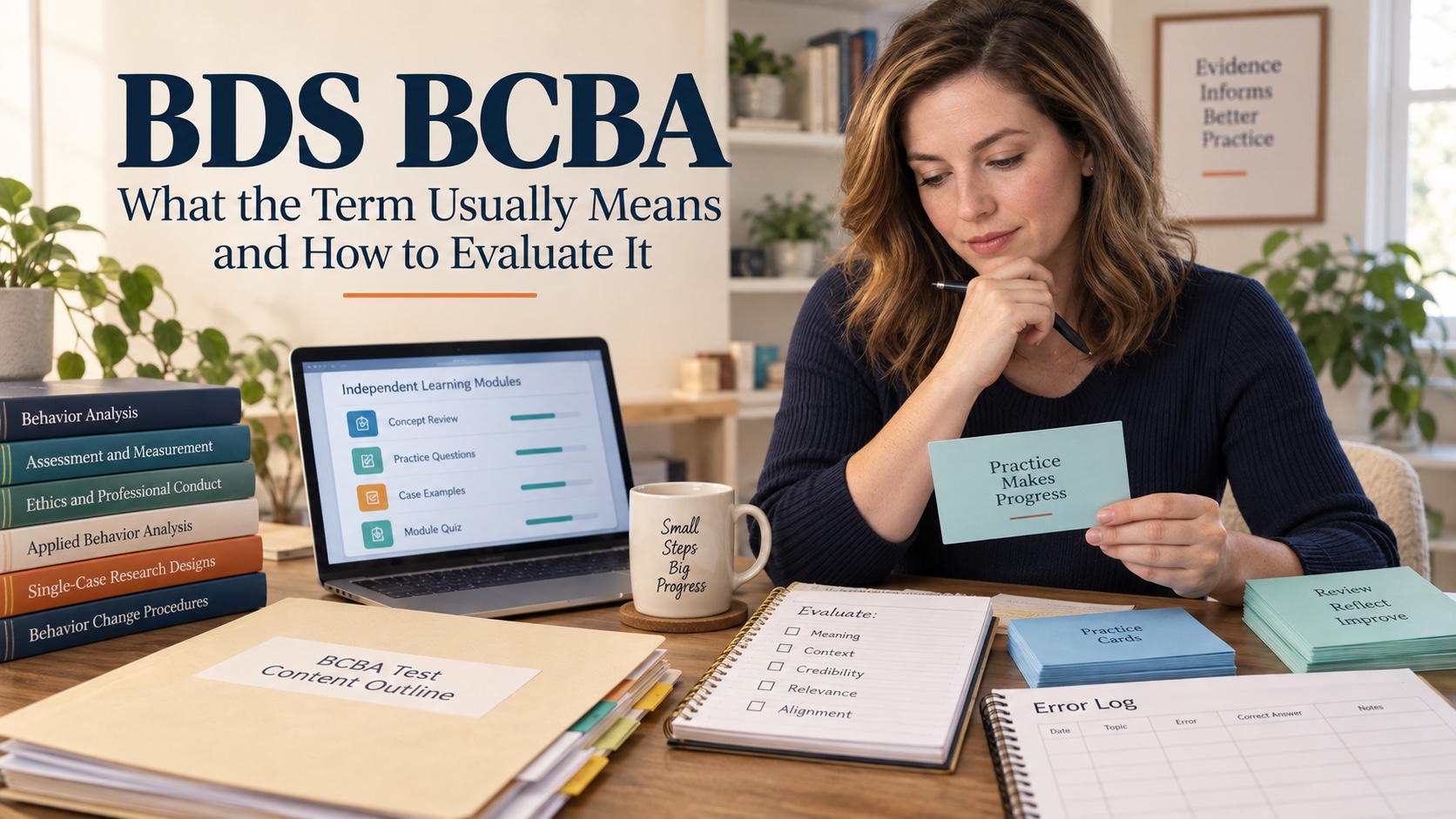
BDS BCBA: What the Term Usually Means and How to Evaluate It
If you search for BDS BCBA, you are probably trying to identify a study product used by BCBA candidates or graduate ABA programs. In this context, BDS commonly refers to Behavior Development Solutions and its CBA Learning Module Series, a commercial learning program that public descriptions position as BCBA and BCaBA exam preparation or a curriculum supplement.
The important boundary is easy to miss: BDS is not the Behavior Analyst Certification Board. The BACB publishes the BCBA requirements, Test Content Outline, Handbook, examination policies, and certification decisions. An independent product can help you study, but it cannot replace the official sources, create eligibility, grant certification, or guarantee a passing result. Before you compare any module program with a free resource or an app, first decide what job the resource must do for you.
Table of Contents
What does BDS BCBA mean?
“BDS BCBA” is not the name of a BACB credential or a separate BCBA examination. It is a shorthand search phrase for a commercial study resource associated with Behavior Development Solutions. Public descriptions commonly use the name BDS for a CBA Learning Module Series and describe the product as a structured, online, self-paced learning program for behavior analysts in training.
That description tells you what kind of resource it is, not whether it is right for every candidate. A module program may be useful for repeated discrimination practice, fluency work, and a structured sequence. Another learner may need a plain-language concept guide, full-length practice, audio review, a lower-cost free route, or more support interpreting difficult scenarios. “Popular” and “best” are not interchangeable decisions.
The phrase can also be confusing because BDS has other meanings in education, health, business, and data science. Look for the context: BCBA, CBA Learning Modules, exam preparation, TCO, behavior analysis, and module practice point toward Behavior Development Solutions. A search result with the same three letters but no behavior-analysis context may refer to something else.
BDS versus official BCBA sources
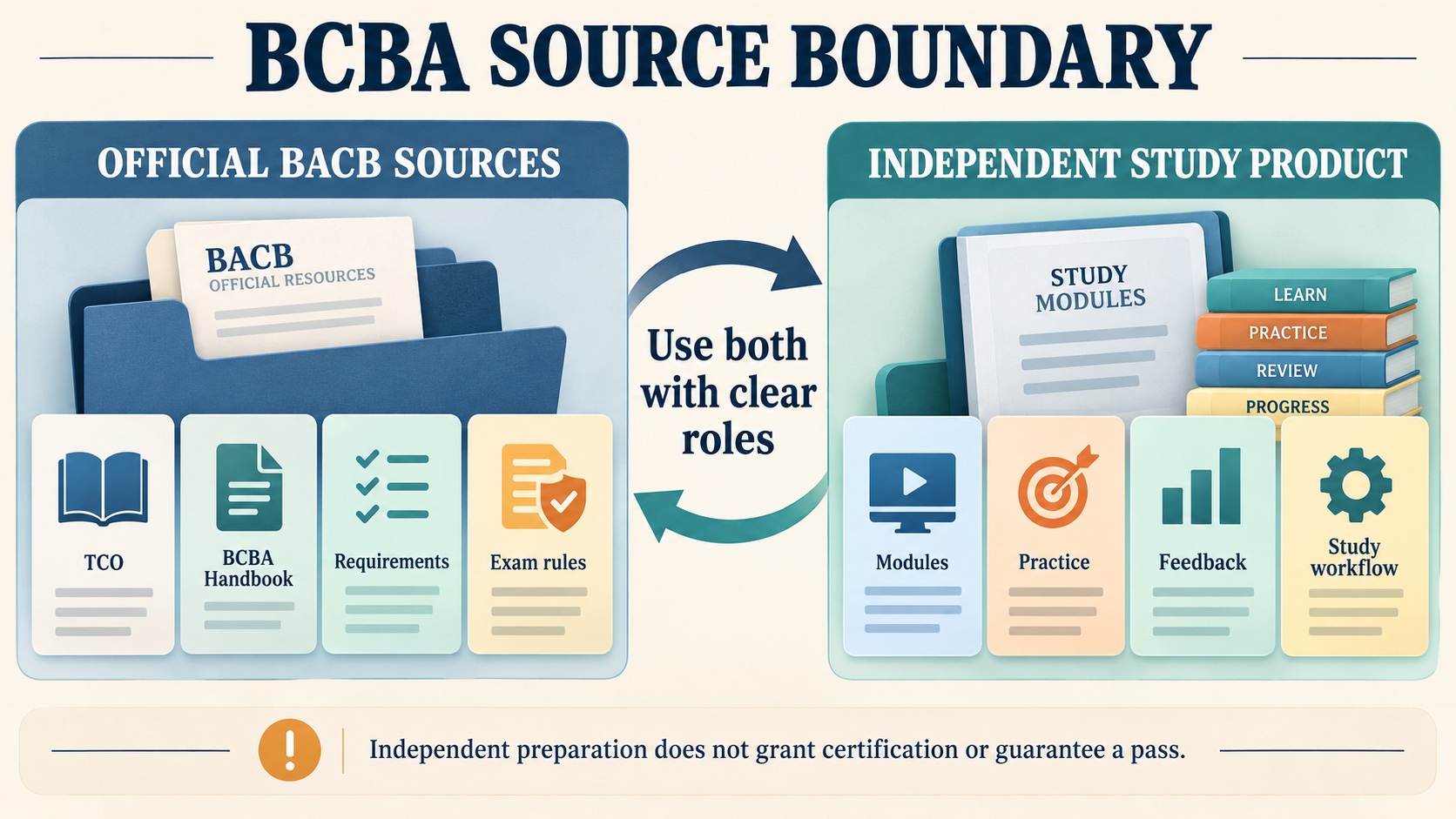
The official BACB source layer answers questions that a study product cannot decide:
- What content is current? The BACB Test Content Outline identifies the current BCBA examination content and edition.
- What are the eligibility and application rules? The BCBA Handbook and current requirements explain the applicable pathways, documents, fieldwork, and application boundaries.
- What happens at the examination? BACB examination information and Pearson VUE resources control delivery, scheduling, and testing-center rules.
- What counts as certification? The BACB makes the certification decision; no independent course, module score, or completion badge grants the BCBA credential.
An independent study product can organize explanations and practice around public content. It should not present itself as an official BACB course unless the BACB explicitly says so, and candidates should not infer endorsement from a product’s appearance, terminology, or use by a university program. Check the source and the product’s own current terms rather than relying on a forum comment or an old advertisement.
What a module-based study program may help with
Module-based preparation can solve a particular problem: a large body of BCBA content feels too broad to review in one undifferentiated pile. A sequence of smaller learning units can give you a place to start, a defined objective, repeated practice, and a record of what remains uncertain.
For example, a module can help you practice a discrimination among terms, apply a principle to a short scenario, or work through a measurement or design decision. A learner who benefits from immediate responding and repeated feedback may prefer that format to rereading a textbook. A program can also make it easier to schedule a short study block when a full mock exam is not realistic.
Those benefits do not remove the need for transfer. A candidate can reach a module criterion through recognition and still struggle with a new question that changes the setting, behavior, client variables, or answer choices. Pair module work with explanation, delayed retrieval, mixed practice, and longer scenario rehearsal. Ask yourself whether you can explain the concept without seeing the choices.
Also consider workload. A very large module bank may be useful for a learner with months to prepare and a clear tracking system. It may be a poor fit for someone who has a short runway, weak foundations, limited screen time, or a need for more guided explanation. More questions are not automatically more learning.
How to decide whether a module program fits
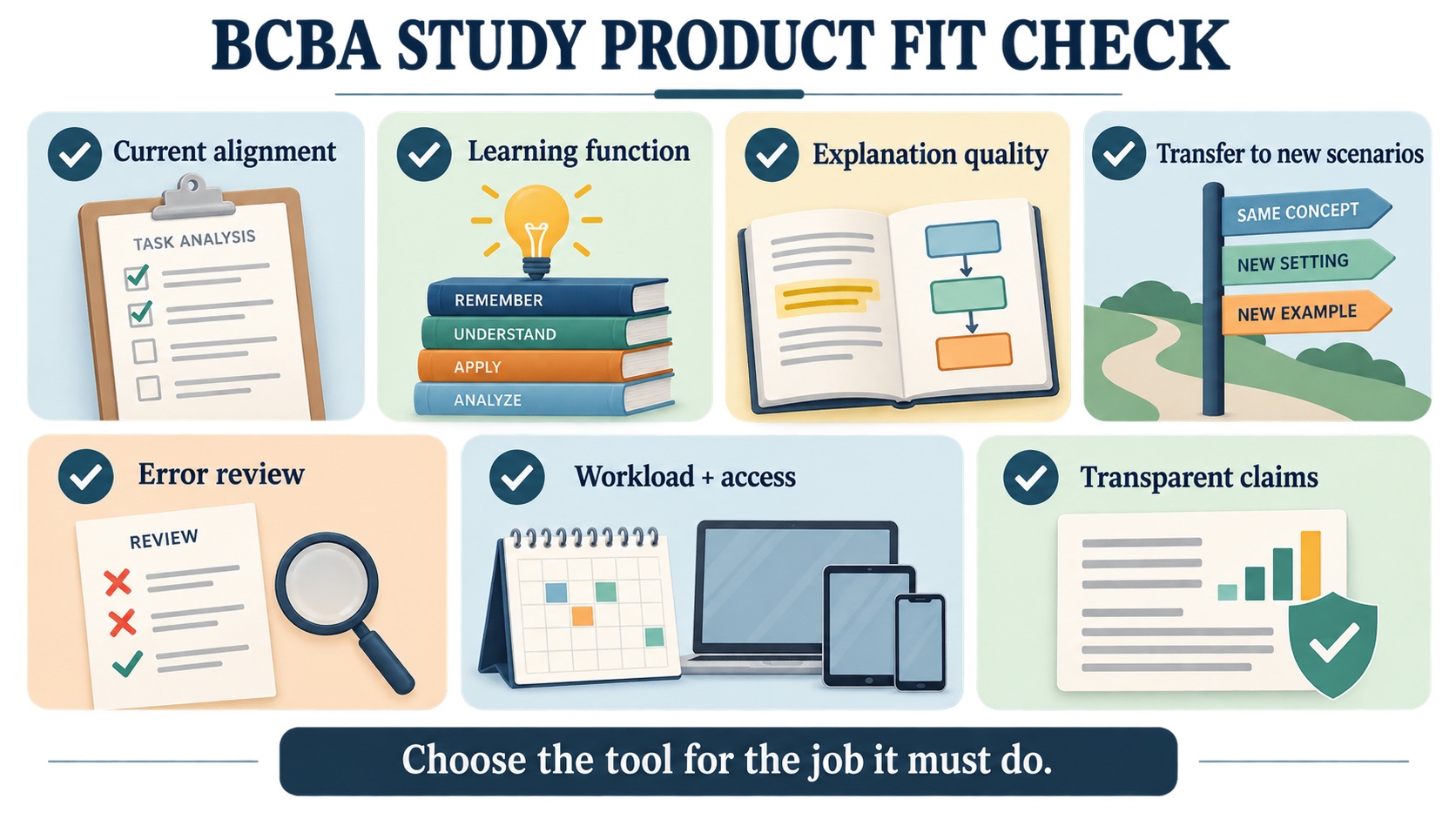
Use this checklist before purchasing or committing to a module program:
- Current alignment: Does the provider identify the current BCBA TCO edition and explain how it handles future changes?
- Learning function: Does the product teach, prompt retrieval, provide fluency practice, simulate exam decisions, or mainly track completion?
- Explanation quality: Can you see why the best answer fits and why the distractors fail, or are you only collecting percentages?
- Transfer: Does the program include varied scenarios and mixed review, or does it repeat a narrow wording pattern?
- Error review: Can you save uncertain items, record the missed distinction, and return after a delay?
- Workload: Is the amount of material compatible with your schedule, fieldwork, coursework, and examination date?
- Access: Does it work on the devices you actually use, and are the subscription period, renewals, support, and data practices clear?
- Claims: Are outcomes described with transparent conditions, or does the page imply that completion guarantees a pass?
A free trial or demo can answer interface questions, but it cannot prove that a product covers every topic or predicts your examination performance. Use a demo to test the learning experience: Can you state the rule, explain the example, and identify your next review step?
How to build a balanced BCBA study stack
You do not need to force one product to do every job. A balanced stack might include:
- Official layer: current BACB TCO, BCBA Handbook, requirements, ethics code, and examination information.
- Concept layer: a textbook, course notes, or plain-language resource that closes understanding gaps.
- Retrieval layer: flashcards or short questions for definitions, distinctions, and essential decision rules.
- Application layer: original scenario questions with explanations and mixed practice.
- Full-form layer: timed mock exams to rehearse pacing and decision-making across the whole session.
- Review layer: an error log, delayed retrieval calendar, and a plan to revisit weak domains without abandoning the rest of the outline.
BDS may be one candidate for the module or structured-practice layer. ABA Study Online can support the discovery, free question, app, and mock-exam layers. The point is not to create a long shopping list. It is to make each resource’s job explicit and remove gaps between learning a rule, applying it, and reviewing it later.
How to read product claims carefully
Exam-preparation providers often discuss completion, mastery, user results, or pass rates. Treat each claim as a conditional statement that needs context. Ask:
- Who was included in the claim?
- What did “completion” or “mastery” require?
- How close to the examination did learners finish?
- Was the result self-reported, independently verified, or published with a comparison group?
- Does the claim apply to the current TCO and examination period?
- Is the claim describing the product’s users, not promising what will happen to every buyer?
Do not turn a provider’s outcome claim into a personal guarantee. The BACB does not endorse specific preparation materials, and an independent product cannot control your eligibility, study time, prior coursework, test-day conditions, or examination form. A careful article can discuss a product’s learning design without ranking it as universally best.
Common study mistakes
- Confusing BDS with BACB: BDS is an independent provider; BACB controls certification and official requirements.
- Studying only to a completion percentage: explain and apply the concept in a new scenario.
- Using one product as the whole plan: keep the official source layer and add full-form practice and error review.
- Ignoring version dates: check the current TCO and Handbook before relying on older modules or notes.
- Equating a difficult module with the live exam: practice difficulty and official exam difficulty are not automatically comparable.
- Buying on a pass promise: evaluate evidence and fit, not guarantees.
Use ABA Study Online’s BCBA learning resources, free questions, app review tools, and mock exams as complementary routes. Compare every independent tool against the current BACB sources and your own study job.
FAQ and sources
Is BDS the same as the BACB?
No. BDS usually refers to Behavior Development Solutions, an independent learning provider. The BACB is the certification board that publishes requirements, examination content outlines, policies, and certification decisions.
What are BDS modules for the BCBA exam?
Public descriptions commonly present the CBA Learning Module Series as structured online preparation or a curriculum supplement for BCBA and BCaBA candidates. Check the provider’s current product description for exact features, edition alignment, access, and terms.
Are BDS modules required for BCBA certification?
Do not assume they are required by the BACB. A university or employer may assign an independent product for its own program, but the current BACB requirements and Handbook control certification eligibility.
Can BDS guarantee that I pass the BCBA exam?
No independent study product can guarantee a certification result. Treat completion or outcome claims as conditional evidence and keep the official BACB source layer in your plan.