
BCBA Unrestricted Hours Activities: What Counts?
When trainees search for BCBA unrestricted hours activities, they often want a list they can copy into a log. A list helps, but it is not the whole decision. The activity must be behavior-analytic, related to a client’s services, appropriate to the trainee’s fieldwork, and reviewed within the supervision arrangement. The supervisor—not a generic internet checklist—must evaluate whether the activity supports the applicable requirements and the trainee’s goals.
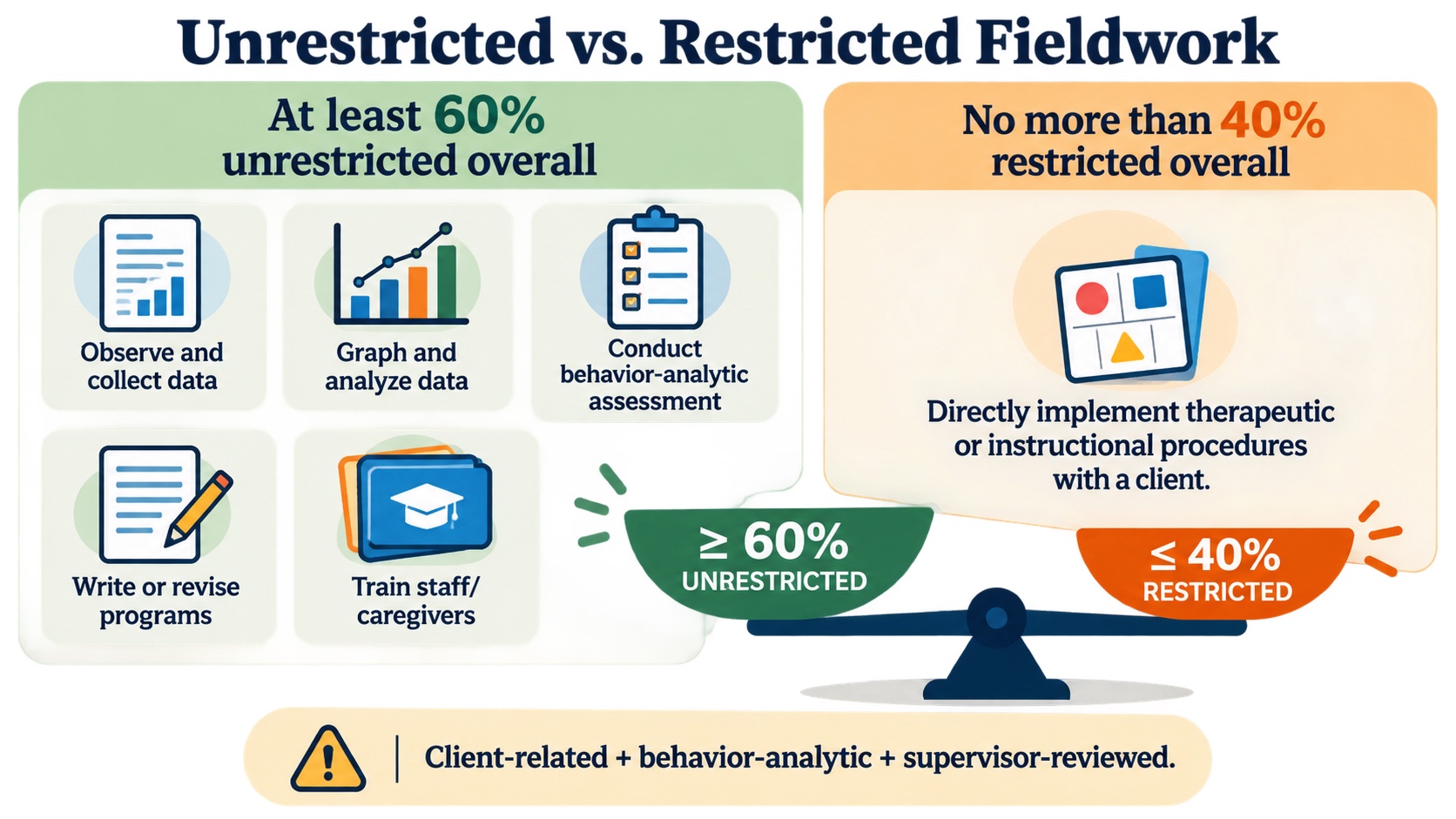
The current BCBA fieldwork rule is a useful starting point: at least 60% of total supervised fieldwork must be unrestricted. Restricted activities are not automatically bad, and working directly with a client does not automatically make an activity restricted. What matters is what you are doing, why you are doing it, how it is connected to the client, and which skills the activity develops.
The short answer
Unrestricted activities are fieldwork activities that more closely represent work a BCBA is likely to perform after certification. The BACB’s current handbook gives examples such as observing and collecting data, conducting behavior-analytic assessments, graphing and analyzing data, writing or revising behavior-analytic programs, training staff or caregivers, and meeting with clients about behavior-analytic services.
These examples are not a blank authorization. An activity must still satisfy the handbook’s client-related and behavior-analytic boundaries, fit the supervision plan, and be recorded accurately. Keep the description specific enough that a supervisor can understand what happened and what skill was practiced.
| Fieldwork question | Practical check |
|---|---|
| Is it unrestricted? | Does it resemble behavior-analytic work commonly performed by a BCBA? |
| Is it countable? | Is it behavior-analytic, client-related, and connected to the applicable supervision arrangement? |
| How much is needed? | At least 60% of total supervised fieldwork must be unrestricted for BCBA fieldwork; confirm the rule set for your pathway and timeline. |
| Who decides? | Your qualified supervisor reviews the activity against the current BACB requirements and your fieldwork plan. |
What unrestricted means
Think of unrestricted work as practice in the broader behavior-analyst repertoire. It can include analyzing why a program is or is not working, selecting and interpreting measurement, designing or revising a behavior-analytic program, assessing variables related to intervention, or training the people who implement a plan. The point is not to make a trainee perform independently; it is to create supervised opportunities to learn BCBA-level tasks.
The 60% requirement is calculated across the total accumulated fieldwork hours. It does not have to be met in every calendar month, although monthly planning is still useful. A month with more restricted implementation does not disappear from the record; it changes the total balance you need to monitor.
Some activities look advanced but still do not count if they are unrelated to behavior analysis or not connected to a client. General paperwork, billing, unrelated training, course homework, and passive reading may be useful in life, but they are not automatically fieldwork hours. The record should explain the behavior-analytic task, not only the setting where you were present.
Examples of unrestricted activities
Observation and data analysis
Observe a client or service context with a defined purpose, collect relevant data, graph the results, and discuss what the pattern suggests. The learning value is in connecting measurement to a behavior-analytic decision. Simply being in the room while another person delivers services is not enough; document what you observed and how it informed the case.
Behavior-analytic assessment
Under supervision, participate in a behavior-analytic assessment such as a preference assessment or functional assessment activity when it is appropriate to the case and within your training. Record the assessment question, the method used, the data collected, and the supervisor feedback. Do not present participation as independent diagnosis or independent clinical authority.
Program writing and revision
Draft or revise a behavior-analytic program connected to a client’s needs, then review the operational definitions, measurement plan, teaching steps, prompting or reinforcement procedures, generalization plan, and decision rules with your supervisor. A generic worksheet with no client connection is not the same as supervised program development.
Staff and caregiver training
Train staff or caregivers on behavior-analytic procedures or content that they need to implement for a client. A strong fieldwork note can identify the skill taught, how you modeled or rehearsed it, what feedback was provided, and how implementation fidelity will be monitored.
Client meetings and literature review
Meet with clients or caregivers about behavior-analytic programming and services when the meeting is part of the case. Research literature relevant to a current client’s programming and explain how the source informed a supervised decision. “I searched the internet” is not enough; record the question, the relevant finding, and the connection to the program.
Restricted activities and the 40% ceiling
Restricted activities involve delivering therapeutic or instructional procedures directly to clients. Examples can include implementing an existing teaching program, running an approved behavior-reduction procedure, or delivering direct instructional practice. These experiences can build important implementation skills, but the BCBA fieldwork rule limits the overall proportion of restricted activities to no more than 40% because trainees also need experience with assessment, analysis, program development, supervision, and systems-level work.
Do not classify all client contact as restricted. A direct observation for the purpose of analyzing data may be unrestricted, while the same hour could be restricted if you are solely implementing a client’s treatment procedures. The purpose, task, and behavior-analytic decision determine the classification. Ask your supervisor when the line is not clear.
How to review an activity before logging it
- Name the client-related question. What behavior, skill, assessment, program, or service decision is this activity connected to?
- Describe the behavior-analytic task. Use a concrete verb such as observe, measure, analyze, assess, design, revise, train, or review.
- Identify the role. Were you implementing an existing procedure, or were you practicing a supervised analyst-level task? Do not inflate your authority in the log.
- Save the evidence. Keep the data, graph, draft program, training outline, feedback note, or meeting record in a secure system consistent with the supervision contract.
- Check the running balance. Track unrestricted and restricted totals across the whole fieldwork experience, not only by intuition at the end.
- Ask before counting. Your supervisor is responsible for reviewing whether activities meet the current requirements and support your fieldwork goals.
A useful log entry is more specific than “worked on case.” For example: “Observed escape-maintained task refusal during a scheduled assessment, recorded latency and context variables, graphed the week’s data, and reviewed possible assessment next steps with the supervisor.” The entry still needs to be accurate and supervisor-approved, but it shows the connection between the activity and the skill being developed.
What to watch during the 2027 transition
The BACB’s published 2027 BCBA Requirements continue to state that at least 60% of total supervised fieldwork must be unrestricted, while other fieldwork details and forms change for applicants under the 2027 requirements. Do not copy a 2027 form or monthly limit into an earlier record without checking the transition guidance that applies to your application.
Keep your requirement version, supervision contract, monthly forms, activity descriptions, and running totals together. If the official handbook or transition resource changes, update the planning record before changing how you classify future activities. When in doubt, ask the supervisor and consult the current BACB source rather than relying on a social-media example.
FAQ
What percentage of BCBA fieldwork must be unrestricted?
The current BCBA fieldwork rule requires at least 60% of total supervised fieldwork to be unrestricted. The handbook also explains that restricted activities may make up no more than 40% overall. Confirm the requirements and transition rules for your fieldwork pathway.
Can RBT work count as BCBA unrestricted hours?
RBT work is not automatically unrestricted. Direct implementation is often restricted, while a client-related, supervised activity such as data analysis, behavior-analytic assessment, program development, or staff training may be unrestricted. The supervisor must review the actual task and documentation.
Does unrestricted mean I can work independently?
No. Unrestricted describes the type of activity, not permission to practice independently. Trainees continue to work under the applicable supervision and ethics requirements.
Can coursework or general paperwork count?
Not automatically. The BACB handbook excludes non-behavior-analytic activities and coursework assignments from fieldwork. Use the current handbook and supervisor review for the specific activity.