BCBA Test: Current Exam Structure, Content, and Study Boundaries
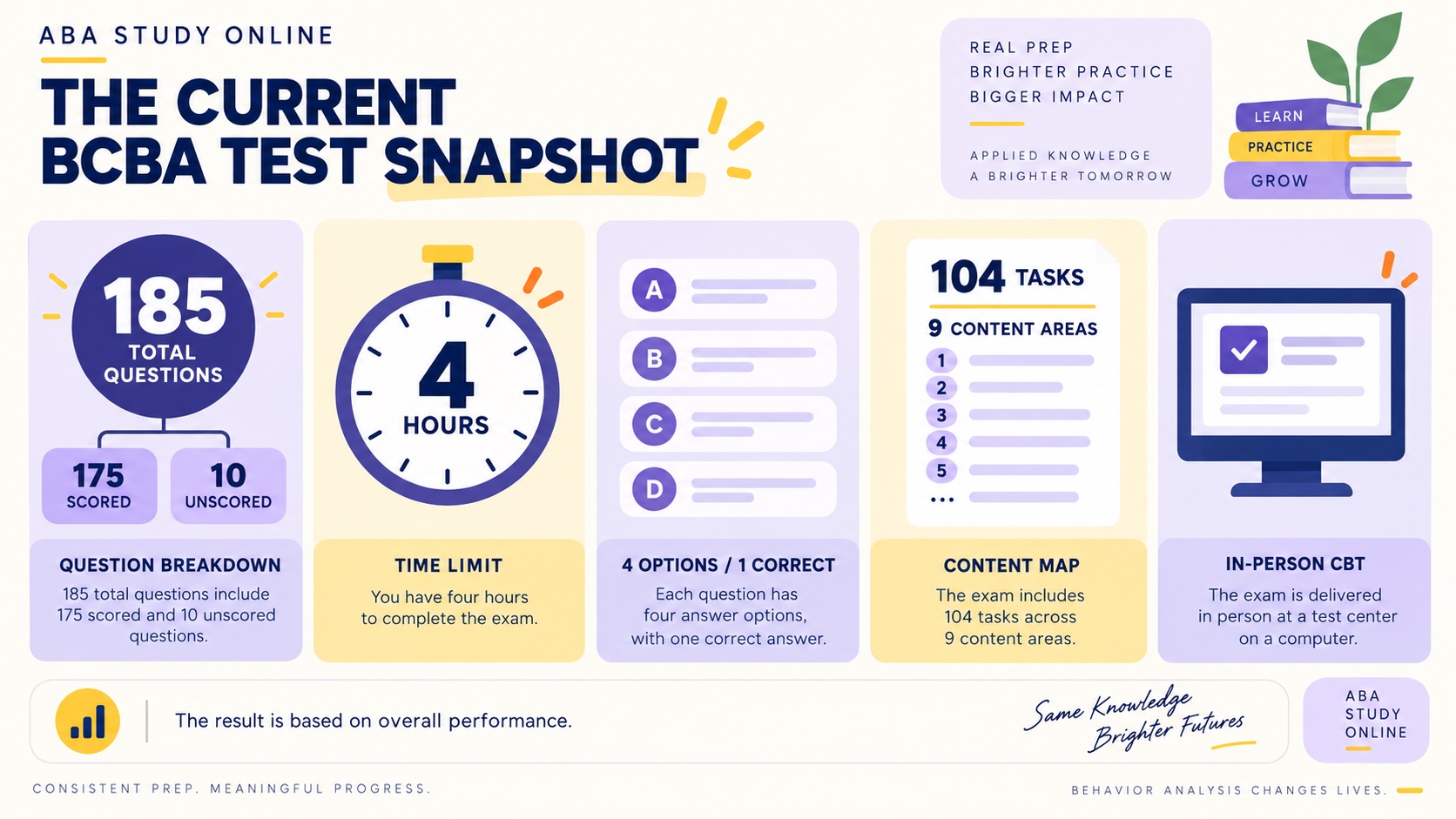
If you are searching for the BCBA test, start with the current official structure rather than a practice provider’s headline. The BACB certification examination is based on the BCBA Test Content Outline (6th ed.). The public BACB examination page describes 185 questions in total; the current BCBA Handbook explains that this total contains 175 scored questions and 10 unscored questions. Candidates have four hours, each question has four possible answers with one correct answer, and the examination is delivered in person through computer-based testing.
That snapshot tells you what the test is. It does not tell you which questions will appear on your form, which score a third-party practice set should produce, or whether you are eligible to apply. This guide maps the documents, content areas, and boundaries so you can read BCBA test information accurately and choose the right next study page.
Table of Contents
What the BCBA test is
The BCBA test is the high-stakes certification examination used by the Behavior Analyst Certification Board for people who have received an approved determination and are completing the certification pathway. The BACB describes BCBA certification as a graduate-level certification in behavior analysis. BCBAs are independent practitioners who provide behavior-analytic services and may supervise the work of RBTs, BCaBAs, and other professionals who implement services.
The word “test” can make the whole pathway sound like one event, but several decisions happen before and after the examination. Eligibility requirements, coursework, fieldwork, application processing, authorization, scheduling, the examination itself, and maintenance requirements are related but not interchangeable. A question about whether your fieldwork qualifies belongs to the current BCBA Handbook, not to a practice question bank. A question about what the exam samples belongs to the current TCO and examination information.
This distinction matters for study planning. If you need an exam overview, read this page. If you need theory review, use the dedicated BCBA Theory Blocks. If you want question practice, begin with the free BCBA questions. Each destination should do a different job instead of making one page carry the entire certification pathway.
Which official document answers which question
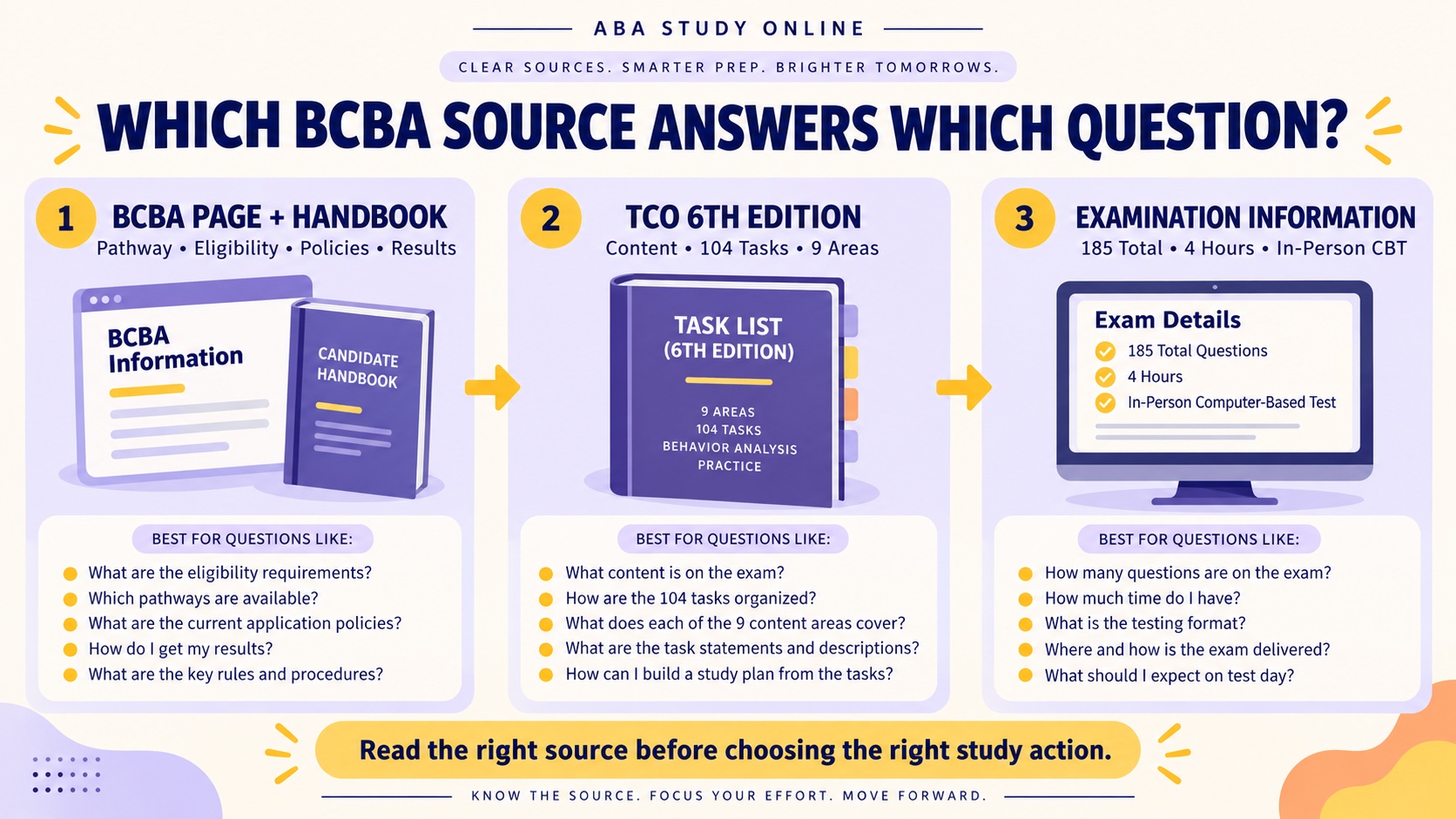
Three BACB resources are especially useful, but they are not copies of one another:
- The BCBA page and Handbook: explain the certification pathway, eligibility, application, examination policies, scheduling, security, results, and maintenance. The current Handbook is updated as needed, so a saved PDF should not be treated as permanently current.
- The BCBA Test Content Outline (6th ed.): maps the knowledge and skills into 104 tasks across nine content areas. It is the content blueprint, not a study guide and not a list of guaranteed question wording.
- The Examination Information page: gives a concise operational view of examination length, total questions, in-person delivery, computer-based testing, and Pearson VUE logistics.
When a study page says “BCBA test,” ask which of these jobs it is actually performing. A page can be current on question count but outdated on eligibility. A flashcard deck can teach a useful definition but omit task application. A mock exam can help with pacing but cannot reveal which items on the official form are scored. Clear source labeling is part of good study design.
The current BCBA test snapshot
Here is the compact version to keep in your notes:
- 185 total questions: 175 scored questions plus 10 unscored questions, according to the current Handbook.
- Four hours: the time allocation includes the examination experience and the official navigation/terms process described in the Handbook.
- Four options, one correct answer: BCBA examination items are multiple choice.
- 104 tasks: the current TCO describes tasks a behavior analyst should be able to perform.
- Nine content areas: the tasks are organized into broad knowledge and skill areas.
- Overall result: the Handbook states that the result is based on overall performance, not separate pass marks for each content area.
- In-person computer-based delivery: the BACB contracts with Pearson VUE to deliver examinations at authorized testing locations.
The 175 scored and 10 unscored questions are not two separate tests. They appear within the 185-question examination experience, and candidates cannot identify the unscored items while taking the exam. That is why a practice resource should not present a personal percentage as an official score equivalent. Practice can estimate how you are performing on that resource; it cannot label individual BACB items or reproduce the secure examination.
What the nine content areas mean
The nine content areas are a map for coverage, not nine separate mini-exams. The current TCO and Handbook list the following rounded shares of the 175 scored questions:
- Behaviorism and Philosophical Foundations — 5%: the scientific and philosophical assumptions that frame behavior analysis.
- Concepts and Principles — 14%: foundational behavioral relations, processes, and distinctions.
- Measurement, Data Display, and Interpretation — 12%: selecting, recording, displaying, and interpreting behavior data.
- Experimental Design — 7%: design logic and interpretation of single-case research arrangements.
- Ethical and Professional Issues — 13%: ethical decision-making, professional responsibilities, and boundaries.
- Behavior Assessment — 13%: assessment processes and interpretation of relevant information.
- Behavior-Change Procedures — 14%: procedures used to increase, decrease, maintain, or generalize behavior.
- Selecting and Implementing Interventions — 11%: choosing and carrying out interventions based on assessment and evidence.
- Personnel Supervision and Management — 11%: supervision, training, performance, and management systems.
The percentages are useful for deciding whether your study map is lopsided. They are not permission to ignore a 5% area, and they are not a personal prediction. A learner who reads “14%” as “I can skip the rest” is using the blueprint as a shortcut instead of as a coverage check. A better question is: “Which content area needs a new explanation, a comparison, or a fresh scenario?”
What the testing format changes for your preparation
Because the BCBA test is computer-based and time-limited, preparation should include more than recognizing definitions on paper. You need to practice reading a scenario, locating the controlling facts, comparing alternatives, and committing to the best answer without turning every item into an open-book search. The official format also makes navigation and pacing relevant: a candidate may review items, but breaks use the examination clock.
Practice the format in layers. Start with short, fully explained questions when you are learning a distinction. Then mix content areas so you must identify what the question is testing. Later, use longer timed sets and review why each answer was stronger or weaker. If a practice set is labeled as a full simulation, check whether it matches the current structure and whether it provides rationales. A timer without review is only a timer.
Also practice confidence tracking. Mark an answer as certain, uncertain, or guessed before reading the rationale. A wrong answer marked certain often signals a misconception. A correct answer marked guessed may need retrieval later. This information is more actionable than a single percentage, and it connects the broad BCBA test overview to a real study decision.
What the BCBA test does not tell you
The current test outline does not answer every question a candidate may have:
- It does not decide eligibility. Degree, coursework, fieldwork, application, and authorization questions belong to the current Handbook and BACB portal guidance.
- It does not provide a public question bank. The Handbook describes examination security and prohibits disclosure or reconstruction of secure questions.
- It does not endorse a study product. The BACB says it cannot endorse specific study guides or preparation materials, and purchasing materials does not guarantee passing.
- It does not turn a third-party score into a pass prediction. A practice result is evidence about one set under one set of conditions.
- It does not make every 2027 claim an exam-edition change. Requirements-transition documents must be read separately from the current TCO and Handbook examination sections.
If you are preparing now, save the retrieval date for the official Handbook and TCO, check the edition before building a long schedule, and then choose the smallest study action that answers your current uncertainty. That might be a Theory Block, a comparison of two concepts, a small set of original questions, or a timed review. The best next step depends on the evidence from your study—not on a generic promise that one resource works for everyone.
FAQ and official sources
How many questions are on the BCBA test?
The current BCBA testing experience has 185 questions in total. The Handbook breaks that into 175 scored questions and 10 unscored questions. The public examination-information page uses the total-question view, while the Handbook provides the scored/unscored breakdown.
How long is the BCBA test?
Candidates have four hours. The current Handbook explains that the time allocation includes the examination experience and related navigation and terms processes; review the official document for the details that apply to your appointment.
Is the BCBA test based on the 6th edition?
Yes, the current BACB Handbook and BCBA TCO identify the BCBA Test Content Outline (6th ed.) as the current examination-content boundary. The Handbook also says candidates test under the TCO edition in effect for the relevant authorization and appointment, so recheck official materials before scheduling.
Does the BCBA test have separate pass marks for each content area?
No. The Handbook states that the examination result is based on overall performance, not performance in each content area. The rounded percentages help you plan coverage; they are not separate score cutoffs.
Did the 2027 BCBA requirements create a 7th-edition test?
The existence of 2027 requirements and transition guidance is not, by itself, evidence of a 7th-edition TCO. Keep eligibility and maintenance changes separate from examination-content changes, and verify the current Handbook and TCO before relying on a future-edition claim.
For current information, read the BACB BCBA page, the BCBA Handbook, the BCBA Test Content Outline (6th ed.), the BACB Examination Information page, and the BACB TCO index. For future eligibility context, use the official 2027 BCBA requirements and transition guidance. ABA Study Online’s educational pages and practice materials are independent resources, not BACB-endorsed examination content.