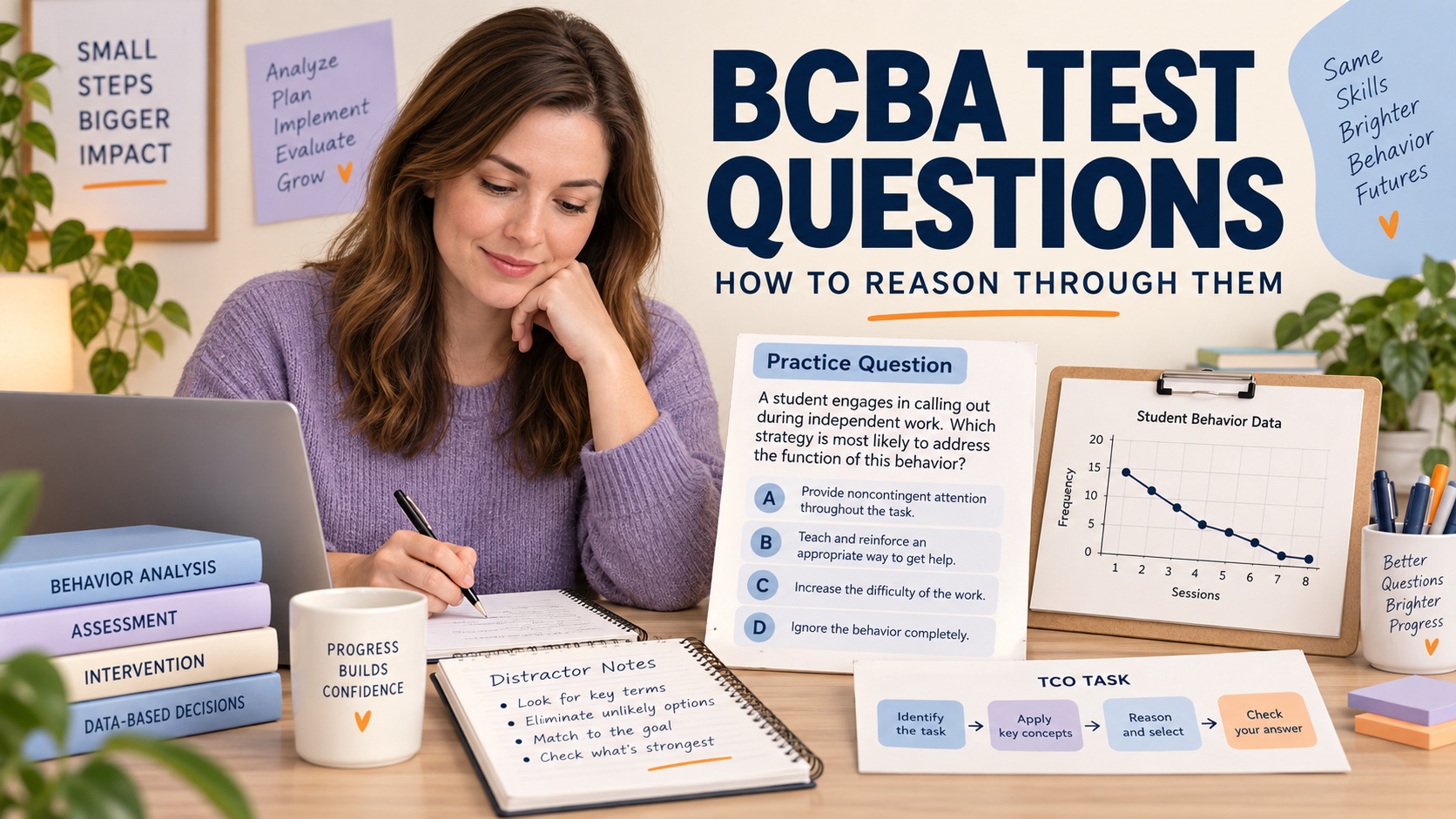
BCBA Test Questions: How to Reason Through Them
When you search for BCBA test questions, you may be looking for more than a list of answer choices. You need to practice the reasoning the question demands: identify the relevant task, notice the decisive detail, distinguish a tempting distractor, and choose the answer that is best supported by the scenario.
This guide explains how to use original BCBA practice questions effectively. It covers the current exam boundary, question anatomy, common question types, a simple distractor method, and a review workflow that maps mistakes to the current Test Content Outline (TCO). Practice questions on ABA Study Online are study content, not secure BACB items or an official BACB question bank. Use the current BCBA Test Content Outline and BCBA Handbook for authoritative preparation guidance.
Table of Contents
Know the current BCBA question boundary
The BCBA examination is currently based on the 6th-edition TCO beginning in 2025. The examination has 185 multiple-choice questions: 175 scored questions and 10 unscored pilot questions. Each question has four answer choices with one correct answer, and candidates have four hours.
The TCO organizes 104 tasks into nine domains. That blueprint tells you what content and skills to cover, but it does not mean an independent website can reproduce secure examination items. A useful practice question can be aligned to a TCO task without claiming that it appeared on the BACB exam.
The current BCBA Handbook recommends preparing with the TCO, the Ethics Code for Behavior Analysts, and materials from your training. It also states that the BACB cannot endorse specific study guides or guarantee a pass from purchasing study materials. Treat that as a quality standard: practice resources should explain their scope, use original content, and avoid pretending that a score is an official result.
Anatomy of a strong practice question
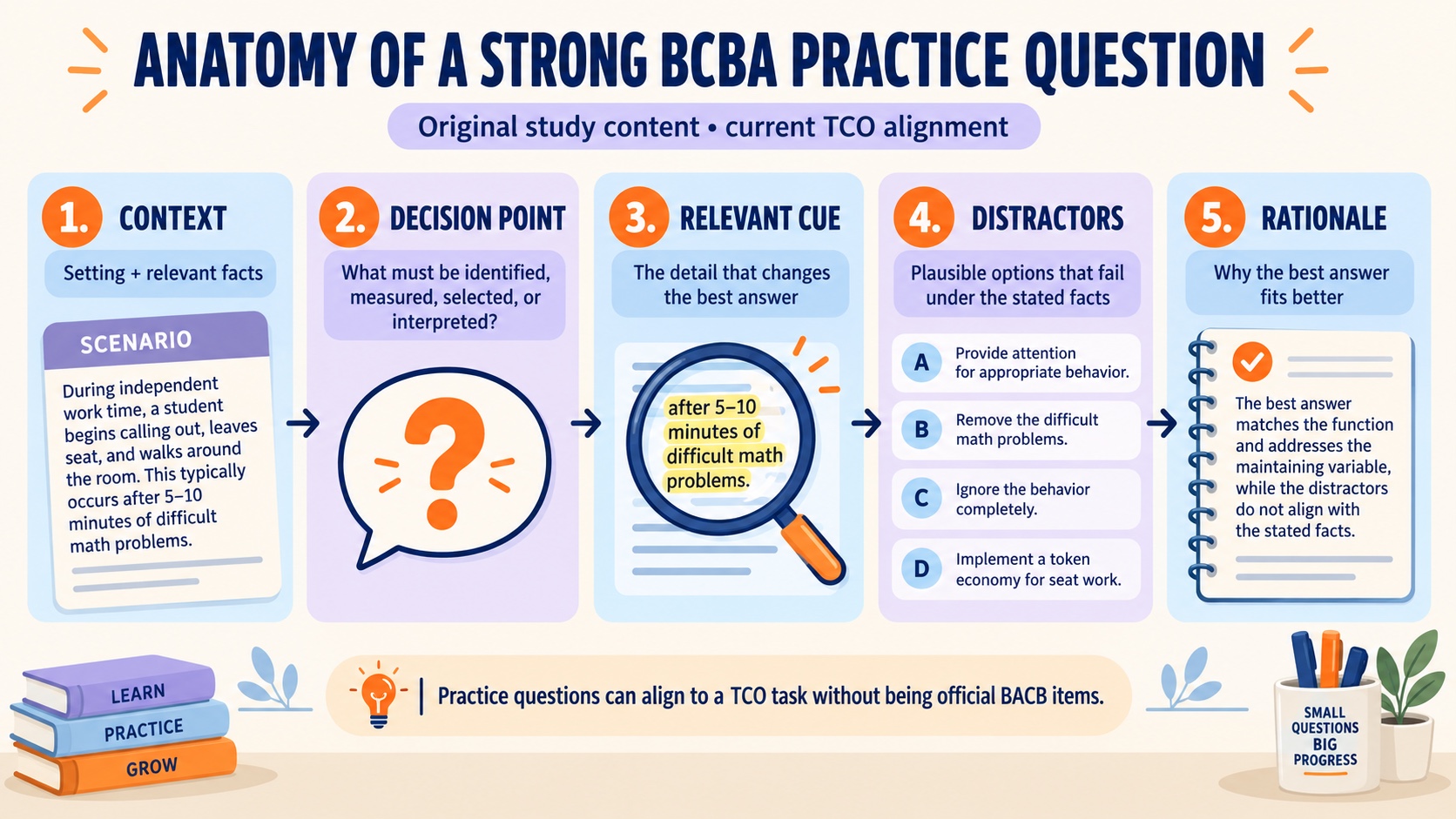
A good BCBA test question usually has several parts:
- Context: enough information to understand the setting, learner, behavior, or professional situation.
- Decision point: the question asks what to identify, measure, select, interpret, or do next.
- Relevant cue: a detail that changes which answer is best.
- Distractors: alternatives that may be reasonable in another situation but fail under the facts given.
- Rationale: an explanation that names the distinction rather than only revealing a letter.
Before looking at the answer choices, read the final sentence and identify the task. Is the question asking for a measurement, a function hypothesis, an ethical response, an intervention choice, or a supervision action? Then return to the scenario and underline the facts that constrain that decision.
Common BCBA question types
Concept and principle questions
These questions ask you to identify or distinguish behavior-analytic concepts. Do not stop at the definition. Translate each option into the contingency or process it describes. Pay attention to whether a stimulus was added or removed, what happened to the future probability of behavior, and whether the scenario describes an operation or a process.
Measurement and data questions
First ask what dimension the question is measuring. Frequency, rate, duration, latency, and interresponse time answer different questions. For graphs, describe the level, trend, variability, and timing before choosing an interpretation. If a calculation is required, write the units and check whether the answer matches the observation period.
Assessment questions
Look for the assessment purpose and the information already available. A question may ask you to select a measurement, interpret assessment data, identify a priority, or decide whether referral is needed. Avoid jumping to an intervention when the scenario is still asking for assessment.
Intervention and behavior-change questions
Match the procedure to the function, goal, context, and written plan. Consider social validity, client-informed goals, risk, generalization, maintenance, and the data needed to monitor effects. The best answer is not automatically the most intensive procedure or the one with the most familiar acronym.
Ethics and supervision questions
Identify the professional boundary and the person’s role. Consider client welfare, competence, confidentiality, consent, cultural responsiveness, conflicts, and documentation. For supervision questions, look for effective feedback, role clarity, training, performance monitoring, and timely action when client welfare is at risk.
How to compare distractors
Many difficult questions contain more than one answer that sounds reasonable. Use a four-question filter:
- Does it answer the question asked? An answer can be true but still respond to a different decision point.
- Does it use the strongest cue? Prefer the option that accounts for the specific fact the scenario emphasizes.
- Is it within the role and scope? Do not choose an action that assumes authority the person in the scenario does not have.
- Does it preserve evidence and ethics? Avoid choices that ignore data, client welfare, informed participation, or required consultation.
Try to state why each distractor fails. “It is not the answer” is not a rationale. A stronger note might say, “This option describes an intervention, but the question asks for the measurement dimension,” or “This action changes the plan without the supervision or assessment information described.” That sentence is the study material you need to keep.
Be cautious with absolute words such as always, never, immediately, and only. They are not automatically wrong, but they deserve inspection. Then check the facts; do not reject an answer just because it contains a strong word.
Build a deliberate practice routine
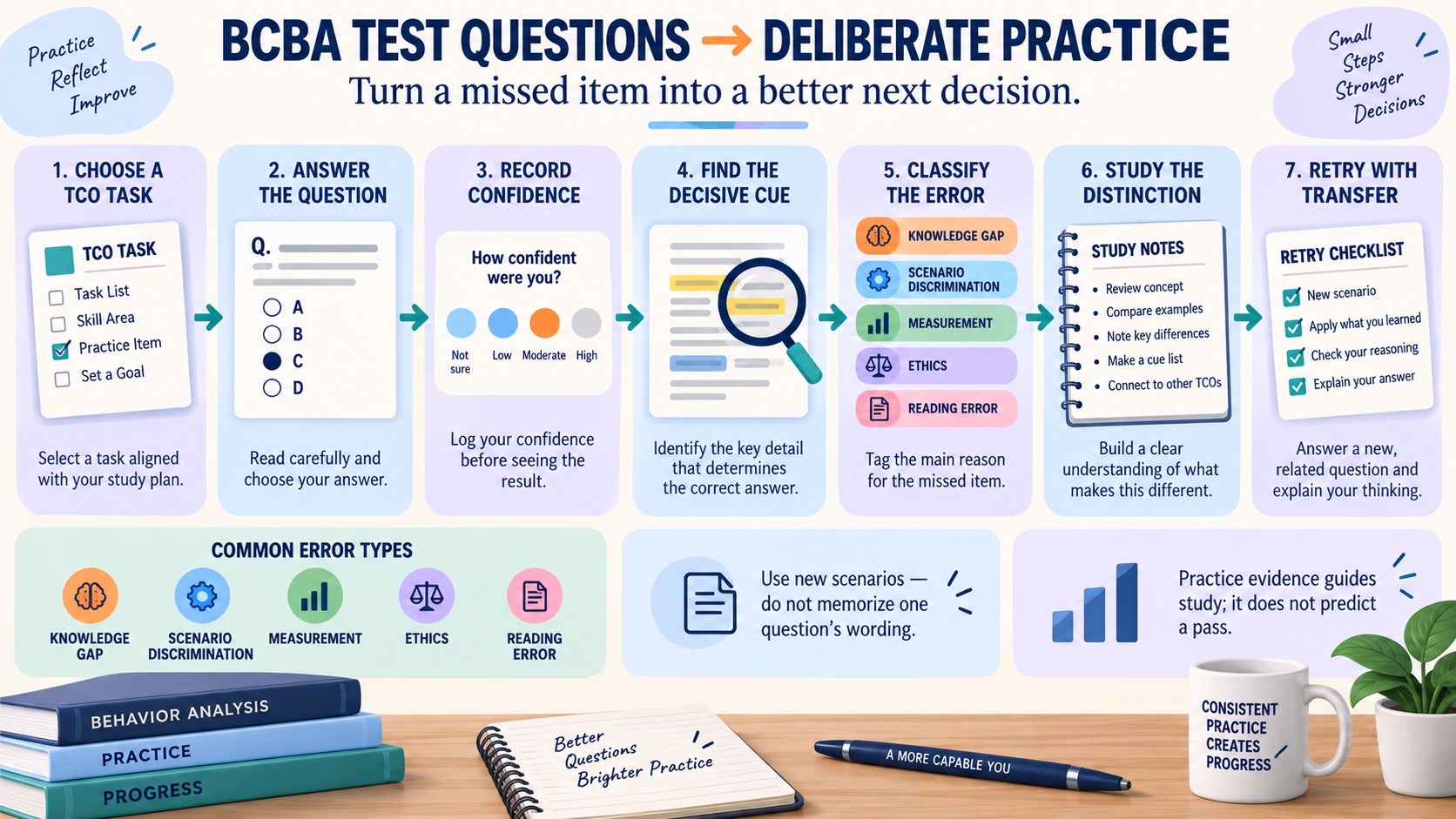
Use a small cycle instead of opening random questions whenever you have time:
- Choose a TCO area. Start with a task you need to learn or a pattern from your error log.
- Answer a defined set. Use new questions and write a one-sentence reason for each uncertain answer.
- Tag confidence. Mark each answer low, medium, or high confidence before reading the rationale.
- Classify the error. Use labels such as knowledge gap, scenario discrimination, measurement, ethics, or reading error.
- Study the distinction. Review the TCO task, course notes, worked example, graph, or ethics resource that addresses the gap.
- Retry with transfer. Use a new scenario so you test the idea, not your memory of the earlier wording.
Mix focused and mixed practice. Focused practice helps you build a concept; mixed practice asks you to recognize which concept matters. Both are necessary. A short set of carefully reviewed questions can teach more than a long set that produces no notes.
Review wrong answers by TCO task
Create an error log with the question topic, TCO domain or task, your choice, the best answer, the decisive cue, and the next review action. If you miss a measurement question, write the measure you chose and the measure that fits the question. If you miss an intervention question, record which assessment or function detail you overlooked.
Suppose a scenario describes a learner beginning a response several seconds after an instruction and asks which measure captures that delay. If you choose duration because the response itself lasts for a period, the error is a distinction between latency and duration. Your next action is not to reread every measurement term equally. Work several new contrasts and explain which event starts and ends each measure.
Do not study only the questions you missed. A small practice set may contain too few items to represent a task. Use the error log to choose priorities while continuing to review the full TCO. The goal is a more flexible response to new scenarios, not a perfect memory of one quiz.
Mistakes that make practice less useful
Using old or unlabeled material. Check the TCO edition and track. A page that does not state its source is difficult to evaluate.
Memorizing letters. A remembered answer is fragile when the scenario changes. Explain the rule or decision point instead.
Reading the rationale only when wrong. Correct answers with low confidence may reveal weak understanding. Review those too.
Choosing the most impressive intervention. Match the answer to assessment, function, ethics, client-informed goals, and the practitioner’s role.
Expecting an independent quiz to predict a pass. Use it as study evidence. Do not convert a practice percentage into a certification promise.
FAQ and official sources
Are online BCBA test questions official?
Most online practice questions are independent study content. The BACB examination uses secure items, and a practice page should not claim to reproduce them or have BACB endorsement.
How many BCBA questions should I practice?
Use a mix of focused and mixed sets. Short sets work well for learning a distinction; longer timed sets help with transfer and pacing. Track what the set represents instead of chasing one number.
What should I do after missing a question?
Record the relevant TCO task, identify the decisive cue, classify the error, study the distinction, and answer a new scenario. Do not only reread the correct letter.
Where should I verify current BCBA content?
Use the current BCBA TCO, BCBA Handbook, and BACB Examination Information. Natural study links are also available through BCBA practice, the ABA glossary, and the ABA Study Online app.
Sources checked for this guide: Behavior Analyst Certification Board, BCBA Test Content Outline (6th ed.); BCBA Handbook; and BACB Examination Information.