BCBA Test Preparation: A Question-First Study Routine
If you are searching for BCBA test preparation, you probably need more than another list of terms to memorize. You need a way to decide what to study, what a missed question is telling you, and when to move from untimed review to mixed practice. A useful preparation routine connects the current official source documents to repeated retrieval and careful explanation.
This page gives you that operating routine. It does not promise a number of study hours, reproduce official BACB questions, or turn a practice score into a certification prediction. Use the current BACB materials as the boundary, then use original practice to learn how you make decisions under realistic constraints.
Table of Contents
Start with the current BCBA source boundary
Before you buy a course, download a flashcard deck, or build a calendar, identify which documents define the current exam. The BACB’s current BCBA Handbook, updated in June 2026, directs candidates to the BCBA Test Content Outline (6th ed.), the Ethics Code for Behavior Analysts, and materials from their training. The BCBA Test Content Outline describes the knowledge and skills assessed for entry-level practice.
The current handbook describes an examination with 175 scored questions and 10 unscored questions, four hours to complete, and four answer choices with one correct answer. The 104 tasks are organized into nine content areas. These facts help you understand the scale of the task, but they do not tell you the exact wording, order, or difficulty of your examination form.
Keep two kinds of change separate. The 6th edition TCO is the current exam-content boundary shown in the BACB materials. The 2027 BCBA requirements concern eligibility, coursework, fieldwork, documentation, and maintenance changes. A discussion of 2027 requirements is not evidence that a “7th edition” exam outline has replaced the 6th edition. Recheck the official handbook and TCO when you plan your application and when you schedule the examination.
This source check is also a quality filter for study products. The BACB states that it cannot endorse specific study guides or preparation materials, and that purchasing study materials does not guarantee that you will pass. A useful third-party resource can still be useful, but it should identify its edition, explain its answers, correct errors transparently, and clearly state that it is unofficial.
Choose a compact preparation stack
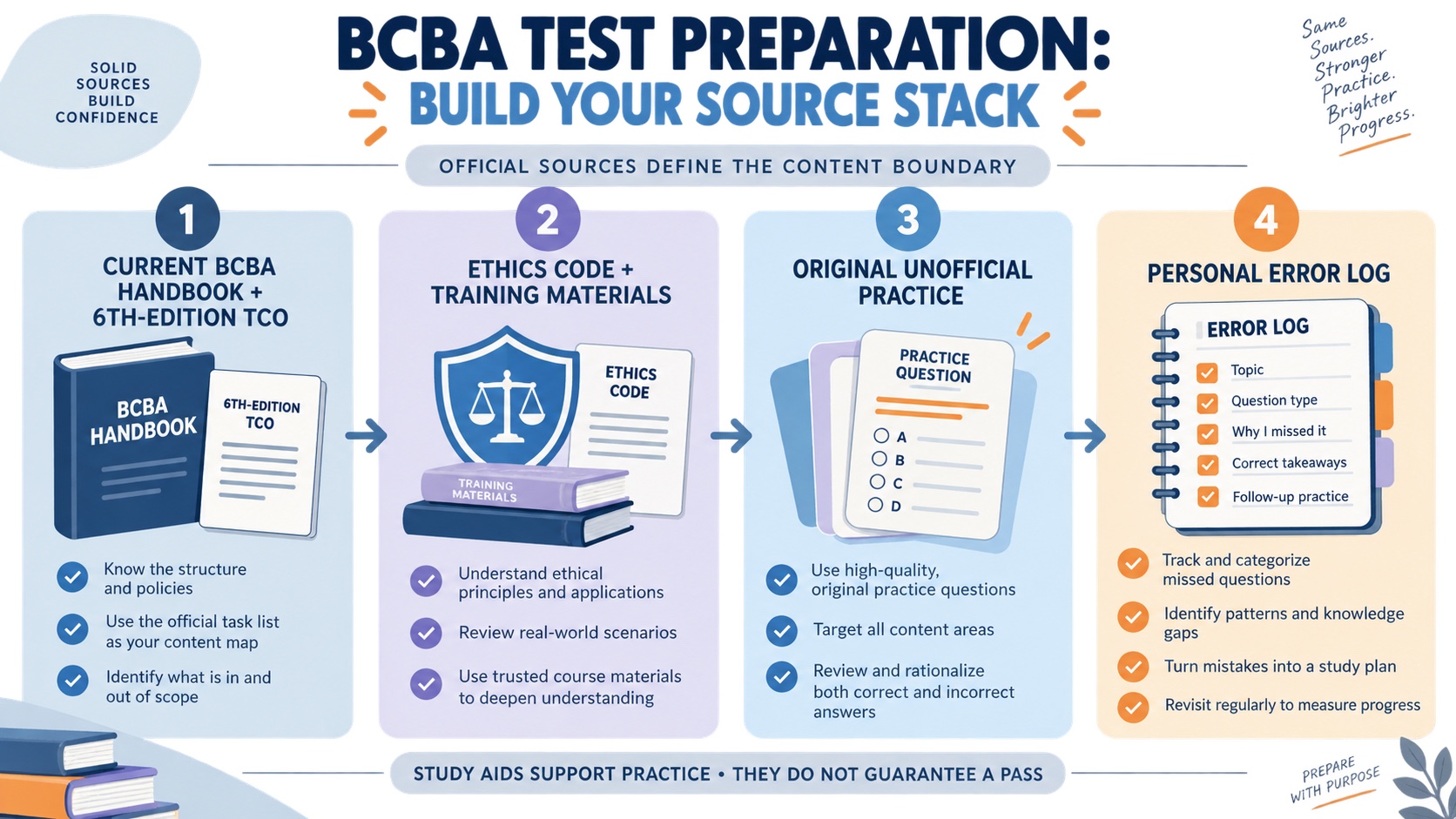
A preparation stack is the small set of resources you will actually use repeatedly. More resources do not automatically create better preparation. Start with four layers:
- Official boundary: keep the current BCBA Handbook and 6th-edition TCO available. Use the Ethics Code for ethical and professional decisions.
- Training foundation: return to your course notes, assigned texts, lectures, or supervisor-supported materials when a question exposes a content gap.
- Original practice: use questions that require a decision and provide a rationale for the correct answer and the distractors. Practice material should be labeled as unofficial.
- Personal record: keep an error log that records the task or distinction, the evidence you missed, and the next repair action.
Do not ask one resource to do every job. The TCO tells you what the examination content includes; the handbook explains examination and certification boundaries; training materials deepen the ideas; practice questions reveal how well you can use them. A flashcard may help you retrieve a definition, but it cannot by itself show whether you can choose a measurement, interpret a graph, evaluate a functional hypothesis, or select an ethical next step in a scenario.
Take a baseline before building a schedule
A baseline set is not an official readiness test. It is a short sample that helps you identify the type of problem you are having. Choose a manageable mixed set, answer without looking up each item, and mark your confidence before checking the rationale. Review correct answers that were guesses as well as incorrect answers.
Classify each item using one primary error type:
- Knowledge gap: you did not know the definition, procedure, rule, or relationship.
- Discrimination gap: you knew the terms but confused close alternatives, such as two measurement systems or two reinforcement arrangements.
- Application gap: you knew the concept in isolation but could not select it when the scenario added context, data, or a professional boundary.
- Process gap: you misread the stem, rushed, changed a well-supported answer, or spent too long on one item.
The category matters because each gap needs a different repair. A knowledge gap may call for a short reading and retrieval check. A discrimination gap needs a comparison. An application gap needs new scenarios. A process gap needs pacing or question-reading rehearsal. If every miss is recorded only as “wrong,” your calendar will be unable to respond to the pattern.
Turn every question into a review loop
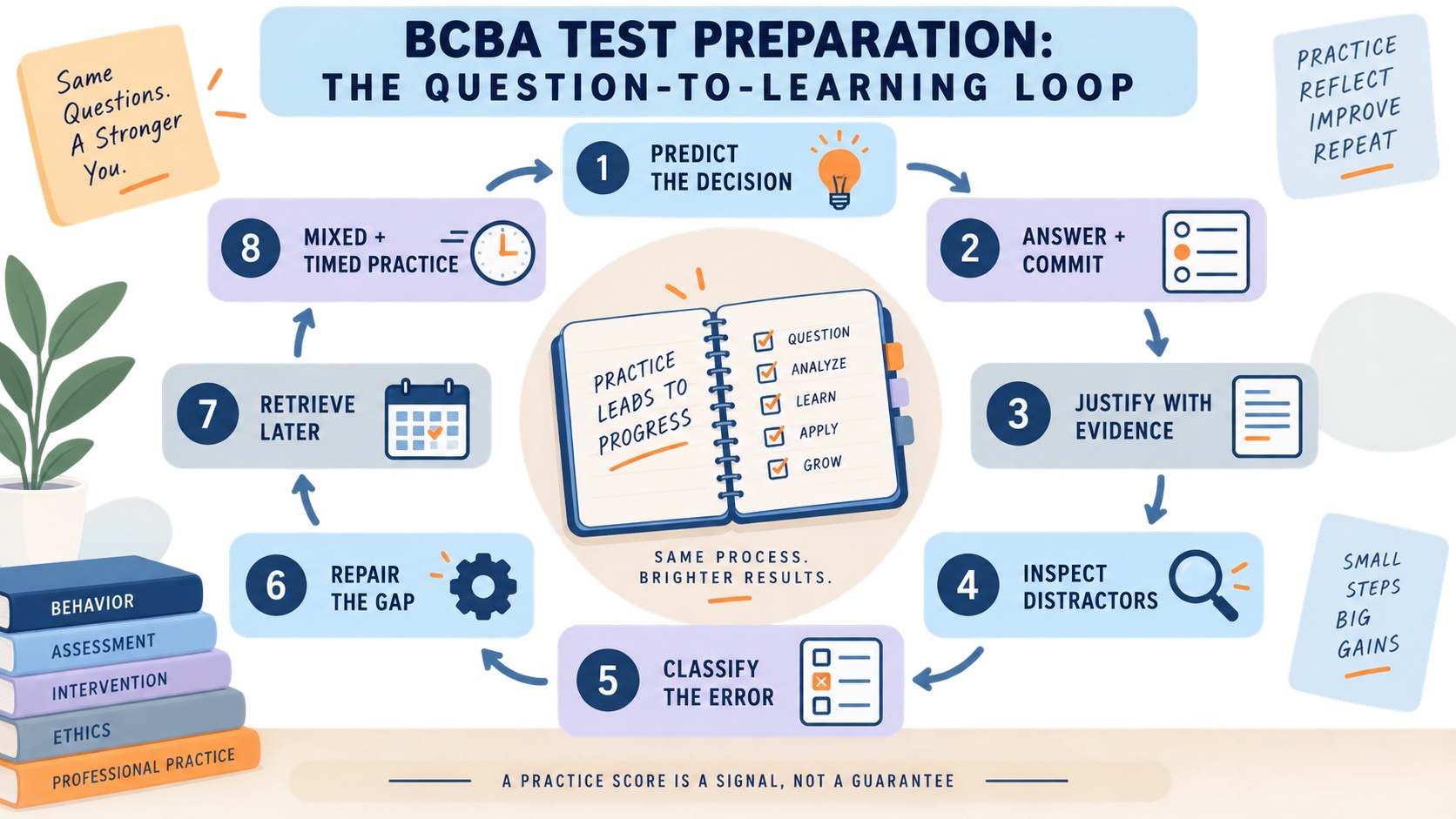
Question volume becomes useful when each item produces a learning decision. Use this seven-step loop:
- Predict the decision: before reading every option repeatedly, ask what the stem is really asking you to identify, compare, measure, or do.
- Commit to one answer: choose under a reasonable time limit. Do not convert every practice item into an open-book search.
- Explain the evidence: write one sentence that connects the best answer to the facts in the stem.
- Inspect the distractors: identify the exact feature that makes each alternative weaker, too broad, out of scope, or inconsistent with the evidence.
- Classify the error: record whether the issue was knowledge, discrimination, application, or process.
- Repair the gap: read a targeted section, draw a two-column comparison, revisit a Theory Block, or discuss the boundary with an instructor or supervisor.
- Retrieve later: answer a new item about the same distinction after a delay. Immediate recognition is not the same as durable retrieval.
For example, suppose a question describes a behavior measured across unequal observation periods. If you select a measure because it sounds familiar, your review should not stop at the correct letter. Ask what the observation opportunity was, what quantity the measure represents, and why the competing options do not fit the scenario. Then create a new example that changes one feature. That comparison is more valuable than copying the definition again.
Choose a preparation runway you can sustain
There is no single official number of weeks or hours that fits every BCBA candidate. Choose a runway that leaves enough time for retrieval and review, not only reading. The same question-first routine can fit different calendars:
- Short runway: use one daily mixed set, review every miss, and select only the two or three distinctions that most affect the next session. Keep the official source documents close and avoid adding new resource piles.
- Steady runway: alternate targeted domain work with mixed retrieval. Reserve one session each week for reviewing the error log and another for longer, unlabeled practice.
- Long runway: build a first cycle for broad coverage, a second cycle for application and discrimination, and a final cycle for mixed and timed rehearsal. Revisit weak areas after a delay instead of completing them once and closing the file.
At the end of each week, answer three questions: Which error type decreased? Which distinction still produces uncertainty? What is the smallest next action that would generate better evidence? This keeps the plan adaptive when coursework, fieldwork, employment, or family responsibilities change.
Add mixed and timed rehearsal
Early practice can be untimed because you are learning how to reason. Later practice should remove topic labels and add time boundaries so you must identify the relevant content area yourself. Increase difficulty in stages:
- Begin with short sets and full rationale review.
- Mix two or three content areas so you must discriminate among question types.
- Add longer blocks and practice flagging an uncertain item without losing the decision you already made.
- Use a full-length practice experience only when you can reserve time to review it carefully.
Avoid the preparation traps that waste time
Passive reading as the whole plan
Reading can repair a gap, but it does not demonstrate retrieval or application. After a short reading block, close the material and explain the distinction from memory, then test it with a new scenario.
Old-edition materials without a source check
Older notes may contain useful concepts, but they should not silently define your current study map. Check the TCO edition, task wording, ethics source, and handbook before building a calendar around a saved file.
Chasing a single score
A practice score describes one set under one set of conditions. Review missed items, guessed-correct items, and repeated error types. Do not translate a third-party score into an official pass prediction.
Believing “exact replica” language
No commercial or free study page should imply access to secure BACB examination content unless the BACB itself says so. Look for original questions, transparent rationales, edition labels, and a clear unofficial-resource boundary.
FAQ and official sources
How many hours should I study for the BCBA exam?
There is no one official hour requirement for preparation. Use a baseline to identify the breadth and type of your gaps, choose a sustainable runway, and increase practice only when you can still review the reasoning behind your answers.
Is the BCBA exam based on the 6th edition?
The current BACB examination and handbook materials identify the BCBA Test Content Outline (6th ed.) as the current outline. Candidates should re-check the current official materials because the handbook explains that testing uses the TCO in effect for the relevant authorization and appointment.
How many practice questions should I complete?
Choose a volume that leaves time for rationale review and later retrieval. Ten carefully reviewed questions can be more useful than a large set whose explanations you never inspect. Increase the set length as you build mixed and timed fluency.
Are mock exams helpful?
They can help you rehearse pacing, mixed retrieval, and review habits. Their value depends on question quality and what you do afterward. A mock score is not an official readiness decision or a pass guarantee.
Did the 2027 requirements create a 7th-edition BCBA exam?
The official 2027 materials describe changes to eligibility and maintenance requirements, not a confirmed 7th-edition examination outline. Keep the eligibility transition documents separate from the current exam-content documents, and verify the official handbook and TCO before relying on a claim about a future edition.
For current boundaries, read the BACB BCBA Handbook, the BCBA Test Content Outline (6th ed.), the BACB’s test-content-outline page, the examination-information page, and the official 2027 transition guidance. For learning support, you can also use ABA Study Online’s BCBA Theory Blocks, free BCBA questions, and ABA Definition Search; these are original educational resources and are not BACB-endorsed examination content.