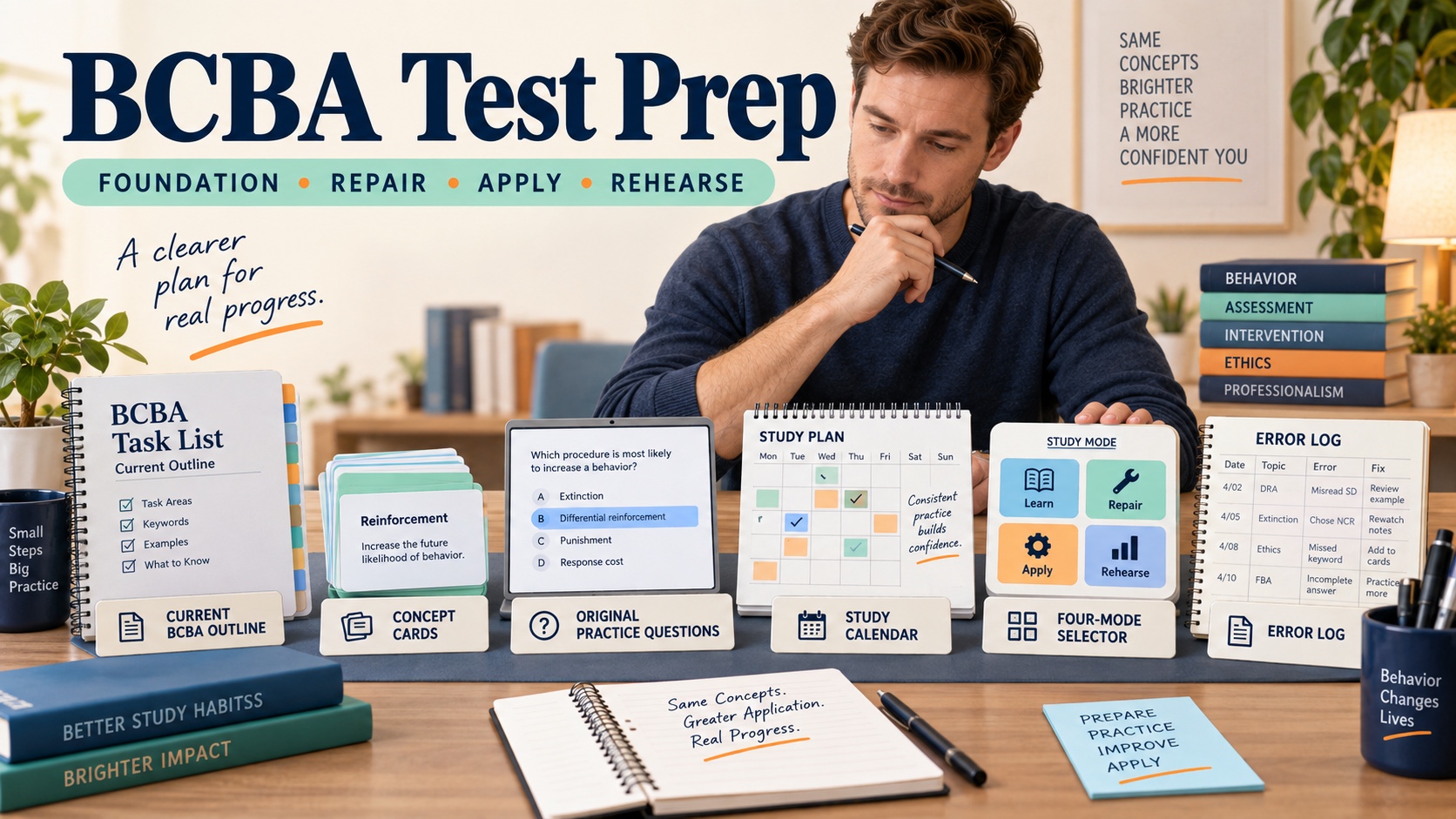
BCBA Test Prep: Choose the Right Study Mode Before You Add More Materials
BCBA test prep is not one product, one score, or one perfect calendar. It is a sequence of decisions. If you cannot explain a concept, you need a foundation block. If you confuse two similar procedures, you need repair. If you know the definition but miss the scenario, you need application. If you understand the content but lose time in mixed practice, you need rehearsal.
Starting with the wrong mode creates a familiar problem: the learner keeps buying or downloading resources without producing better evidence. This guide gives you a simple selector, a one-week starting sequence, and the boundaries that keep unofficial practice separate from the current BACB examination. For a detailed question-by-question review loop, use the related BCBA test preparation routine; this page focuses on choosing what kind of preparation to do next.
Table of Contents
Set the current BCBA test-prep boundary
Before planning sessions, open the current BCBA Handbook and the BCBA Test Content Outline (6th ed.). The handbook identifies the outline, Ethics Code, and training materials as important preparation sources. The current public examination structure is 175 scored questions plus 10 unscored questions, four hours, and four answer choices with one correct answer. The outline organizes 104 tasks into nine content areas.
Use those facts as a boundary, not as a practice-score formula. A third-party quiz can have a different length and still be useful if it explains what it measures. A percentage on an unofficial set is not an official pass prediction. The BACB also does not endorse specific study guides, and buying study materials does not guarantee a result.
Keep the 2027 transition separate from exam-edition claims. The current 2027 materials describe changes to eligibility, coursework, fieldwork, and maintenance. They do not automatically establish a “7th-edition” BCBA examination. When a resource mixes those topics, return to the official handbook and TCO before you rebuild your study plan.
Diagnose the gap before choosing a mode
Use your most recent study evidence, not your mood, to choose the next mode. Complete a small mixed set or explain a concept without notes, then ask which sentence sounds most like you:
- “I do not know what this means.” This is usually a foundation gap.
- “I know both terms, but I keep switching them.” This is a discrimination or repair gap.
- “I can define it, but I miss the scenario.” This is an application gap.
- “I know the material, but I rush or run out of time.” This is a process or rehearsal gap.
Record accuracy, confidence, error type, and pacing. A correct answer chosen by guessing belongs in the review set. A missed item that combines measurement, assessment, and ethics may need a different repair from a simple vocabulary miss. One useful next action is more valuable than a dramatic but vague plan.
Choose among four BCBA test-prep modes
Mode 1: Foundation
Use foundation mode when the source language is unfamiliar or you cannot explain a concept in plain words. Choose one small topic, read or watch one reliable explanation, and make a concept map with a definition, contrast, example, and decision question. Stop when you can close the source and explain the idea—not when you have opened five tabs.
Output: one page of cues and one closed-book explanation. Move on when: you can retrieve the core distinction and identify what evidence would matter in a simple scenario.
Mode 2: Repair
Use repair mode when two close alternatives keep colliding. Put them in a two-column comparison: defining feature, when it fits, what it is not, data clue, and ethical or role boundary. For example, if you confuse two measurement systems, compare what each counts, what observation opportunity it assumes, and how the result would affect a decision. Then answer a few new items that change one feature at a time.
Output: a comparison card and a corrected explanation. Move on when: you can tell which feature controls the answer in more than one example.
Mode 3: Apply
Use application mode when you recognize a term but cannot use it in a scenario. Hide the answer choices first and predict what the question is asking you to measure, explain, select, or do. Then work through the choices and state why each distractor is weaker. Practice with original, clearly labeled questions and keep clinical examples bounded; a study scenario is not enough information to make an individualized treatment decision.
Output: one new scenario with a written rationale. Move on when: your explanation uses the facts in the scenario rather than only repeating a definition.
Mode 4: Rehearse
Use rehearsal mode when you can work through mixed content but need information about pacing, attention, and transfer. Remove topic labels, use a reasonable time boundary, mark uncertain answers, and review the error log afterward. A full mock exam belongs here, after you have a plan to review it. Taking longer tests repeatedly without repair creates less information than one carefully reviewed rehearsal.
Output: a pacing record, confidence pattern, and targeted retry list. Move on when: you can compare sessions under similar conditions and identify the next repair instead of chasing a magic score.
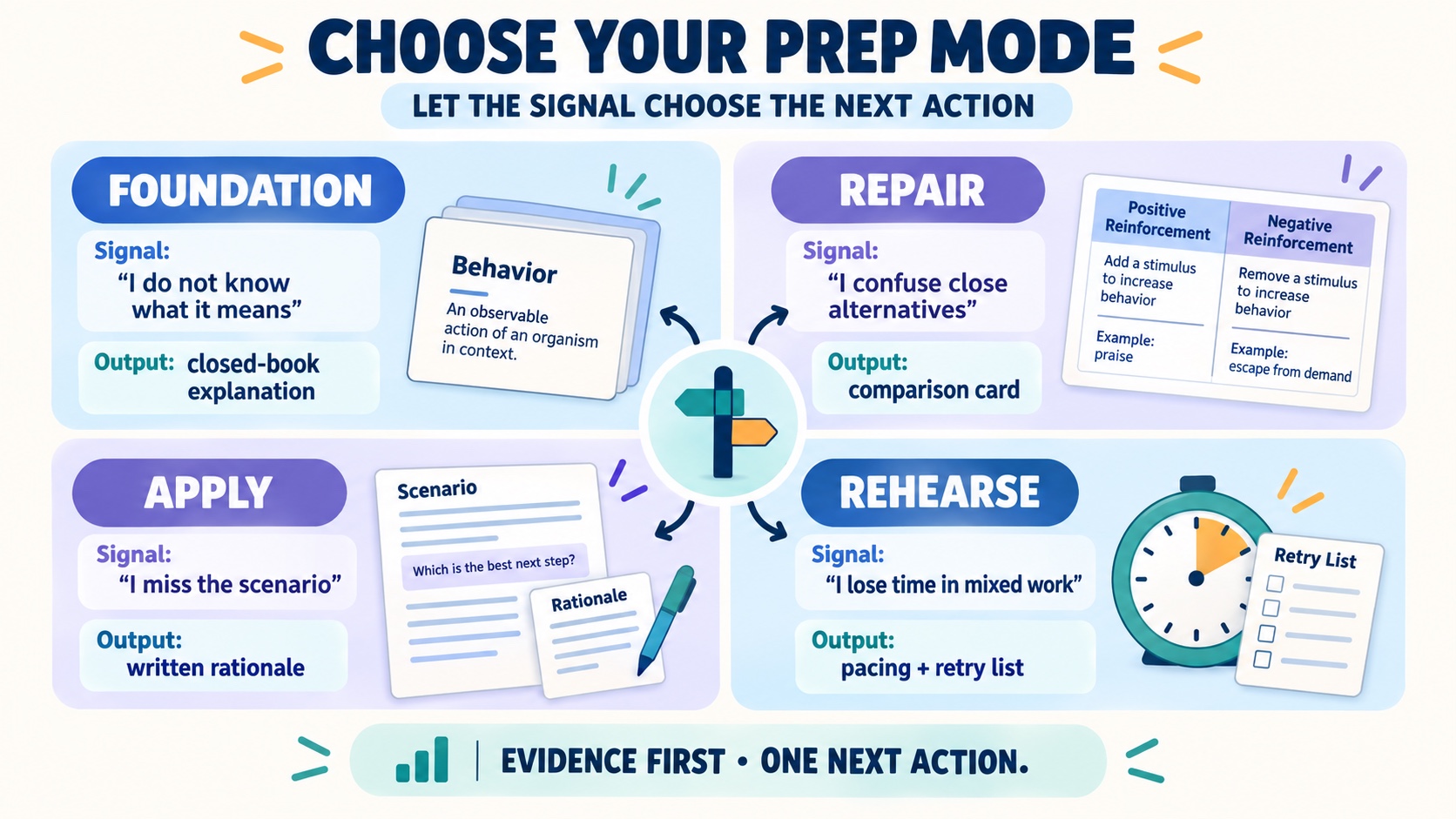
Give each mode a stop condition so preparation does not become endless. Foundation ends when you can explain the concept with the source closed. Repair ends when you can distinguish the alternatives in a new example. Application ends when your rationale uses the scenario evidence and role boundary. Rehearsal ends when you have recorded pacing and a targeted retry list. These conditions create visible progress without pretending that one session proves mastery.
Run a one-week starter sequence
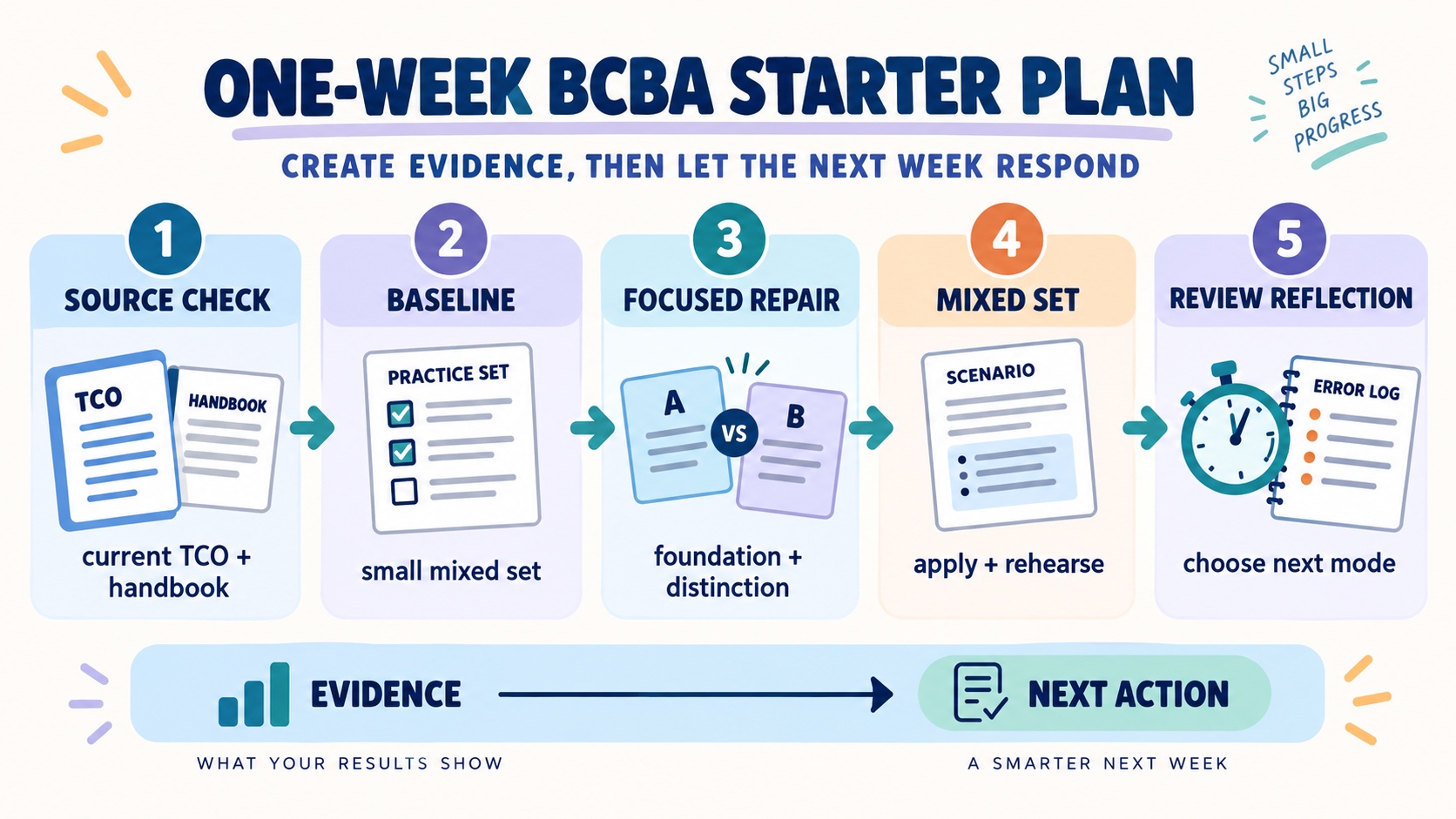
If you are unsure where to begin, use one week to create evidence rather than trying to finish the whole outline:
- Day 1 — boundary and baseline: check the current TCO and handbook, choose a small mixed set, and record confidence and error type.
- Day 2 — foundation: repair the two least familiar concepts with a short map and closed-book explanation.
- Day 3 — repair: compare one pair of concepts that produced confusion and answer new examples.
- Day 4 — apply: work through original scenarios without relying on topic labels; explain the distractors.
- Day 5 — mixed return: revisit the earlier concepts after a delay and mix them with a related domain.
- Day 6 — short rehearsal: use a longer timed set, flag uncertainty, and record pacing rather than only a percentage.
- Day 7 — reflection: review the log and select the next week’s mode. Keep what helped; remove a resource that produced no usable feedback.
The sequence is intentionally small. If your schedule is limited, combine two days into one block. If you have more time, repeat a mode with a new content area. The important behavior is the handoff from evidence to action: your last session should tell you what the next session is for.
Choose materials without building a pile
Give every resource one job. The official TCO defines the content boundary. The handbook explains certification and examination rules. Training materials deepen concepts. An original question bank rehearses decisions. A glossary helps when a term remains unclear. An app can make short return sessions easier. A mock exam tests mixed performance and pacing. If two resources do the same job but neither explains answers, adding a third may not solve the problem.
Keep a source note beside your calendar: edition, document name, and the date you checked it. That small habit makes it easier to replace an outdated file without losing your personal study history.
When you evaluate an unofficial resource, look for its edition label, transparent scope, original questions, explanations for correct and incorrect options, correction process, and clear statement that it is not BACB-endorsed. Avoid claims about live, recalled, leaked, or “exact replica” questions. Secure examination content is not a legitimate marketing promise.
Use the BCBA learning path for structured theory review, free BCBA questions for application practice, mock-exam information when you are ready for rehearsal, and the ABA Definition Search for vocabulary gaps. These are independent educational resources; the BACB remains the authority for certification and exam rules.
Avoid prep traps that feel productive
- Starting with a full mock: without a review plan, a long score hides the reason behind each miss.
- Changing resources every day: switching prevents you from seeing whether a method improved retrieval.
- Studying only the largest domain: blueprint weight can guide attention, but foundational errors can appear anywhere.
- Counting completion as mastery: finishing a video or card deck is not the same as explaining and applying the concept.
- Using an old outline silently: check the edition before you make it your calendar.
- Turning a score into a promise: unofficial practice cannot establish an official pass standard or guarantee an outcome.
BCBA test-prep FAQ
What is the best BCBA test prep?
The best starting mode depends on the gap you can observe. Use foundation for unfamiliar concepts, repair for close distinctions, apply for scenario difficulty, and rehearse for mixed or timed performance. A resource is useful when it produces better evidence and a clearer next action.
Should I use flashcards, practice questions, or a mock exam?
Use them for different jobs. Flashcards support concise retrieval, questions support application, and mock exams support mixed pacing. Do not let a mock replace foundation or repair, and do not let flashcards become a substitute for scenario reasoning.
How long should BCBA test prep take?
There is no universal preparation length that guarantees a result. Choose a sustainable runway, include spaced return and rationale review, and change the mode when your evidence changes. Your calendar should leave time for repair, not only first exposure.
Is BCBA test prep the same as the official BACB exam?
No. Independent preparation resources can support learning, but the BACB controls eligibility, examination administration, secure content, and official results. Use current official sources for the boundary and label third-party practice honestly.
Did the 2027 requirements create a 7th-edition BCBA exam?
The official 2027 materials address eligibility and maintenance changes. They do not automatically establish a new examination outline. Keep the current TCO and the 2027 transition documents as separate source checks.