BCBA Test Pass Rate: The Latest Official Numbers and What They Mean
If you are looking for the BCBA test pass rate, the latest official annual data available from the BACB report a 51% first-time pass rate and a 23% retake pass rate for BCBA candidates tested in 2025. Those numbers are useful, but they need careful interpretation. They describe two different candidate groups, and neither percentage is your personal probability of passing.
This guide puts the numbers in context, explains the five-year trend, separates overall examination data from university-program reports, and turns the information into a practical study decision. The goal is not to make the exam sound easy or impossible. It is to help you use official data without letting a population statistic replace an honest readiness check.
Table of Contents
What is the latest BCBA pass rate?
The BACB’s annual data report lists two 2025 BCBA figures:
| Candidate group | Candidates tested | Percentage passing |
|---|---|---|
| First-time candidates | 9,955 | 51% |
| Retake candidates | 13,196 | 23% |
The simplest answer to “What is the BCBA pass rate?” is therefore 51% if you mean first-time candidates in the latest report. If you mean people taking the examination again, the listed rate is 23%. Combining them into one number would hide an important difference in the populations.
These are examination outcomes, not a ranking of individual people. The report does not say that every candidate had the same education, fieldwork history, preparation time, language background, testing conditions, or reason for sitting for the examination. It also does not tell us why a candidate passed or did not pass. Use the figures as context, not as a personal forecast.
How has the rate changed?
The official historical table gives the following BCBA percentages:
| Year | First-time pass rate | Retake pass rate | First-time candidates tested |
|---|---|---|---|
| 2021 | 60% | 28% | 12,107 |
| 2022 | 55% | 24% | 7,179 |
| 2023 | 56% | 23% | 8,255 |
| 2024 | 54% | 25% | 9,911 |
| 2025 | 51% | 23% | 9,955 |
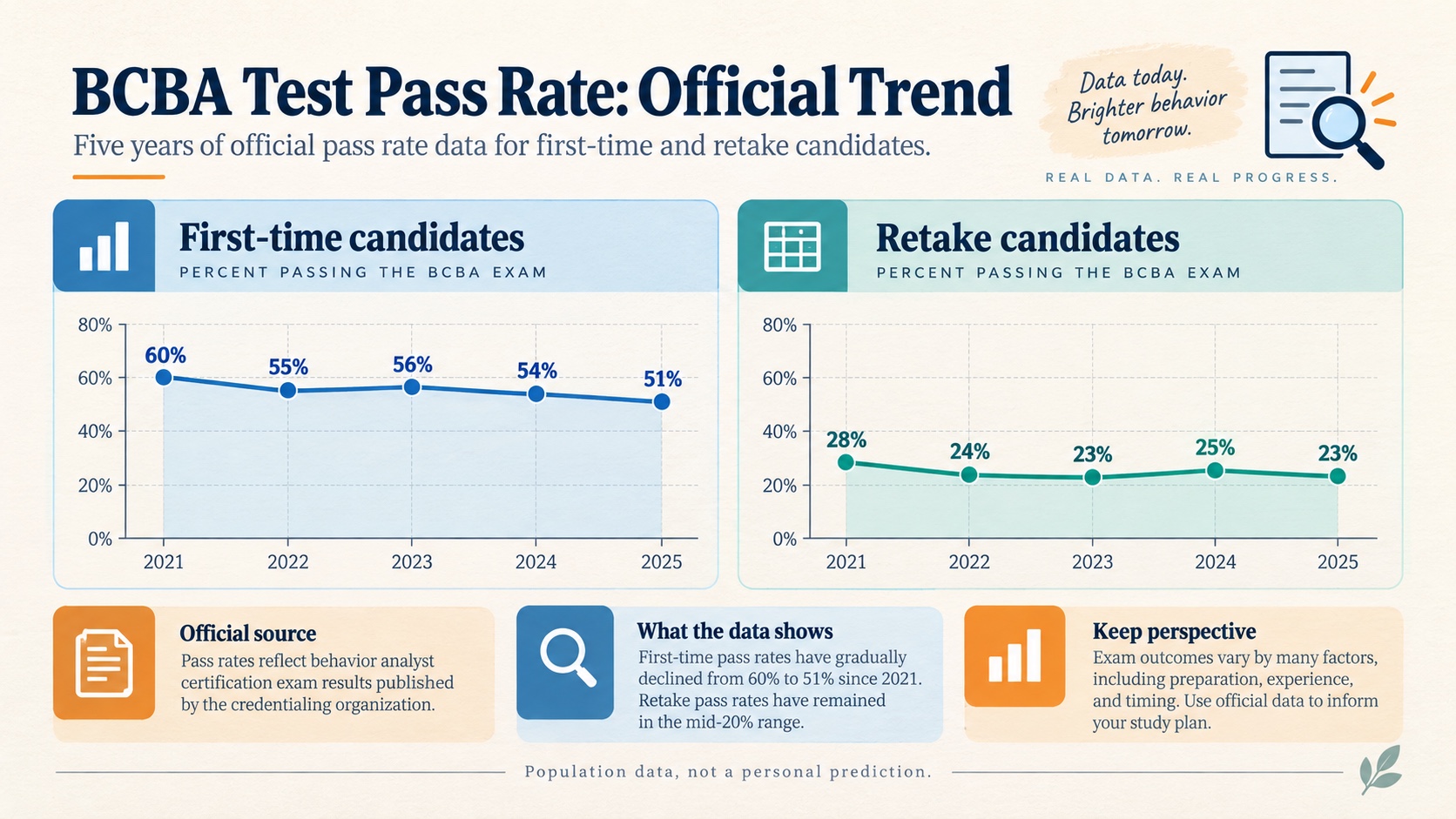
The first-time rate moved from 60% in 2021 to 51% in 2025, while the retake rate stayed lower across every year shown. That pattern is worth noticing, but it is not enough to prove that the examination became harder or that one specific preparation method caused the change. Candidate mix, application volume, training pathways, examination forms, and other conditions can affect annual results. A responsible article reports the pattern and leaves unsupported explanations out.
What does the pass rate actually mean?
A pass rate is a proportion of candidates in a defined group who passed during a defined period. It can answer a question such as, “What percentage of first-time BCBA candidates tested in 2025 passed?” It cannot answer, “Will I pass if I take the exam next month?”
Your own readiness is better evaluated with evidence closer to your work: whether you can explain the current BCBA Test Content Outline, apply concepts to new scenarios, interpret data, reason through ethics and supervision decisions, and maintain accuracy during a timed mixed set. A practice score is still not an official prediction, but it can show which tasks need more study than a general pass-rate statistic can.
Be especially careful with headlines that turn 51% into “you have a 51% chance.” The annual figure is not a calibrated individual probability. It does not adjust for your coursework, supervised fieldwork, language, previous attempts, study hours, or the exact examination form you will receive.
How are university pass rates different?
BACB also publishes pass-rate reports for first-time BCBA and BCaBA candidates associated with ABAI-accredited degree programs and Verified Course Sequences. Those reports can help a prospective student investigate a program, but they are not the same dataset as the overall annual examination rate.
The university reports do not include programs with fewer than six first-time candidates in a year. They also describe candidates who took the examination for the first time in that year, which may include people who completed a program earlier. BACB advises readers to evaluate each program’s report on its own and not compare a training-program rate directly with the overall examination rate, because large programs can affect the overall figure.
That means a school’s listed percentage is not a guarantee for every graduate, and a missing percentage is not automatically evidence of poor quality. Look at the candidate count, reporting year, program type, and eligibility pathway before drawing a conclusion.
Does the pass rate tell you the passing score?
No. The pass rate is not a raw-score cutoff. BACB establishes the passing score for each base examination form using a modified Angoff method, and statistical equating accounts for differences in difficulty among forms. Because the form and scale matter, the number of correct answers needed can vary; BACB does not report a universal “you need X out of Y” rule.
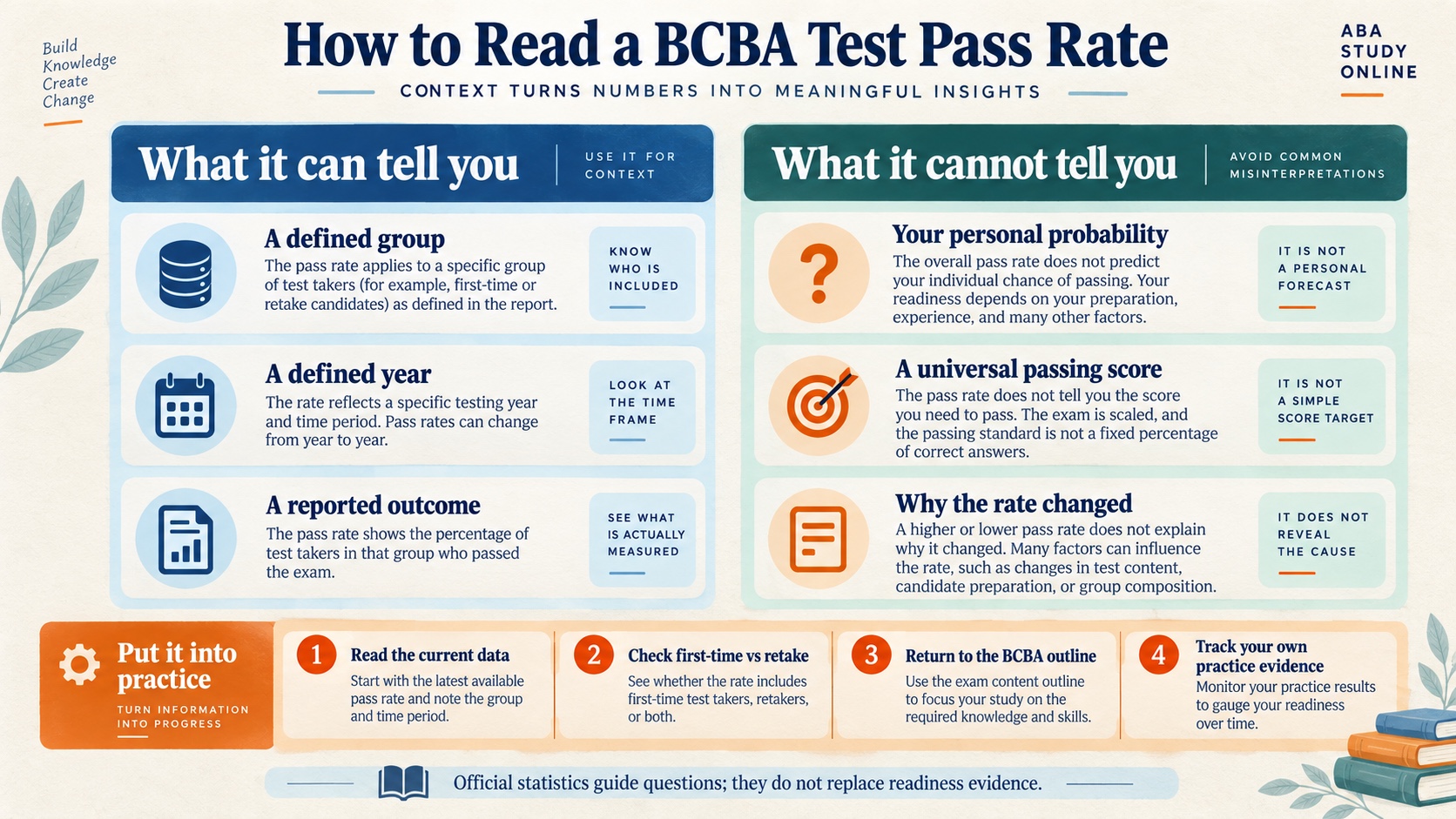
This is also why an unofficial article should not promise that a certain mock-exam percentage equals a BACB pass. A practice set can be harder or easier than a secure form, and a scaled examination result is not a direct conversion of one public percentage.
When you read any pass-rate table, ask four questions before you react. What year does the table represent? Is the group made up of first-time candidates, retakes, or both? How many people were included? What definition did the publisher use for “passing”? Those questions prevent a dramatic headline from doing more work than the data can support. They also make it easier to compare two reports honestly: a large annual overall dataset and a small program-level first-time dataset may both be accurate while answering different questions.
For your own preparation, keep a separate progress record. Note the content outline version, the date of each mixed practice set, the domains represented, the type of error, and whether time pressure changed your decision. That record is more actionable than repeatedly checking a national percentage. It can show whether you are improving in application, pacing, and explanation across the full blueprint.
How should the data change your study plan?
The numbers support a steady plan, not panic. Start with the current BCBA Test Content Outline and mark each task as explain, apply, or revisit. Then work through four layers:
- Concept accuracy: define the term in plain language and distinguish it from its nearest distractor.
- Scenario application: decide what the data show, what the practitioner should do next, and which action respects scope and ethics.
- Mixed practice: combine domains so you cannot guess the answer from the section label.
- Timed review: practice pacing, mark uncertain questions, and analyze the reason for each error instead of only counting misses.
If you take the exam again, do not study only the task areas listed on a performance report. BACB cautions that the number of questions tied to one task is small and may not represent complete understanding. Use the report to choose examples and a starting point, then review the full content outline. The ABA Study Online BCBA learning path and BCBA question practice area can support that process, but they do not replace current BACB materials.
What does this say about 2027?
The BACB has announced significant BCBA eligibility and maintenance changes taking effect in 2027. Those changes affect the certification pathway and ongoing requirements; they do not let us turn the 2025 pass-rate report into a prediction for 2027. If you are applying or planning an examination around the transition, read the current BCBA Handbook and transition guidance for your application timing, then use the current examination content resources for your scheduled exam.
A useful rule is to keep three questions separate: Which requirements apply to my application? Which test content outline applies to my appointment? What does my own practice evidence say I should review? A public pass rate can provide context for the first conversation, but it cannot answer the other two for you.
BCBA pass-rate FAQ
What is the latest official BCBA test pass rate? In the latest available BACB annual data report, 51% of first-time BCBA candidates and 23% of BCBA retake candidates passed in 2025.
Is the BCBA exam pass rate 51% for everyone? No. That is the 2025 first-time population rate. It is not a personal probability, a guarantee, or a universal result for every future examination window.
Why is the retake rate lower? The official data show a lower rate for retakes, but the table alone does not establish why. Do not turn the association into a causal explanation.
Can I calculate the BACB passing score from 51%? No. BACB uses modified Angoff standard setting and statistical equating. The pass rate is not the number of questions you must answer correctly.
Do university pass rates predict my result? They can help you investigate a training program, but BACB advises against comparing program rates directly with the overall examination rate. Review the year, candidate count, and report definition.