BCBA TCO: How to Use the BCBA Test Content Outline
If you are searching for the BCBA TCO, you are probably trying to answer more than “where is the PDF?” You may want to know what the outline means, which domains deserve the most attention, how the tasks connect to practice questions, or whether a 2027 transition has created a new exam outline. The short answer is that the current BACB BCBA Test Content Outline is the 6th edition. It describes the knowledge and skills assessed on the examination; it is not the same document as the 2027 BCBA Requirements.
The most useful way to study with a TCO is to turn each domain and task into a learning map. Read the task verb, connect it to a definition or procedure, practice it in a scenario, and record what you still need to retrieve. Keep the official BACB TCO and current examination information as your source of truth, especially when a question concerns eligibility, fieldwork, application timing, or a future transition.
Table of Contents
Short answer: what is the BCBA TCO?
TCO stands for Test Content Outline. The current BCBA TCO, published by the Behavior Analyst Certification Board, organizes the exam content into nine domains and 104 task statements. It describes the knowledge and skills identified as important for entry-level BCBA practitioners by the relevant job-task analysis. The current outline says the BCBA examination includes 175 scored questions and 10 unscored pilot questions.
A TCO is best understood as a blueprint. It can help you check coverage, prioritize practice, and notice a domain you have ignored. It does not tell you the exact questions you will see, provide a universal raw-score passing number, or replace the current BCBA Handbook, examination information, ethics requirements, or eligibility documents. Use the official BCBA TCO 6th edition together with the BACB’s examination information.
What the current BCBA TCO contains
The outline is organized around domains and tasks. A domain is a broad content area, such as measurement or behavior assessment. A task is a more specific statement of what a candidate may need to identify, distinguish, explain, select, or apply. Those verbs matter. “Identify” calls for recognition and discrimination; “explain” asks for a defensible account; “select and implement” requires connecting evidence, procedure, and context.
The TCO also gives a question distribution by domain. The distribution helps you allocate study time, but it should not become a reason to abandon smaller domains. A less heavily weighted domain can still contain concepts that connect to other areas, and an unfamiliar task can remain a meaningful weakness even if its percentage is modest.
Read the outline in three passes. First, scan the domain names so you understand the map. Second, mark every task with a confidence rating based on retrieval, not recognition. Third, attach each task to a study action: define, compare, graph, calculate, interpret, choose, or explain a scenario. This turns a long document into a queue of learnable decisions.
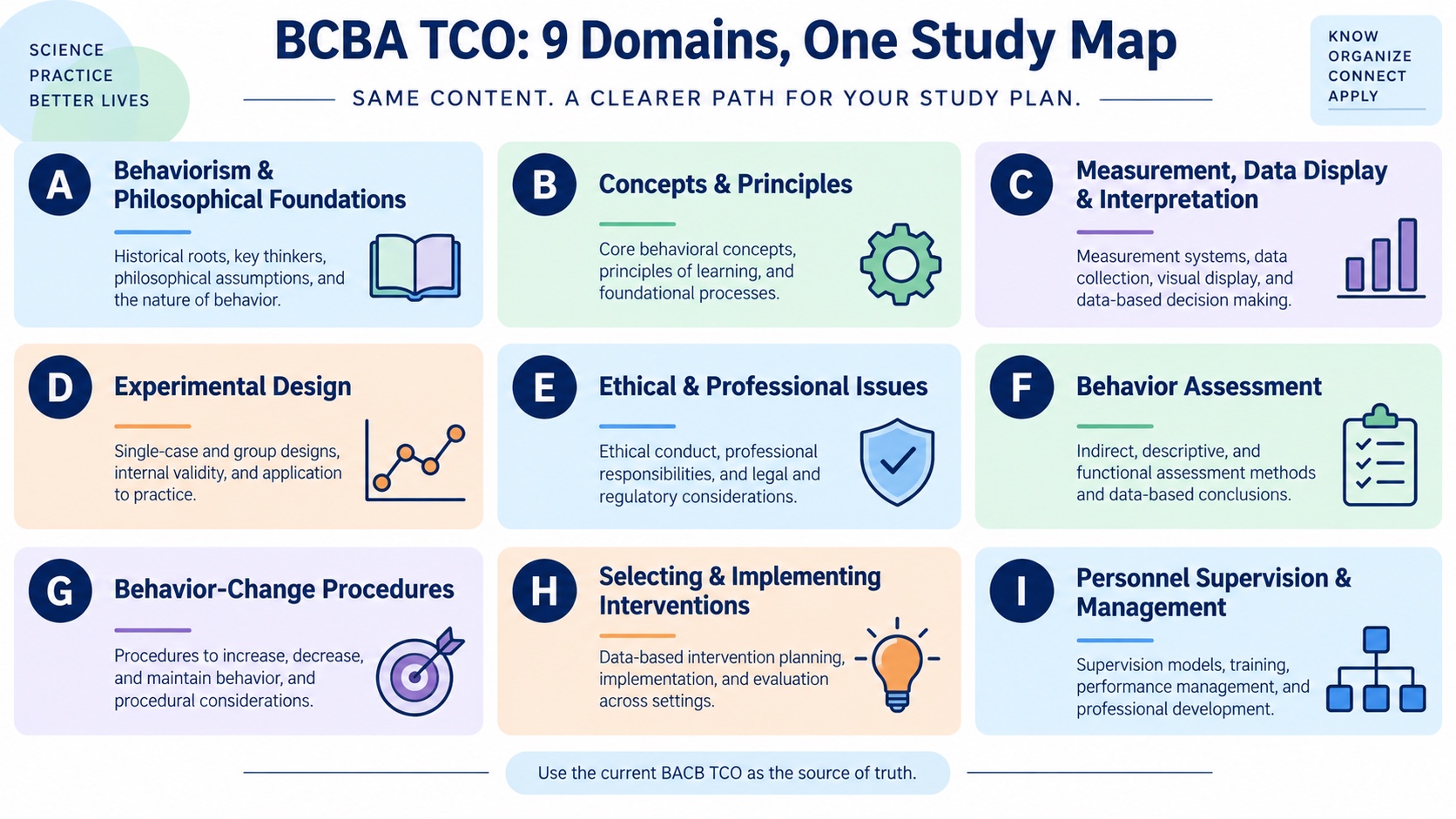
The nine BCBA TCO domains
- Behaviorism and Philosophical Foundations: the science’s goals, assumptions, radical behaviorism, distinctions among behaviorism and applied behavior analysis, and the dimensions of ABA.
- Concepts and Principles: behavioral units, conditioning, reinforcement and punishment, schedules, extinction, stimulus control, generalization, motivating operations, verbal behavior, and related processes.
- Measurement, Data Display, and Interpretation: measurement systems, data collection, visual display, and the interpretation of patterns that support decisions.
- Experimental Design: design logic, internal validity, and how arrangements of measurement and conditions support conclusions about relations.
- Ethical and Professional Issues: ethical conduct and professional responsibilities, including the need to consult current BACB ethics and professional resources when a question is rule-sensitive.
- Behavior Assessment: assessment methods and the reasoning used to interpret information about behavior and its context.
- Behavior-Change Procedures: procedures used to increase, decrease, or maintain behavior, together with procedural and contextual considerations.
- Selecting and Implementing Interventions: selecting, implementing, monitoring, and evaluating interventions with attention to evidence and client-centered decision-making.
- Personnel Supervision and Management: supervision, training, performance management, and the professional systems that support competent practice.
These summaries are orientation points, not replacements for the task statements. Keep the exact wording available while studying. A short phrase such as “interpret data” can hide several decisions: what was measured, whether the display fits the measure, what pattern is present, and what conclusion is justified.
How to use the question distribution
The current 6th-edition TCO lists the following approximate distribution: A 5%, B 14%, C 12%, D 7%, E 13%, F 13%, G 14%, H 11%, and I 11%. The numbers are useful for planning, not for predicting an exact personal score. They describe the examination blueprint, not a promise that every form will feel evenly distributed in the same way.
Use the distribution as a starting point for three study buckets:
- Coverage: every domain and task has at least one clear review entry.
- Priority: larger domains receive enough repeated practice to match their breadth.
- Repair: missed or uncertain tasks return to the next retrieval cycle regardless of domain size.
A common mistake is to multiply the percentage by the number of pages in a study guide and call the result a plan. A better plan asks what you can do with the information. If a task says “distinguish,” create contrasting examples. If it says “interpret,” practice reading a display and defending the conclusion. If it says “select and implement,” work through a case that includes constraints and monitoring.
How to turn a task into a study session
Choose one task and build a short loop:
- Retrieve: write what the task means before opening your notes.
- Clarify: check the authoritative definition, procedure, or source.
- Discriminate: compare the target with a nearby concept that could be confused with it.
- Apply: answer a scenario or create a bounded example.
- Explain: state which evidence makes the answer stronger than the alternatives.
- Schedule: return after a delay and mark whether the task is still available from memory.
For example, a measurement task should not end with memorizing a definition. You might identify what is being measured, select a measurement system, inspect a small data display, and explain what can—and cannot—be concluded. A concepts task might require contrasting positive reinforcement with negative reinforcement in a scenario while keeping “positive” and “negative” tied to adding or removing a stimulus, not to good or bad.
Use practice questions as evidence of what needs repair, not as a substitute for reading the task statements. Your error log can include the task code, the missed distinction, the evidence you overlooked, and the next example to retrieve.
BCBA TCO versus 2027 requirements
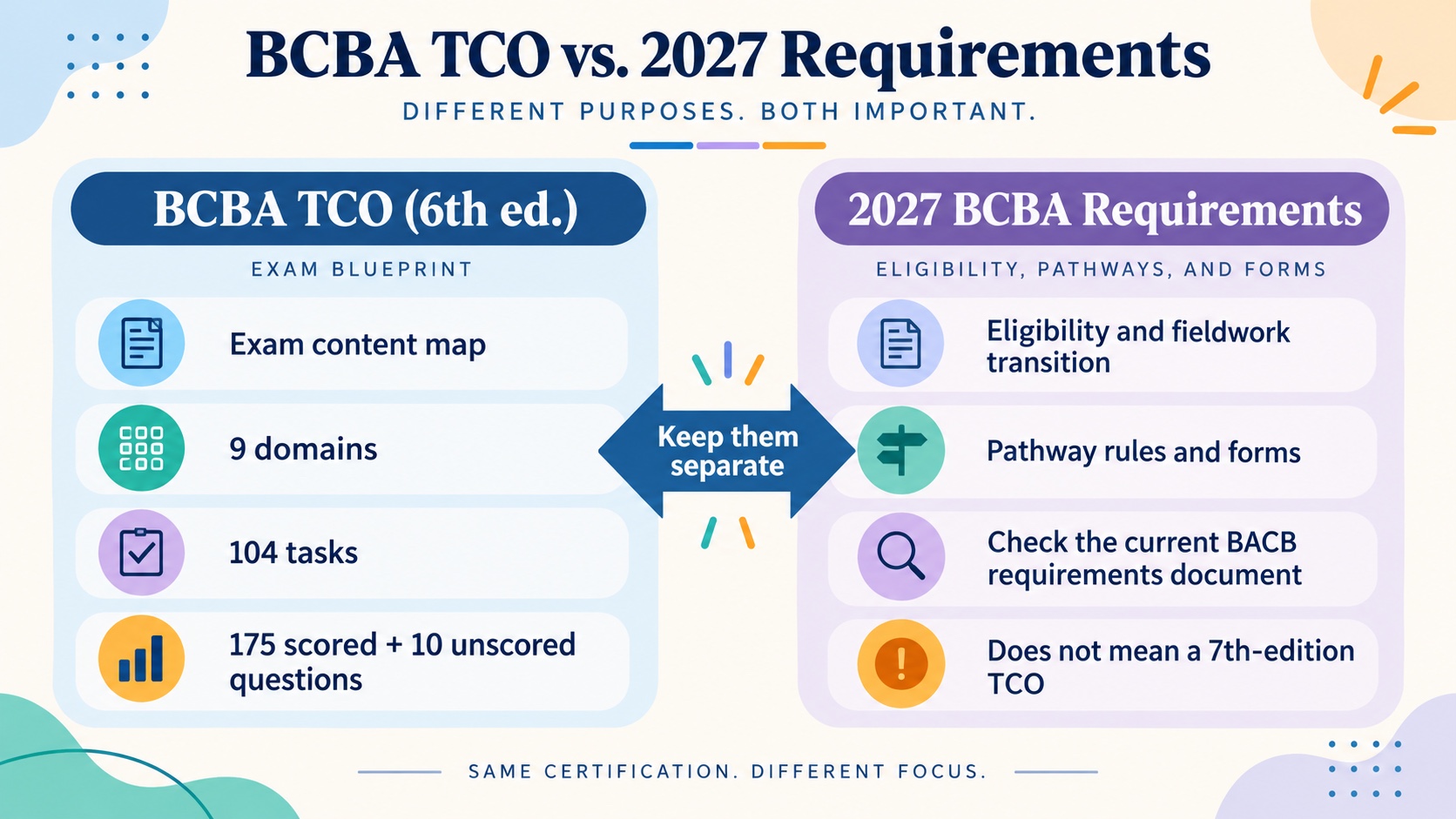
This is the distinction that causes the most confusion. The BCBA TCO is an examination-content document. The 2027 BCBA Requirements document addresses certification pathways, eligibility, coursework, supervised fieldwork, forms, and transition rules. They answer different questions and should be studied from different pages.
Current BACB materials state that applicants affected by the 2027 transition use the applicable 2027 requirements and forms. The 2027 requirements document also states that candidates must pass the BCBA examination based on the BCBA TCO 6th edition, which went into effect January 1, 2025. In other words, seeing “2027 BCBA Requirements” does not by itself mean that a BCBA TCO 7th edition has been released.
When you see a social post or prep page claiming a new TCO, check three things: the document title and edition, the effective date, and whether the claim comes from a current BACB page or PDF. Keep your eligibility checklist linked to the current requirements document and your exam study map linked to the current TCO. If BACB publishes a new outline later, update the study map from the official release instead of guessing from a transition headline.
Common TCO study mistakes
- Studying only domain names: names provide orientation, but tasks provide the learning targets.
- Using percentages as a pass calculator: the blueprint is not a personal score prediction or universal raw cut score.
- Confusing a TCO with eligibility: the exam map does not replace the handbook or 2027 requirements.
- Reading without retrieving: recognition can feel fluent while recall remains fragile.
- Ignoring smaller domains: every domain belongs in coverage and repair, even when its share is lower.
- Memorizing a prep provider’s labels: preserve the official task language and verify current editions.
- Assuming an article is current forever: check the official BACB page before relying on dates, forms, or transition details.
A practical TCO-based study plan
Start with a one-page inventory of the nine domains. Under each one, list the task statements and give yourself three labels: ready to explain, recognize but cannot apply, or needs a first pass. During the first cycle, aim for coverage. During the second, emphasize scenario application and error repair. During the third, mix domains so you must choose the relevant concept instead of relying on a predictable chapter order.
Keep a weekly review rhythm. A short session can use one task and one scenario. A longer session can combine a high-weight domain with a smaller domain, then finish with a mixed set. The ABA Study Online app can support retrieval, flashcards, section practice, audio review, and progress tracking, while the website’s mock-exam destination can serve a separate longer rehearsal. Neither replaces the official BACB source.
Finally, revise the plan when your evidence changes. If you repeatedly miss a task, do not hide it inside a completed-domain percentage. Create a simpler explanation, compare it with a neighboring concept, work a new scenario, and schedule another retrieval attempt. A TCO-based plan is useful because it stays connected to the decisions the exam expects—not because it makes the study process automatic.
BCBA TCO FAQ
Is the current BCBA TCO the 6th or 7th edition?
The current BACB materials reviewed for this article list the BCBA Test Content Outline as the 6th edition. The 2027 BCBA Requirements are a separate transition and eligibility document; they do not, by themselves, indicate a 7th-edition TCO.
How many domains are in the BCBA TCO?
The 6th-edition BCBA TCO organizes content into nine domains and 104 task statements. Use the official document for the exact task wording and current edition status.
How many questions are on the BCBA exam?
The current 6th-edition TCO describes 175 scored questions and 10 unscored pilot questions. Confirm the current examination information before scheduling because exam policies and documents can change.
Does the TCO tell me what score I need to pass?
No. It is a content blueprint, not a universal raw-score calculator. Use the BACB examination information for current scoring and reporting information, and use practice performance as a study signal rather than an official result.
Should I study the 2027 requirements for the exam?
Study the 2027 requirements if they apply to your certification pathway, fieldwork, coursework, or forms. Study the TCO for examination content. Keep the two documents connected in your planning but do not treat one as a replacement for the other.
Sources and boundaries
- BACB BCBA Test Content Outline (6th ed.)
- BACB Test Content Outlines for BACB Certifications
- BACB Examination Information
- BACB 2027 BCBA Requirements
- Dunlosky et al. (2013), effective learning techniques review
- Carpenter, Pan, and Butler (2022), spacing and retrieval practice review
- ABA Study Online BCBA learning resources, free questions, app review, and mock exams