BCBA Task List: A Current 6th Edition Study Guide
If you search for a BCBA task list, you are likely looking for the examination content map that organizes what to study. The current BACB document is the BCBA Test Content Outline (6th ed.). The phrase “task list” remains common in search results and older study resources, but a current BCBA plan should name the outline, edition, and effective examination period.
This guide explains how to use the current BCBA outline without confusing it with the BCBA Handbook, the Ethics Code for Behavior Analysts, or the 2027 certification requirements. It maps the nine domains to practical study actions and uses an applied scenario to show how BCBA reasoning moves from evidence to intervention and supervision decisions. It is independent educational material, not official BACB examination content or a pass guarantee.
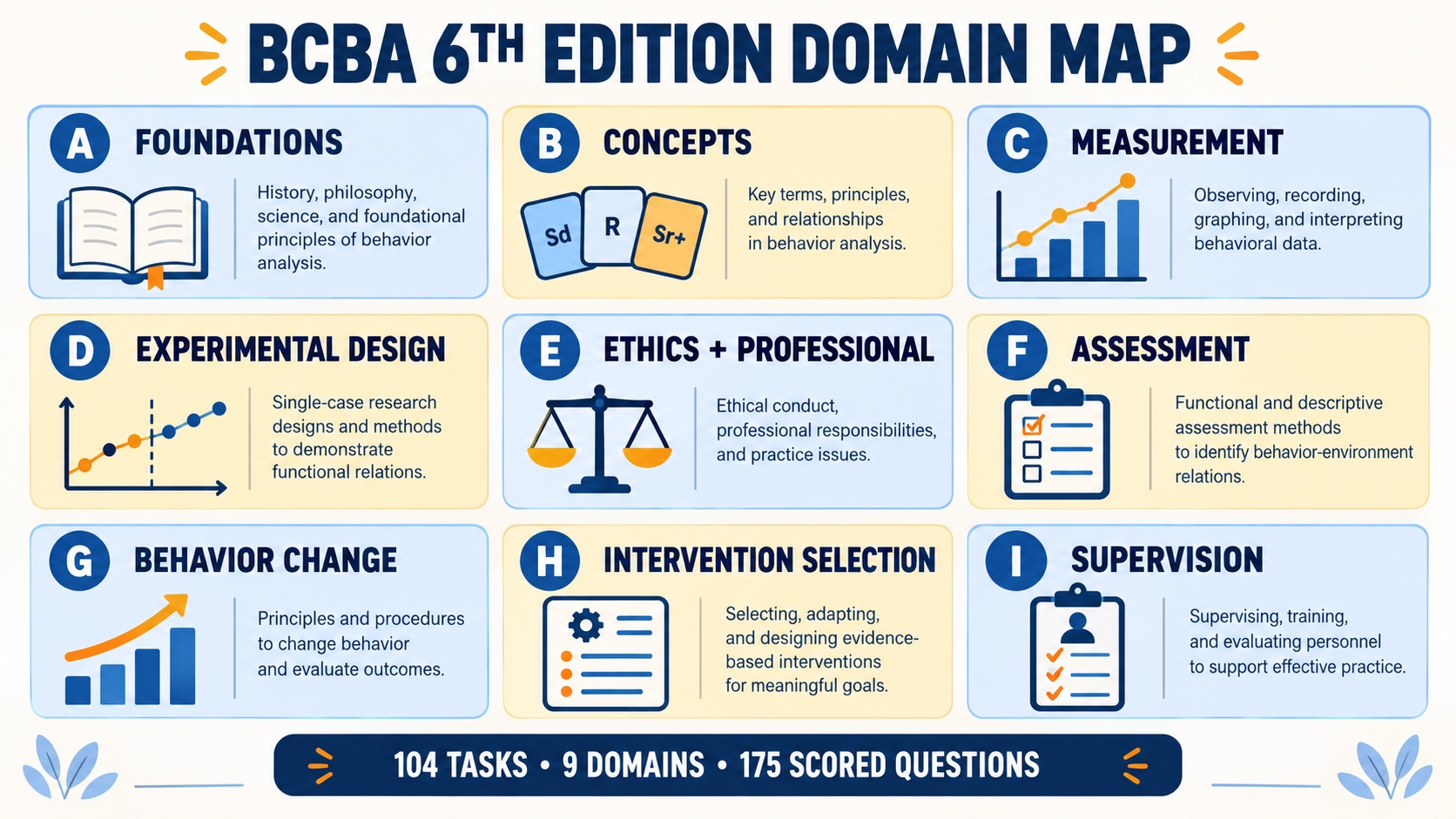
Quick answer: Use the BCBA Test Content Outline (6th ed.) for examination content. It organizes 104 tasks across nine domains and the current examination structure includes 175 scored questions and 10 unscored pilot questions. Build a domain map, practice the task verbs, review the evidence in each scenario, and return to the official source when a question depends on an edition, requirement, or application rule.
Source boundary: The outline is not a complete BCBA certification checklist or a clinical protocol. Use the current BCBA Handbook for eligibility, fieldwork, application, examination procedures, and maintenance. Use the Ethics Code and applicable law or licensure requirements for professional obligations.
What the current BCBA outline does
The BCBA Test Content Outline (6th ed.) describes the knowledge and skills represented on the BCBA examination beginning in 2025. It gives you a content map, not the exact wording of future questions. It does not replace graduate training, supervised fieldwork, ethical judgment, or the current handbook.
Before using any resource labeled “BCBA task list,” verify:
- It identifies the BCBA track rather than BCaBA or RBT;
- It names the 6th edition and current examination period;
- It links to the current BACB outline or examination page; and
- It is being used for study, not represented as the handbook, official questions, or clinical authorization.
The nine BCBA domains
The official outline gives each domain a rounded share of the current examination. These percentages can help you distribute review time, but they do not predict the exact questions or guarantee that a domain will feel easy because it has fewer items.
A. Behaviorism and Philosophical Foundations — 8 questions, 5%
Review the goals of behavior analysis as a science, philosophical assumptions, radical behaviorism, distinctions among behaviorism and applied practice, and the dimensions of ABA. Practice explaining how a philosophical assumption changes what counts as useful evidence.
B. Concepts and Principles — 24 questions, 14%
Build comparison sets for behavior and response classes, stimulus classes, conditioning, reinforcement and punishment, schedules, extinction, stimulus control, generalization, motivating operations, verbal behavior, emergent relations, behavioral momentum, matching, imitation, and observational learning. The study target is discrimination inside a scenario, not a dictionary recital.
C. Measurement, Data Display, and Interpretation — 21 questions, 12%
Connect the measurement to the dimension of behavior, inspect data quality, and interpret level, trend, variability, and other display features cautiously. Ask whether a change could reflect a measurement-system change, implementation problem, or context shift before attributing it to an intervention.
D. Experimental Design — 13 questions, 7%
Study single-case designs, functional relations, internal and external validity, replication, threats, and ethical costs. For each design, write what changes, what stays comparable, what is measured, and what alternative explanation the design helps address.
E. Ethical and Professional Issues — 22 questions, 13%
Review the current Ethics Code for Behavior Analysts, client welfare, consent, confidentiality, competence, cultural responsiveness, documentation, boundaries, public statements, supervision, and professional responsibility. Keep the BACB Ethics Codes page beside your study notes rather than relying on an old ethics chart.
F. Behavior Assessment — 23 questions, 13%
Practice selecting and interpreting descriptive assessment, functional assessment, skill assessment, preference assessment, and other methods according to the question. Separate observation, hypothesis, and conclusion; match the level of inference to the evidence actually available.
G. Behavior-Change Procedures — 25 questions, 14%
This is the largest domain. Review reinforcement, punishment, extinction, prompting and fading, shaping, chaining, discrimination training, token systems, generalization, maintenance, and verbal behavior procedures. Explain the contingency, goal, learner experience, integrity check, and possible side effects.
H. Selecting and Implementing Interventions — 20 questions, 11%
Connect assessment results to socially significant goals, intervention selection, contextual fit, stakeholder collaboration, treatment integrity, effectiveness, generalization, and maintenance. A good answer shows why the intervention fits the data and the person, not only why the procedure is familiar.
I. Personnel Supervision and Management — 19 questions, 11%
Study performance assessment, training, feedback, supervision, organizational systems, equity, documentation, and outcome monitoring. Practice deciding what support a staff member needs and what evidence will show whether the support changed performance.
Turn task verbs into study actions
The verbs in the BCBA outline should change how you practice:
- Identify: recognize the term, feature, or relation in an applied example.
- Distinguish: compare close alternatives and state the feature that changes the answer.
- Explain: describe the concept in plain language and connect it to a case.
- Interpret: read data or an observation, state what it supports, and name the uncertainty.
- Select: choose a method or intervention based on the goal, evidence, context, and ethics.
- Implement or monitor: sequence steps, check integrity, and define what outcome prompts revision.
Keep an error log with the domain, task verb, concept, evidence problem, and next practice action. “I need to study assessment” is too broad. “I confuse a descriptive pattern with a demonstrated functional relation” gives you a specific comparison, scenario, and source check.
A cross-domain BCBA study scenario
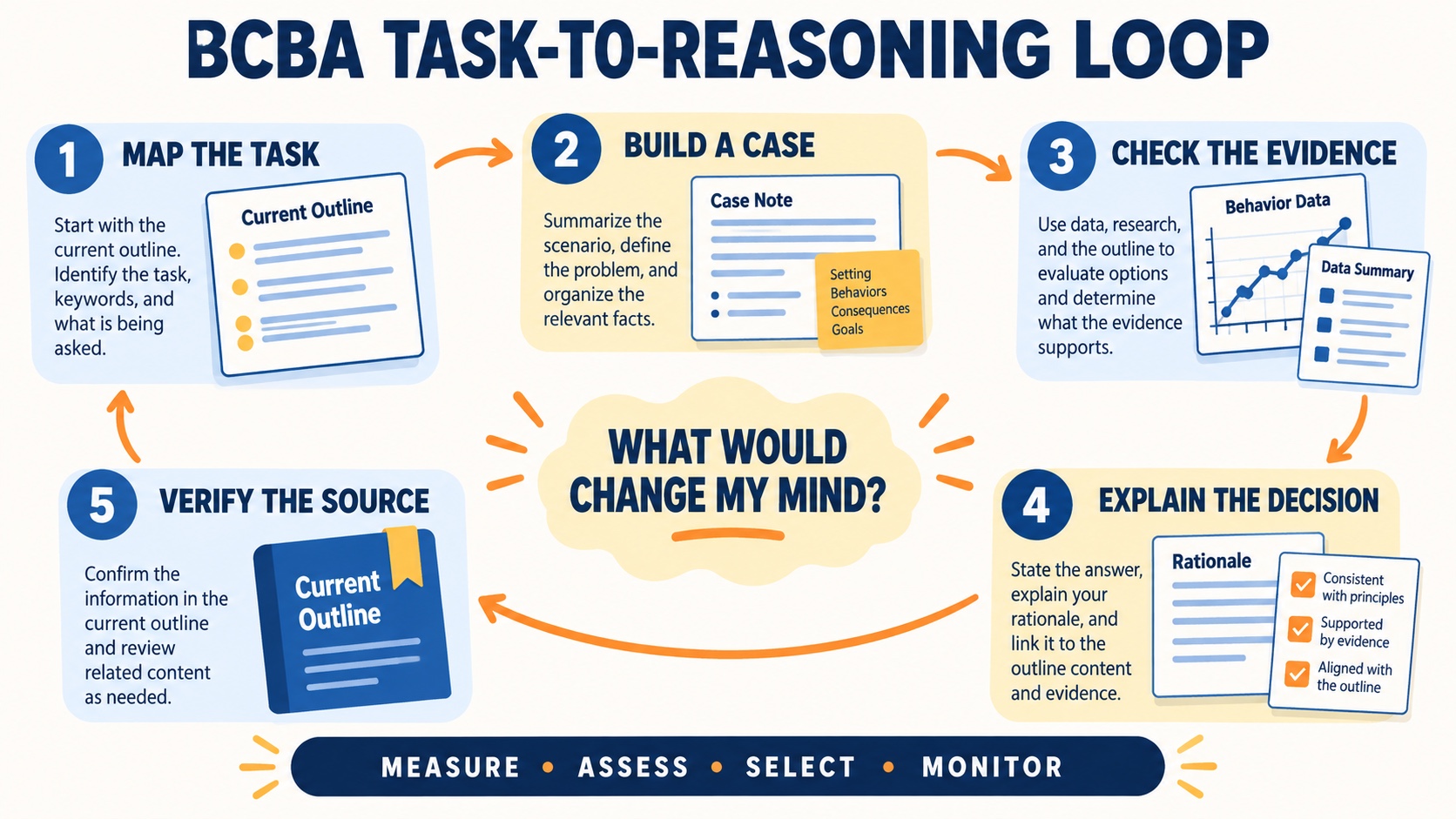
Imagine that a learner’s independent communication is increasing in one teaching setting but not transferring to a second person. A BCBA scenario may ask you to interpret the graph, examine the measurement system, check whether the intervention was implemented as written, and choose a next step that supports generalization.
A defensible response begins with the data rather than a dramatic intervention. Describe the pattern, check whether the measure captures independent responding, review the teaching and generalization arrangement, consider learner and stakeholder priorities, and select a reversible next step with monitoring. If staff performance is part of the pattern, the decision may also involve supervision and performance support. This is why BCBA study should connect domains instead of treating each label as a disconnected flashcard deck.
For practice, write the scenario in five lines: target, measurement, current pattern, possible explanation, and next decision. Then add one sentence about what would change your mind. That final sentence is important because BCBA reasoning is not only choosing a procedure; it is specifying how the team will learn whether the decision helped and when another review is warranted. It also makes your rationale easier to discuss with the people responsible for implementation and follow-up.
Common BCBA task-list mistakes
- Using the BCaBA outline by default: shared terms do not make the tracks interchangeable.
- Memorizing percentages as predictions: weights distribute study time but do not reveal the exact examination form.
- Choosing an intervention before checking the data: assessment and measurement should constrain the next decision.
- Ignoring implementation integrity: a flat outcome may reflect performance support or procedural drift.
- Treating ethics as a separate vocabulary list: ethical reasoning often changes how data, consent, privacy, and intervention are handled.
- Mixing the outline with 2027 requirements: verify the current TCO, handbook, and transition pages separately.
BCBA task list FAQ
Is there a current BCBA task list?
The current BACB examination document is the BCBA Test Content Outline (6th ed.). “BCBA task list” remains a common search phrase, but use the current outline name and edition in your study file.
How many domains are on the BCBA outline?
The current BCBA Test Content Outline (6th ed.) organizes 104 tasks into nine domains, from behaviorism and philosophical foundations through personnel supervision and management.
Does the BCBA outline tell me whether I can apply?
No. Use the BCBA Handbook and current requirements pages for education, fieldwork, application, examination procedures, and maintenance. The outline is an examination-content map.
Is ABA Study Online official BCBA exam content?
No. ABA Study Online provides independent explanations, practice, and study tools. Use the current BACB documents for official examination and certification information.