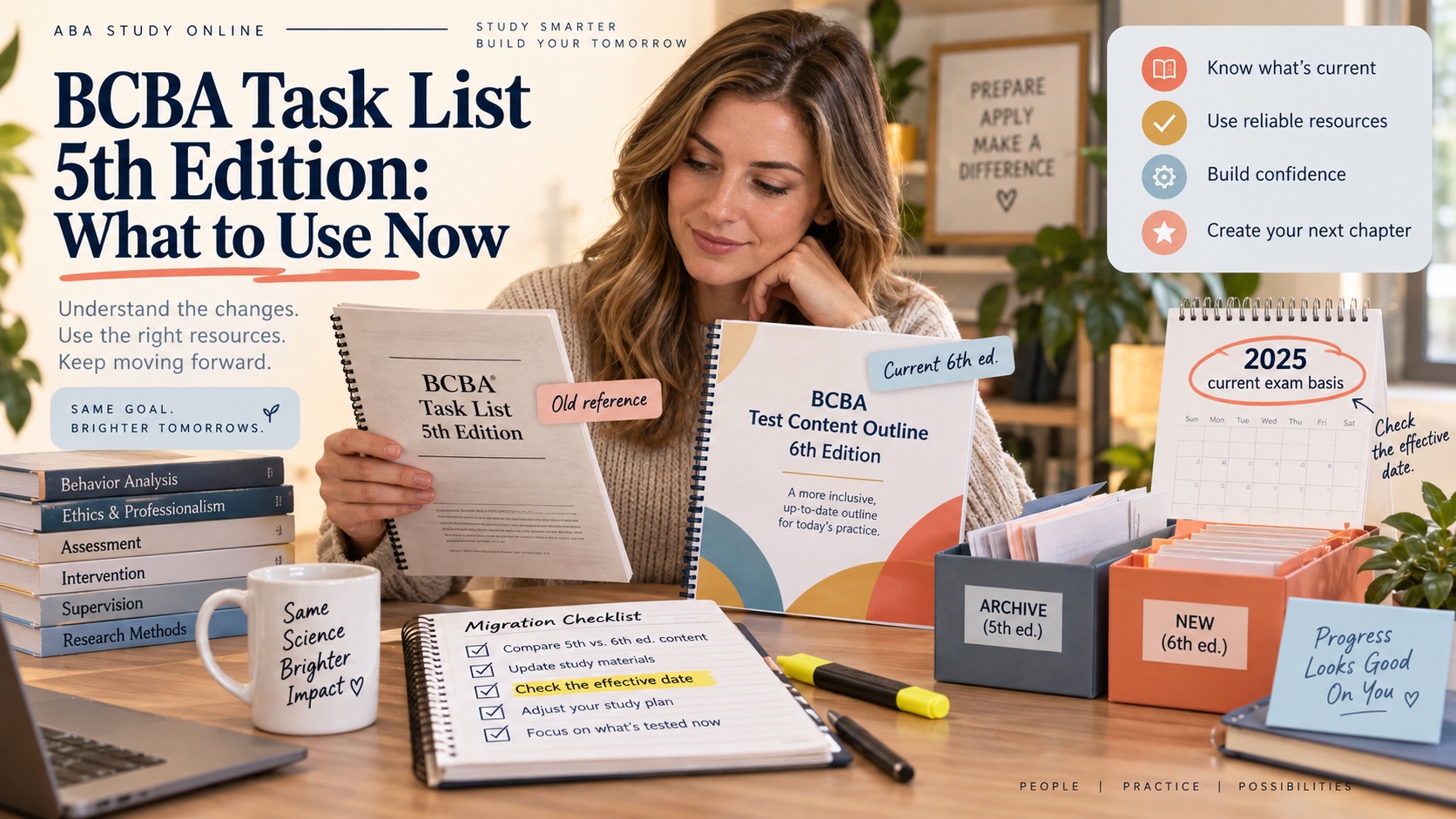
BCBA Task List 5th Edition: What to Use Now
If you searched for the BCBA Task List 5th edition, you may be looking at an older course, a saved PDF, or a study guide that still uses familiar task-list language. The important question is not whether the old document is easy to find. It is whether it is the current content reference for the BCBA examination you plan to take.
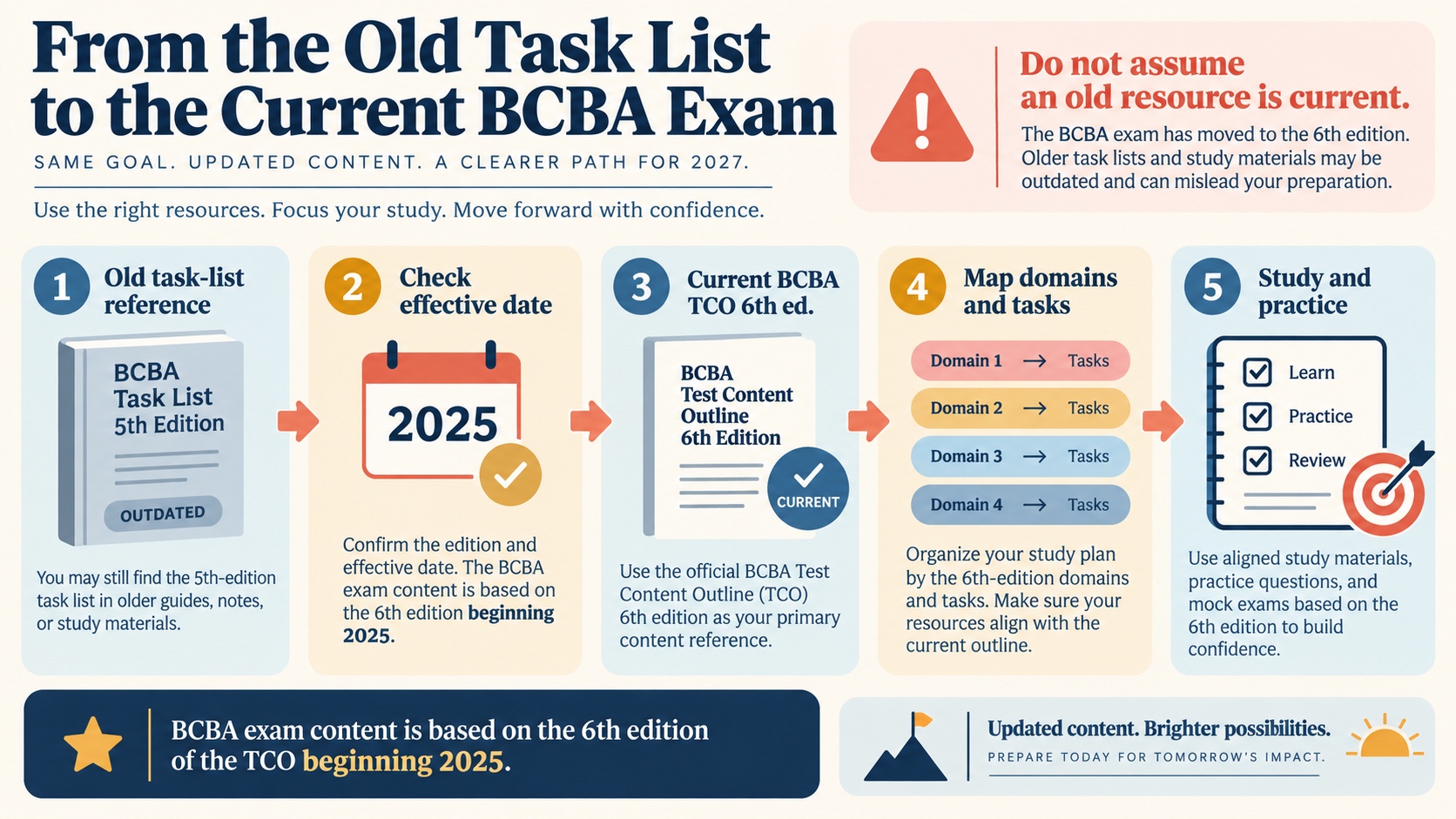
For current exam preparation, the BACB identifies the BCBA Test Content Outline (6th ed.) as the examination content outline beginning in 2025. The older 5th-edition task list can help explain why legacy resources use certain labels, but it should not silently replace the current outline in your study plan. Version control is part of good exam preparation.
The short answer
The current BCBA examination content reference is the BCBA Test Content Outline (6th ed.), not the 5th-edition task list. The BACB’s current task-list page labels the 6th edition as effective January 1, 2025, and its BCBA outline describes 104 tasks organized into nine content areas. Before you study, download or open the current source from BACB and record its title, edition, effective date, and access date.
This answer is about examination content. A study guide may still mention the 5th edition because it was written earlier, because it compares changes, or because it has not been updated. Do not assume that every definition or example in an old guide is wrong; do assume that you need to compare it with the current outline before using it as your coverage map.
Why the 5th edition still appears
Older task lists remain visible because graduate courses, flashcards, videos, saved bookmarks, and marketplace listings can stay online long after an exam outline changes. Search engines also preserve older pages when people continue to search the old phrase. That creates a practical problem: a resource can look polished and still be version-mismatched.
Legacy terminology can also persist in conversations. A supervisor, instructor, or classmate may use “task list” as a general phrase for the exam outline. Ask which edition they mean. The label alone is not enough. Your study notes should use the current document’s domain and task wording, while older material should be marked as historical, comparative, or supplementary.
What controls the current BCBA exam
The current BCBA TCO groups the examination content into nine areas: behaviorism and philosophical foundations; concepts and principles; measurement, data display, and interpretation; experimental design; ethical and professional issues; behavior assessment; behavior-change procedures; selecting and implementing interventions; and personnel supervision and management.
The outline lists 175 scored questions and 10 unscored pilot questions, with the examination completed in four hours according to the current BCBA materials. The percentages can help you distribute study time, but they are not a promise about the exact mix of questions you will personally see. Your plan should cover every area and then give extra practice to the tasks you cannot explain or apply.
How the 2027 requirements transition fits in
The 2027 BCBA transition can make version questions even more confusing. Certification requirements, application pathways, fieldwork forms, and examination content are related but not identical. The BACB’s guidance for the 2027 requirements transition states that, as of its published guidance, the BCBA examination is based on the 6th-edition TCO and that there were no upcoming changes to the BCBA examination or TCO at that time.
That means “2027 changes” should not automatically be translated into “a 7th-edition BCBA exam.” Check the current BACB transition guidance, handbook, and examination pages for the part of the pathway you are asking about. If you are deciding whether to apply under one set of certification requirements or another, that is a different research task from choosing the exam content outline.
How to update an old study plan
- Freeze the old version: label the PDF, notes, or course “5th edition / historical reference” and record its date.
- Open the current BACB source: use the official BCBA TCO 6th edition and the current BCBA Handbook.
- Rebuild the headings: make your study notebook follow the current nine content areas and task statements.
- Compare, do not blindly copy: move useful explanations into the current heading only after checking that the example still fits the task.
- Audit your practice questions: identify which edition each question claims to follow and prioritize current-aligned material.
- Record uncertainty: when a rule or eligibility question is time-sensitive, link to the current handbook instead of relying on a static summary.
A practical migration sheet needs only four columns: old heading, current heading, explanation worth keeping, and action needed. Some concepts will map easily. Others may require a new application example or a new review of ethics, assessment, intervention, or supervision language. The point is to make the difference visible so an outdated heading does not hide an unstudied task.
Keep the comparison sheet beside your practice results so version checking becomes part of ordinary study rather than a last-minute rescue.
If a resource does not name its edition, treat that missing label as a reason to verify it, not as evidence that the material is current.
Common version mistakes
- Calling every outline a task list: use the actual edition and document title in your notes.
- Using a cached PDF without a date: verify the official page and effective date.
- Assuming 2027 requirements mean a 7th edition: requirements transitions and exam-outline changes are separate decisions.
- Using old questions as the main coverage map: practice questions should follow the current TCO or be clearly labeled historical.
- Replacing the official source with a commercial summary: summaries can teach, but the BACB handbook and TCO control current policy and scope.
Use the ABA Study Online BCBA route to organize explanations and practice around the current outline, and return to the official BACB documents whenever a requirement, testing rule, or effective date may have changed. This page clarifies the version problem; it is not a substitute for the current handbook.
FAQ
Is the BCBA Task List 5th edition still current?
For current BCBA examination preparation, use the BCBA Test Content Outline 6th edition. The 5th edition may be useful as a historical comparison, but it should not be your primary current exam map.
When did the BCBA 6th edition start?
The BACB identifies the 6th-edition BCBA TCO as effective January 1, 2025 and states that the BCBA examination content is based on it beginning in 2025.
Does the 2027 BCBA transition create a 7th-edition exam?
Not automatically. The 2027 certification-requirements transition and the examination TCO are separate. Check the current BACB guidance before assuming an examination-outline change.
Can I still use my old 5th-edition study guide?
You can use it for background or comparison, but label it as old, cross-check its coverage against the current 6th-edition TCO, and avoid treating its headings or policies as current without verification.