
BCBA Supervision: Roles, Training, Fieldwork, and the 2027 Boundary
The phrase BCBA supervision sounds like one topic, but it can describe several different relationships. A BCBA may supervise an RBT who is providing services, a BCaBA who is practicing under supervision, or a trainee who is collecting supervised fieldwork toward BCBA or BCaBA certification. The documentation, qualifications, and measurement rules are not identical for those situations.
That is why a useful supervision answer begins with a question: Who is being supervised, and for what purpose? This guide maps the three main contexts, explains the 8-hour supervision-training boundary, and gives a dated overview of the 2027 BCBA fieldwork rules without turning one future snapshot into a universal rule for every person receiving supervision.
Quick answer: BCBA supervision is structured oversight provided by a qualified supervisor for a specific person and purpose. A BCBA may supervise ongoing services for RBTs or BCaBAs, or supervise trainees completing fieldwork toward certification. The BACB requires 8-hour supervision training before a person provides supervision in the roles covered by the Supervisor Training Curriculum Outline (2.0). The relevant handbook, supervision contract, current forms, and local rules still determine the details.
The three supervision contexts
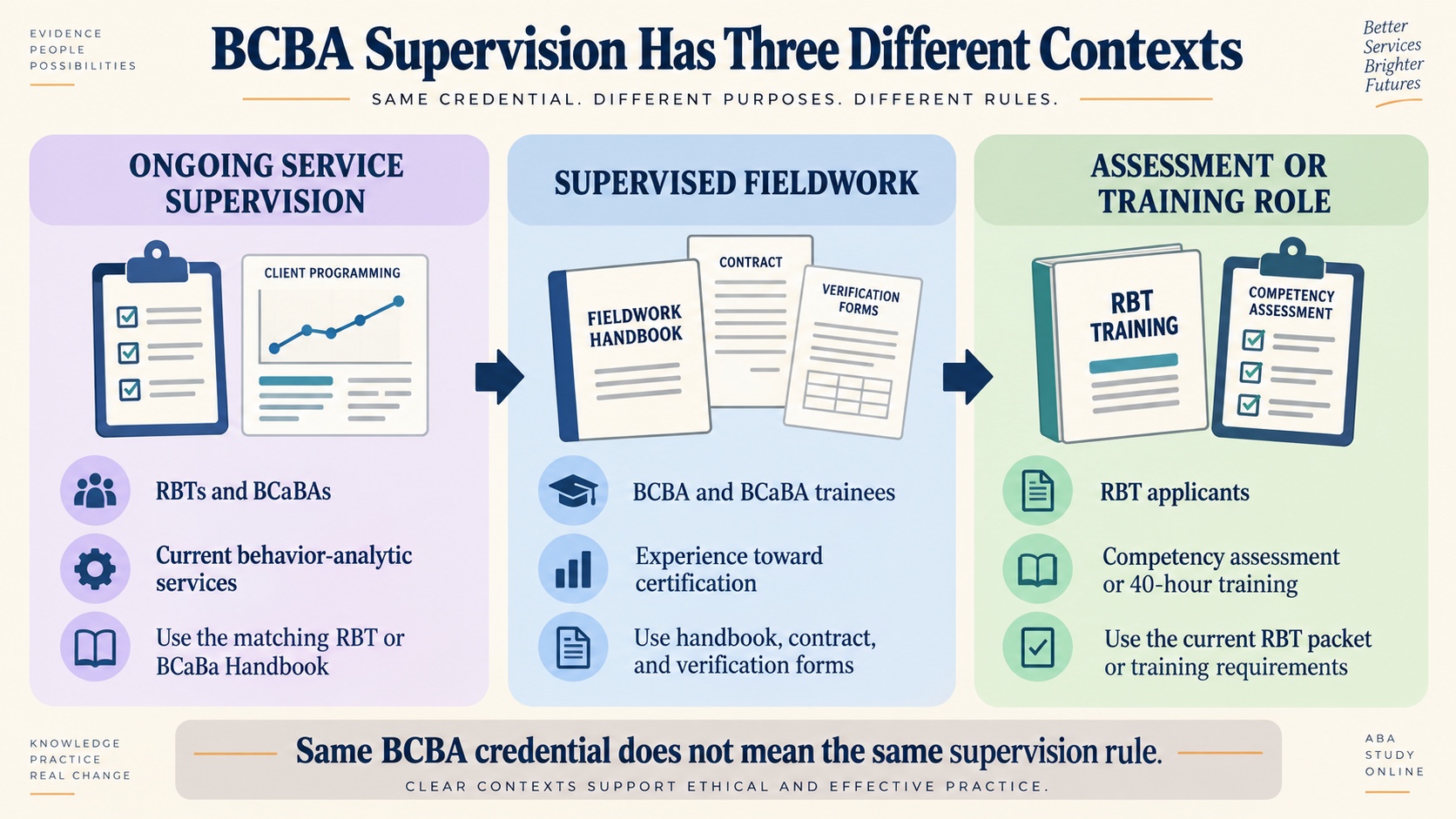
Start by sorting the relationship into one of these contexts:
| Context | Who receives supervision? | Main source to check |
|---|---|---|
| Ongoing service supervision | Current RBTs or BCaBAs providing behavior-analytic services | RBT or BCaBA Handbook, supervision resources, and workplace/client requirements |
| Supervised fieldwork | BCBA or BCaBA trainees accruing experience toward certification | BCBA or BCaBA Handbook, supervision contract, and fieldwork verification forms |
| Assessment or training role | RBT applicants completing competency assessment or 40-hour training | RBT packet and RBT training requirements; this is not the same as monthly service supervision |
The same BCBA may hold more than one role, but a credential alone does not make every role automatic. The supervisor must meet the qualifications, training, relationship, documentation, and ongoing-maintenance requirements that apply to the particular work.
Supervising ongoing services
Ongoing service supervision concerns people who are already providing behavior-analytic services under a supervision requirement. The BACB’s supervision page identifies BCBA supervision of RBTs and BCaBAs as a distinct role and points readers to the ongoing-supervision section of the relevant handbook.
For an RBT, supervision is connected to the RBT’s work and the RBT Supervisor or RBT Requirements Coordinator’s responsibility for that work. For a BCaBA, behavior-analytic services are provided under the supervision of a BCBA or another supervisor permitted by the current requirements. In both cases, “supervision” should mean more than a generic check-in: the supervisor needs enough knowledge of the work and client programming to evaluate performance, give useful feedback, and protect service quality.
Do not copy the supervision percentage from an old blog post or from a different credential. The exact ongoing-supervision rules, required contacts, documentation, and maintenance obligations belong to the current RBT or BCaBA Handbook. The user’s state, payer, employer, and client-service requirements may add obligations as well.
Supervising BCBA or BCaBA fieldwork
Fieldwork supervision is for a trainee who is accumulating experience toward certification. It is not the same as supervising a certified RBT’s ongoing services. The trainee’s fieldwork must be tied to behavior-analytic work, client programming, observation, feedback, and documentation that can support the relevant monthly and final verification forms.
The current BCBA Handbook describes supervisor qualifications for fieldwork. A supervisor may be an active BCBA with no current disciplinary sanctions, certified for at least one year, and meeting the ongoing supervision continuing-education requirement. A BCBA certified for less than one year may qualify when the other requirements are met and the BCBA receives monthly consultation from a qualified consulting supervisor.
Fieldwork can be organized with one supervisor or, when the rules permit, multiple supervisors or settings. That does not mean the trainee can collect disconnected hours and ask someone to sign at the end. The supervision contract, client relationship, observation, activity classification, and verification forms need to tell one coherent story about how the fieldwork was supervised.
Supervisor qualifications and 8-hour training
The BACB’s Supervisor Training Curriculum Outline (2.0) identifies 8-hour supervision training as a prerequisite for supervisors who oversee BCBA or BCaBA fieldwork trainees and current BCaBA or RBT certificants who require ongoing supervision. The training must be completed before providing the covered supervision.
Beginning January 1, 2026, the official curriculum states that the 8-hour supervision training may only be offered by ACE Providers. That is a training-provider rule, not a claim that completing the course alone makes someone qualified for every supervision role. The supervisor still needs the credential, experience or consultation status, current maintenance requirements, relationship to the work and clients, and documentation required by the relevant handbook.
Before a supervision relationship begins, a supervisee or trainee can reasonably ask:
- Which credential and role is this supervision for?
- Has the supervisor completed the required 8-hour supervision training?
- Does the supervisor meet the current handbook’s qualification and maintenance rules?
- What is the supervision contract or written agreement?
- How will client observation, feedback, records, and verification be handled?
- Which version of the handbook and forms applies to the application or certification cycle?
The 2027 BCBA fieldwork snapshot
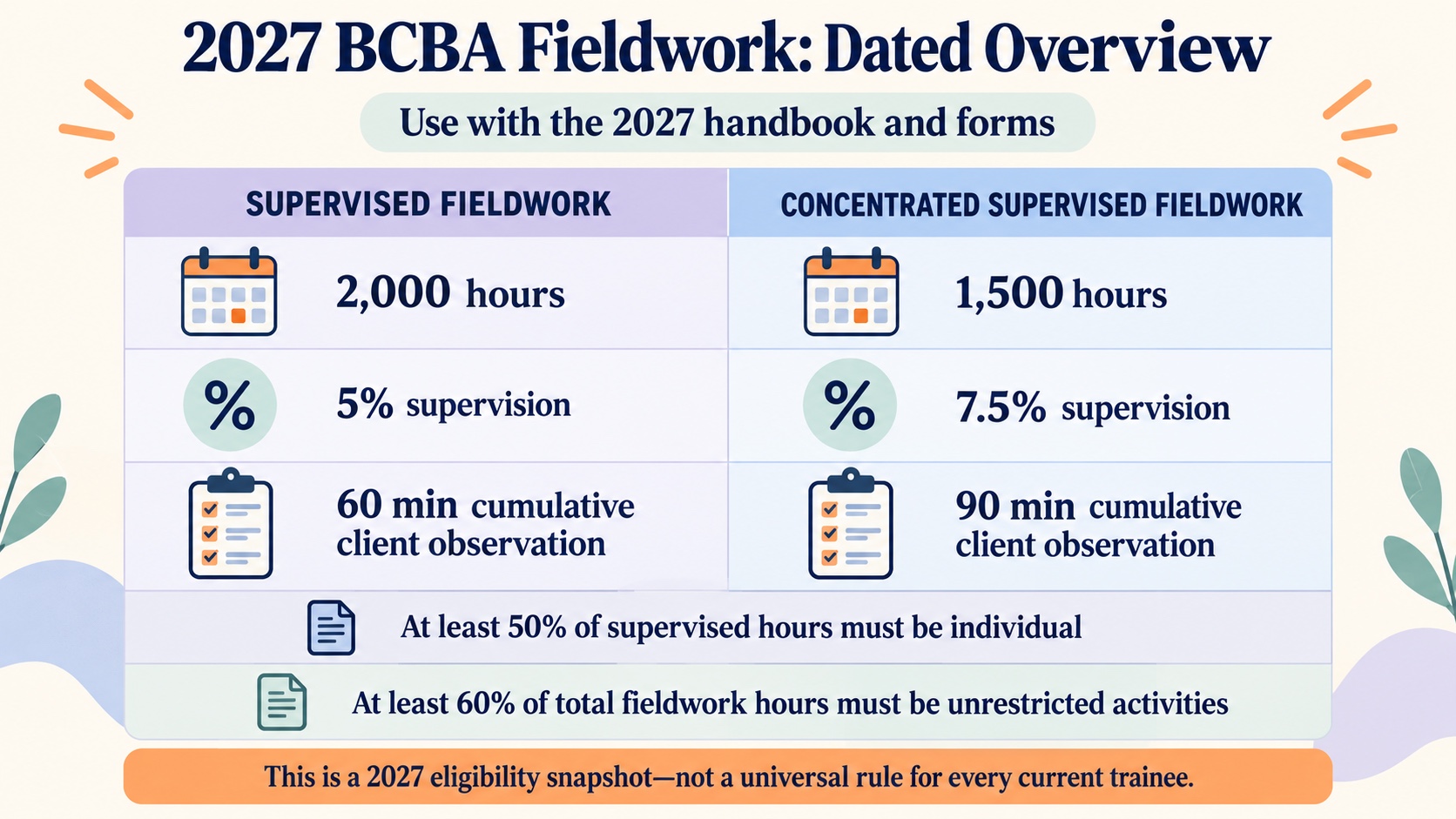
The BACB’s 2027 BCBA Requirements page gives a future-eligibility overview for applicants whose requirements are governed by the 2027 rules. It lists two fieldwork types: Supervised Fieldwork with 2,000 hours and Concentrated Supervised Fieldwork with 1,500 hours.
For that 2027 overview, supervision is 5% of hours for Supervised Fieldwork and 7.5% for Concentrated Supervised Fieldwork. Each supervisory period contains a minimum of 20 and a maximum of 160 fieldwork hours. Client observation is 60 cumulative minutes for Supervised Fieldwork and 90 cumulative minutes for Concentrated Supervised Fieldwork. At least 50% of supervised hours must be individual, and at least 60% of total supervised fieldwork hours must be unrestricted activities.
These numbers are useful only when the date and fieldwork type stay attached to them. They are not a shortcut for interpreting a current trainee’s contract, and they do not replace the complete 2027 handbook. The BACB also notes that applicants after January 1, 2027 will use the applicable 2027 monthly and final fieldwork forms. If your application crosses the transition, confirm the correct guidance before counting hours.
Documentation and ethical quality
Good supervision leaves evidence of a real supervisory relationship. Depending on the role, that evidence can include a contract, supervision notes, direct observations, feedback, monthly verification forms, final verification forms, activity records, and audit documentation. A signature is not a substitute for supervision that actually evaluates the trainee’s or supervisee’s work.
The supervisor also has to respect client dignity, confidentiality, scope of competence, and the limits of the supervision relationship. If a supervisor cannot observe or understand the relevant client programming, the arrangement may not support the quality or documentation the handbook expects. State licensure and employer policies can add another layer, so BACB supervision should not be treated as the only rule in the room.
Use a source-first supervision check
A practical way to prevent confusion is to write the supervision question in one sentence before opening a form. For example: “I am a BCBA supervising a trainee under the 2027 fieldwork requirements,” or “I am supervising a current RBT under the ongoing-supervision rules.” That sentence identifies the person, purpose, and governing date. From there, choose the matching handbook, confirm the supervisor’s qualification, and record how observation and feedback will occur.
This small check also helps when a workplace uses one word—“supervision”—for several activities. A staff meeting, a clinical case consultation, a competency assessment, and a fieldwork observation may all be valuable, but they do not automatically satisfy the same BACB requirement. Labeling the activity before documenting it makes later review clearer for the trainee, the supervisor, the organization, and any auditor.
Common mistakes
- Using “BCBA supervision” as one universal checklist: first identify RBT, BCaBA, trainee, assessment, or training context.
- Confusing fieldwork supervision with ongoing service supervision: they have different purposes and source documents.
- Treating the 8-hour course as the entire qualification: credentials, maintenance, consultation, client relationship, and documentation still matter.
- Copying 2027 numbers into a current contract without checking dates: attach every percentage and form to the correct eligibility version.
- Counting meetings instead of evaluating work: supervision quality depends on observation, feedback, and client-related programming, not only calendar time.
FAQ
Can a BCBA supervise RBTs and BCaBAs?
A BCBA may serve in those supervision roles when the relevant BACB requirements, training, maintenance rules, relationship requirements, and state or employer rules are met. The current handbook for the person being supervised controls the details.
Can a BCBA supervise a BCBA trainee?
Yes, a qualified BCBA may supervise fieldwork for a BCBA trainee. The supervisor must meet the current fieldwork-supervisor requirements, including credential status, sanctions and maintenance boundaries, 8-hour supervision training, and any consultation requirement for a newer BCBA.
Is the 8-hour supervision training the same as BCBA certification?
No. It is a supervision-training requirement for covered roles. It does not replace BCBA certification, the relevant handbook, a supervision contract, or ongoing professional obligations.
Do the 2027 fieldwork percentages apply to everyone now?
No. The percentages and hours in this article are labeled as the 2027 BCBA eligibility overview. Your governing requirements depend on your application and transition status. Use the current BACB handbook and forms for your situation.
Where should I verify a supervisor?
Start with the BACB Certificant Registry and the current BCBA or BCaBA Handbook. Confirm the supervisor’s credential, supervision-training status, and willingness to meet the documentation and client-related requirements before signing an agreement.