BCBA Supervision Requirements: Fieldwork Rules and the 2027 Transition
If you are searching for BCBA supervision requirements, you may be trying to answer several questions at once: How many fieldwork hours are required? How often must supervision occur? What does a qualified supervisor need to do? Which rules apply now, and what changes on January 1, 2027? The short answer is that BCBA fieldwork is not just a running total of hours. It is a structured arrangement with supervisor qualifications, contacts, observation, activity requirements, documentation, and verification.
This guide uses “supervision requirements” to mean supervised fieldwork for a BCBA applicant. It is not a guide to supervising RBTs or BCaBAs, maintaining an existing BCBA credential, or making an individual eligibility decision. BACB rules can change, and your application pathway may affect which transition provisions apply. Use the current BCBA Handbook, the 2027 BCBA Requirements page, and written guidance from BACB when your situation needs a definitive answer.
Table of Contents
What BCBA supervision requirements cover
BCBA fieldwork supervision connects your practical behavior-analytic work to the experience requirements for the certification pathway. The arrangement should make it possible for a supervisor to evaluate your work, provide feedback, observe relevant practice, and verify that the hours and activities were completed under the applicable rules. A spreadsheet that contains only a monthly number of hours does not demonstrate all of those pieces.
The current pathway described in the BACB Handbook includes a choice between 2,000 hours of supervised fieldwork and 1,500 hours of concentrated supervised fieldwork. The concentrated option has a higher supervision percentage. The number of hours is only one part of the plan: you also need an eligible supervisor, an appropriate supervision arrangement, qualifying activities, the required contact pattern, and complete records.
Start by identifying which pathway and eligibility rules apply to you. Then write down the date on which you expect to complete fieldwork and whether your application will be submitted under the current rules or the 2027 requirements. The BACB’s Upcoming Changes information explains the timing of major changes. Do not assume that beginning fieldwork automatically locks every future requirement to the rules in effect on your start date.
How to confirm supervisor qualifications
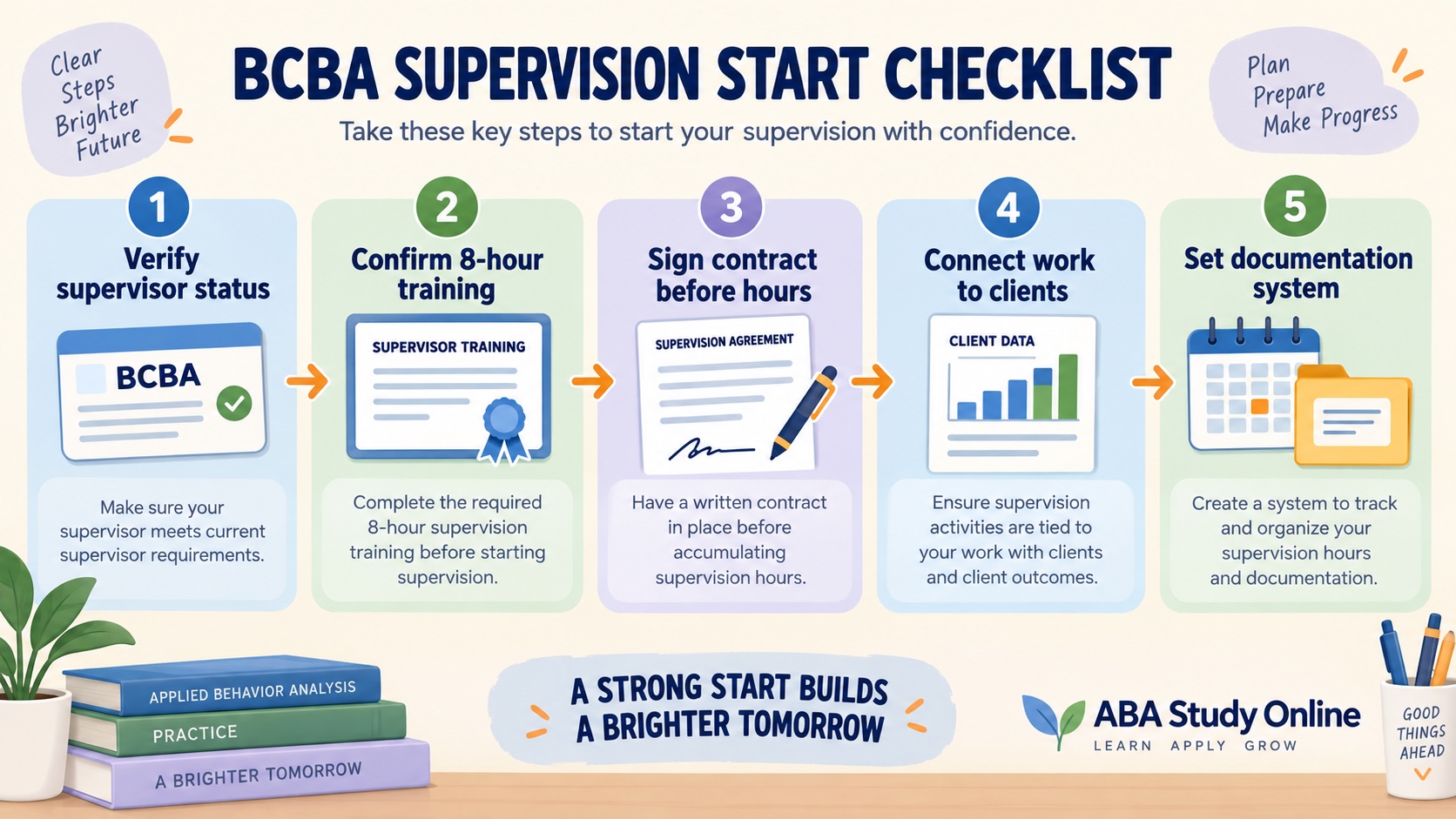
A supervisor should be checked before the arrangement begins, not after several months of hours have accumulated. The current Handbook describes supervisor eligibility requirements, including an active BCBA certification and the absence of current disciplinary sanctions. It also describes experience and consultation routes for supervisors, along with the required supervision training. A person who is knowledgeable about ABA is not automatically an eligible BCBA fieldwork supervisor.
Ask the prospective supervisor to identify the certification status and the route through which they meet the current supervision qualifications. Confirm that the person has completed the required 8-hour supervision training or otherwise meets the applicable BACB rule for the arrangement. If the supervisor is using a newer-supervisor consultation route, document the consulting-supervisor relationship and the monthly consultation expectations rather than treating them as informal details.
The supervision relationship also needs professional boundaries. The Handbook addresses conflicts, multiple relationships, contracts, and the responsibilities of both parties. A written agreement should state who supervises you, where fieldwork occurs, how contacts and observations will be scheduled, what happens when a session is cancelled, how feedback is delivered, how records are corrected, and how the arrangement ends. A contract does not override BACB requirements, but it makes the practical responsibilities visible.
It is useful to keep three documents separate: the supervision contract, the fieldwork tracker, and the monthly verification form. The contract defines the relationship. The tracker is a working record that helps you monitor hours, activity type, contacts, observations, and percentages. The verification form is the formal monthly record signed by the trainee and supervisor. Combining everything into one informal note makes later review harder.
Current requirements versus the 2027 transition
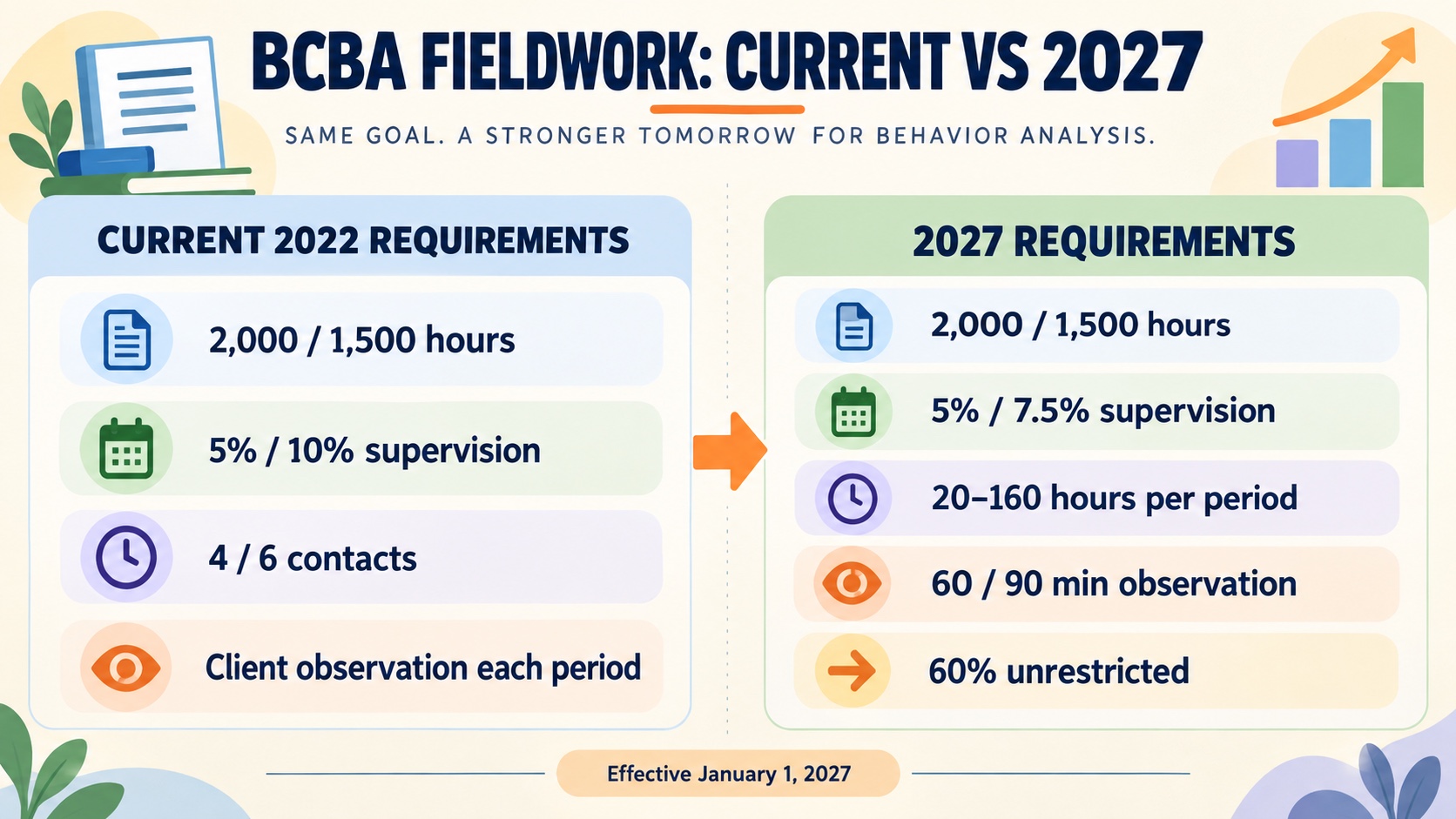
As of 2026, the current Handbook presents the 2022 requirements for fieldwork. BACB’s 2027 requirements page describes changes effective January 1, 2027. The most important planning rule is to label every checklist and tracker with its time period. “The BCBA requirements” is too vague when the requirements are changing.
| Topic | Current 2022 requirements | 2027 requirements |
|---|---|---|
| Fieldwork option | 2,000 supervised hours or 1,500 concentrated supervised hours | 2,000 supervised hours or 1,500 concentrated supervised hours |
| Supervision percentage | 5% supervised fieldwork or 10% concentrated fieldwork | 5% supervised fieldwork or 7.5% concentrated fieldwork |
| Hours per supervisory period | Use the current Handbook and applicable fieldwork rules when planning the period | 20–160 fieldwork hours per supervisory period |
| Client observation | Observation with a client is required each supervisory period under the current structure | At least 60 minutes for supervised fieldwork or 90 minutes for concentrated fieldwork, cumulatively per period |
| Unrestricted activities | Plan qualifying unrestricted activities and document them under the current rules | At least 60% of fieldwork hours must be unrestricted activities |
| Individual supervision | At least 50% of supervision contacts must be individual | At least 50% of supervision must be individual |
This comparison is a planning summary, not a replacement for the official documents. One especially important difference is the 2027 supervisory-period range: the 2027 requirements specify a minimum of 20 and a maximum of 160 fieldwork hours per period. The change in the concentrated supervision percentage also means that a tracker built for 10% should not be carried forward without checking the transition rules. Review the official language before deciding which set applies to your application.
There is also a timing issue. The BACB has published transition information for people who are close to the change date. A candidate may need to complete an application by a stated deadline to be evaluated under current requirements. That is different from simply having started fieldwork before the deadline. Keep a copy of any official transition instruction you rely on, and ask BACB if your completion date, application date, or pathway creates uncertainty.
Supervision structure and monthly contact
Supervision should be regular enough to support feedback while the work is still fresh. Under the current structure, the Handbook describes minimum contacts for each supervisory period, individual and group supervision expectations, observation, and limits on group supervision. The supervisor should be able to review your work directly, not only receive a summary at the end of a month.
Use a recurring monthly agenda. First, review the hours and activity categories. Next, review one or more client-related examples, data displays, assessment or intervention decisions, and ethical or professional questions. Then complete direct observation or review the observation record, identify feedback, and agree on one or two specific practice goals. Finally, check the documentation before both parties sign. This sequence turns supervision into a feedback loop rather than a signature appointment.
At least half of the supervision should be individual under the current and 2027 summaries. Group supervision can be useful for discussion and perspective, but it does not replace individual feedback. Keep the group size, participants, subject, and supervisor record clear. If the supervision includes video, make sure the recording and review are consistent with client consent, privacy, and the applicable professional and organizational policies.
Fieldwork activities should also be described precisely. “Worked with client” is not enough to show whether an hour was unrestricted or restricted. A stronger entry briefly identifies the activity, the behavior-analytic decision or skill involved, the data or materials reviewed, and the supervisor feedback. Examples might include analyzing a data pattern, drafting a functional behavior assessment component, evaluating intervention fidelity, preparing caregiver-training materials, or reviewing a treatment decision with the supervisor. Only classify an activity as unrestricted when it meets the applicable BACB definition and your supervisor agrees with the classification.
Documentation and verification forms
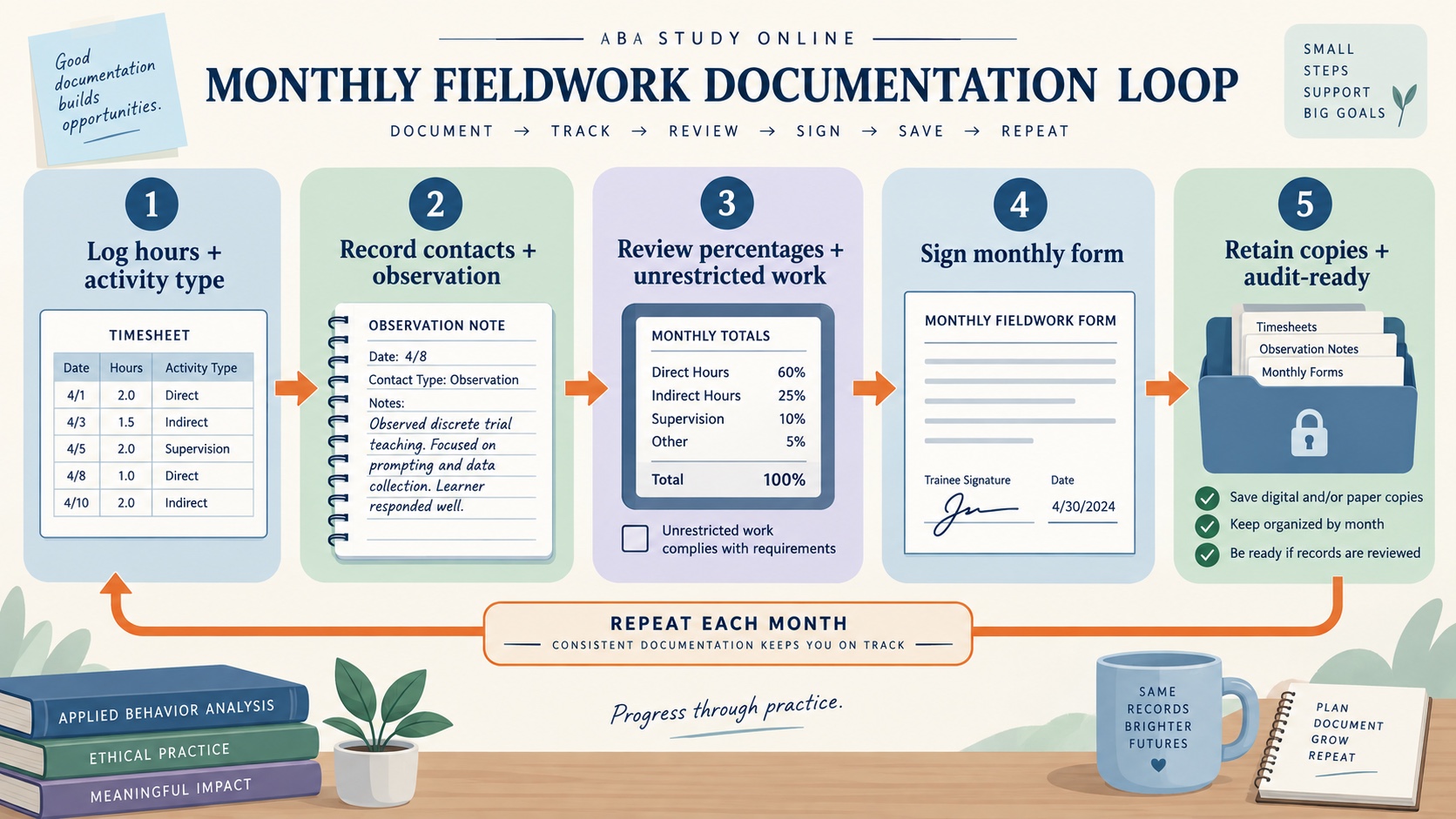
Documentation is part of the fieldwork requirement, not administrative decoration. The BACB’s recent fieldwork documentation guidance emphasizes that trainees and supervisors should maintain records and sign the monthly fieldwork verification forms by the required deadline. The BACB also states that records should be retained for the required period. Use the current forms and keep copies in a secure location that can be accessed if the application is audited.
A practical monthly record should let you answer these questions without reconstructing the month from memory:
- How many fieldwork hours were completed, and during which dates?
- Which hours were unrestricted, and what specific activities support that classification?
- How many individual and group contacts occurred?
- When did client observation occur, who observed it, and what feedback followed?
- What supervision percentage was reached for the period?
- Did both trainee and supervisor sign the correct form by the applicable deadline?
Do not silently edit a signed record when you find an error. Follow the correction process described by the current BACB materials and keep an audit trail. If a supervisor changes, preserve the records for the completed period and create a new agreement for the new relationship. If a month has missing signatures, missing observation, or unclear activity classifications, address it promptly while the people and calendar details are still available.
A practical planning checklist
Before the first fieldwork hour, create a one-page requirements sheet with the date it was checked. Include the pathway, target completion date, current or 2027 rule set, supervisor name and certification details, supervision percentage, expected contacts, observation plan, unrestricted-activity plan, form deadlines, and storage location. Add a link to the official source you used. This dated sheet helps you notice when an old template is being reused after a rule change.
Each month, compare the tracker with the official requirement summary and the signed form. Do not wait until the final month to calculate the percentage. A candidate can have enough total hours and still have a problem with supervision percentage, individual contact, observation, unrestricted work, or missing documentation. A simple green-yellow-red review can work: green means complete and signed; yellow means a correction is scheduled; red means the month should not be treated as complete until the issue is resolved.
For study support, separate certification concepts from fieldwork administration. You can review foundational terms in the ABA glossary, use the ABC data sheet tool to practice objective documentation, and explore the BCBA learning track or BCBA practice questions. These resources can support learning, but they do not replace supervisor feedback, official forms, or BACB eligibility decisions.
Common mistakes to prevent
Counting hours before the agreement is ready. Start with a written arrangement and confirm the supervisor’s qualifications. If the arrangement is unclear, the later spreadsheet cannot repair the missing foundation.
Using an old percentage. The current concentrated requirement and the 2027 concentrated requirement are not the same. Put the effective date beside every percentage in your tracker.
Calling every clinical hour unrestricted. Classification depends on the activity, not only on the setting or job title. Write enough detail for the supervisor to review the classification.
Leaving observation until the end of the period. Observation is easier to complete and document when it is scheduled in advance. A last-minute observation can fail because of cancellations, consent, or an unavailable supervisor.
Treating a signature as supervision. A signature verifies a record; it does not replace observation, feedback, contact, and discussion. Keep notes that show what was reviewed and what changed in your practice.
FAQ and official sources
Is BCBA supervision the same as BCBA maintenance supervision?
No. This article focuses on supervised fieldwork for a BCBA applicant. Ongoing professional development and maintenance of an existing credential are different topics with different requirements.
Do the 2027 rules change the total number of fieldwork hours?
The BACB’s 2027 summary keeps the 2,000-hour supervised option and the 1,500-hour concentrated option, while changing other planning details such as supervision percentage, supervisory-period limits, observation time, and unrestricted activity expectations. Read the official transition instructions before applying the summary to your case.
Can a tracker replace the BACB forms?
A tracker is a planning aid. It should help you monitor requirements, but it does not replace the current BACB forms, signatures, contracts, or records required by the applicable rules.
Where should I verify the rules?
Start with the BACB Supervision, Assessment, Training, and Oversight page, the current BCBA Handbook, the 2027 BCBA Requirements page, and BACB’s fieldwork documentation guidance. If your dates or pathway are unusual, ask BACB directly rather than relying on a general article.
Well-organized supervision protects the quality of your fieldwork and gives you a better learning experience. Treat the requirements as a living, dated system: verify the supervisor, plan the contacts and observation, classify activities carefully, review the monthly numbers, and preserve the signed record. When the 2027 transition is relevant, keep current and future rules visibly separate until the official transition guidance tells you which path applies.