
BCBA Supervision Hours: Fieldwork Totals, Percentages, and the 2027 Change
If you are searching for BCBA supervision hours, you may be asking how many hours you need, how much supervision must be attached to them, or whether the 2027 requirements change your plan. The clearest starting point is this: in a certification conversation, the phrase usually refers to supervised fieldwork hours for a BCBA applicant. It does not automatically mean continuing-education hours, ongoing supervision for an already-certified BCBA, or the monthly supervision requirements for an RBT.
This guide focuses on fieldwork toward BCBA certification. It summarizes the current 2022 requirements and the BACB’s 2027 overview, then turns the numbers into a monthly tracking routine. The BACB Handbook, transition guidance, and forms control your situation; this page cannot determine whether an individual hour will be accepted.
Table of Contents
What “BCBA supervision hours” usually means
The BACB uses supervised fieldwork as part of the experience route toward certification. A trainee applies behavior-analytic knowledge in a real setting while a qualified supervisor provides oversight, observes relevant work, gives feedback, and verifies the record. That makes supervision a training relationship as well as a compliance process.
It helps to separate four phrases that are often blended together:
| Phrase | What it usually describes | Why the distinction matters |
|---|---|---|
| BCBA fieldwork hours | Experience a trainee accrues toward BCBA certification | Uses the BCBA Handbook and fieldwork verification rules |
| BCBA supervision hours | Informal search language for the supervision attached to that fieldwork | The supervision percentage, contacts, observation, and records matter—not only the total |
| RBT or BCaBA supervision | Ongoing oversight of a current certificant providing services | Uses different role-specific handbook requirements |
| BCBA supervision CEUs | Continuing education or maintenance obligations for a certificant or supervisor | Does not replace supervised fieldwork toward initial certification |
If you meant the broad meaning of BCBA supervision across RBTs, BCaBAs, trainees, and the 8-hour supervision-training boundary, see the BCBA supervision overview. If you need the contract and supervisor-qualification checklist, use the BCBA supervision requirements guide. This page owns the hours-and-accounting question.
Current BCBA fieldwork hours at a glance
As of 2026, the current BCBA Handbook presents the 2022 fieldwork structure. A trainee may complete either 2,000 hours of Supervised Fieldwork or 1,500 hours of Concentrated Supervised Fieldwork. The concentrated option requires more supervision per period, which is why its total-hour target is lower.
| Current 2022 fieldwork rule | Supervised Fieldwork | Concentrated Supervised Fieldwork |
|---|---|---|
| Total hours | 2,000 | 1,500 |
| Supervisory period | One calendar month | One calendar month |
| Fieldwork hours per period | 20–130 | 20–130 |
| Supervisor contacts per period | 4 | 6 |
| Client observation per period | 1 observation | 1 observation |
| Supervision percentage | 5% of hours | 10% of hours |
| Individual supervision | At least 50% of supervised hours must be individual | |
| Unrestricted activities | At least 60% of overall supervised fieldwork | |
For a simple planning example, if a month contains 80 Supervised Fieldwork hours, 5% is 4 hours of supervision. If the same month is being counted as Concentrated Supervised Fieldwork, 10% is 8 hours. Those calculations do not, by themselves, prove that the month qualifies. The contacts, observation, individual-supervision proportion, activity classification, supervisor qualifications, contract, and signed form must also match the applicable rules.
The 20-hour minimum and 130-hour maximum are especially important. A trainee may be busy at a worksite but still have a month that needs review if the fieldwork hours fall outside the applicable range. Keep the calculation beside the calendar, not only in a final total at the end of the entire experience.
How supervised and concentrated fieldwork differ
Supervised Fieldwork and Concentrated Supervised Fieldwork are not two labels for the same month. Under the current structure, they have different total-hour targets, supervision percentages, and contact counts. If hours are combined across fieldwork types, the relevant requirements for the chosen type still need to be satisfied for that period and supervision structure.
The current Handbook explains that concentrated hours have approximately 1.33 times the temporal value of supervised hours when a trainee combines fieldwork types toward the overall requirement. In a planning example, 100 concentrated hours may be converted by the BACB’s process to approximately 133 hours of value when combined with supervised hours. That does not mean a trainee should edit the signed form or multiply numbers casually in a personal tracker. The official documentation system and BACB review process control how the conversion is handled.
One practical decision rule is: choose the fieldwork type before calculating the month’s percentage and contacts, then label the month clearly. Do not use the 5% supervised calculation for a concentrated month, and do not count six contacts as a substitute for the rest of the concentrated requirements. A good tracker has separate columns for fieldwork type, total hours, required percentage, actual supervision, contacts, observation, individual supervision, unrestricted activity, and signatures.
What changes for 2027 applicants
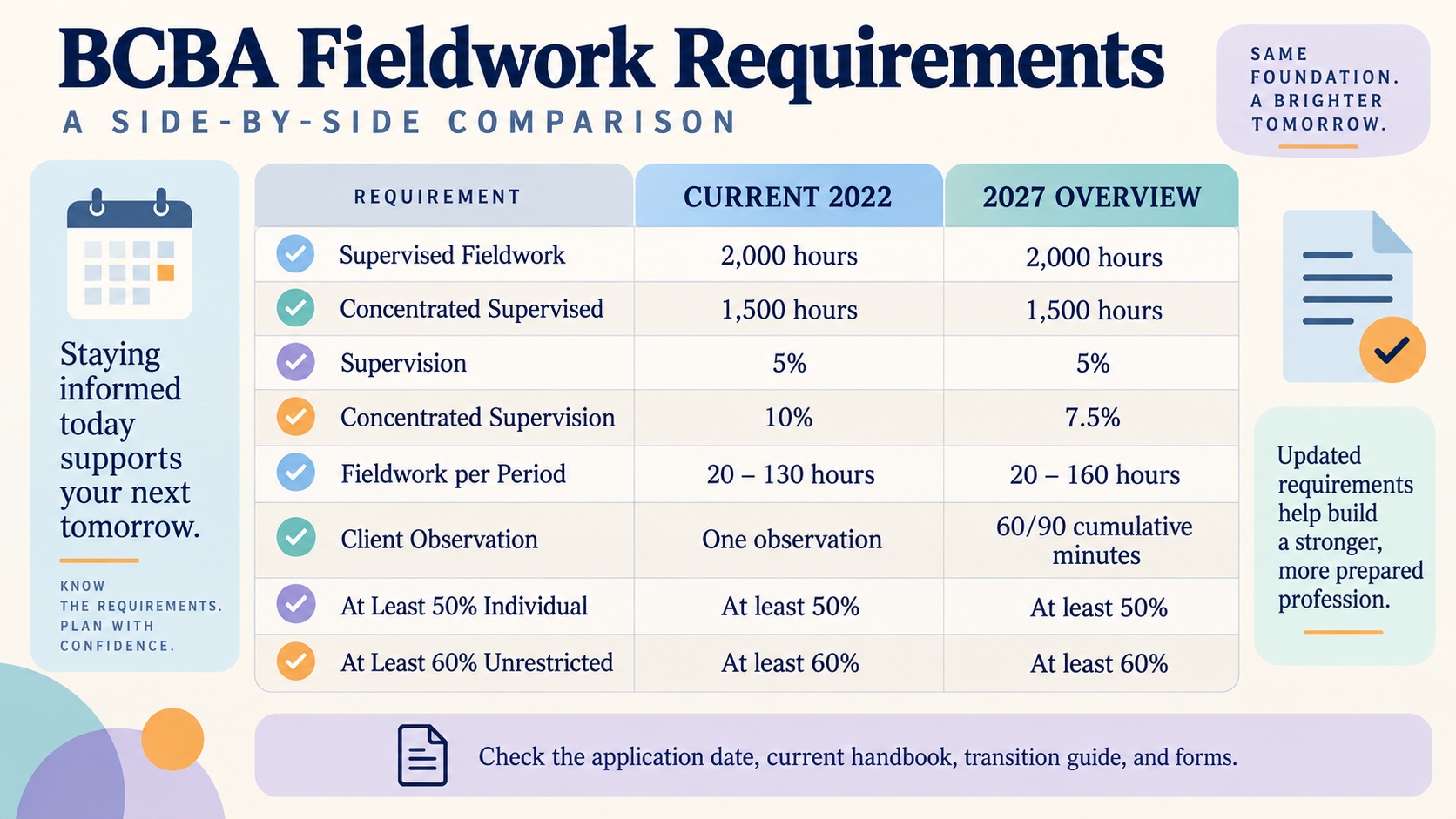
The BACB’s 2027 BCBA Requirements keep the 2,000-hour Supervised Fieldwork option and 1,500-hour Concentrated Supervised Fieldwork option, but they change several monthly planning details. The most visible change for concentrated fieldwork is the supervision percentage: the 2027 overview lists 7.5%, compared with 10% in the current 2022 structure.
| Topic | Current 2022 structure | 2027 overview |
|---|---|---|
| Supervised Fieldwork total | 2,000 hours | 2,000 hours |
| Concentrated total | 1,500 hours | 1,500 hours |
| Supervised / concentrated percentage | 5% / 10% | 5% / 7.5% |
| Fieldwork per period | 20–130 hours | 20–160 hours |
| Client observation | One observation per period | 60 / 90 cumulative minutes |
| Individual supervision | At least 50% | At least 50% |
| Unrestricted activities | At least 60% | At least 60% |
These are dated requirements, not a suggestion to rewrite an existing record. BACB’s transition guidance says that a complete application, including payment and required documents, received by December 31, 2026 can be reviewed under the current requirements. Applications on or after January 1, 2027 use the applicable 2027 requirements and forms. If your fieldwork and application cross the boundary, maintain a separate, clearly labeled record for each form version the official guidance requires.
The 2027 change is also why the answer to “How many BCBA supervision hours do I need?” cannot be only one number. A complete answer includes the total fieldwork type, the date that governs the application, the monthly range, the supervision percentage, and the observation and documentation requirements. Check the current BACB transition guide before relying on a general summary.
How to track hours during each supervisory period
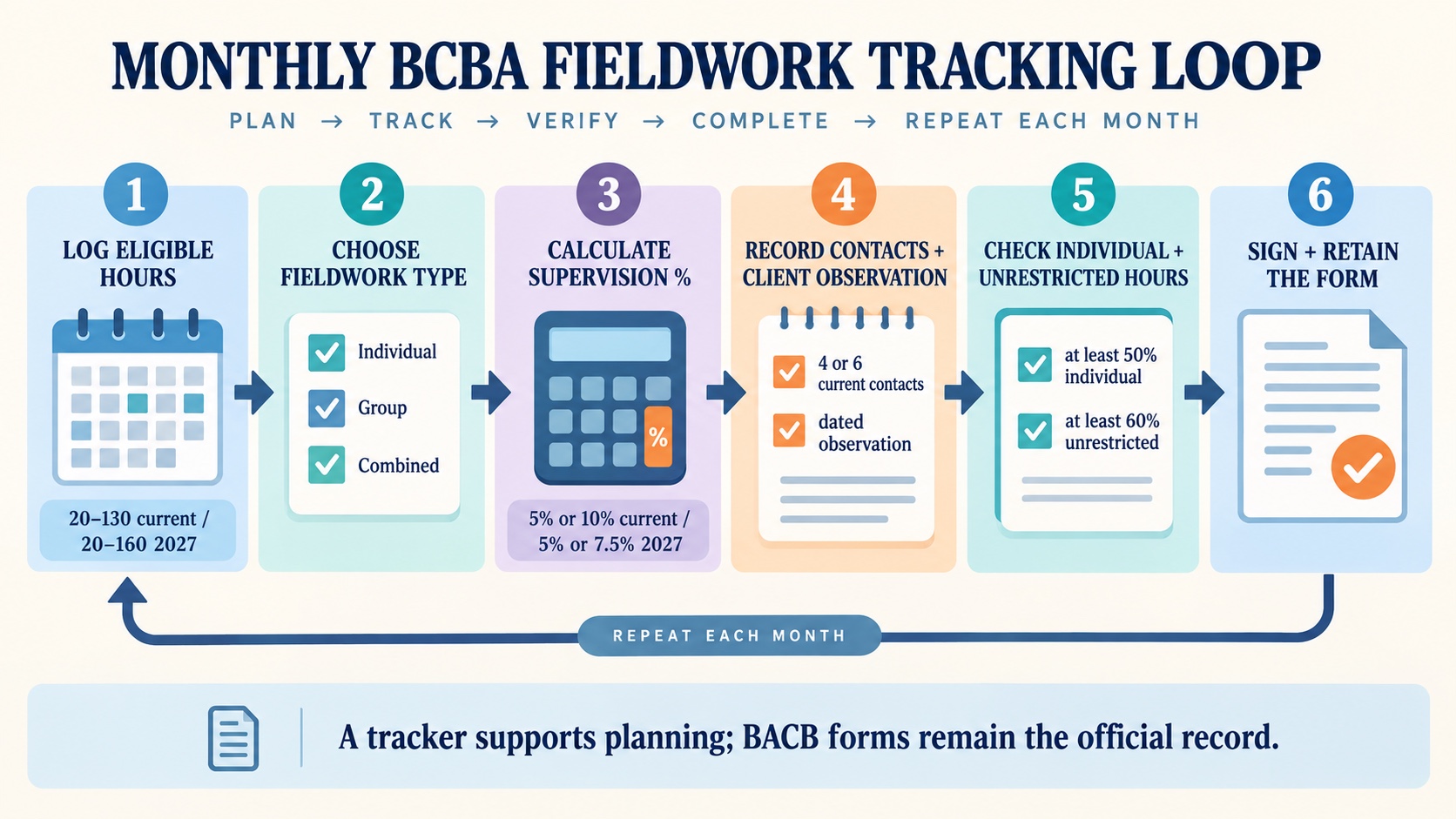
A monthly tracker should help you find a problem while the month is still easy to reconstruct. It should not replace the BACB’s official monthly or final verification forms. Start with the governing version and fieldwork type at the top of the month, then use the following sequence:
- Log the fieldwork hours. Record the dates, setting, activity, and total hours. Keep work that is not behavior-analytic or not approved for fieldwork out of the qualifying total.
- Calculate the required supervision. Multiply the month’s eligible fieldwork hours by 5%, 10%, or the applicable 2027 percentage. Write the formula and the result, rather than recording only “met.”
- Record contacts and observation. Track each supervisor contact, whether it was individual or group, and the client observation with its date and feedback. A last-day appointment is risky if a client, supervisor, or consent requirement changes.
- Classify unrestricted activities. Describe the behavior-analytic decision or skill involved. “Worked a shift” is not enough to show why an activity is unrestricted. Ask the supervisor to review uncertain classifications before the record is signed.
- Check individual supervision and signatures. Compare the individual-supervision proportion with the governing rule, review missing fields, and have the trainee and supervisor complete the applicable form on time.
- Retain the record securely. Keep the contract, tracker, signed verification form, observation notes, and any correction history together. Use privacy-protective storage and follow the current BACB retention and correction guidance.
For a quality supervision relationship, the meeting should do more than confirm arithmetic. The behavior-analytic supervision literature emphasizes structured goals, competence evaluation, feedback, and a clear supervisory relationship. Review one data pattern, case decision, assessment or intervention component, or professional question each period. Then record what feedback was given and what the trainee will practice next. This creates evidence of learning as well as a cleaner fieldwork record.
Common mistakes with BCBA supervision hours
Counting only the grand total. A trainee can reach a large number of hours while missing the percentage, contact, observation, unrestricted, or signature requirement for a particular period.
Using a 2027 number in a current checklist. The 2027 concentrated percentage and monthly maximum are different from the current 2022 values. Put the effective date beside every formula.
Calling all supervised work unrestricted. Unrestricted status depends on the activity and its behavior-analytic relevance, not simply on a job title, clinic, or client population. Describe the activity so the supervisor can evaluate it.
Confusing ongoing supervision with fieldwork. RBT and BCaBA supervision systems have their own purpose and handbook. A recurring service-supervision meeting does not automatically become BCBA fieldwork supervision.
Letting an app or spreadsheet replace the official record. A digital tracker can support organization and error checking. It cannot replace a qualified supervisor, a contract, required observation and feedback, or BACB verification forms.
FAQ and official sources
How many hours are required for BCBA fieldwork?
The current and 2027 BACB overviews list 2,000 hours of Supervised Fieldwork or 1,500 hours of Concentrated Supervised Fieldwork. The applicable requirements also include monthly limits, supervision, contacts, observation, activity classification, and documentation.
What is the current supervision percentage?
For the current 2022 structure, the overview lists 5% for Supervised Fieldwork and 10% for Concentrated Supervised Fieldwork. The 2027 overview lists 5% and 7.5%, respectively. Confirm which version governs your application before calculating.
Are BCBA supervision hours the same as CEUs?
No. Fieldwork hours are supervised experience toward initial certification. CEUs are continuing-education units connected to maintenance or other professional requirements. They should not be combined in one total.
Can I use a fieldwork tracker instead of BACB forms?
Use a tracker as a planning aid, but complete and retain the applicable BACB monthly and final verification forms. The current Handbook and transition guidance determine which version is required.
Where should I verify the rules?
Start with the BACB BCBA Handbook, the 2027 BCBA Requirements page, the Supervision, Assessment, Training, and Oversight page, and the fieldwork documentation guidance. If your application date or pathway is unusual, ask BACB rather than relying on a general article.
Good fieldwork planning keeps the number, the rule version, and the evidence together. Identify the fieldwork type, calculate the correct percentage, schedule contacts and observation, describe unrestricted activities, and review the signed record every month. That routine makes the hours more useful for learning and makes the transition to 2027 easier to check.