BCBA Study Guide: Current 6th Edition Exam Plan
A BCBA study guide should help you make decisions, not simply give you a longer glossary. Start with the current BCBA Test Content Outline (6th ed.), map its nine domains, and then practice explaining why a measurement, assessment, intervention, or supervision choice fits the evidence in a scenario.
This guide also keeps two questions separate: “What can appear on the examination?” and “What do I need to qualify for certification?” The current outline answers the first. The current BCBA Handbook, including its separate 2027 eligibility material, answers the second. This is independent educational material, not official BACB examination content or a pass guarantee.
Quick answer: Use the current BCBA Test Content Outline (6th ed.) as your exam-content map, the BCBA Handbook for eligibility and testing rules, the Ethics Code for professional responsibilities, and your training materials for depth. The current examination has 175 scored questions plus 10 unscored pilot questions, or 185 total, with four hours to complete it. Study by domain, then mix domains so you practice identifying the evidence before selecting a decision.
Do not use “2027” as a substitute for the exam edition: 2027 eligibility requirements concern how a person may qualify for certification. They do not automatically mean that the current BCBA examination outline has become a 7th edition. Check the current BACB TCO and Handbook separately whenever a date, pathway, coursework, fieldwork, or authorization question matters.
What a current BCBA study guide should cover
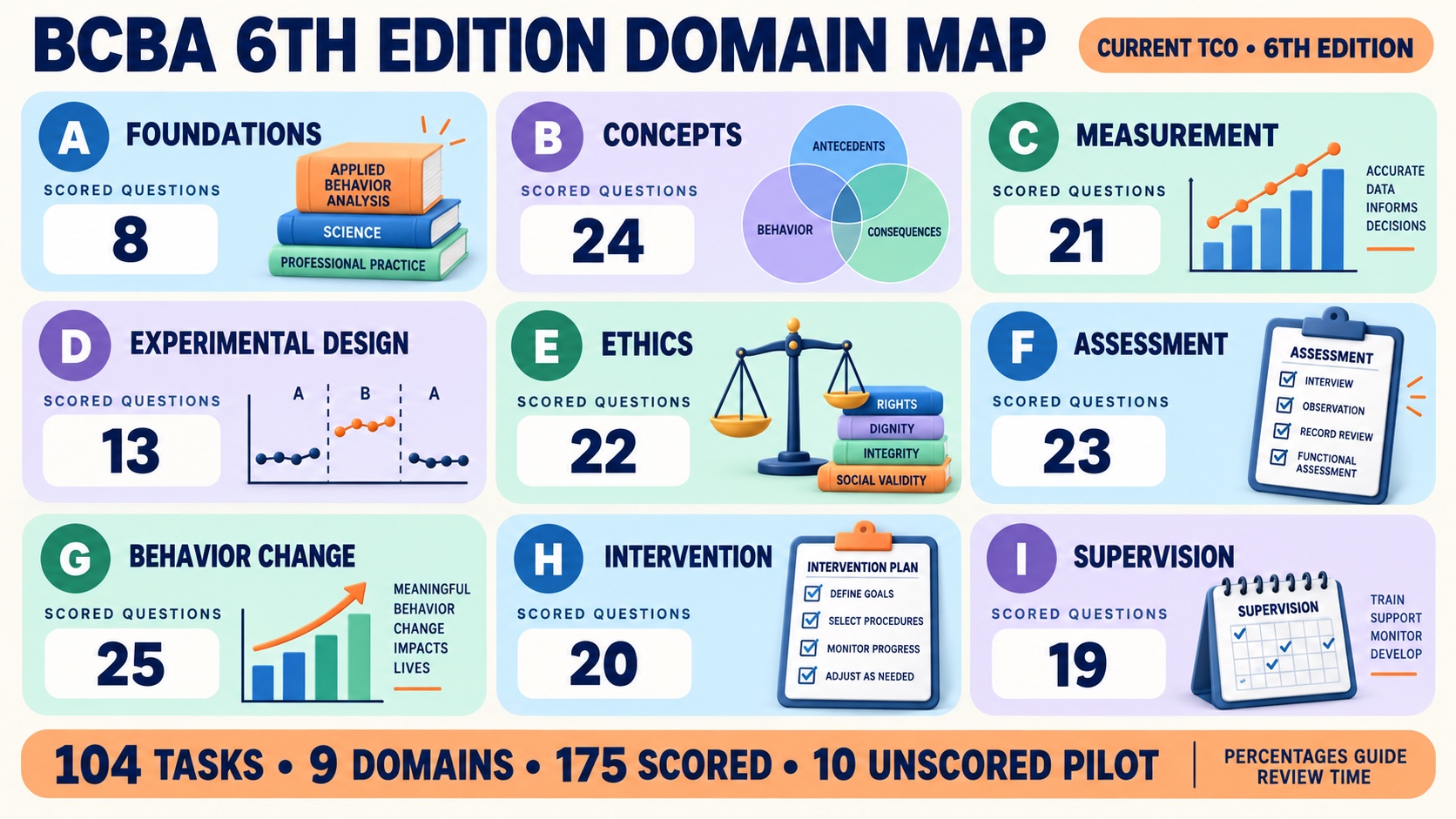
The BCBA Test Content Outline (6th ed.) describes entry-level knowledge and skills represented on the examination beginning in 2025. It contains 104 tasks organized into nine content areas. The current Handbook says the examination uses four answer choices with one correct answer, gives candidates four hours, and includes 175 scored questions plus 10 unscored questions.
A useful guide therefore has four layers:
- Source map: the current TCO, Handbook, Ethics Code, and training materials.
- Concept map: definitions, comparisons, data patterns, procedures, and professional boundaries.
- Application: original scenarios that ask what to do next and why.
- Feedback loop: a rationale and error log that changes the next practice session.
A study guide cannot tell you the exact wording of future questions. It should make the reasoning visible enough that you can explain why an answer fits the data, goals, context, ethics, and role responsibilities better than the alternatives.
The nine BCBA study domains
The official outline assigns rounded shares to each content area. Use them as a review-allocation signal rather than a prediction of question order or difficulty.
Foundations, concepts, and evidence: A–C
A. Behaviorism and Philosophical Foundations — 8 questions, 5%: Review the goals and assumptions of behavior analysis, radical behaviorism, distinctions among behaviorism, experimental analysis, applied behavior analysis, and professional practice, plus the dimensions of ABA. Practice explaining how a philosophical assumption changes what counts as useful evidence.
B. Concepts and Principles — 24 questions, 14%: Build comparison sets for response classes, stimulus classes, conditioning, reinforcement and punishment, schedules, extinction, stimulus control, generalization, motivating operations, verbal operants, emergent relations, behavioral momentum, matching, imitation, and observational learning. The exam target is discrimination inside a case, not a dictionary recital.
C. Measurement, Data Display, and Interpretation — 21 questions, 12%: Match a measurement system to the dimension of behavior, inspect data quality, and interpret level, trend, variability, and other display features cautiously. Ask whether a change could reflect a measurement or implementation problem before attributing it to an intervention.
Design, ethics, and assessment: D–F
D. Experimental Design — 13 questions, 7%: Study single-case designs, functional relations, replication, validity, threats, and ethical costs. Write what changes, what stays comparable, what is measured, and which alternative explanation the design helps address.
E. Ethical and Professional Issues — 22 questions, 13%: Use the current Ethics Code for Behavior Analysts with the Handbook. Practice consent, confidentiality, competence, cultural responsiveness, documentation, public statements, scope, supervision, and transitions. Ethics should change the decision, not sit in a separate vocabulary folder.
F. Behavior Assessment — 23 questions, 13%: Practice selecting and interpreting record review, descriptive assessment, skill assessment, preference assessment, and functional analysis according to the question. Separate observation, hypothesis, and conclusion; match the strength of your claim to the evidence available.
Change, intervention, and supervision: G–I
G. Behavior-Change Procedures — 25 questions, 14%: Review reinforcement, punishment, extinction, prompting and fading, shaping, chaining, discrimination training, token systems, generalization, maintenance, and verbal behavior procedures. Explain the contingency, target, learner experience, integrity check, and possible side effects.
H. Selecting and Implementing Interventions — 20 questions, 11%: Connect assessment results to socially significant goals, contextual fit, stakeholder collaboration, treatment integrity, effectiveness, generalization, and maintenance. A familiar procedure is not automatically the best procedure for a particular person and setting.
I. Personnel Supervision and Management — 19 questions, 11%: Study performance assessment, training, feedback, supervision, documentation, equity, organizational systems, and outcome monitoring. Practice deciding what support a staff member needs and what evidence will show whether the support changed performance.
A 12-week BCBA study routine
Twelve weeks is a planning example, not a BACB requirement. Adjust the pace to your training, fieldwork, examination authorization, and available study time.
- Weeks 1–2 — Build the map: read the current TCO, create nine domain headings, and mark task verbs such as identify, distinguish, explain, interpret, select, implement, and evaluate.
- Weeks 3–5 — Build fluency: work through foundations, concepts, measurement, and experimental design with short comparisons, graphs, and worked examples.
- Weeks 6–8 — Connect decisions: study ethics, assessment, behavior-change procedures, and intervention selection through applied scenarios rather than isolated definitions.
- Weeks 9–10 — Add supervision: review personnel supervision and management, then revisit domains where the error log shows repeated uncertainty.
- Week 11 — Interleave: mix domains in one session so you must identify the relevant concept before choosing an answer.
- Week 12 — Simulate and repair: use timed mixed practice, review every uncertain item, and create a final list of comparisons, source checks, and pacing decisions.
Use a repeatable session: recall yesterday’s material, learn or clarify one target, answer a small set of applied questions, explain the rationale, and schedule the weak items for later retrieval. The BCBA study path can hold the theory step, free BCBA questions can hold the practice step, and the ABA Study Online app is planned for flashcards, section practice, audio review, progress, and tools.
How to practice application and rationale
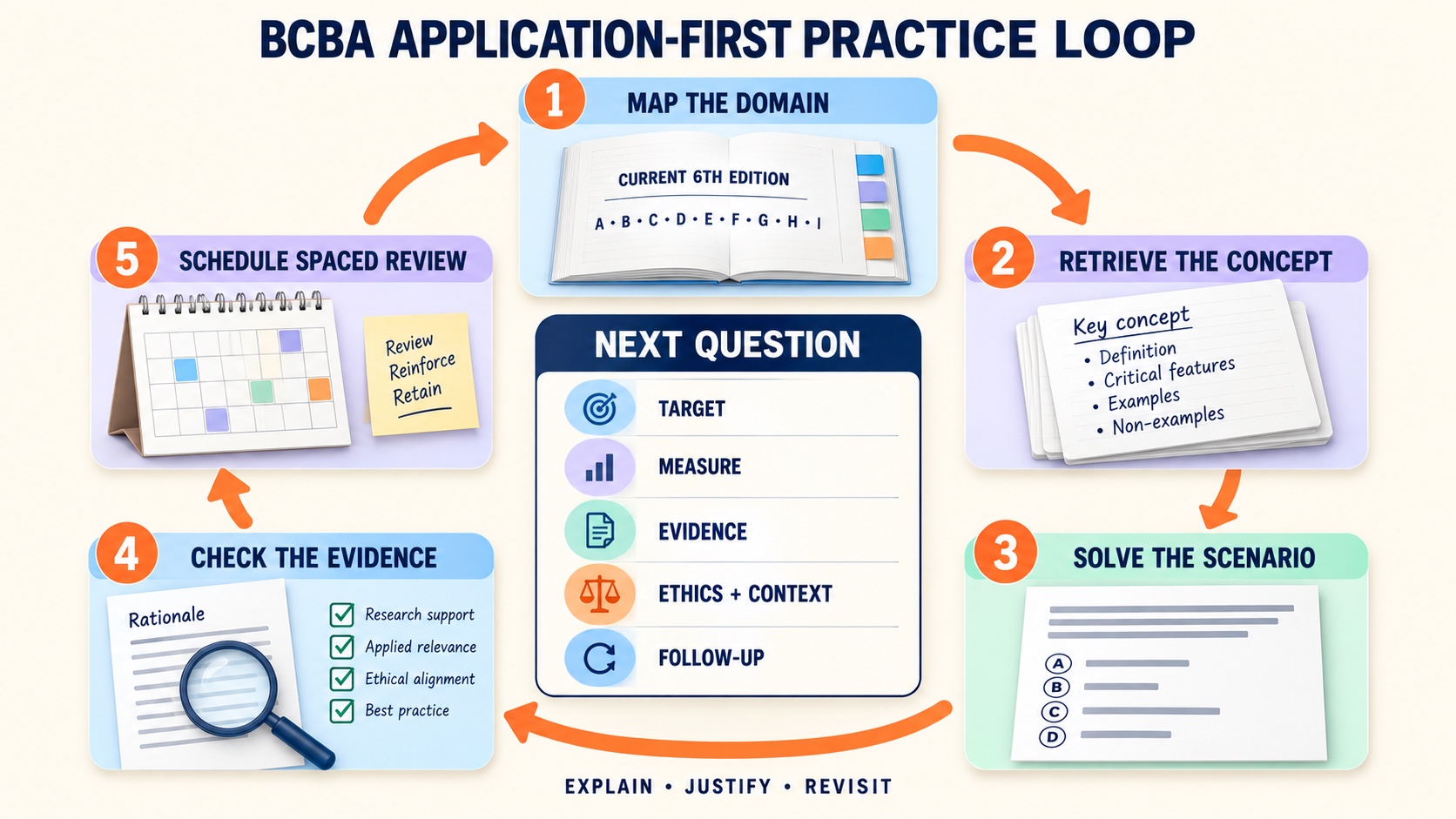
Before looking at the answer, write five short notes: the target, the measure, the relevant evidence, the decision being asked for, and the constraint that matters. Then choose an answer and explain why the other options are weaker. This makes the practice more like the work of a behavior analyst: a decision should be tied to data, goals, context, ethics, and follow-up.
Keep an error log with:
- Domain and task verb: which content area and action were involved?
- Concept distinction: which two ideas or procedures did you confuse?
- Evidence boundary: did you claim more than the observation or graph supports?
- Implementation boundary: did you skip integrity, context, supervision, or stakeholder priorities?
- Next repetition: what will you retrieve again, and when?
For a measurement error, return to a graph and explain the pattern in plain language. For an assessment error, write what the method can and cannot demonstrate. For an intervention error, list the goal, evidence, contextual fit, and monitoring rule before choosing a procedure. Retrieval practice and spaced review are general educational methods supported by research; they are not BACB requirements or a promise of examination performance.
Common BCBA study-guide mistakes
- Studying “the task list” without checking the edition: use the current BCBA TCO (6th ed.) and verify source dates.
- Confusing 185 total with 175 scored: keep the 10 unscored pilot questions visible in your exam-format notes.
- Treating domain percentages as pass thresholds: they help allocate study time; they do not create nine separate pass/fail results.
- Mixing eligibility with exam content: use the Handbook and current 2027 eligibility section for pathways, coursework, and fieldwork.
- Choosing a procedure before checking the evidence: measurement and assessment should constrain the next decision.
- Counting practice scores without reading rationales: an error only helps when it changes the next practice action.
BCBA study guide FAQ
What is the current BCBA task list?
The current examination blueprint is the BCBA Test Content Outline (6th ed.). “BCBA task list” remains common search language, but a current study file should name the 6th edition and link to the current BACB source.
How many questions are on the BCBA exam?
The current structure includes 175 scored questions and 10 unscored pilot questions, for 185 total questions. Candidates have four hours, and each question has four answer choices with one correct answer.
Does the BCBA study guide cover 2027 requirements?
A study guide can explain the boundary, but the current BCBA Handbook is the source for eligibility pathways, coursework, fieldwork, application, and maintenance. The examination outline and the 2027 eligibility requirements should be checked as separate documents.
Is ABA Study Online official BCBA exam content?
No. ABA Study Online provides independent explanations and practice. Use the current BACB TCO, Handbook, Ethics Code, and other official resources for certification and examination information.