BCBA Sample Exam: How to Choose and Use One
When you search for a BCBA sample exam, you may want a quick way to see what the questions feel like before committing to a longer study session. The important question is not only how many items a page contains. You also need to know whether the sample uses original practice content, reflects the current BCBA Test Content Outline (TCO), explains the distractors, and helps you decide what to study next.
This guide gives you a practical way to evaluate a sample exam without confusing it with secure BACB examination content. It explains the current exam boundary, the TCO coverage a credible sample should make visible, the difference between a short sample and a full mock exam, and a review loop that turns missed questions into better decisions. Use the official BCBA TCO, BCBA Handbook, and BACB Examination Information for certification rules and current examination information. Independent practice questions are study content, not official BACB questions.
Table of Contents
Start with the current BCBA exam boundary
The current BCBA examination is based on the BCBA TCO, 6th edition, beginning in 2025. The official TCO describes 104 tasks organized into nine domains and identifies 175 scored questions. The BACB Examination Information page separately lists 185 total BCBA questions and four hours of testing time. That difference matters: a sample page should not casually call 185 questions “all scored,” and it should not turn the official blueprint into a promise about the exact order or wording of live items.
The examination uses multiple-choice questions with four possible answers and one correct answer. It is delivered through computer-based testing at authorized Pearson VUE locations. The BACB also uses multiple forms and equated scoring, so an online percentage from a third-party quiz is not an official score and cannot be converted into a guaranteed passing result.
Be careful with the phrase “real BCBA questions.” Secure examination items should not be copied, reconstructed, or advertised as available through an independent study site. A responsible sample exam states that its scenarios and answer choices are original, then points learners to the official TCO for the content boundary. It can resemble the kind of reasoning required without claiming access to the item bank.
Check the sample exam’s TCO coverage
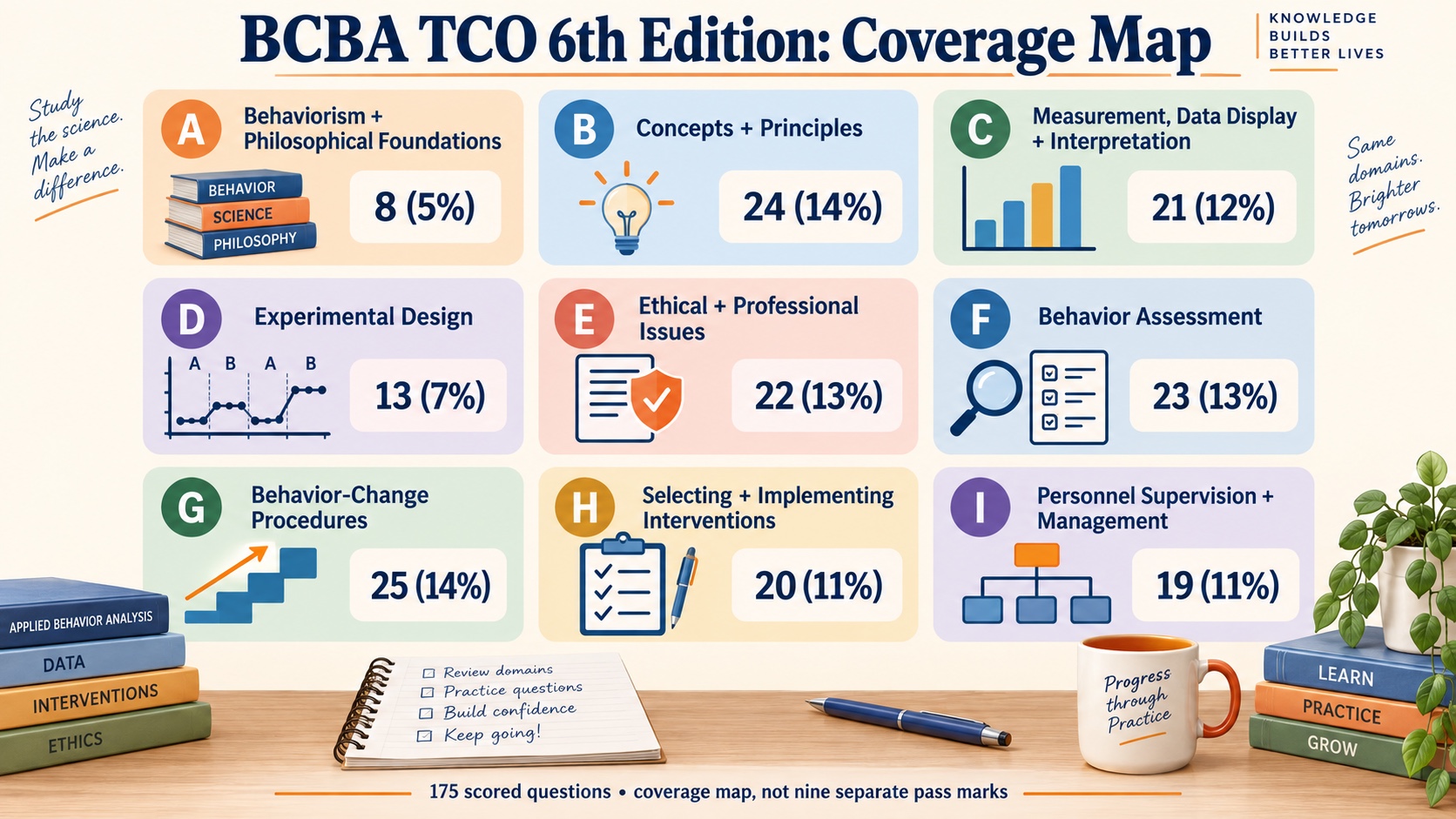
A sample does not need to reproduce the entire examination blueprint in ten questions. It should, however, tell you what it is sampling. The current BCBA TCO lists these nine scored-question areas:
| Domain | Official focus | Scored questions |
|---|---|---|
| A | Behaviorism and Philosophical Foundations | 8 (5%) |
| B | Concepts and Principles | 24 (14%) |
| C | Measurement, Data Display, and Interpretation | 21 (12%) |
| D | Experimental Design | 13 (7%) |
| E | Ethical and Professional Issues | 22 (13%) |
| F | Behavior Assessment | 23 (13%) |
| G | Behavior-Change Procedures | 25 (14%) |
| H | Selecting and Implementing Interventions | 20 (11%) |
| I | Personnel Supervision and Management | 19 (11%) |
The percentages are a coverage map, not nine separate pass marks. A ten-question sample may touch only a few domains, while a larger diagnostic set can distribute items more broadly. What matters is that the provider labels the intended domain or task and does not imply that a small quiz represents the whole examination.
Look especially for application across the domains. A useful item may ask you to select a measurement procedure under environmental constraints, interpret a graph, choose an assessment step, identify an ethical risk, evaluate an intervention decision, or improve a supervision arrangement. A page filled only with isolated definitions may help with recall but gives you limited evidence about scenario discrimination.
Look for the features that make practice useful
Clear source and edition language
The page should name the BCBA track and identify the current TCO edition it is using. If it uses older “task list” wording, explain how that language relates to the current TCO rather than leaving the reader to guess. A 2027 eligibility or fieldwork update is not automatically a new examination-content outline. Until the BACB publishes a different BCBA exam outline, keep the exam-content question separate from the certification-requirements question.
Original scenarios with a real decision point
A strong question gives enough context to make a decision without hiding the answer in trivia. The final sentence should ask for one thing: the best measurement, next assessment step, intervention feature, ethical response, or supervision action. The details should matter. If every option would be correct regardless of the scenario, the question is testing word recognition rather than professional reasoning.
Rationales that explain distractors
An answer key that displays only a letter has limited teaching value. Look for a rationale that names the relevant TCO task, identifies the cue in the scenario, and explains why the other choices fit a different situation or decision point. For example, if a question asks for latency and an option describes duration, the explanation should identify which event starts and ends each measure. That distinction is more useful than “B is correct.”
Ethics, culture, and role boundaries
Current BCBA preparation should not treat ethics as a decorative final section. Practice scenarios can require attention to client welfare, confidentiality, consent, cultural responsiveness, competence, conflicts, documentation, or supervision. The answer should also respect role boundaries. Do not select an action that assumes authority the person in the scenario does not have.
Feedback you can act on
The most useful result page gives more than an overall percentage. It should help you see which domain or task needs attention, whether the error was a knowledge gap or a reading mistake, and what to do next. A domain score from a tiny sample is only a weak signal; use it to choose a review activity, not to declare mastery.
Know when to use a sample versus a mock exam
A sample exam is usually a short preview or diagnostic. Use it when you want to understand a provider’s question style, test one concept, find an early weakness, or practice a specific TCO area. You should be able to stop and read the rationale without losing the value of the session.
A mock exam is a longer rehearsal. Use it later, after you have reviewed the content and practiced individual decisions, when you want to work on pacing, fatigue, mixed-domain switching, and a consistent review routine. A full mock can be useful, but it is not automatically the best first step. Taking long tests before you know how to interpret your errors may only create a large pile of unexplained percentages.
Do not compare providers only by item count. Ask whether the set is timed, whether the topic mix is disclosed, whether the rationales are written for the current TCO, whether the questions are original, and whether the results lead to a specific next action. The BACB does not endorse particular commercial study guides or guarantee a passing result from buying one, so transparent scope is a strength.
Review each question as a learning decision
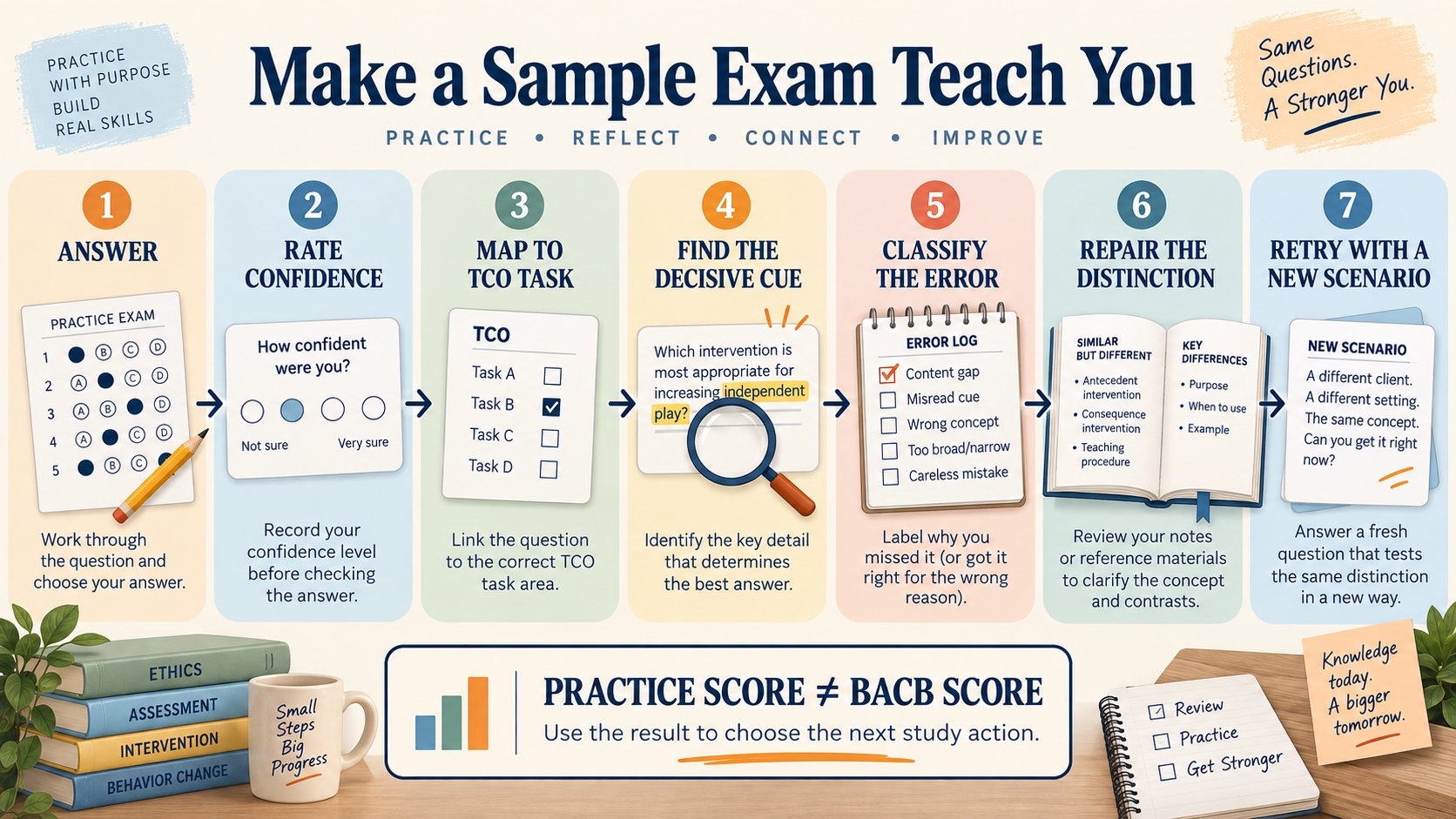
Use this six-step loop after a sample exam:
- Record your answer before reading feedback. Add a confidence label: low, medium, or high.
- Find the TCO task or domain. If the page does not provide one, make your best evidence-based tag.
- Name the decisive cue. Write the fact that made the best answer stronger than the distractors.
- Classify the error. Use a short label such as concept, measurement, application, ethics, reading, or careless error.
- Repair the distinction. Review the source, write a contrast, work a small example, or redraw the data display.
- Transfer the idea. Answer a new scenario that changes the surface details but preserves the underlying decision.
Review uncertain correct answers too. If you guessed correctly, the result does not show stable understanding. Also continue to sample across the full TCO. The BACB cautions that the number of items connected to any one area may be small, so a weak result in one slice should guide study without becoming the only content you review.
Avoid common sample-exam traps
Assuming “free” means official. A free quiz can be thoughtfully written, but price does not establish BACB status or content accuracy.
Trusting an edition label without opening the source. Read the current TCO and handbook yourself. Do not treat a provider’s “updated” badge as proof that the blueprint is current.
Chasing a percentage. Third-party question difficulty, topic mix, and scoring rules vary. Use the result to choose the next study action, not to predict a scaled examination result.
Memorizing the answer letter. A new scenario can change the correct choice. Store the decision rule, the cue, and the contrast with the distractor.
Studying only the weakest domain. A short set may not represent a domain reliably. Repair the visible gap, then return to mixed coverage.
FAQ and official sources
Are online BCBA sample questions official BACB questions?
Usually not. Independent study sites should use original content and should not claim access to secure BACB items or BACB endorsement. Use the official TCO and handbook for the examination boundary.
How many questions are on the BCBA exam?
The current BACB Examination Information page lists 185 total BCBA questions and four hours. The BCBA TCO identifies 175 scored questions; the remaining questions are unscored pilot items. A short online sample should not be presented as a miniature official form.
Is the 2027 BCBA update a new 7th-edition exam?
Do not assume that. Certification and fieldwork requirements can change separately from examination content. Check the current BACB TCO index and official transition materials before using a new-edition label. This guide uses the current BCBA TCO, 6th edition, as its exam-content map.
Where can I practice BCBA questions?
Use a provider that states its scope and review the questions deliberately. ABA Study Online’s BCBA practice questions, BCBA learning path, BCBA test-question guide, and ABA glossary can support study, but none is the BACB and none guarantees certification.
Sources checked for this guide: Behavior Analyst Certification Board, BCBA Test Content Outline (6th ed.); BACB Examination Information; and the BCBA Handbook.