BCBA Requirements 2027: Applicant Checklist for the Transition
“BCBA requirements 2027” is a search for a checklist as much as a definition. You may be trying to decide whether your application timing matters, whether your coursework fits a new structure, or which document to trust when two summaries use different words. The safest starting point is to build an evidence folder before you make a course or fieldwork decision.
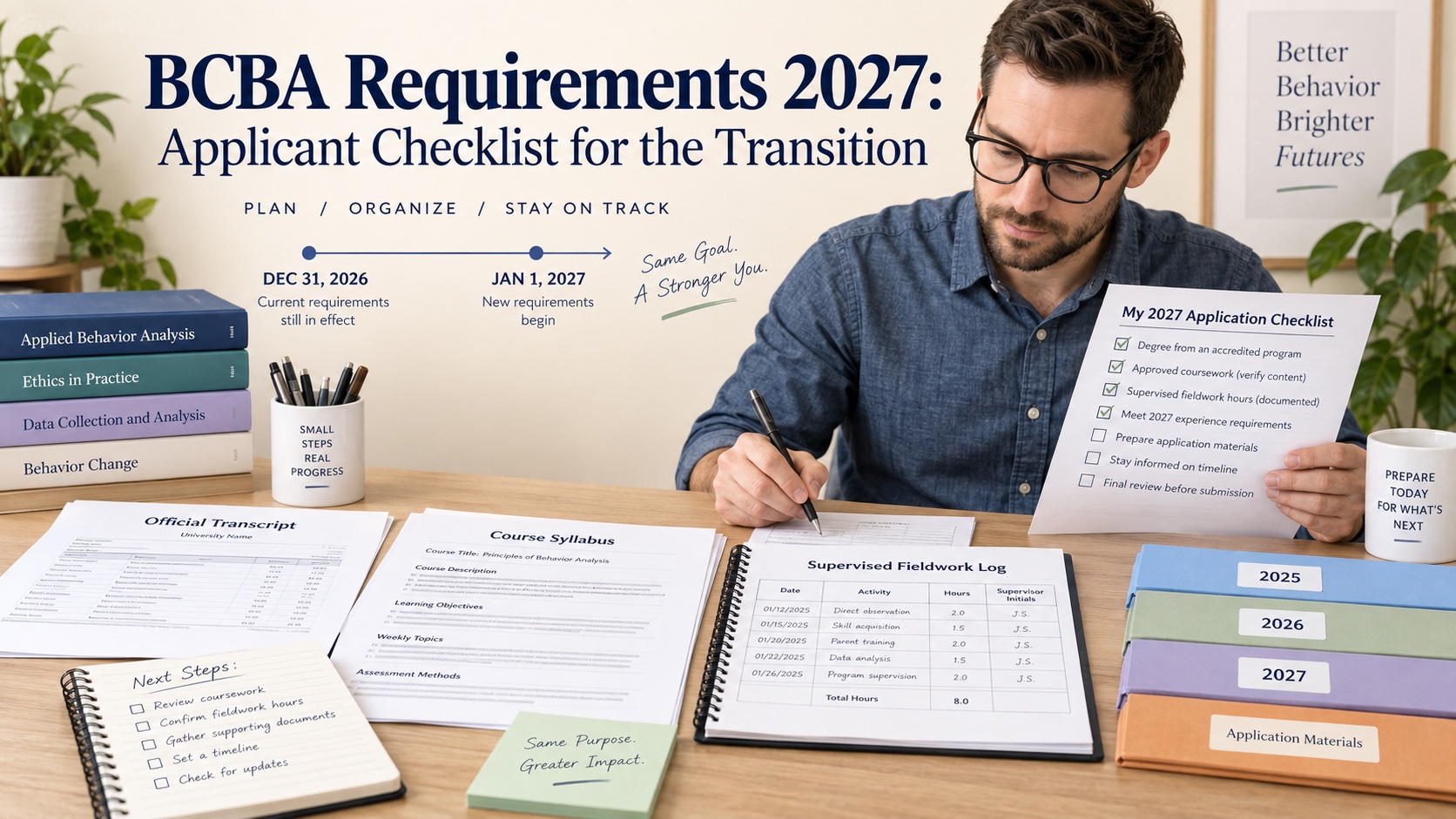
The BACB says significant BCBA eligibility changes take effect January 1, 2027. A complete application—including payment and all required documents—must be received by December 31, 2026 to be reviewed under the current 2022 requirements. Beginning in 2027, the BACB describes two pathways. This page helps you check the right records for each step; it does not decide your eligibility or replace the current BCBA Handbook.
Quick checklist answer: record your intended application window, identify whether Pathway 1 or Pathway 2 is more likely, collect degree and program evidence, compare Pathway 2 coursework with the 2027 transition table, verify fieldwork under the current Handbook, and keep examination information separate. If you are relying on the current 2022 requirements, the BACB’s complete-application boundary is December 31, 2026.
Do not treat a course title, a study-guide label, or a forum answer as proof. A good checklist points each claim back to an official source and leaves a place for the document, date, and question that still needs confirmation.
Check the date and pathway first
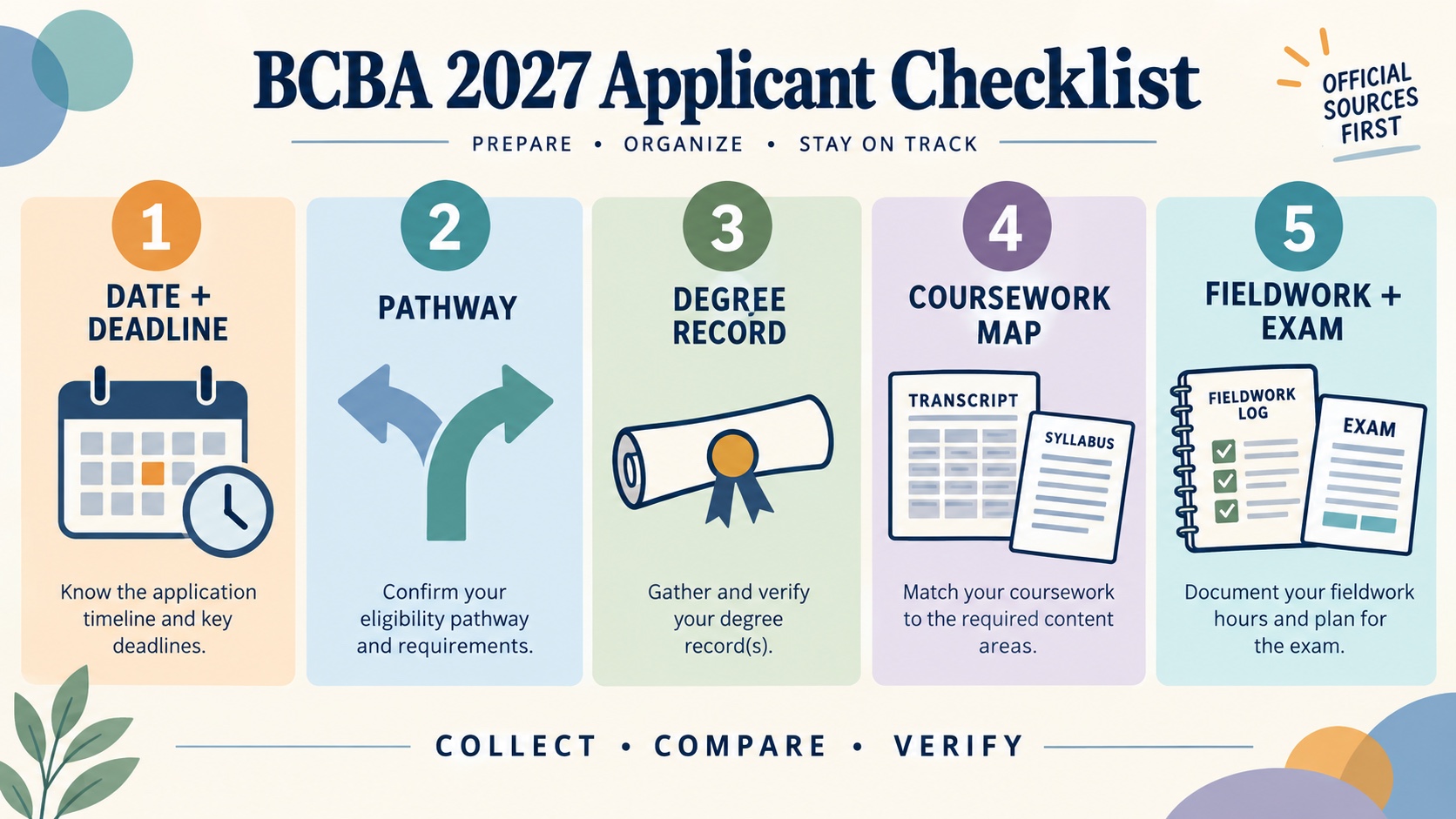
Write two dates at the top of your planning sheet:
- December 31, 2026: the BACB identifies this as the date by which a complete application must be received to be reviewed under the current 2022 requirements. Complete includes payment and required documents.
- January 1, 2027: the new BCBA eligibility framework takes effect for applications made under the 2027 requirements.
Next, note your likely pathway. Pathway 1 uses a master’s degree or higher from an APBA-accredited program or an ABAI-accredited or recognized behavior-analysis degree program as described by the BACB. Pathway 2 uses a master’s degree or higher plus the required behavior-analytic coursework. Both routes also involve supervised fieldwork and the BCBA certification examination.
If you were considering Pathway 3 or 4, the transition guidance says those pathways must be completed before January 1, 2027 if you want to use them. Do not leave this check until the final week; the phrase “almost finished” is not the same as meeting every requirement and submitting a complete application.
Audit your degree record
Put the following in your degree audit folder:
- The degree name and level, including the date awarded.
- The institution and program name as it appeared while you were enrolled.
- Evidence of accreditation or recognition if you are considering Pathway 1.
- Your official transcript and any program documentation needed to explain the degree route.
- A short note identifying the BACB handbook section you used for the interpretation.
The point is not to make your own accreditation decision from a logo. It is to gather the information an official review will need. If your degree was earned during a period when a program’s status changed, record the relevant dates and ask the program or BACB how the status should be documented.
Audit Pathway 2 coursework
The 2027 transition guide retains 315 total content hours for the mapped Pathway 2 coursework while changing course structure and content descriptions. Several areas need freestanding courses, meaning the required content makes up the majority of the course. Compare your transcript and syllabi instead of matching course titles by memory.
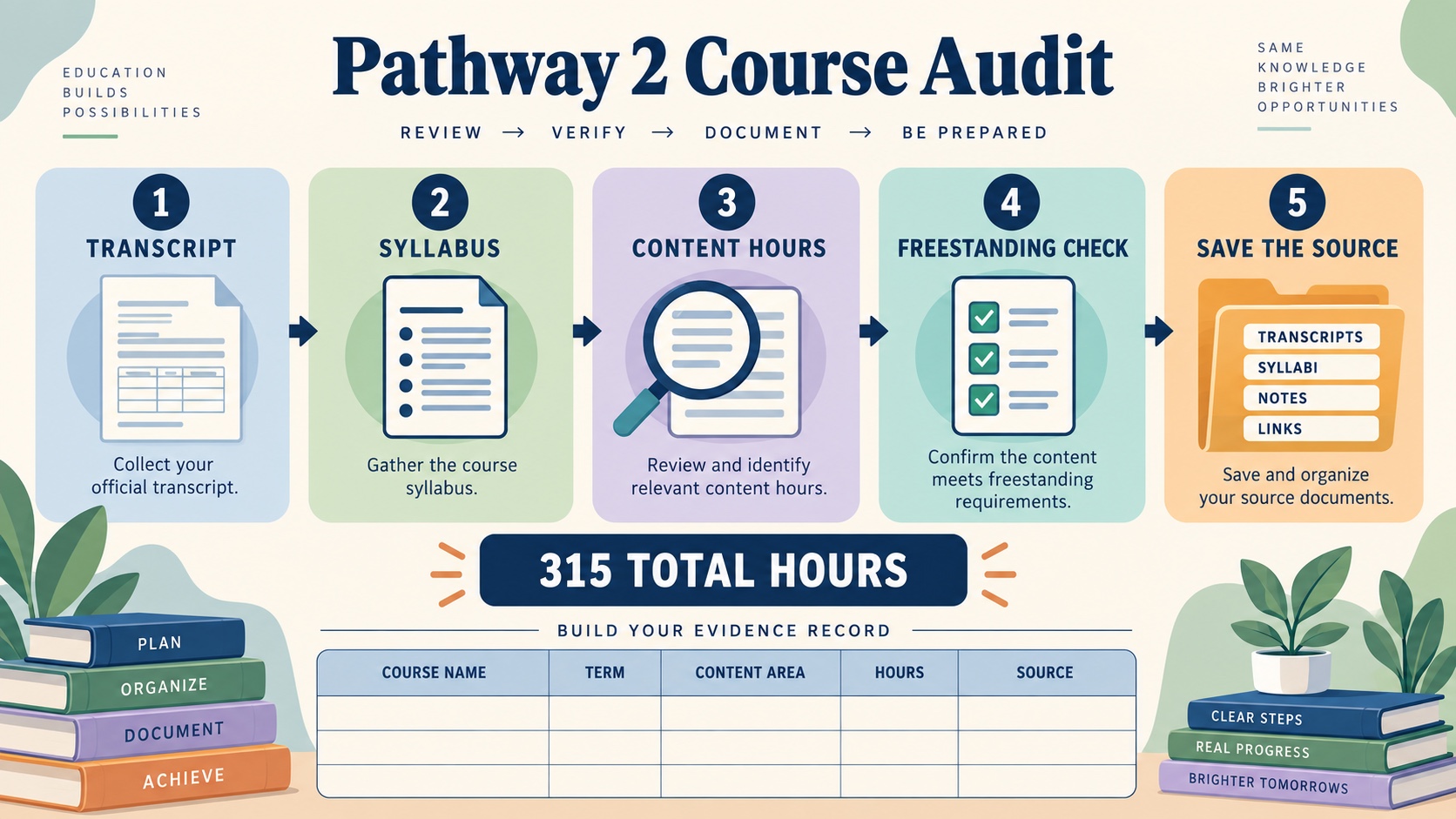
Use this first-pass map:
- Basic Principles of Behavior: 45 hours in one freestanding course.
- Theory and Philosophy in Behavior Analysis: 45 hours in one freestanding course.
- Research Methods in Behavior Analysis: 45 hours in one freestanding course.
- Behavior Assessment and Intervention: 90 hours across two freestanding courses.
- Organizational Behavior Management: 45 hours in one freestanding course.
- Ethics in Behavior Analysis: 45 hours in one freestanding course.
For each course, save the syllabus, content hours, term, institution, and a note about which 2027 category it supports. If one course appears to cover several areas, flag it for review rather than assigning all of its hours to every category. The transition guide explains how older 2022 content maps to the 2027 requirements; your advisor or program coordinator can help you locate the relevant course evidence.
Audit fieldwork and examination records
Make fieldwork a separate folder. Include supervision agreements, verification forms, dates, setting information, supervisor documentation, and the records required by the current Handbook. Do not assume that a transcript audit proves fieldwork compliance, and do not rely on an old checklist simply because the number of hours looks familiar.
Keep examination preparation in its own folder as well. The 2027 eligibility transition is not the same thing as a new examination edition. For exam content, format, and testing procedures, use the current BCBA Test Content Outline and BACB examination information. If a future official exam update is published, replace the exam-specific documents in your folder rather than rewriting the eligibility requirements from memory.
Why keep the dates visible? A fieldwork record, course syllabus, and degree document each describe a different part of the application story. A date helps you see whether the document belongs to the program period you are relying on, whether a form was completed under the correct supervision arrangement, and whether a later change affects the evidence. Add a simple note beside every record: what requirement it supports, which official source you checked, and what question remains open. That small habit reduces the risk of treating a familiar document as proof of a different requirement.
If you are close to the transition, create a short “needs confirmation” list rather than trying to force every record into a yes-or-no answer. Ask about one course, one fieldwork period, or one application document at a time. Specific questions are easier for a program coordinator, supervisor, or official channel to answer than a broad request for a prediction.
Build a source-linked document folder
- Requirements summary: save the BACB 2027 BCBA Requirements page and note the date you checked it.
- Handbook: use the current BCBA Handbook for detailed eligibility, fieldwork, application, and maintenance rules.
- Transition guide: use the 2027 guidance for the 2022-to-2027 coursework conversion and pathway timing.
- Personal records: store your transcript, syllabi, degree documents, supervision records, and application evidence together.
- Open questions: write down unclear course mappings or fieldwork details and route them to a qualified advisor, supervisor, or official BACB channel.
This folder makes the next conversation more precise. Instead of asking “Do I qualify?” you can ask, “Does this course syllabus document the required freestanding content?” or “Which Handbook section controls this fieldwork record?”
Mistakes that create avoidable confusion
- Using “submitted” loosely: the official boundary is a complete application received, including payment and required documents.
- Calling 2027 a 7th edition: the year of an eligibility framework is not an examination-outline edition.
- Counting the same course twice: use the transition table and course evidence before assigning hours.
- Ignoring freestanding-course language: total hours alone may not describe the 2027 structure.
- Combining fieldwork and coursework evidence: keep separate records and source checks.
- Relying on one screenshot: official pages, handbooks, and transition PDFs may be revised; save the source link and check it again.
BCBA requirements 2027 FAQ
When do the 2027 BCBA requirements start?
The new eligibility framework starts January 1, 2027. The BACB says a complete application received by December 31, 2026 can be reviewed under the current 2022 requirements, subject to the official completeness and eligibility rules.
How many pathways are available in 2027?
The BACB describes two pathways beginning January 1, 2027: an accredited or recognized program pathway and a behavior-analytic coursework pathway. Your degree, coursework, fieldwork, and application evidence determine which details you must document.
Do I need new courses for 2027?
Some applicants may need additional or differently structured coursework, especially if prior courses do not meet the standalone-course and content-hour conditions. Compare your records with the official transition guide; do not decide from a course title alone.
Does this checklist replace the BCBA Handbook?
No. It helps you organize the review. The current BCBA Handbook and official transition materials control the requirements, and an individual eligibility question may need an official or qualified review.
Use study resources for the right job
Study pages should help you learn, not make an eligibility promise. Use the BCBA study path for concepts, the BCBA practice questions for applied reasoning, and the ABA Definition Search when terminology needs another pass. Keep your application checklist tied to official BACB documents.