BCBA Practice Questions: How to Study With the 6th-Edition TCO
If you are looking for BCBA practice questions, you probably want more than a long list of items. You want to know whether the questions reflect the current exam content, whether the explanations teach the decision, and what to do when your answers are inconsistent. A useful practice set should help you connect a scenario to the relevant task, distinguish close answer choices, and identify the next concept to review.
This guide explains how to use practice questions with the current BCBA Test Content Outline (6th ed.). It does not reproduce live BACB questions, claim access to official exam items, or turn a practice percentage into a promise about your result. Use the current BACB sources for the rule and examination details that apply to your application.
Table of Contents
Short answer: what makes practice questions useful?
Useful BCBA practice questions do three things. First, they represent a task or distinction from the current TCO. Second, they require you to apply that distinction to a realistic situation. Third, they provide an explanation that shows why the best answer fits and why the alternatives do not.
That means a question about reinforcement should not be difficult only because the wording is confusing. It should help you distinguish the contingency, identify what changed, and notice whether the consequence is actually contingent on the response. A question about measurement should ask you to select a defensible measure or interpret a display, not merely recall the spelling of a term.
Practice questions are also different from a full mock exam. A practice set is usually designed for learning: you may pause, read the explanation, look up a task, and try a related item. A mock exam is designed to rehearse pacing, endurance, and decision-making under timed conditions. Both can be useful, but they answer different study needs.
Use the 6th-edition TCO as your map
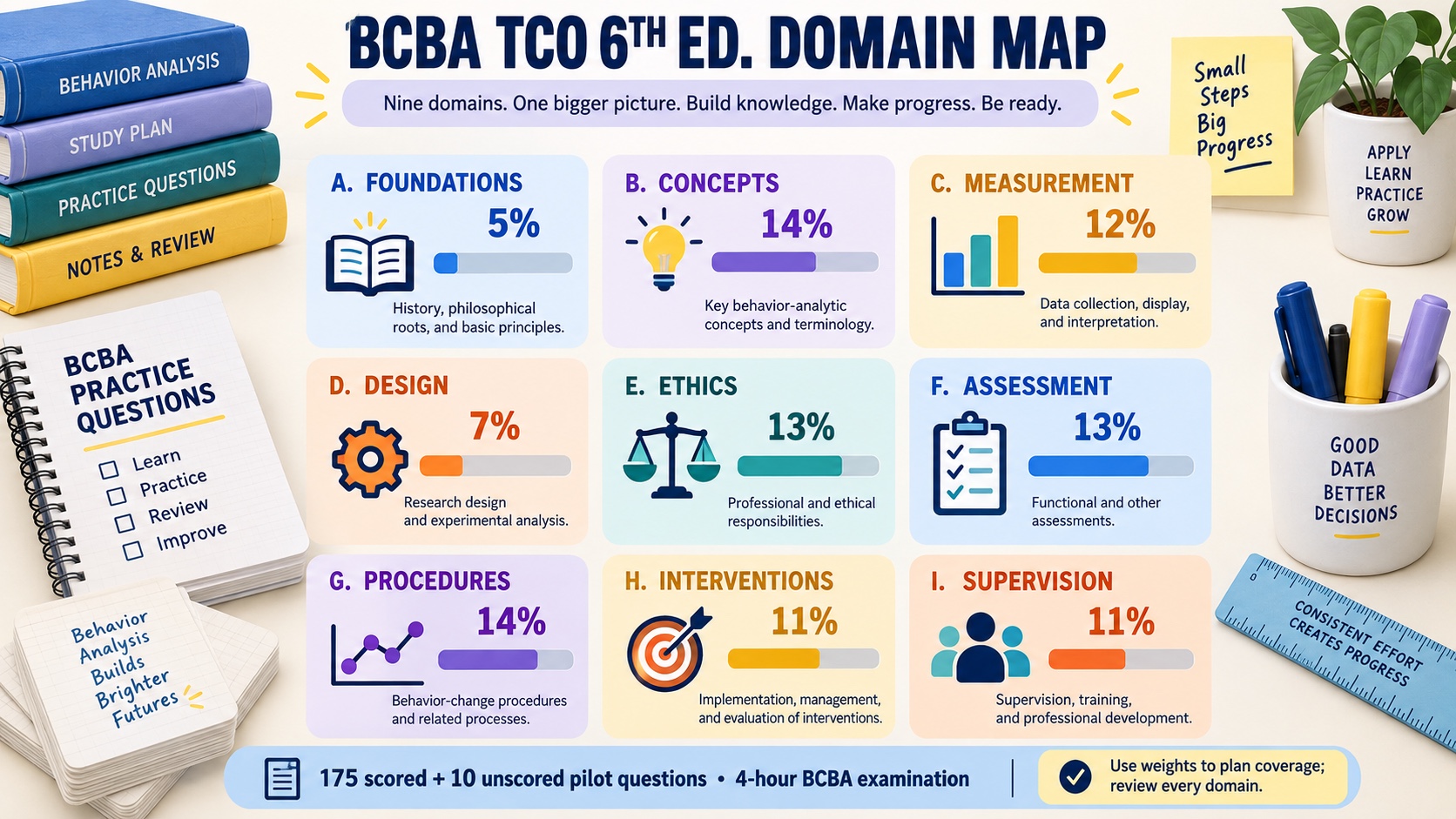
The BCBA TCO (6th ed.) describes 104 tasks across nine domains. The current examination has 175 scored questions and 10 unscored pilot questions; the BACB examination-information page lists 185 questions and 4 hours for the BCBA examination. The TCO is the better tool for deciding what a practice question should teach because it names the skills and distinctions, not only the total number of items.
| Domain | TCO share | Practice emphasis |
|---|---|---|
| A. Behaviorism and Philosophical Foundations | 5% | Assumptions, goals of science, radical behaviorism, and dimensions of ABA. |
| B. Concepts and Principles | 14% | Contingencies, schedules, stimulus control, motivating operations, verbal behavior, and related distinctions. |
| C. Measurement, Data Display, and Interpretation | 12% | Measurement selection, data display, interpretation, and procedural accuracy. |
| D. Experimental Design | 7% | Design logic, threats to validity, and interpretation of single-case arrangements. |
| E. Ethical and Professional Issues | 13% | Ethical decision-making, documentation, scope, culture, and professional responsibilities. |
| F. Behavior Assessment | 13% | Assessment selection, observation, preference assessment, and functional assessment logic. |
| G. Behavior-Change Procedures | 14% | Teaching, reinforcement, prompting, shaping, extinction, and behavior-change procedures. |
| H. Selecting and Implementing Interventions | 11% | Intervention selection, implementation, monitoring, generality, and social validity. |
| I. Personnel Supervision and Management | 11% | Training, feedback, performance management, supervision, and systems decisions. |
Weights are a planning signal, not permission to skip a lower-weight domain. If you spend all your time on concepts because they feel familiar, you may avoid the domains where your decision-making is less stable. Use the TCO to balance your practice set, then use your error log to decide where your next review should go.
How to evaluate a BCBA practice question
Look for a clear task
Before looking at the answer choices, ask what the item is testing. Is it asking you to identify a function, choose a measurement procedure, interpret a graph, select an intervention, or respond to an ethical issue? If you cannot name the task, the item may be testing reading endurance rather than useful knowledge.
Look for a meaningful scenario
A strong scenario gives you enough information to make a decision without hiding the answer behind irrelevant detail. It may include an observable response, an antecedent, a consequence, a data display, or a supervision context. The question should reward careful application, not guessing which option sounds most technical.
Check whether the distractors are defensible
Good distractors are plausible because they reflect a common misconception. For example, an item about positive reinforcement may include an option that describes something being added but never establishes that the behavior increased. The explanation should name the missing part of the contingency. If three options are obviously unrelated, the question may inflate a score without strengthening discrimination.
Read the explanation after every miss
An answer key that says only “B is correct” is not enough for serious review. The explanation should connect the correct answer to the scenario, identify the relevant TCO task, and show why the alternatives fail. If an explanation cites a rule or current requirement, verify it against the current BACB source rather than treating an old prep book as the final authority.
A practice-question review loop
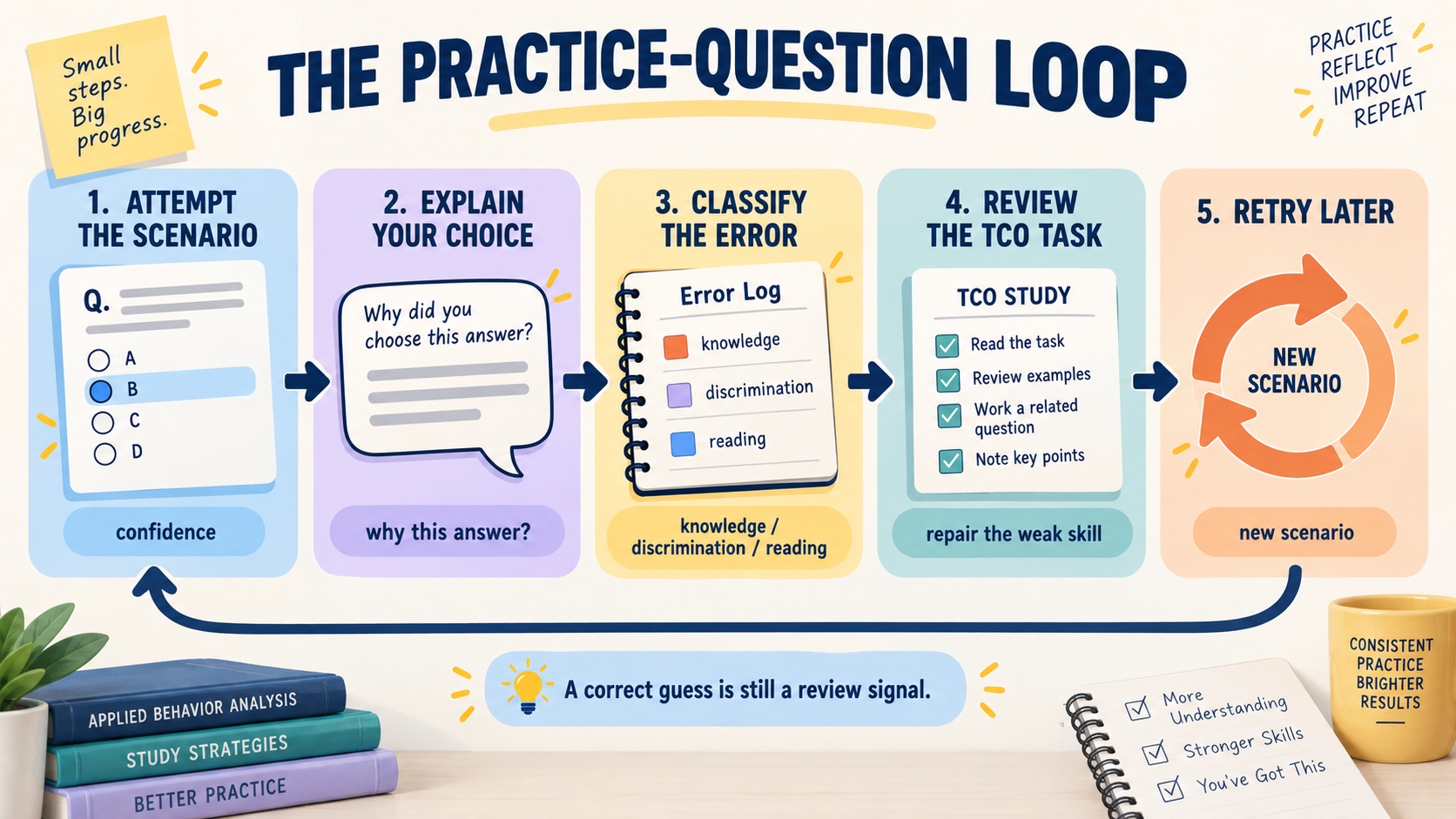
Use a four-part loop instead of completing questions once and moving on:
- Attempt: answer without searching first. Mark your confidence as high, medium, or low.
- Explain: write one sentence explaining the contingency, measurement, assessment logic, ethical issue, or intervention decision.
- Classify: record the TCO domain, the task or concept, and the type of error. Common categories include knowledge gap, discrimination error, calculation or graph error, reading error, and overthinking.
- Reattempt: return to the item later, then complete a new item testing the same distinction in a different scenario.
The most valuable part of this loop is the explanation you produce before checking the answer. If you chose correctly for the wrong reason, count that as a review signal. A correct guess should not be allowed to look like stable mastery.
How to build a weekly routine
Start with a short diagnostic set across all nine domains. The goal is not to create a dramatic score; it is to see where your errors cluster. Then divide the week into three kinds of work:
- Retrieval: complete a small mixed set without notes and explain your choices.
- Repair: review one or two weak tasks using notes, examples, graphs, or source material.
- Transfer: complete new scenarios that change the learner, setting, measure, or intervention detail.
Keep the sets small enough to review well. Twenty carefully analyzed questions can teach more than one hundred items followed by a quick answer check. As the exam approaches, add timed blocks to practice pacing, but do not replace untimed explanation work with speed alone.
When you use free BCBA practice questions, check the date, the TCO edition, the terminology, and the explanation quality. Free does not automatically mean poor, and paid does not automatically mean current. The question set should identify its source boundary and avoid claiming to be an official BACB item.
Common practice-question mistakes
Watch for these patterns:
- tracking only a percentage and never recording why an answer was wrong;
- studying the largest question bank without checking TCO coverage;
- memorizing the answer order or familiar wording instead of learning the distinction;
- treating a practice quiz as a full mock exam;
- using an old task-list edition without checking what the current TCO says;
- assuming a 2027 certification-eligibility change means a new BCBA exam edition; or
- accepting an explanation that conflicts with an official current source.
The BACB’s current 2027 transition guidance separates certification requirements from examination updates and states that there are currently no upcoming changes to the BCBA examination or TCO. Continue to study from the 6th-edition TCO unless the BACB publishes a later examination update that applies to your test date.
You can use the BCBA learning path to organize domain review, BCBA practice questions for retrieval, the ABA glossary for quick definitions, and the ABA Study Online app for repeatable review. These are learning resources, not BACB endorsements, official exam items, or score guarantees.
FAQ and official sources
Where should I start with BCBA practice questions?
Start with the current BCBA Test Content Outline (6th ed.) and a small mixed diagnostic set. Use the results to identify tasks and error types before choosing a larger question routine.
Are free BCBA practice questions useful?
They can be useful when the questions are current, the answer choices are defensible, and the explanations teach the relevant task. Check the TCO edition and source boundary instead of judging a set only by price.
How many BCBA practice questions should I do?
There is no universal number that proves readiness. Choose a volume you can review carefully, then increase timed practice later for pacing. Your error log and repeated performance on new scenarios matter more than one large total.
What is the difference between practice questions and a mock exam?
Practice questions are usually for learning and explanation. A mock exam is a longer timed simulation for pacing and endurance. Use practice questions to repair skills before relying on a mock score as a progress signal.
Is the 6th edition still relevant for the 2027 change?
The BACB’s current transition guidance says that 2027 changes concern certification requirements and that there are currently no upcoming changes to the BCBA examination or TCO. Verify the current BACB guidance for your application and test date.